

In the last three months of 2025, retail stores added 461,500 jobs for the holidays, according to Challenger, Gray & Christmas. By the end of January, about 96% of that gain was gone. By February, retail actually had 90,400 fewer jobs than it did back in September.
And yet, in that same January, retail employers still hired 487,000 people, per the Bureau of Labor Statistics. Most seasonal jobs really do end when the season does. The hiring… just doesn’t stop. A good chunk of the people who end up staying are the ones who were already inside the building when a regular job opened up.
Nobody Publishes the Odds
If you’re taking a seasonal job hoping it turns into something permanent, the first thing to know is that nobody tracks how likely that is. Not the BLS, not job boards, not the trade groups.
The only numbers out there come from the companies themselves. Michaels says “nearly 50%“ of its seasonal in-store positions converted to regular jobs after last season. The year before, it said more than 50%. Target says more than half of its seasonal store team members stayed on after last season (Target). Amazon and UPS both talk about a path to a permanent job… but neither gives an actual number. Those are just the company claims, and nobody really checks them.
So the rest of this runs on what the hiring data actually shows, plus what managers, and actual seasonal workers describe from the inside.
Who Gets Kept On
First off, there has to be an opening. This part is mostly out of your hands, unfortunately. Stores hire extra people for the holiday rush on purpose, knowing most of them won’t be needed come January. The seasonal workers who stay usually fill spots left by regular employees who quit, transfer, or simply move on after the holidays.
Managers and workers describe it pretty consistently. A store brings on a couple dozen seasonal people and keeps a handful. One year it keeps nobody, the next year it keeps one or two, depending on how much of the regular staff is leaving.
That makes turnover the real driver here. In retail, the quit rate averaged 2.56% a month through the first nine months of 2025, that’s the lowest since at least 2015. In 2026 it’s back up to about 3.03%, according to BLS job turnover data. More people quitting means more openings after the holidays, which is probably good news for this season’s seasonal workers. Because, low turnover isn’t always loyalty, and when nobody leaves, there’s nowhere for a seasonal hire to work.
Showing Up Beats Hustling
When managers talk about who they keep, the same two things come up over and over. Attendance first. Availability second. Speed and effort actually matter a lot less than people expect.
A former retail operations manager put it bluntly in one thread: They let a couple of good workers go because their availability was bad, and kept a few average ones who just kept showing up. Workers at Target, Kohl’s, Costco, and Bath & Body Works describe it the same way. Call-outs and late arrivals are usually what knock people out of the running.
Fulfillment jobs add one more thing: A speed number. Warehouse and online-order pickers get measured on how many items or orders they move per hour, and that’s where the ‘speed and effort number’ matters when decisions get made.
One more that workers repeat: Don’t quit mid-season if you’d ever even consider working there again. Leaving early can cost you rehire eligibility, and that list is more important than it sounds.
Open Availability Is the Price of Entry
Most seasonal jobs come with a catch: You’re expected to be available… a lot. Weekends, holidays, and sometimes really early starts. Workers stocking shelves at big-box stores describe 3am and 4am start times, and that schedule is what wears a lot of new seasonal hires down in the first month or so.
Some places limit how unpredictable those schedules can get. Oregon requires retail, hospitality, and food service employers with 500 or more employees worldwide to post schedules at least 14 days ahead. A handful of cities have their own versions too, and sometimes ignoring those rules turns into a $38.9 million mistake for employers.
But in most of the country, there’s no rule at all. If your availability is limited because of school, kids, a second job, or caring for someone, say so upfront and ask what’s actually required. It’s better to know in November than to get cut in January for something you couldn’t change.
Say It Once, Early
Managers can’t read minds, and plenty of seasonal hires don’t actually want to stay. So tell them you do. Once, casually, in your first week or two: “I’d definitely be interested in staying on after the season if there’s an opening.”
There are a few other moves that come up again and again:
- Ask When They Decide. Closer to the holidays, ask when those decisions usually get made, and who makes them.
- Ask to Be Cross-Trained. Learning a second department, especially one that’s hard to staff, makes you much easier to keep. It’s the same training problem behind why nobody wants to train the next generation of experienced workers. If they’ve already trained you, you’re cheaper to keep than a new stranger.
- Say You’d Take a Different Job. Workers describe being kept on as a cashier or in receiving even though they were hired for something else. If you’re open to that, let them know.
- Bring It Up Again After Christmas. If nobody has said anything by the last week of December, it’s fair to ask again.
Where the Season Sticks
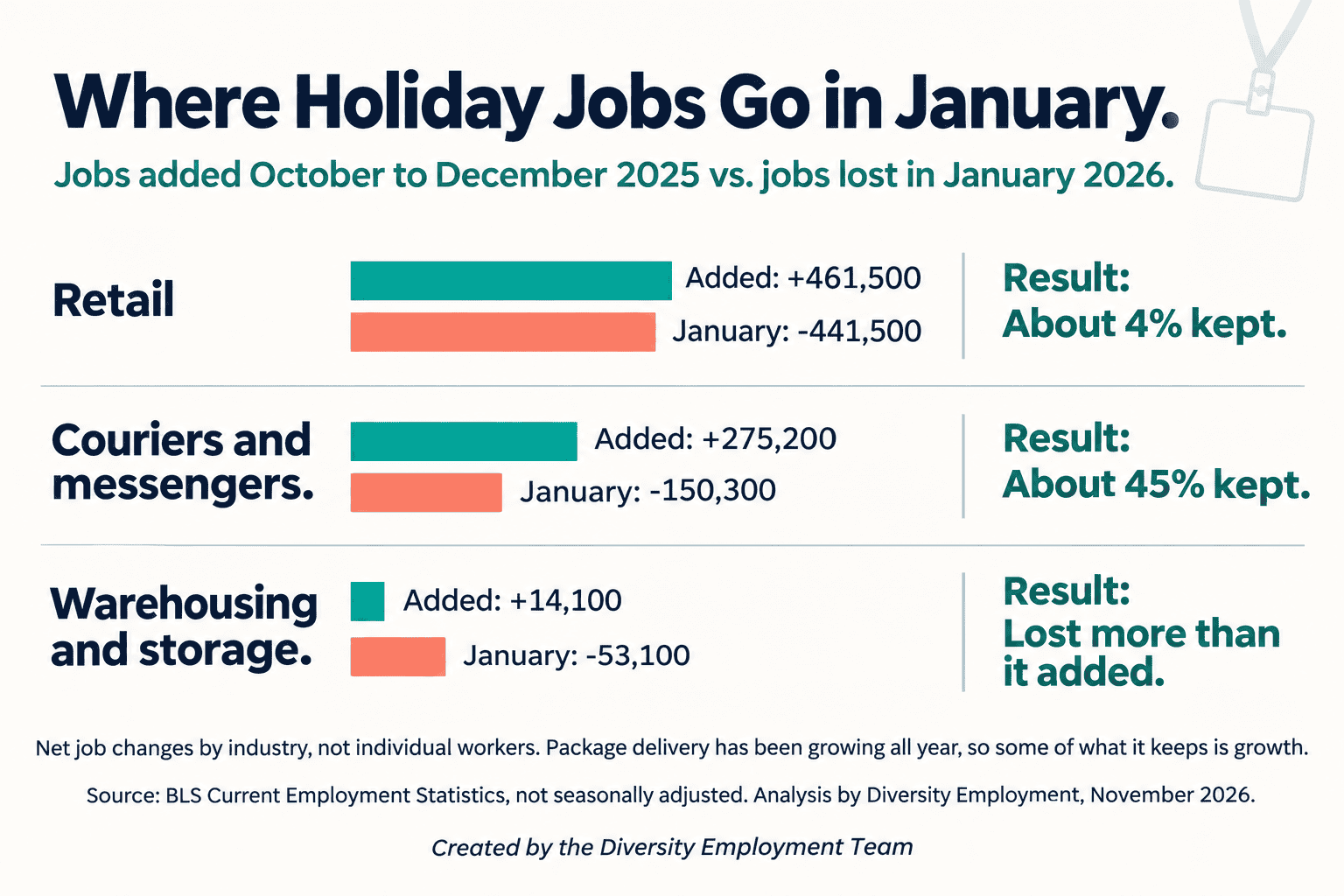
Not every industry drops its holiday workers at the same rate. We compared each industry’s fourth-quarter job gains to its January losses using BLS payroll data (not seasonally adjusted).
Last season, couriers and messengers, which covers a lot of package delivery, added 275,200 jobs and lost 150,300 in January. That’s about 45% of the holiday gain still there after January. In recent years that number has run between 37% and 51%. Retail kept about 4% last season, and somewhere between 4% and 12% in recent years.
Warehousing is the odd one. Its payrolls added only 14,100 jobs in the fourth quarter of 2025, compared with 147,800 in 2020. Some of that work may run through staffing agencies or automation now, but the data alone can’t say which.
A Couple of Caveats
Before anyone switches industries over this, a couple of things. Package delivery has been growing all year, so some of what it “keeps” is just growth. Couriers and messengers added about 71,000 jobs between February and October, according to BLS, well before anyone was hiring for the holidays.
And a kept delivery job isn’t always a full-time one. Seasonal UPS workers describe staying on for one day a week, or moving into part-time warehouse work. In union workplaces, workers say the contract can decide who moves up first, and current part-time union members are usually ahead of a seasonal hire. So if delivery is where you land, ask the same questions about hours and who gets first shot at full-time work, that you’d ask anywhere else.
Ask These Before You Say Yes
A lot of hiring events are still running through late November, so there’s still time to ask the questions that tell you what you’re actually signing up for.
- “Is this job seasonal, temporary, or part-time?” And then read the title on the offer. Workers have described applying for regular jobs and getting hired as a seasonal employee without realizing it, one of them six months in. Same rule as any offer letter: Read what you sign before you start.
- “Am I employed by this company, or by an agency?” It changes who you’d be asking for a permanent job, and it can change the rules for unemployment later.
- “How many seasonal people did this location keep last year?” A real number is a good sign. A shrug with a “not sure…” isn’t.
- “When do you decide who stays, and how will I find out?” Decisions usually happen between late December and mid-January. Some workers say they just kept getting scheduled. Others who didn’t, found out by email or a group text.
- “If I’m kept on, what hours do people usually get in February?” Seasonal hours obviously drop hard after the holidays, and one shift or two a week probably won’t cover the bills. It’s better to know before you count on it.
- “What availability do you need, and are holidays required?” Availability is one of the biggest things managers look at when deciding who stays. If school, kids, or another job limits yours, it’s better to find that out as soon as you can.
- “If there’s no spot in January, can I stay on the rehire list?” Some workers who weren’t kept initially got called back weeks later. Leaving on good terms and letting them know your interest can have a nice payoff.
Reading the Answers
Good Signs: A manager who can tell you how many seasonal workers they kept last year. A rough date for decisions. And, especially an offer to train you in more than one department or area.
Red Flags: Nobody was kept last year. You get vague answers about hours. Or, it’s an agency job where nobody can explain how you’d ever get hired directly. None of those mean you shouldn’t take the job, per se. They just mean you should probably keep job hunting while you work it.
Being “Kept On”: February’s Schedule
Getting kept on and having a job you can live on are two very different outcomes. Workers who stayed after the season describe their hours dropping hard in January and February. Some down to a few shifts a week, or even less, until the next busy stretch. More than one person said that most of their coworkers have a second job.
The national numbers only show part of that. Average weekly hours in retail dipped from 30.3 in December to 29.2 in January last season, according to BLS. Averages can hide a lot though, especially for the newest and lower-priority people on the schedule.
There are already 4.8 million people working part time who want more hours, as of October. If you’re kept on with too few hours, you’re not alone, and plenty of people opt to add a second job instead of switching.
Seasonal, Temporary, Part-Time, and On-Demand
These labels sound almost interchangeable, but they mean pretty different things for your odds of sticking around.
- Seasonal: Built to end. You’re just hired for the rush, with a built-in end date in mind.
- Part-Time: Ongoing, just fewer hours. No automatic end date.
- Temporary or Agency: You work at the store or warehouse, but the staffing agency is your actual employer.
- On-Demand: App-based or pool-based shifts you pick up one at a time, those jobs don’t have a set path to regular employment very often at all.
The labels are shifting, too. Indeed Hiring Lab found that among the big employers, mostly retailers, the ratio of holiday-season job postings actually labeled seasonal fell from 34% to about 20% this year, with part-time postings rising from 38% to 49%, as of the end of September (Indeed Hiring Lab). So during the holidays, don’t just search “seasonal.” Monster found that fewer than 3% of the seasonal postings it looked at in 2025 even had any obvious seasonal wording in the job title. A part-time listing posted in November may be the same work without an end date attached.
Agency and on-demand work is a bit tougher. Retailers are leaning on “on-demand pools” before hiring new seasonal workers, according to Challenger. And in a well-known study of low-income job seekers in Detroit, economists David Autor and Susan Houseman found that people placed into direct-hire jobs increased their earnings by about $2,000 a year, while those placed into temp agency jobs saw their earnings drop by about $1,000 a year (MIT News). It’s older research, from 1999 to 2003, but the takeaway still seems to hold: If you can get hired directly, it’s probably still the better option. However, app-based shift work can still be worth it for extra income, as long as you know who gig jobs actually work for. Just don’t count on gigs for steady income, or a path to a full-time job, though.
Health Coverage Usually Waits
Federal rules actually name seasonal retail workers. For counting employees under the Affordable Care Act, the IRS lists “retail workers employed exclusively during holiday seasons” as seasonal workers (IRS). A seasonal employee is basically someone hired into a job that will usually last six months or less.
In plain terms, large employers are allowed to watch a new seasonal worker’s hours for 3 to 12 months before they have to offer health coverage (federal regulations). A holiday job is usually over long before that window is up.
One exception this year: Amazon says seasonal employees working at least 30 hours a week can get coverage starting January 1st, 2027, with plans starting at $5 a week. But again, that only helps if you’re still there in January. But it does kind of make it a good reason to try and stay.
A Tryout With an End Date
One longtime retail worker described mall jobs this way: A lot of them start as seasonal so the store can let go of anyone who doesn’t work out, without technically firing them. Another called the seasonal stretch a three-month probation period.
That’s a fair way to think about it. For most people it works like a tryout, and the end date gives the employer an easy exit. Probation labels usually mean less than people think when it comes to being fired or laid off. With seasonal work, though, the end date is real.
Why the Holiday Hiring Numbers Never Match
Every fall, headlines report holiday hiring is up, or down, or the lowest since some year. A lot of that confusion comes from the fact that the most-quoted numbers measure totally different things.
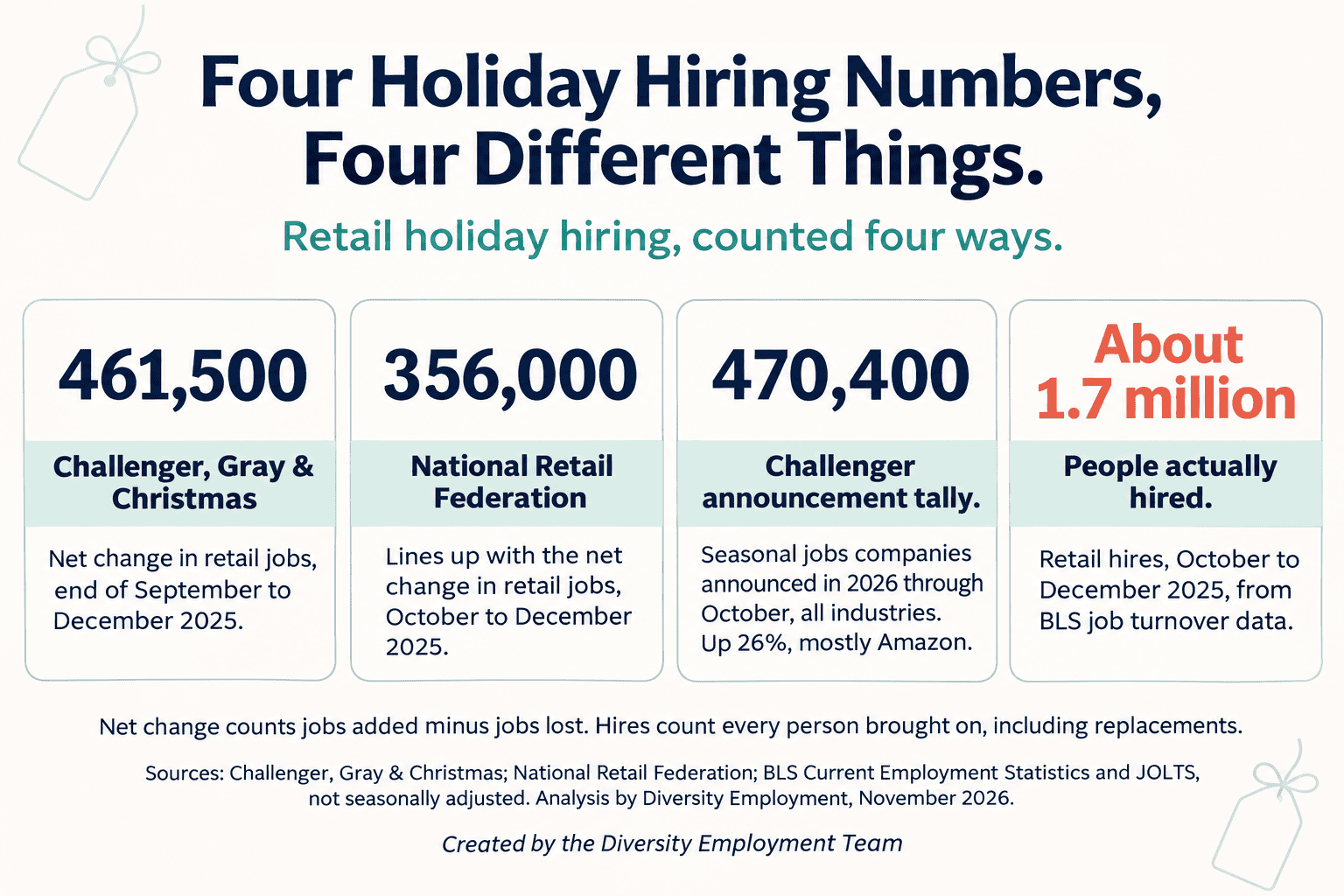
Four Numbers, Four Different Things
- Challenger’s Seasonal Retail Jobs: They counted 461,500 seasonal retail jobs last year, and forecast 450,000 for 2026 (Challenger). That’s the net change in retail jobs from the end of September to December, based on BLS data that isn’t seasonally adjusted. Our check against BLS matches it exactly.
- NRF’s Seasonal Hires: The National Retail Federation expects retailers to hire 325,000 to 375,000 seasonal workers this year, “in line with last year’s estimated 356,000” (NRF). NRF doesn’t publish how it gets there, but last year’s figure lines up with the October-to-December change in retail jobs as BLS first reported it (355,500).
- Challenger’s Announcement Tally: Companies have announced 470,400 seasonal jobs so far this year, up 26% from last year (Challenger). That’s a sum of company announcements across all industries, and most of it is Amazon’s 300,000, which Challenger actually counts as Technology, not Retail. Only 5 companies had announced, compared to 11 at this same point last year.
- The People Actually Hired: Retail employers hired about 1.7 million people from October through December 2025, according to BLS job turnover data (JOLTS). That’s about 3.7 times the “seasonal” number, because most holiday hiring is replacing people who leave.
So the same firm can forecast a slightly smaller season and report announcements up 26% in the same fall, and both can still be accurate. They’re just measuring different things.
The 15% That Was Closer to 10%
Challenger reported last season’s 461,500 as the smallest seasonal gain since 2008, and about 15% below the 543,100 added in 2024. The first part holds up. The second part needs a footnote.
The 543,100 figure matches BLS data as it was published in early 2025. Every February, BLS revises the past year’s job numbers against more complete records, and that revision lowered the 2024 holiday gain to 510,600 (St. Louis Fed archive). Compared on today’s data… last season was down about 10%. Still a real drop, just a bit smaller than the headline.
This Season So Far
The early signs look steadier than the forecasts. In October, retail added 134,800 jobs before seasonal adjustment, compared with 98,900 last October (preliminary BLS data). Holiday job postings on Indeed were running about 10% above last year at the end of September, and searches for seasonal work were up 28%, so expect more competition this season.
Delivery is picking up even faster. Couriers and messengers added 57,000 jobs in October before seasonal adjustment, almost double the 30,300 they added last October. Transportation and warehousing as a whole added 87,000, up from 44,800 (preliminary BLS data, via FRED). That lines up with Amazon and UPS both announcing bigger numbers than last year.
Timing matters, too. Monster’s 2026 Seasonal Hiring Index found October is usually the busiest month for seasonal job postings, and activity drops about 24% from October to November. The window isn’t closed in late November… but it is getting smaller, so it’s better to apply now than to wait any longer.
Who’s Hiring
The big announcements so far:
- Amazon: More than 300,000 seasonal, part-time, and full-time jobs, with seasonal workers averaging about $20/hr.
- UPS: Announced 100,000 seasonal workers, after announcing no number last year. UPS also said in January it would cut up to 30,000 operational jobs in 2026, according to Reuters.
- Michaels: More than 10,000 seasonal workers, with current employees able to pick up extra holiday hours.
- Dick’s Sporting Goods: More than 11,000 seasonal workers across its Dick’s and Foot Locker stores (Dick’s).
- USPS: A little more than 10,000 seasonal workers, down from 40,000 just a few years ago (USPS).
- Macy’s: No number yet, but it’s hiring seasonal workers in stores and select supply chain locations, with a nationwide hiring event at Macy’s, Bloomingdale’s, and Bluemercury stores on November 19th (Macy’s).
Walmart, Kohl’s, and FedEx still hadn’t announced national numbers as of mid-November. Kohl’s told Retail Dive it hasn’t shared a total, and Walmart, which didn’t answer Retail Dive’s question, has mainly been hiring store by store in recent years, according to TheStreet. Target hasn’t announced a national number either, and told Retail Dive it doesn’t share estimates anymore. Its seasonal staffing fact sheet says it starts by offering extra hours to current team members and its On Demand team, about 43,000 existing store workers who pick up shifts when they want, before hiring seasonal workers. It did tell The Atlanta Journal-Constitution it’s hiring about 2,300 seasonal workers in metro Atlanta alone (AJC). Its pay fact sheet, updated October 30th, says the average wage for its frontline team members is above $18.50/hr (Target).
Meanwhile, retailers announced 3,692 job cuts in October, the most for the industry since June 2025. “Companies are trimming permanent roles and leaning on seasonal workers to cover the busiest weeks of the year,” Challenger said.
What’s Behind It
As for why, the trade groups mostly point to costs. NRF cites higher gas prices, persistent inflation, higher interest rates, and consumer debt. Challenger points to prices, tariffs, and energy costs, and says retailers are leaning on automation and existing staff first. The data fits that, but it can’t prove automation is the main reason on its own. The Postal Service is one of the few employers to explain its own drop. It says better staffing, fewer supervisor vacancies, and less overtime left it with a more stable year-round workforce, so it only needs about a quarter of the seasonal workers it used to. It’s also added 673 package sorting machines over the past six years.
The broader numbers point a few directions at once. Adjusted for overall inflation, retail sales (not counting restaurants) are up about 11% since September 2019, while retail employment is basically flat, at about 15.5 million both then and now (Census, BLS). Stores are also carrying less stock. Retail inventories were worth about 1.36 months of sales in August, down from 1.46 in September 2019 (Census). More sales with the same number of people fits with automation and self-checkout, but it also fits more shopping moving online, and less stock to unload in the back room. The data can’t really pull those apart. Even Challenger noted this fall that the reasons companies give for cutting jobs have shifted from technology to the economy.
The Work Is Moving
The work itself is also moving. Retail made up about 61% of seasonal job postings on Indeed this year, down from about two-thirds in 2019, while loading and stocking jobs rose from 3.5% to 9%. More of the season is happening in warehouses and on delivery routes, and less on the sales floor.
Online shopping is a big part of why. E-commerce made up 17.1% of retail sales in the second quarter of 2026, up from 11.2% at the end of 2019, according to the Census Bureau (via FRED). And couriers and messengers employed about 1.1 million people this October, roughly 32% more than in October 2019 (BLS, not seasonally adjusted). The holiday jobs are still out there. More of them just come with a scanner or a delivery route these days.
What January Actually Looks Like
The Giveback
This is how much of each holiday season’s retail job gain was gone by the end of January, from our analysis of BLS payroll data (not seasonally adjusted, current as of November 2026).
| Holiday season | Jobs added Oct-Dec (net) | Jobs lost in January | Share given back | February vs. September |
|---|---|---|---|---|
| 2015-’16 | 708,100 | 596,000 | 84% | -26,900 |
| 2019-’20 | 651,900 | 593,200 | 91% | -95,900 |
| 2023-’24 | 541,700 | 485,700 | 90% | -45,300 |
| 2024-’25 | 510,600 | 447,300 | 88% | -60,900 |
| 2025-’26 | 461,500 | 441,500 | 96% | -90,400 |
Source: Diversity Employment analysis of BLS Current Employment Statistics, retail trade, not seasonally adjusted (via FRED). Net changes, not individual workers.
In the five years before the pandemic, retail gave back about 90% of its holiday gain by the end of January. Last season it was 96%. And by February, retail employment was below where it started in September in every season in the table.
How It Shows Up in the Data
BLS counts the end of a seasonal job as a layoff. Its definition literally includes “terminations of seasonal employees (whether or not they are expected to return next season)” (BLS).
In January 2026, retail layoffs reached 211,000, the fewest for any January since at least 2015 (January 2025 was 313,000). That’s mostly because the holiday wave was already smaller to begin with. Counting everyone who left a retail job in December and January, whether laid off or quitting, it was about 1.28 million people.
January Still Hires
In January 2026, while all those seasonal jobs were ending, retail still hired 487,000 people and had 628,000 open jobs. Hiring picked up from there, to 531,000 in February and 658,000 in March.
Those are the jobs seasonal workers are competing for. If you’re already in the building, you’re the easiest hire a manager can make. And if you weren’t kept, being on the rehire list still puts you near the front. Workers describe being the first ones called when a spot opened up, or even getting rehired six weeks after the season ended.
Your Last Paycheck
When a seasonal job ends, final pay rules depend on your state. In California, a worker who’s laid off is generally owed final wages immediately, at the time of termination (California Labor Commissioner). In Texas, final pay for a laid-off worker is due within 6 calendar days (Texas Workforce Commission).
Other states set their own deadlines, so check your state labor department’s site. Either way, keep your last pay stub and a copy of your schedule. You’ll probably want both if you plan to file for unemployment.
Unemployment After a Seasonal Job
This isn’t legal advice, and every state runs its own programs. But a few rules trip up seasonal workers more than anyone else. The basics for every state are in this state-by-state unemployment benefits guide.
A Season Ending Isn’t Quitting
When a job ends because the work ran out, that’s generally not treated as quitting. The state looks at the facts of your separation and decides. If your seasonal job ends and you don’t have another one lined up, file right away and let the state make the call.
Quitting before the season ends is a different story. In most states, you generally have to have lost your job “due to a lack of available work,” according to the U.S. Department of Labor, so walking off a week before your end date can cost you a claim you’d possibly otherwise have. And if you’re kept on but your hours get cut way back, check your state for partial benefits. Most states pay something for weeks you work reduced hours and earn under a set amount.
Why Your Holiday Wages Might Not Count Yet
Unemployment eligibility is based on what you earned during a “base period,” a 12-month window of past wages. Almost every state uses the first four of the last five completed quarters, according to the U.S. Department of Labor.
That’s a problem for holiday workers. If you file in January, February, or March of 2027, that standard window runs from October 2025 through September 2026. Your holiday 2026 paychecks aren’t in it.
37 states plus D.C. have an alternative base period that uses the last four completed quarters instead, which would include your holiday wages (as of DOL’s most recent comparison, from 2023). Most states also want wages in at least two quarters, so a holiday job by itself usually won’t qualify you. It’s much more likely to help by adding to wages you already had made before that job.
That matters a lot for anyone coming back from a long job search. If your last real paycheck was a while ago, the timing of a claim can decide whether you can qualify at all.
California vs. Texas
California: If you don’t have enough wages in the standard base period, EDD automatically checks the alternative one, the last four completed quarters. You need at least $1,300 in your highest-earning quarter, or $900 in that quarter with total base period wages of at least 1.25 times that amount (EDD).
Texas: The base period is the first four of the last five completed quarters, and the only alternative is for medical reasons. You need wages in more than one quarter, and total base period wages of at least 37 times your weekly benefit (Texas Workforce Commission). Holiday 2026 wages start counting for claims filed in April 2027.
If an Agency Hired You
Staffing agency workers have one extra rule to watch. In 32 jurisdictions, if an assignment ends and you don’t contact the agency for a new one, it can be treated as quitting (DOL).
Texas spells it out: Contact the agency no later than the next business day, and give it three business days to offer you something new before you apply for benefits. If you came in through an agency, ask about its check-in rules before the season ends.
If Your Employer Is a Designated Seasonal Employer
13 states limit benefits earned from officially designated seasonal employers to weeks inside that employer’s season. It’s mostly for businesses with a set operating season, and it’s probably rare for holiday retail. But if your state is on the list (Arkansas, Arizona, Colorado, Indiana, Maine, Massachusetts, Michigan, Mississippi, North Carolina, Ohio, Pennsylvania, South Dakota, and Tennessee), it’s definitely worth asking.
Even then, it only limits the wages you earned from that employer during its season. Wages from your other jobs, or from that same employer outside its season, can still count toward a claim at any time of the year, according to DOL. The quickest way to find out is to ask HR whether the business is a designated seasonal employer in your state, or you can call your state’s unemployment office.
How to Check Your State
- Find Your State’s Base Period: Search your state’s unemployment site for “base period” and see if it has an alternative one.
- Check the Quarters Rule: See if you need wages in two or more quarters.
- Write Down Main Dates: Your start date, the last day, and the reason the job ended (preferably in writing).
- If You Came Through an Agency, Check In: Do it the same day your assignment ends, and keep proof.
- File Anyway: If you’re not sure, apply and let the state decide.
A Way Back In
Who This Matters To
Seasonal jobs have always been a way in for people without an easy one. Students and younger workers, for sure. Applicants ages 18 to 24 made up 40% of retail job applicants in September, up from 37% a year earlier, according to iCIMS data reported by Modern Retail.
But also people who’ve been out of work for a while. There are 2.0 million long-term unemployed people right now, 27.6% of everyone unemployed (BLS). In the worker accounts we read, there was a retiree going back to work, a laid-off tech worker taking 3am stocking shifts because it was the only offer that came through, and a driver who took a seasonal delivery job right as his unemployment ran out.
Use the Season, Keep Looking
For people in that spot, a seasonal job can do a lot even if it doesn’t turn into a permanent job. It’s recent work, a recent reference, and maybe a few more weeks of wages on your record. Just keep applying while you work it, and don’t turn down a permanent offer somewhere else for a maybe.
When you list it later, be straightforward: The real title and the dates, like “Seasonal Sales Associate, November 2026 to January 2027.” Seasonal work is normal, and hiring managers know what it is. At Diversity Employment, we’d much rather see you walk out of January with a job than a goodbye text, and our job board is a good place to keep looking for year-round openings while you work the season.
The holiday hiring numbers mostly measure jobs that are built to end. The jobs that last go to whoever is already there, keeps showing up, and maybe just asked to stay.