
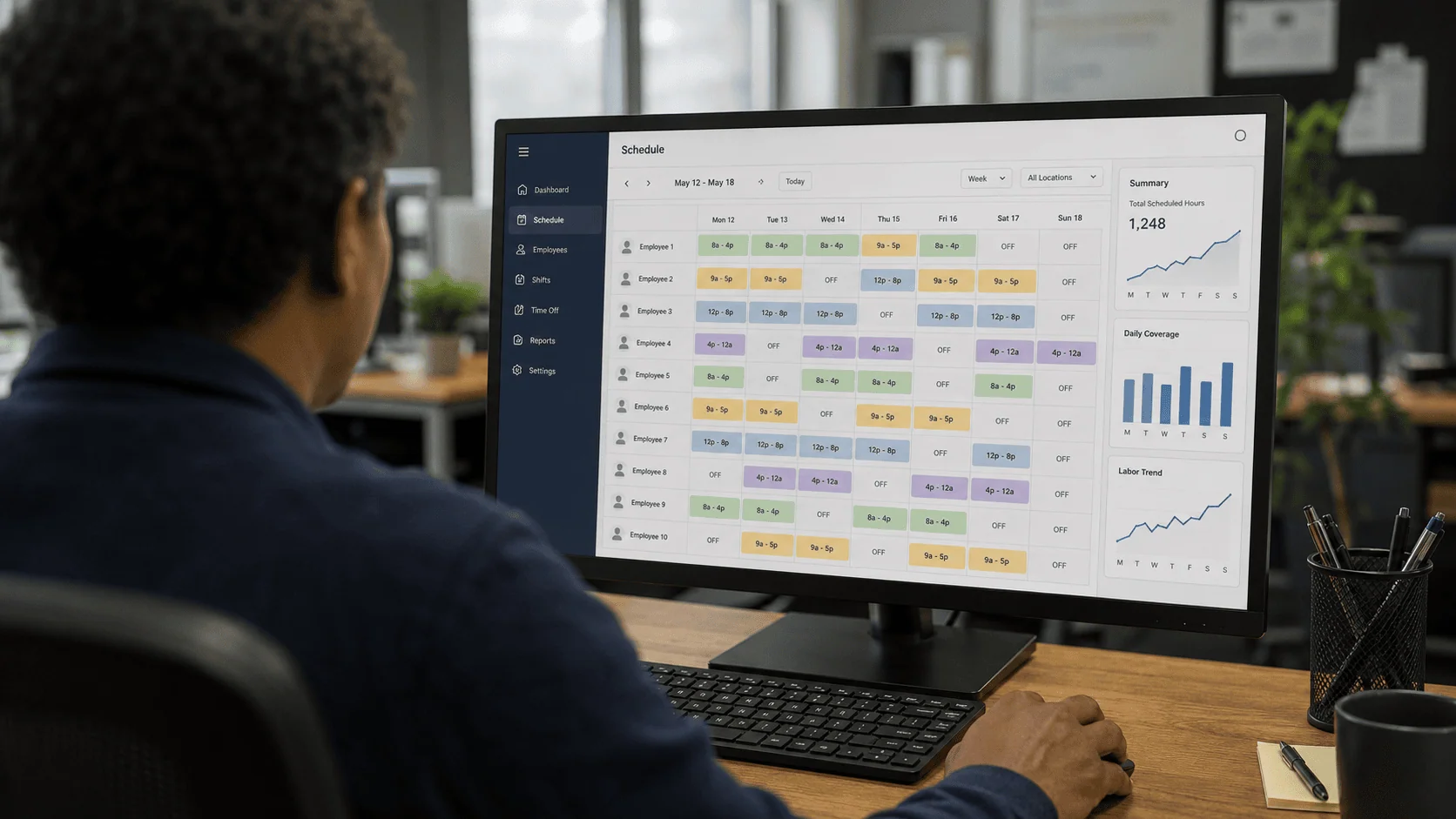
A lot of companies spent the last two years buying brand new scheduling software specifically to fix growing flexibility complaints. Now, schedules get posted further out. Shift-swaps run through an app and approval process, instead of a simple group text. Turnover hasn’t moved.
The reason is straightforward once you see it. That software fixed predictability. It’s not built to fix control. Those are two separate problems. They need two separate solutions. Most employers have spent a lot of money trying to solve only one of them. Many did so without realizing there even is a second issue, still sitting there.
Flexibility Isn’t One Thing
For years, workplace surveys measured flexibility the way most concepts get measured: with a question. “Do you have flexibility at work?” Yes or no. But that question can’t tell an employer what to actually build. It combines at least three different things into a single word.
The Three-Part Definition
The American Job Quality Study (AJQS) did a 2025 survey of more than 18,000 U.S. workers. It was led by Gallup along with the Upjohn Institute, Jobs for the Future, and the Families and Workers Fund. It is the first real attempt at a national scale to pull those three things apart. And, it defines a high-quality schedule as one with three specific properties.
- Predictability: An employee knows their hours at least two weeks out, unless they already control their own hours.
- Stability: Total weekly hours don’t swing by more than 25 percent over a month, unless the worker chooses so.
- Control: The employee has genuine input into at least two aspects of their schedule. That could be how many hours they work, or which days. It could also be the ability to get a few hours off when something comes up.
Score every U.S. employee against that definition and 62 percent fail. That’s the headline number the study got covered for. At Diversity Employment, we notice it’s also the least useful number in the whole report. Because reporting it without context is the same as using a yes or no for “Do you have flexibility at work?”
What’s Actually Missing
Break the 62 percent apart and a more focused picture appears. About one in four employees deal with unpredictability. Meaning they don’t really know their hours two weeks ahead. A similar share, 28 percent, deal with instability: their hours swing hard from month to month. But 41 percent, the largest group by a wide margin, have little or no control over their schedule at all. Control in the study’s own definition doesn’t mean picking your own hours outright. It means having any structured say whatsoever in a schedule someone else builds for you regardless.
That’s a different failure than not knowing if you’re working Saturday. A worker can know she’s on the schedule for a Tuesday two full weeks in advance. That technically clears the predictability bar with room to spare. She can still have never once been asked whether Tuesday actually works for her. One maintenance worker interviewed for the study described a completely opposite experience. His employer lets him leave early on school days to help his grandsons with homework. Then he works a longer shift on Fridays to make up the time. That arrangement counts as control. Most hourly and frontline workers have never been offered anything close to it.
Some Sectors Suffer More
Retail and food service specifically run worse than that 27 percent national unpredictability figure suggests. The Shift Project at Harvard has tracked hourly workers at large retail and food-service chains for close to a decade. It found that close to two-thirds of those workers get less than two weeks’ notice of their schedule. More than a third also report being required to work a closing shift one night, then open again the next morning. There’s a name for that, particularly miserable, shift arrangement: a “clopening” shift. It happens specifically because nobody that has a say in the schedule ever has to work one.
The Money Underneath the Schedule
The financial stakes here go past inconvenience. Research using JPMorgan Chase Institute data published in 2025 found that hourly workers see a typical month-to-month change in earnings of around 9 percent. In one out of four months, that swing hits 21 percent or more. That’s usually bigger than the balance sitting in their checking account. None of that shows up as a wage problem. Base pay and hourly rates stay exactly the same. What moves underneath them is their schedule. And a schedule nobody has any input into is a schedule that can move without warning.
The instability doesn’t stay limited to a worker’s personal finances. A worker who can’t predict or influence their income has a direct reason to act. They might pick up a second job with more flexible availability. They might also call out when a shift conflicts with something they can’t move. Or they might leave for a marginally more stable job the first chance they get. The turnover an employer eventually measures usually started here. And it began several months earlier… as a math problem in someone else’s checking account.
Who Feels This Most
The AJQS data also lines up along certain lines. They have less to do with demographics in the usual sense. They have more to do with how replaceable a company treats a given ‘set of hours’ to be. Part-time employees are far more likely than full-time employees to end up with low-quality schedules. The disparity is hard to miss: 34 percent versus 25 percent. That’s mainly because part-time hours get used as the buffer a business adjusts first when demand changes.
Education tracks along the same pattern. Workers whose highest credential is a high school diploma or less report low-quality schedules at nearly double the rate. Compare that to workers with a bachelor’s degree: 31 percent versus 22 percent. Workers with the least formal credentialing and the least full-time status consistently land on the wrong side of that math. The reason has nothing to do with who they are. It comes down to how disposable their hours are being treated to begin with.
That gap is important. The two fixes employers reach for first are posting schedules earlier and smoothing out hour-to-hour swings. Both are aimed at the smaller portion of the problem.
The Flexibility Nobody’s Actually Building
If control is a real issue, the next question is which kind of control workers actually want. “Control” on its own still isn’t specific enough to build against. Gallup has tracked this directly by asking frontline workers two separate questions. First, which types of flexibility they value enough to switch jobs for. Second, which types their current employer already offers.
The mismatch isn’t where most coverage of this topic points. Remote work is actually near the bottom of what frontline workers actually value. Only about one third of them say it’s worth changing jobs for. And that amount has been falling since 2022, not rising. It’s also rarely ever offered. The reason is obvious, because most frontline jobs can’t be done from a laptop. Neither side of that particular gap is moving. Plus, it was never really the center of this story for this workforce sector.
The PTO Gap
Another real big problem is paid time off. Fifty-nine percent of frontline workers say they value having more vacation or PTO. That’s higher than any other flexibility type Gallup measured. And, only 16 percent say their employer actually delivers it. That’s the widest mismatch anywhere in the dataset. It’s wider than remote work, wider than a four-day workweek, or anything else on the list.
Compare that to flexible start and end times. That’s valued by 34 percent of workers and offered by 33 percent. That particular flexibility problem is close to solved already. Choice over which days a person works sits in similarly decent shape as well. It’s valued by 36 percent, and offered by 33 percent.
UKG’s most recent global frontline study even lines up with this from a different angle. Fifty-seven percent of frontline employees say they can’t take as much time off as they’d like. In hospitality specifically, 58 percent say their schedule makes it impossible to maintain a healthy lifestyle. Flexibility is the single most important factor in whether frontline workers stay or leave, right after pay. Employers keep under-delivering on one specific piece of it… Actual time away from work, not hour-by-hour control over start and end times.
Why ‘Easy’ Flexibility Keeps Getting Built Instead
Flexible start times and shift swaps are just certain kinds of flexibility. A scheduling platform can hand an employer that kind of flexibility as a default setting. Genuine time off? That’s a harder operational problem. Someone still has to cover the shift, and that costs time, money, and planning. A software toggle doesn’t solve that on its own. That’s most of the explanation for why employers keep investing in the flexibility that’s already closest to being solved. Their biggest issues just sit untouched, right in the product they just bought.
The Algorithm Myth, What’s Actually True
The popular belief right now is that AI-driven scheduling is the fix for all of this. But where does that belief really come from? The workforce scheduling AI market is projected to grow 15 to 23 percent a year through the early 2030s. Note: that range depends on which market estimate is used. But, nearly every vendor in that space tells a version of the same story. It’s efficiency for the business and satisfaction for the worker, delivered by the same algorithm. Vendors routinely advertise labor cost reductions in the range of 8 to 15 percent. Then they pair that with claims of improved employee satisfaction, as if those two numbers came from the same thing.
What the Tools Are Built to Optimize
Here’s what’s actually true. These systems are demand-forecasting engines first. They take in sales data, foot traffic, call volume, or patient census, etc. Then they put out a staffing plan matched as tightly as possible to predicted demand. When done well, that genuinely can improve predictability. A system that can forecast demand three weeks out can post a schedule three weeks out. It can improve stability too, since calming demand naturally calms the hours built around it.
None of that requires the system to ask a worker what they actually want. Control isn’t a byproduct of demand forecasting. It has to be built in as a separate input, and weighed against the optimization the tool already exists to run. That’s a harder thing to engineer. It’s also a less flattering thing to put in a sales deck than a claim about forecasting accuracy.
What Happens in Practice
A 2025 multi-stakeholder study published at the ACM Conference on Fairness, Accountability, and Transparency interviewed regulators, worker advocates, managers, and workers directly. It found that scheduling software built to meet fair workweek law often still leaves workers without real input into their schedule. Compliance and genuine control turned out to be two different things to design for. The real issue is that efficiency against a demand curve is the specific thing it was built to solve. An employer can roll out one of these platforms and watch predictability and stability metrics improve on a dashboard. All while complaints about having no say in the schedule stay completely unchanged. The tool was never really made for that particular problem.
What Deliberate Design Looks Like
Control and performance don’t have to be a tradeoff. A widely studied case involving Gap Inc. was published in the journal Management Science. It found that giving retail workers more input into their own schedules, alongside more stable hours, increased store productivity by 5.1 percent. Control has to be a deliberate design choice, weighed against whatever optimization a platform already runs by default. It doesn’t happen automatically just because forecasting gets better.
Now It’s Also a Compliance Problem
Turnover in these jobs is already expensive on its own. Replacing an hourly or frontline worker is commonly estimated to cost around 40 percent of that worker’s annual salary. And annual turnover in hospitality specifically has run well above 70 percent in recent years. Even setting that aside, there’s a more immediate reason to take this seriously. It has gotten very expensive to get wrong, and the cost keeps climbing.
The Starbucks Settlement
On December 1, 2025, New York City’s Department of Consumer and Worker Protection announced a $38.9 million settlement with Starbucks. It’s the largest worker protection settlement in the city’s history. A multi-year investigation found more than 500,000 violations of the city’s Fair Workweek Law. That was across over 300 locations, spanning July 2021 through July 2024. The city’s findings were that workers were denied predictable schedules, and had hours cut without notice. They were also kept involuntarily part-time while new employees kept getting hired at the same locations. Starbucks agreed to pay $35.5 million in restitution to more than 15,000 workers, plus $3.4 million in civil penalties. It also agreed to change its scheduling practices in the city going forward.
New York’s ordinance is like most fair workweek laws. It requires 14 days’ advance notice of a schedule, plus premium pay when that schedule changes on short notice. It also protects the right to decline extra hours without penalty. And it gives workers first access to newly available shifts before an employer hires someone new to fill them. None of that’s weird or extreme, it’s simply closer to the baseline definition of a predictable schedule. The size of the settlement is a reminder that missing that baseline is much more than just a retention problem.
The Patchwork Map
The bigger operational headache is for any employer with more than one location. That baseline doesn’t exist nationally, and the map is currently moving in two directions at once. Oregon is the only state with a statewide predictive scheduling law. Roughly ten cities and counties run their own versions. That includes San Francisco, Chicago, Seattle, Philadelphia, and New York. The list has grown by three jurisdictions since 2024 alone. At the same time, eleven states have passed laws banning cities from ever adopting this kind of ordinance. At least eight more states have active bills under consideration right now. Some would create new requirements. Others would block them outright.
The rules inside existing jurisdictions keep shifting too. Chicago’s coverage threshold, for instance, rises every July, tied to inflation. That means an employer can move in or out of coverage without changing a single policy. There is also no federal standard yet. Two bills introduced in Congress would create one: the Schedules That Work Act and the Part-Time Worker Bill of Rights Act. But neither has passed. Until then, a company operating in Chicago and Indianapolis follows two entirely different rulebooks. Both sets of rules are covering the same job. That split has nothing to do with anything the company decided. It comes down to which side of a state line the store happens to sit on. It’s a live compliance map that needs to be checked location by location, not assumed from a company-wide policy. And checking now is a better idea than waiting until after a complaint arrives.
Audit Your Schedule, Not Your Software
Start here, in this order, before trying any more new software.
- Check what your current tool is actually made to optimize. Pull up the configuration on whatever scheduling platform you use. Check whether worker preference is a real input into the algorithm, or just a field that gets collected and ignored. If nobody in the building can answer that question with confidence… that’s the answer.
- Separate “posted early” from “had a say.” A schedule can clear every predictability requirement on the books and still contain zero worker input. Check whether employees have a structured way to indicate day or shift preference before a schedule goes out. A way to request a swap after it’s already final isn’t enough on its own.
- Audit PTO access on its own, apart from scheduling flexibility. If recruiting materials talk about flexibility, check that promise against the reality. Look at actual accrual rates, approval rates, and how hard coverage is to find for a day off. This is very likely the biggest gap in the building, and it’s the one a scheduling app has no ability to fix by itself.
- Map compliance exposure by address, not by state. For any employer with more than one location, start by building a list. Note which stores fall under a fair workweek ordinance. Note what each one specifically requires, and when those requirements are set to change. A single company-wide policy will not cover jurisdictions with different rules, and the rules change every year in some of them.
- Ask about predictability, stability, and control as three separate questions. A simple “Are you happy with your schedule?” survey question hides which of the three parts is broken. Splitting the question apart is the only way to know which fix actually applies.
- Price out coverage before promising time off. If PTO access is the problem, the limiting factor is usually who covers the shift, not the written policy. Build that coverage cost into the plan before expanding PTO on paper. Otherwise the difference between promised and delivered flexibility simply doesn’t match up.
The Real Fix
None of this means that scheduling software was a bad purchase. A tool that improves predictability and smooths out wild swings in hours really is solving a real problem. And it’s solving that problem well. But, it’s solving a narrower problem than most companies assume. And the part it leaves out doesn’t fix itself just because the rest got better.
The actual fix is a decision, made separately from whatever platform is underneath it. Give workers a real say before a schedule gets built. Don’t just send a notification once it’s already final. That decision won’t show up on a vendor’s feature list. It has to be made on purpose, by the people running the business… or it doesn’t happen at all.
The Workaround
There’s already a preview of what happens when it isn’t. On-demand shift marketplaces like Instawork and Qwick are growing fast. The reason is simple: traditional scheduling just can’t flex fast enough to cover the growing gap. They solve the coverage problem in the short term, but also treat the shift as the only unit that matters. That shift comes stripped of the benefits, consistency, and relationships that used to come with a job. That’s the direction frontline work drifts in by default, one uncovered shift at a time. It will keep happening, unless somebody upstream decides to build the control pieces on purpose.