

Leadership always wants more out of you this quarter than it did last quarter. Faster decisions. Visible AI adoption. Costs stayed flat while the team ran with one less person than it did after the last round of cuts. But your team wants the opposite. They want real coaching. An honest answer about their next move. Managers who notices when they’re underwater, and actually does something about it. Just hearing the words “checking in” during a fifteen-minute call doesn’t cut it anymore.
Managers are supposed to be the translator between those two demands. Yet, nobody mentioned that your actual work, you know: the numbers you’re personally on the hook for, the open tickets, the calls, the deliverables with only your name on them, they didn’t go anywhere.
There’s an actual number that predicts whether you’re managing all of that well, or slowly losing the burn-out battle. It’s 40%.
The 40% Line
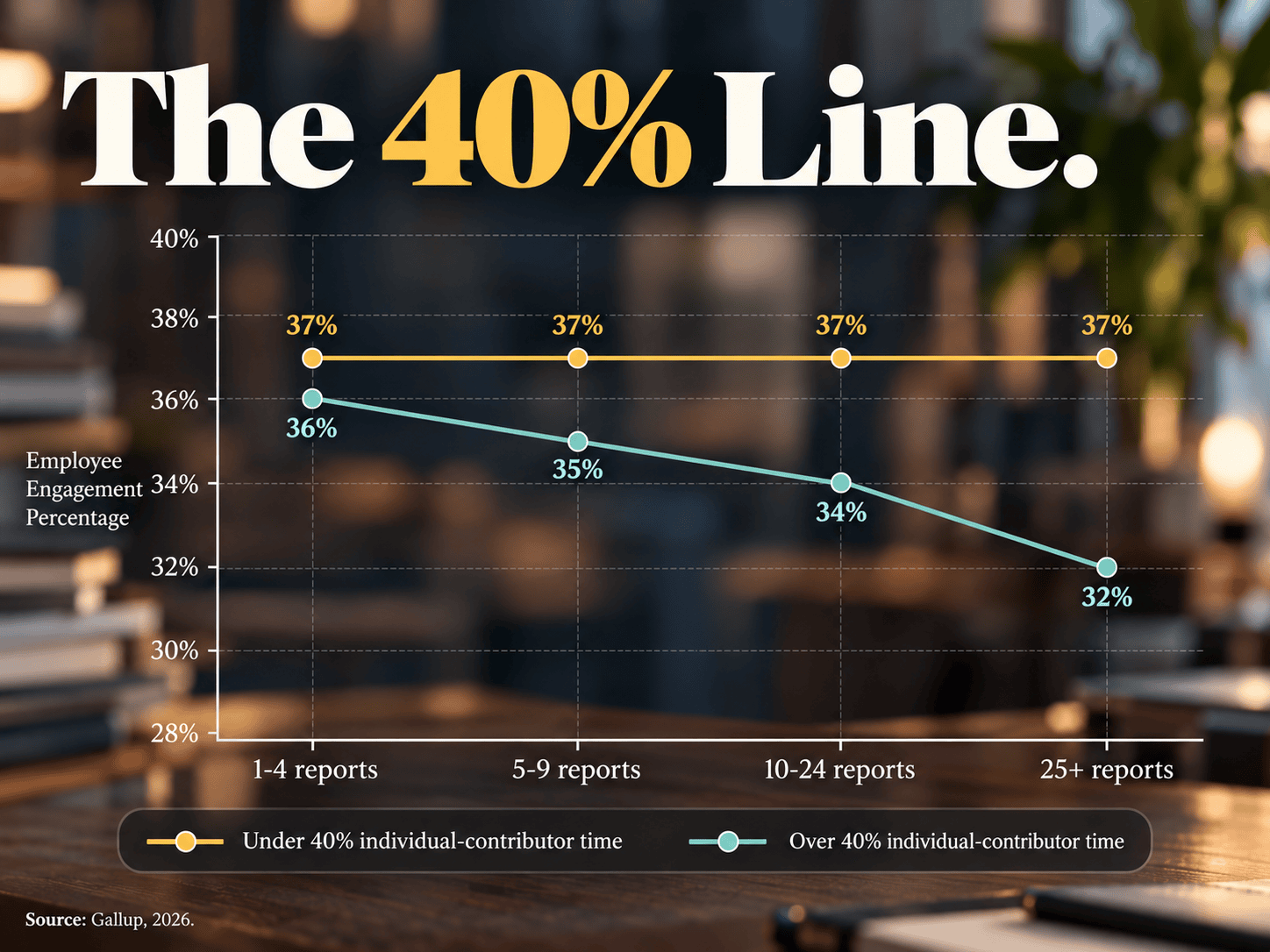
Gallup has measured manager engagement for over a decade. In a report they published this January, it found something much more specific than a simple “managers are busy.” 97% of managers still have their own work to do, on top of managing other people. Answering tickets, serving customers, carrying a piece of actual production, that’s the kind of work Gallup calls a “player coach” role. They found that the average manager spends 40% of their time on it.
Managers spending less than 40% of their time on their own work keep engaged steadily at around 37% no matter how many people report to you. Beyond that 40% though, engagement really starts dropping… Team size starts to matter at that point, too. The bigger the team, the lower engagement goes. A manager below the 40 percent mark with 25 direct reports and a manager over it with the same 25 direct reports are not living the same job at all. Even if their title and their team headcount look identical.
Created by the Diversity Employment Team
Wider, and Less Ready for It
This is happening at the same time spans of control are widening. Gallup’s panel shows the average number of direct reports per manager climbed from 10.9 in 2024 to 12.1 in 2025, a jump that pushed the total increase since 2013 to nearly 50%. The Bureau of Labor Statistics puts the current national ratio at approximately one manager for every 11.5 employees.
Big employers have spent 2025 and 2026 publicly trimming management layers. Amazon and Google are among them, and they’re joined by Oracle, Block, and Cisco in various rounds of the same kind of cut, and analysts call it “The Great Flattening.” That part of the story has already been around a while and been written about dozens of times. What hasn’t been discussed is what happens to the managers still standing after the flattening. Carrying a bigger team and their own individual load all at once, and what that manager stops being able to do.
Talent changes the picture, but not completely. Gallup found that managers rated as ‘high talent’ hold engagement in the 42% to 46% range whether they’re above or below the 40 percent line. Managers rated medium or low talent both drop as team size and individual load climb together. That would be a more comforting finding if organizations were actually screening for it. Only 44 percent of managers worldwide say they’ve ever received formal management training, according to Gallup’s numbers. Apparently, nobody sent them a syllabus.
Where You Actually Fall
Gallup didn’t build a precise instrument for this, and neither can we. But three questions get you a rough read on your own position.
- “In a normal week, how much of your calendar goes to producing work with your name on it, rather than reviewing, coaching, or deciding?”
- “When something urgent hits, do you personally handle it, or do you find the right person and let them handle it?”
- “If you disappeared for two weeks, would just your deliverables be what slipped, or would it be your whole team’s development?”
If your honest answer to all three points toward “I’m still one of the producers,” you’re very likely over the line, whatever your title says.
What the Math Looks Like
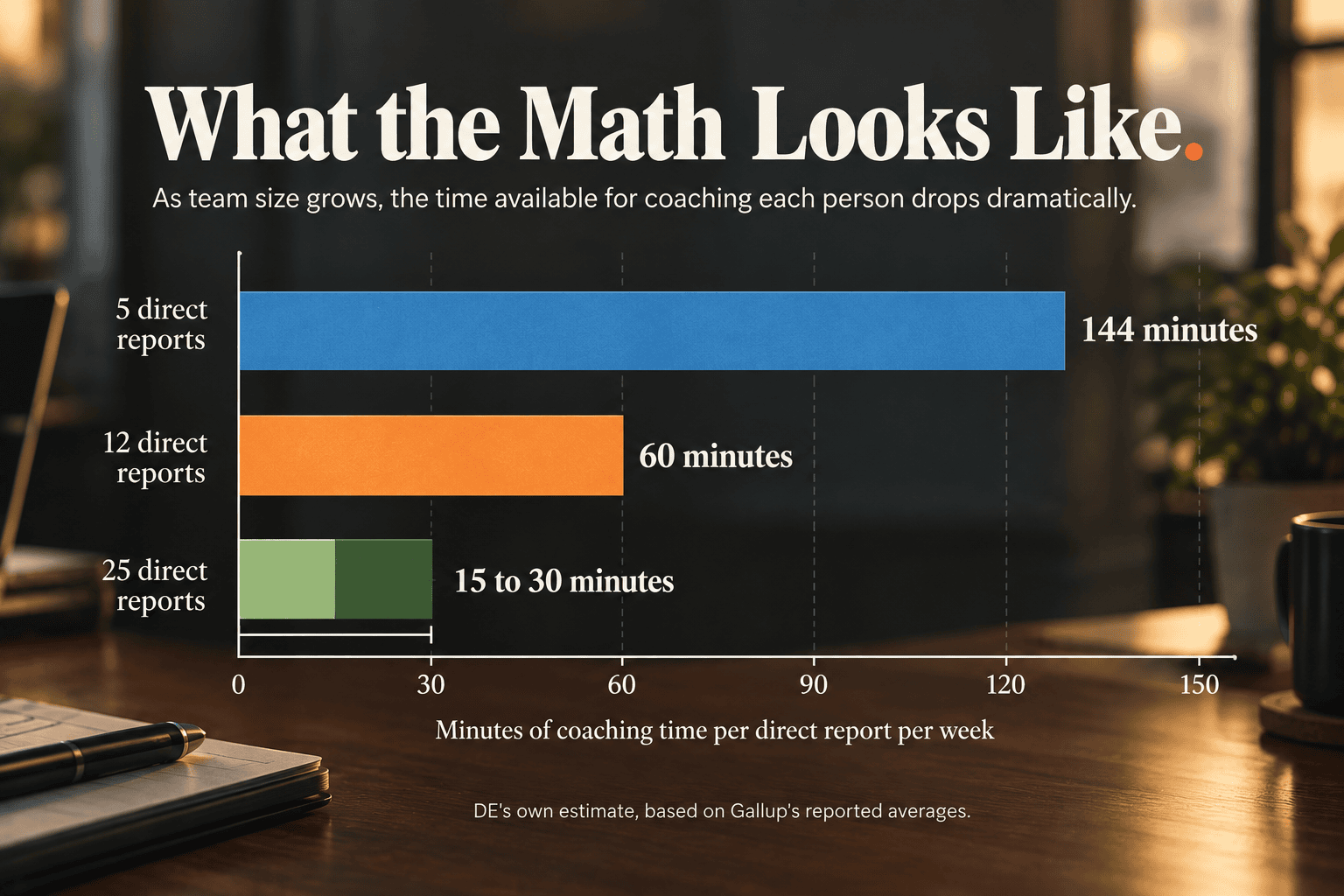
Here’s a way to see what that actually costs, using Gallup’s numbers as the starting point. Assume a standard 40 hour week and a manager sitting right at the 40 percent threshold. That leaves 24 hours a week that isn’t individual work. Some of that is unavoidable overhead, your own meetings, reporting to your managers, or planning that has nothing to do with any one person on your team. Say half of it, a generous 12 hours, is actually available for direct, person to person coaching and development.
At a team of 5, that’s roughly two and a half hours per person, per week. Bump it up to 12 direct reports, which is close to today’s national average, it’s only about an hour. Then at 25, the size Gallup found is becoming more common as flattening continues, it’s under a measly 30 minutes.
Created by the Diversity Employment Team
This is our own estimate, not a number pulled from any single study, and it’s a generous one. It assumes there were no wasted meetings, no reporting up that eats into the 12 hours, no planning that doesn’t touch a specific person. Cut that assumption in half, which is closer to how most weeks actually go, and the real number at 25 direct reports drops to roughly 15 minutes. That’s supposed to be enough of a coaching, feedback, and career conversation budget for each person on the team? Not likely.
Two Specifics Get Lost First
Two things go first, in a predictable order, and neither is on a performance review until the damage is already done.
Feedback Goes First
Weekly feedback is the cheapest, best documented tool a manager has, and it’s usually the very first casualty. Gallup asked employees whether their last conversation with their manager was extremely meaningful. Sixteen percent said yes. Across seven separate studies, and more than 44,000 responses, Gallup found employees who get real, regular feedback are engaged at about 67% to 70%, no matter how big their team is. Employees who don’t get it sit closer to 22% to 26%. Team size alone barely moves the needle. Whether or not the conversation actually happens moves it enormously.
Feedback isn’t some abstract generosity. It’s a specific, schedulable thing a manager either has 15 minutes a week for or doesn’t. And once you’re over the 40 percent line, it’s one of the first things on your list without a hard deadline attached to it. And that’s exactly why it’s the first thing to slip through the cracks.
Mentorship Follows
Mentorship follows closely, and it compounds. We’ve written before, in Gen Z Is Unprofessional, But It’s Not Really Their Fault, about how much of professional competence was never taught in any classroom. It gets passed down informally, through a manager who happens to notice a mistake and corrects it in the moment rather than on a review six months later. When that noticing stops, the people who lose the most are the ones who had the least access to that knowledge anywhere else. First generation professionals, career changers, anyone without a parent or an older sibling who already worked in an office. The communication gap gets noticeably worse every time a manager crosses the 40 percent line.
The Hoarding Nobody Names Right
There’s a specific behavior researchers call “talent hoarding,” and it shows up constantly in employee surveys as a complaint about managers who won’t let their best people move up. A 2025 study of a 200,000 employee manufacturing firm, led by economist Ingrid Haegele, put actual numbers on it for the first time. Seventy-five percent of managers admit to doing it, at least sometimes. Fifty-five percent openly acknowledge that developing a direct report creates a real conflict of interest, because a more developed employee is an employee more likely to leave.
Haegele could trace this because the firm’s own paperwork gives it away. Managers score every employee twice, a private performance rating nobody outside the team sees, and a public potential rating that circulates company wide. A manager looking to hoard doesn’t lie on the private number. They suppress the public one, rating someone’s promotion potential lower than their actual output would justify. It’s subtle enough, deniable, and it costs the manager no extra time at all. That’s why it’s the move an overloaded manager does without much conscious thought.
The Real Reason Managers Hoard
Here’s what flips the usual framing. When Haegele asked managers directly why they don’t invest more in an employee’s career, the top answer wasn’t self-interest. 66% said they have to prioritize short term targets over long-term development. 45% said it’s specifically because replacing a strong performer is hard. 96% of the same managers believe their own direct involvement has a large impact on a report’s career. Only 36% believe the company actually values that impact as much as it values this quarter’s numbers.
Almost every manager in the study knows sponsorship is important. Less than four in ten think it’s worth anything to their own career if they do it. That isn’t a management problem. It’s an incentive problem wearing a manager’s mask.
One Manager Leaves, Everyone Applies
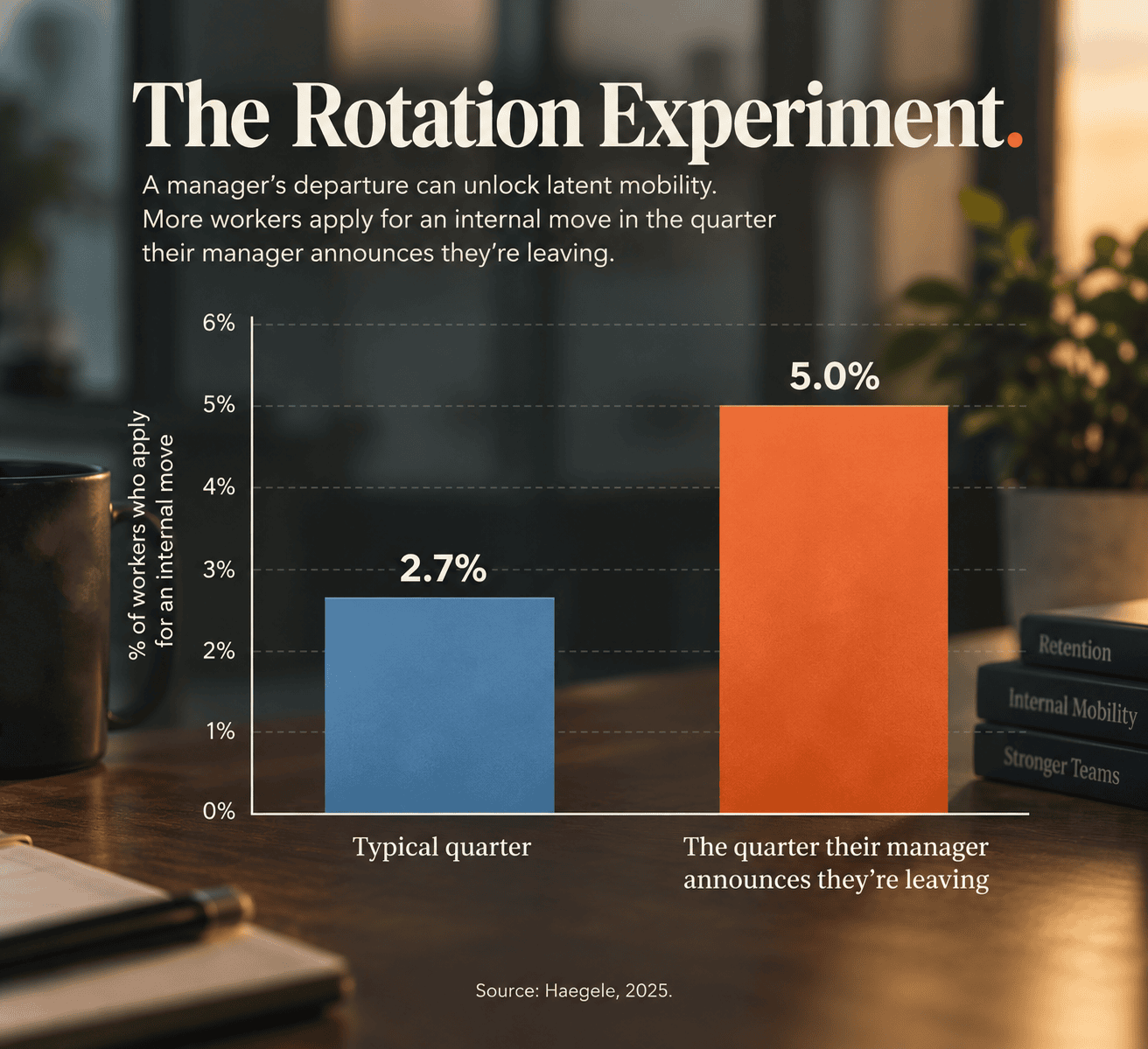
The clearest evidence in Haegele’s research isn’t a survey answer. It’s what happened when managers found out they were about to be reassigned. The moment a manager learns they’re leaving the team, hoarding has nothing left to protect, there’s no more team to lose. In the exact quarter that news landed, worker applications for internal moves jumped by 2.3 percentage points, nearly doubling the normal 2.7 percent baseline. Nothing about the employees changed. Nobody got more ambitious overnight. The only thing that moved was who happened to be sitting in the manager’s chair.
Created by the Diversity Employment Team
The applicants who showed up because of that timing weren’t weak candidates padding the numbers, either. Roughly 49 percent of them went on to land the new position, well above the 28 percent success rate for the average applicant. These were people who were ready the whole time. They just weren’t applying.
Sponsorship Has a Payoff Too
There’s a flip side worth knowing too. A separate study, by researchers J.R. Keller and Kathryn Dlugos, looked at a large U.S. health services company and found that managers who promote their own people at a higher rate actually get rewarded for it later, not punished. Those managers pull in roughly nine percent more internal applicants the next time they have an opening, and close to twelve percent more from the strongest performers specifically. Word gets around about who actually sponsors people. Sponsorship isn’t just a cost eaten for someone else’s benefit. It’s internal advertising.
One honest complication before moving on. Haegele also found that managers with smaller teams will hoard more, because losing one person out of five costs a lot more than losing one out of twenty.
Where It Shows Up Later
Hiring is running into the exact same wall from the other direction. SHRM’s 2026 benchmarking found requisitions per recruiter climbed 67 percent in the past year at large organizations, and more than two in three companies now say they’re struggling to fill open positions. The average hire now goes through 13 interviews, up 42 percent from three years ago. A lot of that added time isn’t candidates being indecisive. Offer acceptance rates have held steady in the mid to upper 70 percent range for years, so it isn’t candidates walking away either. It’s qualified interviewers with a full-time job that isn’t interviewing, squeezed onto a calendar that was already full before the application existed. The bottleneck happens earlier than most assume: it’s employer selectivity and available reviewer time, not candidate hesitation.
It’s Not Just AI
As stated before, in Nobody Wants to Train the Next Generation of Experienced Workers, employers all want candidates with three to five years of experience while less and less of them are willing to pay for the employees that can create that experience in the first place. Most of the coverage on this pattern points to AI, and AI is a real part of it. But there’s a second cause sitting right under our noses, and it’s one that has nothing to do with any algorithm.
An organization already stretched past its own capacity to coach and mentor doesn’t have room to bring in someone brand new and build them up, whether or not a machine could technically do the entry level tasks instead. It’s not that companies decided junior talent isn’t worth developing. It’s that the people who would have done that developing ran out of time to do it.
The Mobility Numbers Don’t Match
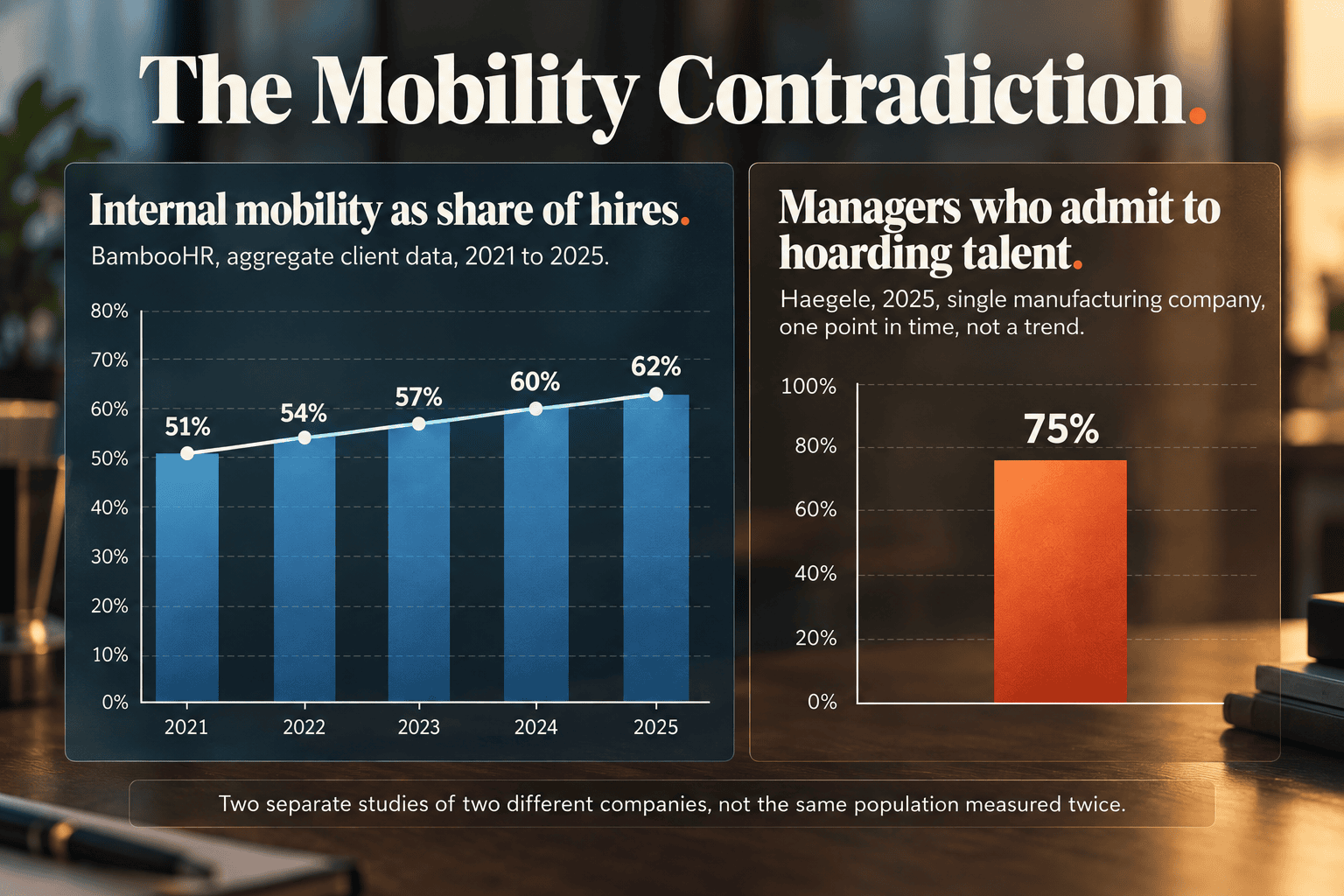
The numbers on internal mobility show a similar split. BambooHR’s data shows internal moves grew from 51 percent in 2021 to 62 percent in 2025, which on its face looks like real progress. But that’s a policy number, set at the top by companies that would rather promote from within than risk an expensive external hire in a hoarder’s market. Under that policy, Haegele’s 75 percent hoarding figure didn’t move. A company can look healthy on a mobility dashboard while a specific high performer, stationed under a manager who’s out of bandwidth, still never hears that the position even opened.
Created by the Diversity Employment Team
Audit Yourself and The Company
This part is meant to be used, not just read. Run through both halves for whichever chair you’re sitting in, or even both.
If You’re the Manager
Run these against your own recent behavior, honestly, before deciding this doesn’t apply to you.
- Have you rated someone’s potential lower than you’d rate their actual performance, even slightly, because a higher rating would make them more visible outside your team?
- Have you left someone off a high visibility project or training roster because losing their time, even briefly, would hurt your own numbers?
- Has a direct report ever mentioned an internal opening to you, and did you respond with genuine encouragement, or with a version of “let’s talk about that later”?
- Do you know, off the top of your head, when each of your reports last had a real, specific conversation about where their career is headed?
None of that makes you a bad manager. The real fixes start with naming what needs to be fixed, not with feeling bad about it.
If You’re the One Above Them
- Do you know what percentage of your managers are over the 40 percent individual contributor line, or have you never actually measured it?
- Does a manager’s track record of promoting their own people count toward their own pay and advancement, or does it really not count for anything?
- Is weekly, meaningful feedback something you expect and check on, or something you assume is happening because nobody’s complained yet?
- Before you flatten another layer of management, have you asked which of the managers left standing actually have the talent to carry a bigger team without their engagement? Or with their team’s development slowly collapsing underneath them?
The Line Isn’t the Problem. Ignoring It Is.
None of it’s really about any one manager’s character. It’s about a threshold that’s easy to measure and consistently ignored. It’s sitting underneath the decisions made for entirely different reasons: cut a layer, widen a span, hit this quarter’s number.
Feedback drops off first. Mentorship follows. Sponsorship gets quietly rationed to whoever’s easiest to replace. Hiring slows because the same overloaded people are the ones supposed to be running it. None of that shows up on the org chart that got redrawn to save money.
The Path Forward
At Diversity Employment, we keep landing on the same notion across everything we cover here.
Opportunity rarely comes down to who worked hardest. It comes down to who just so happened to have a manager with enough fuel in the tank left to notice them.
You can’t fix that by asking managers to care more. Most of them truly already do, Haegele’s own numbers say so. You fix it by treating the 40 percent line the way you’d treat any other capacity constraint, the kind you’d never ignore on a factory floor or in an ER. Measure it. Staff for it. And decide, honestly, whether the position you’re about to get rid of was actually the thing holding everything else up.