

Employee engagement gets talked about like it is some mysterious workplace mood problem.
The survey scores are down. People seem checked out. Managers get tired. Employees are quieter in meetings. Somebody suggests a new recognition program, another pulse survey, maybe a team lunch if the budget allows.
Some of that can help. A little. But most of the time, employees aren’t disengaged because nobody gave them a themed appreciation week. They are disengaged because the work itself has become harder to care about.
When the Workday Teaches People Not to Care
People notice when expectations keep shifting, or when every task is labeled urgent… but no one can explain why it matters most. They notice when they give feedback, and nothing changes. They notice when the same few people carry the extra work, when recognition feels random, and when managers are too overloaded to actually manage.
Employees also notice when their work has been reduced to a task list with no real explanation behind it.
That part matters more than leaders sometimes realize. A person can do the same job very differently when they understand what their work is helping, protecting, preventing, or improving. Even a small connection to the “why” can change how the work feels.
So no, this is not another “make work fun” article. This is about what leadership qualities can actually fix: unclear expectations, broken feedback loops, overloaded managers, pointless friction, weak recognition, and the missing “why” behind the work people do every day.
Employee engagement doesn’t improve simply because you ask your people to care more. It’ll improve naturally when jobs become easier to understand, easier to do well, and easier to feel proud of.

Defining What Employee Engagement Really Is
Employee engagement is a phrase that gets used so often it starts to lose any real meaning.
In some workplaces, it means survey scores. In others, it means people showing up to events, joining committees, team building activities, answering Slack messages quickly, or acting upbeat in meetings. But those are not the same thing as engagement. They might be signs of it. Sometimes. They might also be signs that people know how to perform enthusiasm when leadership is watching.
That distinction matters.
Busy Doesn’t Equal Engaged
You can have an employee who stays busy all day but is completely mentally checked out. Sure, they can still answer emails, go to meetings, and hit all the basic deadlines. All while they feel like just moving things from one pile to a different one.
That’s not always a character problem. It’s honestly more likely a work-flow design problem.
People disengage when they don’t understand what matters the most. They disengage when they feel like their efforts aren’t noticed. When every week brings a new priority, but none of the old priorities officially go away. They disengage when the only reward for being reliable is getting handed more and more work.
So, before leaders try to “boost employee engagement,” they need to get more honest about what they’re actually measuring.
Are people truly invested? Or are they just available?
Are they bringing new ideas, showing they trust the room? Or are they staying quiet because they’ve learned that speaking up just creates more work, tension, or even no changes at all?
A More Useful Way to Define Employee Engagement
Employee engagement is the level of clarity, trust, support, and purpose people feel while at work.
The definition simply gives leaders something to work with.
- If clarity is low, fix the expectations.
- When trust is low, close the loop on feedback.
- If support is low, look at workload, tools, training, and manager capacity.
- If purpose is low, show people why the work matters beyond the task itself.
That is where this topic becomes more manageable. Engagement is not one giant culture problem floating above the business. It is usually a collection of smaller workday problems that leaders either fix, ignore, or accidentally make worse.
Fix What’s Draining People, Not the Symptoms
A lot of employee engagement work lands too far away from the actual work.
Someone sees low scores, low morale, or more people staying quiet, and the first instinct is to add something new. A new program. Committee. Recognition idea. Satisfaction surveys. A new manager talking point that everyone knows came from a corporate slide deck. Etc. Sometimes the intention is good. It just skips the major part where someone asks, “What is making this job harder than it needs to be?”
Because if the day-to-day work is messy, adding more “engagement” on top of it will just feel like one more thing employees have to participate in.
Start With Expectations
Unclear expectations slowly wreck teams.
People can handle a hard job much better than a confusing one. They can handle a busy week better than a week where every priority is supposedly the ‘top priority.’ What burns people out faster is trying to guess what matters, then finding out later that they guessed wrong.
Leaders can fix a lot by making the basics less foggy:
- What does good work actually look like here?
• Which tasks matter most this week?
• What can realistically wait?
• Who needs to approve this?
• What decisions can employees make without asking three people first?
It sounds simple, because it can be. But it is exactly where a lot of frustration comes from. Not from a poorly worded company mission statement. In the daily confusion.
Remove the Friction Everyone Has Learned to Work Around
Every workplace has messy or even broken systems people have just learned to live with.
The meeting that just doesn’t need to happen. The 2-page form nobody reads. The approval step that made sense… two managers ago. That monthly report that takes an hour and doesn’t help anyone make better decisions. That one thing that bounces between departments because nobody really owns, or wants, it. Employees know exactly where these problems are. Usually very specifically.
The trick to finding these pain points is asking in a way that doesn’t sound like having to give a new report. Instead of asking, “How can we improve employee engagement?” try, “What’s something that slows you down every week for no good reason?”
That question is harder to hide from. It also gives leaders something they can actually work with.
Maybe the answer is too many meetings. It’s unclear ownership. A tool that technically works, but makes every simple thing take five extra steps. Maybe it is a manager who wants updates in three different places because no one has agreed on one system.
Whatever it is, fix one visible thing. Not everything. One thing. Then tell people what changed.
That part matters because employees need to see proof that speaking up doesn’t just end up as another note in “to-do” document somewhere.
Don’t Hand Off a Mess and Call It Leadership
Managers are where employee engagement succeeds or falls apart most of the time. But that doesn’t mean leaders can dump every little problem on their teams and call it support.
Even managers can’t create clear standards if leadership keeps changing the direction without explaining why. They can’t protect focus if every department treats their team like an open request window. They can’t build trust if they are asked to sell decisions they don’t even understand themselves.
So, managers need to communicate well. And they need to listen. They need to acknowledge good work, coach teams, and work on catching problems before they turn into full-on resentment.
Managers also need enough room to create that space. If they spend their whole week in meetings, chasing updates, covering gaps, and translating unclear priorities, they are not really managing at all. They’re just absorbing chaos and passing it along.
That’s not a strong employee engagement strategy. That is survival with a title.
Employee Engagement Begins with Leadership
Leaders who want better employee engagement should look at what they are asking their managers to handle on a daily and weekly basis. Then they should remove anything that doesn’t need to be there. Clarify what does. Then stop pretending that managers can fix every issue with better one-on-ones.
Sometimes the most useful engagement work is not adding energy to the team.
It is removing the thing that keeps draining it.
Show Employees Why Their Work Matters
This is one of the easiest employee engagement fixes. Still, somehow it gets missed all the time.
People take on tasks, clear tickets, compile reports, take/make calls, fill out forms, cross-check spreadsheets, conduct follow-ups, cleanups, approvals, and reminders. All of the work keeps moving. And the list keeps refilling. But nobody stops to explain what all or sometimes any of that effort is actually doing.
That kind of work can start to feel a bit mindless.
Get the thing.
Touch the thing.
Send the thing somewhere else.
Repeat.
That’s a pretty bad setup if leaders want anyone to really care.
The Task Isn’t Always the Point
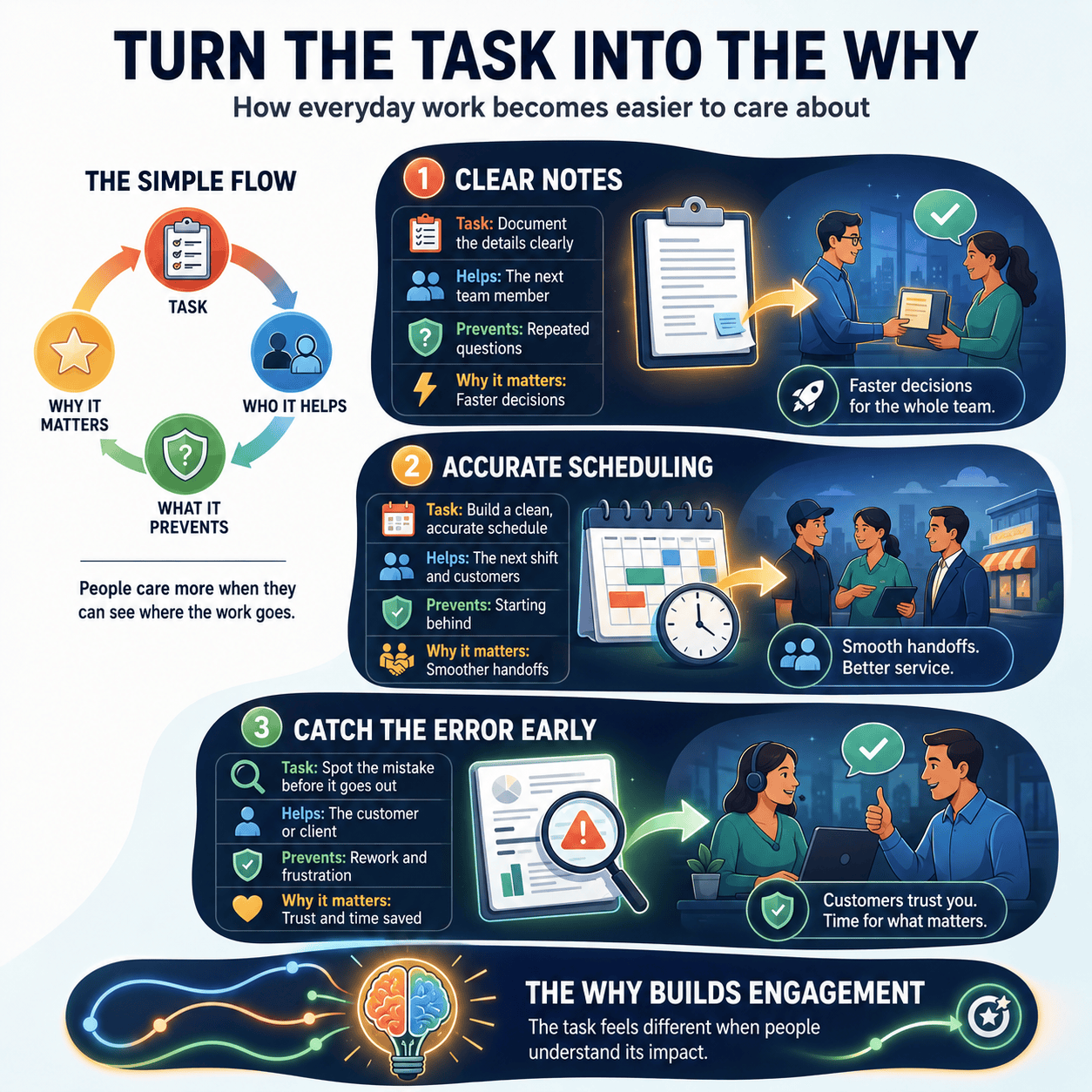
Some employees will do the same task with a totally different mindset once they understand the reason behind it.
Entering information into a system might feel like boring admin work, but accurate information could be what stops a customer from getting billed wrong. The boring stuff can help another team avoid a bad decision, protect a worker from a safety issue, or just keep a client from having to explain the same problem to five different people.
It’s a different story now. Same task. Different weight.
And not every job needs to sound epic. That gets cheesy, fast. People know when leadership is trying too hard to turn normal work into some big emotional speech.
But there is a middle ground between “you are changing the world” and “just get this done by Friday.”
Most people want to know how their work connects to something. Even if that something is small. Even if it is just making the next person’s job easier, preventing a mistake, helping a customer get a straight answer, or keeping the whole process from turning into a mess later.
Make the Why Specific
This is where leaders have to be careful.
Saying “your work supports our mission” is too vague to mean much. It sounds nice, but it just floats above the actual job.
A better version is more direct:
“When you catch that error before the file goes out, the client does not have to waste an afternoon fixing something they did not cause.”
Or:
“When the schedule is accurate, the next team doesn’t walk in already behind.”
Or:
“When your notes are clear, the person after you can make the right call without chasing down three people for context.”
That kind of explanation lands better because it’s tied to the work people actually recognize. It also helps with pride. Not fake pride. Not company-poster pride. Just the kind where someone can say, “Okay, this part kind of matters. I get why I’m doing it.”
Build the Why into Normal Conversations
Leaders can start working the “why” into regular conversations, especially when assigning new work, reviewing projects, or recognizing someone.
Before handing off a task, explain what it affects. After a project, talk about who it affected. Show new hires how the job actually connects to customers, coworkers, safety, revenue, service quality, compliance, or whatever it may be.
When someone does good work, call them out and explain the impact. Not just “great job.” More like, “You caught that early, and it saved the team from having to redo the whole thing next week.” It’s still simple. And it gives that person something to link their effort to.
A lot of employees don’t need, or even want, a motivational speech. If they understand what their work is really helping, they’ll have a much easier time caring about doing it well.
Created by the Diversity Employment Team
Asking for Feedback That Gets Lost
Feedback is a tricky one because most leaders do want to know what’s going on… At least in theory.
They send out a survey. Hold the listening session. Ask for honest thoughts during a meeting. Maybe even say something like, “There are no bad ideas here,” which immediately makes half the room trust the whole thing a little less.
The problem usually isn’t that employees have nothing to say. They almost always do. The problem is they have learned to do the math first.
- Is this worth saying out loud?
- Will anything happen?
- Will it somehow come back on me later?
- Am I about to create more work for myself by being honest?
If people have asked for the same fix three times and nothing changed, they remember that. If they gave thoughtful feedback and only got a vague “we appreciate your input” message back, they remember that too.
After a while, silence starts to feel safer.
Feedback Without Follow-Through Feels Like Theater
This is where employee engagement efforts can accidentally backfire.
A company asks people what would make work better. Employees answer. Then nothing actually happens. Or maybe something does happen, but nobody explains how it connects to what people said.
Then the next time leadership asks, the answers get shorter. Less specific. More polite. More useless, honestly. Not because employees stopped caring overnight. They just stopped believing the conversation was going anywhere.
That is how feedback becomes theater. Everyone plays their part. Leaders ask. Employees respond. A summary gets made. A few safe themes get mentioned. Then the workday goes right back to normal… Employees can smell that from a mile away.
Even When the Answer is No
Leaders don’t need to fix every complaint to build employee engagement. That’s not even realistic. There are requests that are too expensive. Some would create problems somewhere else. They can be fair, but not possible right now. Some are just not the direction the business is going.
Fine. Say that.
People can usually handle a “not right now” better than they can handle being ignored. What frustrates them is giving feedback and then having to guess whether anyone even read it.
A better follow-up sounds more like:
- “Here is what we heard.”
- “This is what we are changing first.”
- “What we simply cannot change right now.”
- “Here is why.”
- “Here is when we will come back to this.”
Those responses prove someone actually touched the feedback after collecting it.
Pick One Thing and Make It Visible
When leadership takes feedback and then tries to fix 19 things at once, it’ll get messy or most of it will fade out. If they collect feedback and nothing gets fixed, everyone learns to not even bother next time.
The better move is to pick one visible issue and handle it clearly. Maybe:
- Employees said meetings are eating their week. Cut one recurring meeting and explain why.
- They said approvals are slowing everything down. Remove one approval step that no longer makes sense.
- They said priorities keep shifting. Start sending a short weekly “what matters most” note so people are not guessing.
Even the small fixes count when people can see them.
That’s what makes feedback feel real. Not the survey platform. Not the participation rate, or the nice-looking chart in the meeting deck. The proof is whether something changed after people told the truth.
Small Management Habits People Actually Notice
Not every employee engagement fix has to be some giant company-wide effort.
Honestly, a lot of it happens in the small things managers either do consistently, or forget to do until there is already a problem.
People notice who gets thanked. They notice who gets interrupted, who gets the messy work, who gets protected from overload, and who gets told, “I know it’s a lot right now, but you’re just so good at this.”
That last one can sound like praise… the first time. By the fifth time, it sounds more like a warning. Small management habits matter because they tell employees what the workplace actually rewards. Not what the company values page says; what really gets rewarded.
Recognition Needs to Name the Actual Work
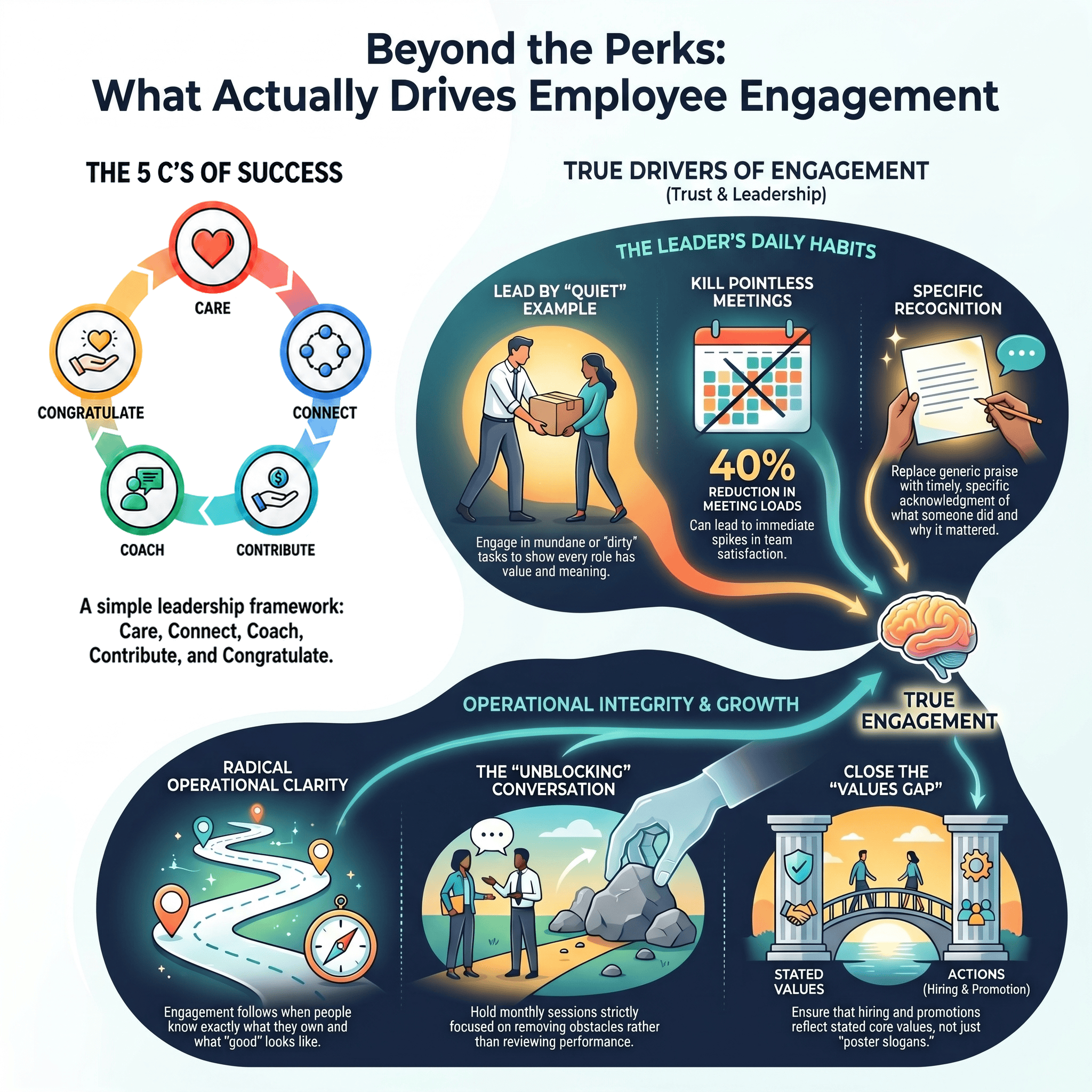
Usually people think of recognition coming from their supervisor, but positive feedback from peers can be just as powerful. “Great job” is fine. It’s not offensive or anything. It’s just not very… sticky. Most people will appreciate recognition a lot more when it includes what they did and why it helped. They don’t like it when a manager is just tossing out praise because they think they’re supposed to. A better version sounds more specific:
“You caught a big mistake before we shipped it out, and it saved everyone from having to clean it up later.”
Or even:
“You explained that in a way the newer team members could actually use. That helped.”
None of it’s complicated. But it proves the manager saw the real work. Not just the final result. And that matters because a lot of employees are doing invisible work all day.
- Answering the extra question.
- Fixing the small mistake.
- Helping the new person.
- Cleaning up the messy handoff.
- Keeping the customer from getting frustrated.
- Preventing the problem nobody else even saw.
If leaders want more engagement, they need to notice the work that keeps things from falling apart.
Growth Shouldn’t Just Mean More Work
This one gets messy fast… A manager says, “This will be a great development opportunity.” Sometimes it is. Other times, it means someone is about to get more responsibility, more pressure, and no extra support or clear path attached to it.
Employees can tell the difference.
Real growth has some kind of shape to it. There is a skill being built. A goal being discussed. A reason for the stretch. Some coaching along the way. Maybe even an honest conversation about where the person wants to go next, instead of assuming everyone wants the same promotion path.
Fake growth is just extra work with fancy wording. It hurts employee engagement because it teaches reliable people to be careful, about being too reliable. If doing a good job only leads to more work getting stacked on top, people eventually learn to only do an okay job.
Leaders can do better, if something is a stretch assignment, say what skill it is meant to build. When someone is taking on extra, talk about what support comes with it. If there isn’t a promotion available, don’t act like there is. Be straight with your people, especially Gen Z workers. Most employees would rather hear the truth than be handed a “growth opportunity” that’s just unpaid overload.
Fairness Shows Up Before Anyone Says the Word
Fairness is one of those things that can sit under the surface for a long time.
People might not bring it up directly. They might not use that exact word. But they are watching it.
Who gets flexibility?
Which team members get the benefit of the doubt?
Who gets the interesting assignments?
Which team gets left with the cleanup?
Who gets promoted after causing the same problems everyone else has to fix?
That stuff adds up. Fast. Once employees feel their workplace is unfair, engagement gets harder to rebuild. Because now the problem isn’t just the workload. It’s trust.
Managers don’t control every part of it. Pay, promotions, staffing, budgets, and policies may be above them. But they still control more than they sometimes realize. They can distribute work more honestly. Stop giving the same dependable person every ugly job. Make expectations clearer across the team. Instead of letting people fill in blanks on their own, clearly explain why decisions are made. And, speak up when something is obviously wearing employees down.
Employees shouldn’t have to guess whether being dependable is turning them into the team’s dumping ground.
Created by the Diversity Employment Team
A Simple Employee Engagement Reset to Actually Use
By this point, it should be pretty clear that employee engagement isn’t just one thing.
It’s expectations. Workload. Trust. Feedback. Managers. Recognition. Fairness. Purpose. The little stuff people deal with all week and the bigger stuff they eventually stop talking about because nothing changes anyway.
That can make the whole thing feel too big to fix. So don’t start with everything. Start with one honest look at the workday.
Ask Better Questions First
Most teams won’t need a special discovery process to find obvious problems. Leadership can learn a lot by just asking better questions; and then actually staying quiet long enough to hear the answers.
Start with things like:
- “What is harder than it needs to be right now?”
- “Where are people wasting the most time?”
- “What keeps getting called urgent, even though it probably isn’t?”
- “What feedback have we already heard but not acted on?”
- “Where are managers spending time that does not actually help their teams?”
- “What good work is happening that nobody is noticing?”
- “What do employees not understand about why their work matters?”
The point of these questions isn’t to impress anyone with the process. The point is to find the part of the workday that actually keeps draining people… and do something about it.
Pick One Fix Employees Can Actually See
This is where leaders sometimes make the mistake of going too big.
They hear employee feedback and want to launch a whole new engagement plan with. New goals. More meetings. A new committee. A flashy new dashboard. New monthly theme. Rebrand as an equal opportunity employer champion. New something/whatever.
And maybe some of that has a place. But if employees are already tired, adding a huge new effort can feel like the exact opposite of help.
This is why ‘pick one visible fix’ is the answer.
Cut a meeting that doesn’t need to exist. Clean up one approval process. Clarify one messy responsibility. Stop one report nobody reads. Change one recognition habit. Give managers one less thing to chase. Explain one piece of work that employees do every day but never really get context for.
One clear fix can do more for trust than a long list of promises. Because employees aren’t judging the announcement. They are watching for the follow-through.
Make It a Normal Leadership Habit
The goal is not to have an employee engagement season. That is how this stuff starts feeling fake. The goal is to make employee engagement part of how leaders manage work all year. Not in a loud way. Just in the normal rhythm of how decisions get made and explained.
- When priorities shift, say what changed and why.
- When employees give feedback, come back with an answer.
- If someone does consistent quiet, useful work, name it.
- When a process is wasting time, fix it instead of making people work around it forever.
- When a manager is overloaded, look at what keeps filling their plate before telling them to be more present with their team.
None of it’s magic. It’s just the kind of basic leadership work that gets skipped when everyone is moving too fast. But that is also why it matters.
Employee engagement is built in the follow-through. The small proof. The thing that changed because someone finally paid attention. That’s really what employees remember.
Employee Engagement Comes Down to the Workday
At the end of all this, employee engagement isn’t very mysterious. They just want to know the what and why, and whether anyone is paying attention when the job gets harder than it should be.
They want feedback to go somewhere. Managers who have enough room to actually manage. Recognition that includes the real work, not just a quick “great job” tossed in because one manager remembered morale exists.
Leaders shouldn’t try to fix every problem all at once. They probably can’t. But they can stop treating the symptoms like whole issues.
Start with the workday. Clear up the fog. Remove anything that keeps draining people. Explain the “why.” Close the loop. Notice the people keeping things from falling apart.
Employees remember when something gets easier because leadership actually listened. They remember when the work finally makes more sense. And that is where employee engagement starts.