

These days leadership qualities have a branding problem. When you hear the phrase do you think of managers in suits, promotions, schedules or charts, performance reviews, maybe some overly serious training video with a stock handshake or puzzle-coming-together photo? Technically that is one version of leadership. It’s just not the first one most people actually learn and use.
The first version is more along the lines of a student who realizes the group project has no real direction or plan and finally says, “Okay, what is everyone actually doing?”
It’s the new employee who writes down a process because everyone keeps explaining it from scratch. It shows up as the job seeker who can talk about a hard customer, a missed deadline, or a messy team situation without sounding like they are still emotionally trapped inside it. It all counts.
Work tends to increasingly ask people to show leadership skills before they even have leadership roles:
- Students are expected to collaborate on projects with no named leader.
- Entry-level workers are expected to take initiative… without overstepping.
Job seekers feel like they’re expected to show their skills or prove their judgment in a 30-minute interview. - People changing career have to articulate their years of experience a way their new employer can understand, and apply to the new position.
- Managers are expected to keep people on track while priorities, tools, and expectations keep shifting around them.
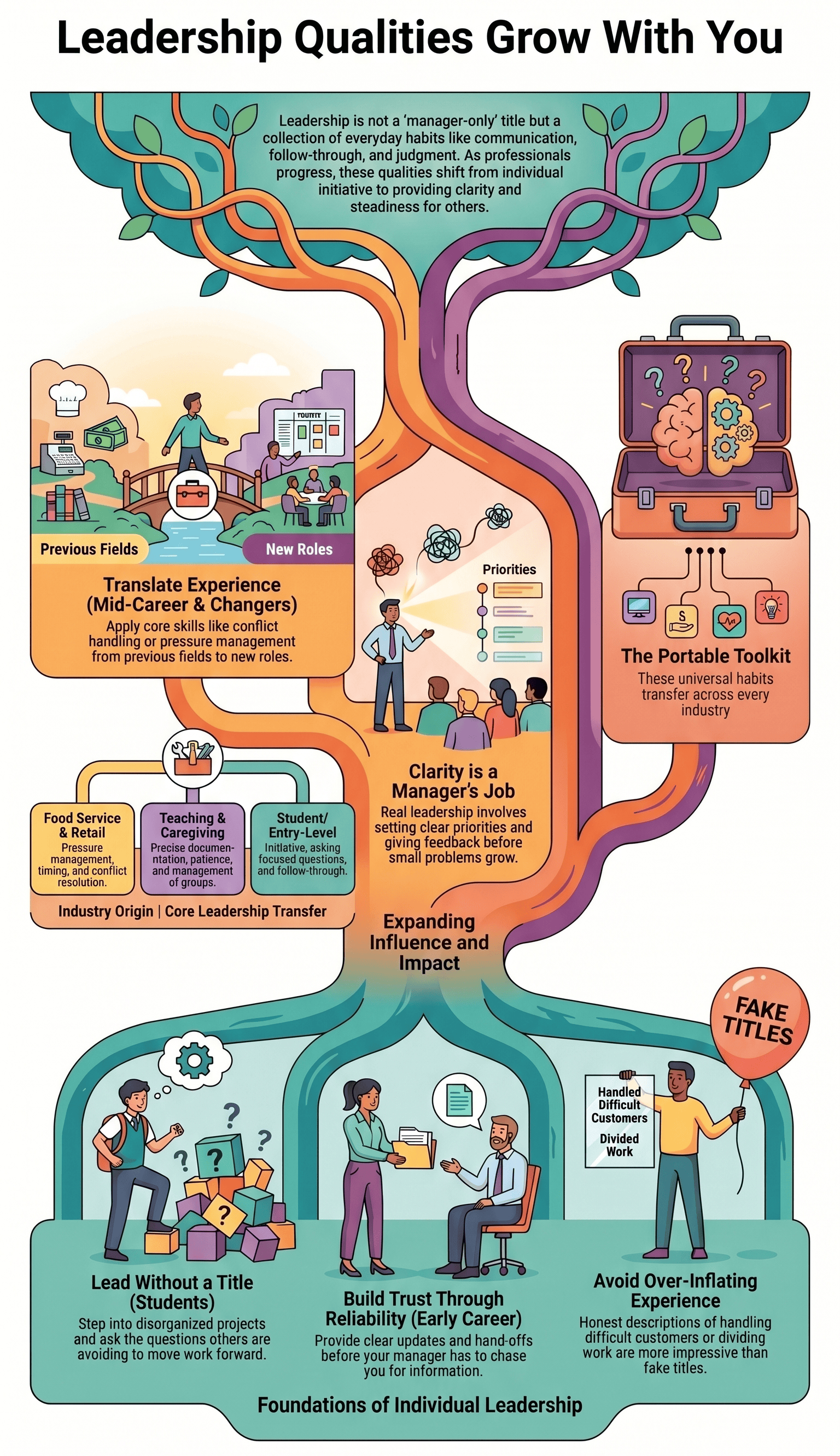
So, when we bring up leadership qualities, we need to stop treating them like a “managers-only” subject.
They are part of everyday work habits. Noticing what is unclear, communicating before confusion spreads, following through, staying calm under pressure, and helping people move toward the next step. They’re not heroic or dramatic. Just the kind of things people start to really miss when nobody does them.
What Counts as Leadership Qualities?
Leadership skills are more broad than delegating a project, they’re good communication, thoughtful judgment, initiative, follow-through, adaptability, conflict handling, trust-building, and decision-making. It sounds like a long list because, technically, it is.
But in a real life diverse workplace, these qualities usually show up as:
- Asking the question everyone else is avoiding.
- Giving a clear update or hand-off before someone has to chase you down and ask.
- Helping divide work fairly among your team.
- Owning a mistake and fixing it without turning it into a courtroom drama.
- Knowing when to speak up, when to ask for help, and when the smartest move is to just pause and wait for better information.
That’s the version of leadership qualities this article is about… The kind students, early-career workers, job seekers, career changers, and even managers all need; in their own ways.
Students and New Graduates Best Leadership Qualities
Students and new graduates get asked in interviews to “explain a time you’ve used your leadership skills…” before they even graduate.
You may be applying for college, internships, scholarships, apprenticeships, part-time jobs, or your first full-time job, and then, suddenly, everyone wants examples. Leadership. Teamwork. Communication. Initiative. Problem-solving. All the words that seem clear until you have to explain them on a resume or during an interview with someone taking notes.
The good news is, most students do have some solid examples. They just might not call them leadership qualities… yet.
Maybe you helped pull a group project together when nobody had a real plan. Maybe you trained a newer employee at a part-time job. Have you ever helped organize a fundraiser, senior event, team schedule, volunteer shift, campus program, club meeting, lab assignment, or internship task? Even just being the person who noticed the instructions really made no sense and finally asked the question everyone else was secretly wishing someone else would ask. That counts.
Not because it sounds impressive in a power skills way. Because it shows you can step into a little bit of confusion and help something move forward.
Do Not Inflate It. Just Explain It Better.
The trap students fall into is trying to make everything sound way bigger than it was.
A group slideshow doesn’t need to become “cross-functional project leadership.” A part-time closing shift does not need to become “operations management.” Nobody believes that. And honestly, it makes your real experience harder to see. The better move is to just be honest.
If your group had no plan, say you helped divide the work and keep the team on a deadline. You trained someone new, tell them what you showed them and why it mattered. If you have experience handling even one difficult customer, explain how you kept the situation calm and from getting worse. If you’ve ever helped with an event, say what you were responsible for and what had to be adjusted when something changed. That is exactly where real leadership qualities stem from.
For students and new graduates, it’s pretty simple. Leadership qualities are: clear communication, follow-through, reliability, adaptability, problem-solving, and good judgment.
You don’t need to perfect them all; but work on enough to show that when something needs structure or a calmer next step, you won’t be just standing there… waiting for someone else to figure it out. That’s the part employers notice.
Because, when an employer asks for an example of leadership, you don’t want to be digging through four years of half-remembered projects and old work schedules in your head. Keep a few real stories on hand. The ones where something was unclear, rushed, tense, or disorganized, and you helped make it a little easier to finish.
That is the perfect kind of student leadership example. And it is probably stronger than trying to sound like a manager before you’ve even had the chance to become one.
Leadership Qualities for Entry-Level and Early-Career Workers
Entry-level and early-career workers have a slightly different version of the same problem. You’re already being told to “take initiative,” but they never really explain where that invisible fence actually is.
- Speak up. But don’t dominate the meeting.
- Ask questions. But don’t ask the same one too many times.
- Be confident, but not overly confident… especially for someone who still can’t find the team’s shared folder.
- Learn fast, but somehow already understand the workflows nobody has documented.
It’s an awkward stage for sure. But this is where leadership qualities start to look less like school examples and more like trust. Not “I trust you with my life!” The more subtle kind. The kind where someone realizes they can hand you something and not have to mentally babysit it the whole time.
Maybe you send the update before your manager has to chase you down. Or, you ask what “finished” actually means before spending half a day on the wrong version of the task. Did you notice that the same question keeps coming up? Then you write down the answer and save everyone from having the same conversation again next Tuesday… and Wednesday… That counts more than it might seem.
You’re not suddenly leading a department. But you are helping the work flow better without adding any confusion to the pile.
Initiative Is Not the Same as Taking Over
This is where people can get into trouble… “Show initiative” sounds simple until you are new and still figuring out: which problems are yours to solve, which ones need approval, and which ones have apparently been broken since 2017, but everyone has made peace with them.
Real initiative starts smaller. You notice the issue. Ask a useful question. Bring one clear example instead of a dramatic speech about the whole system. You offer to take a first pass. You learn the pattern before trying to rebuild it. If you have an idea, you frame it like an option, not a rescue mission.
Early leadership qualities aren’t just walking into a new workplace and acting like the only person who has ever noticed that the printer jams. A real quality of early leadership can just be paying attention long enough to understand what is actually happening, and then trying to help your team in a way they can see and feel.
How Coworkers Start Trusting You
For early career, and new workers, leadership qualities are simple.
Reliability, communication, follow-through, adaptability, and judgment.
And those same words keep coming up for a reason… Employers like them, but coworkers really notice the person who:
- Gives a clear hand-off.
- Can listen to feedback without being defensive or making the rest of the room weird.
- Says, “I can take a first pass at that,” and then actually does.
- Can admit when they are stuck early enough for someone to help.
Those kinds of habits aren’t flashy, but they’re just the kind of thing that makes people think, “Okay, we can definitely trust them with a little more.”
And in the first few years of work, that is usually how the bigger opportunities begin. It’ll be as subtle as someone saying, “Can you loop them in? They know what’s going on.” It’s basically a quiet promotion you can bring up at your performance reviews.
The Shift for Mid-Career Professionals and Career Changers
Mid-career job-changers have a more nuanced problem when explaining leadership qualities. By this point, you probably do have some experience. Maybe even a lot of it. You’ve worked through busy seasons, difficult customers, staff changes, bad systems, confusing managers, weird software rollouts, and at least one process that everyone hated but nobody had the time or energy to fix.
So, when someone asks about your leadership qualities, the answer should be easy… In theory. Except sometimes it’s just not.
After a while, the work you’re good at can start to feel ‘too normal’ to mention. You trained people, but it was just part of the job. Maybe you kept everything organized… But someone had to. Calming down a tense situations happens so often that it stops feeling like a skill. You helped coworkers, covered gaps, explained things clearly, solved problems, and kept the day moving… Then you open your resume and your brain suddenly goes blank.
Leadership Qualities Don’t Explain Themself
The biggest mistake at this stage is assuming your experience will speak for itself. It needs a little help.
A mid-career worker might say, “I was a team lead for five years,” but that does not tell the reader much. Did you:
- Train people?
- Handle scheduling?
- Fix recurring problems?
- Communicate with other departments?
- Keep the team steady when the workload got heavy?
- Help new employees stop looking like lost terrified puppies by day three?
That is where the mid-career-stage of work’s leadership qualities are.
Same thing goes for someone who never had “lead” or “manager” in their title. Being the person people came to when something broke, when a customer needed help, when the new hire had questions, or when the manager was gone; and everyone still needed to get the work done. That counts a lot too.
Leadership qualities aren’t only proven by a title. Sometimes, they are proven by the fact that people trusted you before anyone else officially announced that they trusted you.
Career Changers Need Translation, Not Apologies
Career changers need to do an extra, annoying, thing. They have to explain why their experience from one field still matters in another one. And without sounding like they are trying to get their new employer to connect the dots themselves. That’s where translation really matters. Some common cross-examples are:
- Retail Experience: Conflict handling, training, judgment, scheduling, and customer communication.
- Food Service: Speed, pressure, timing, teamwork, and staying functional while six things are on fire… Sometimes literally.
- Teaching: Planning, constructive feedback, small and large group management, patience (above all), and sometimes explaining the same thing in five different ways until it’s finally understood.
- Caregiving: Prioritization, emotional steadiness, precise documentation, and noticing the small details or changes before they morph into bigger problems.
Almost all of those leadership qualities can be translated into another field. Especially when worded for the right industry’s vocabulary.
The goal isn’t to apologize for the old path. The real work is to explain what carried over. What did people rely on you for? Some problems you solved more than once? Where did you have to stay calm, make a call, organize details, communicate clearly, or help someone else do better work?
Not every old task belongs in your new story; but some really should.
Don’t Let Your Best Examples Get Buried
Mid-career professionals and career changers both have to be careful with the same thing: underselling yourself.
It happens fast and quietly. When you say things like “I just…”:
- “…helped train people.”
- “…handled customer issues.”
- “…kept the schedule organized.”
- “…helped the team get through a busy season.”
That word “just” is suspiciously dismissive.
Honestly, most of the time, the thing right after “just” is actually the useful part. The: Training people. Handling pressure. Keeping things organized. Solving problems before they hit someone else’s desk. Helping your team through a rough stretch without making anything worse. Those aren’t small feats to a new employer, especially when you can show your consistency. Because, it may seem familiar to you, but that doesn’t make it any less impressive to someone else.
For mid-career professionals and career changers, leadership qualities need to be pulled out of the background a little. Not over-inflated, not dressed up until they sound fake, just worded clearly enough that someone else can clearly see the pattern.
Just don’t pretend every job you’ve had was a secret leadership position. If your coworkers and managers trusted you to fix things, explain things clearly, organize the whole team or a project, calm situations down, or even just keep things moving along. That’s all worth saying out loud.
Leadership Qualities for Managers
By the time you’re managing people, leadership is no longer hypothetical. It has a calendar invite. It has names attached to it. Somebody is waiting on your answer in Slack, Teams, email, or from the doorway where they are pretending this will “only take one second.”
And that’s where the job can get a little uncomfortable.
Clarity Becomes Part of the Job
Most of managing isn’t big speeches or the perfect strategy. It’s deciding what matters when six things are all apparently equally urgent. It is noticing that everyone nodded in the meeting, but somehow three people left with three different ideas of what “done” means. It’s giving feedback before the problem has had six weeks to grow a personality.
That’s where real leadership qualities start to look like clarity, timing, trust, and judgment.
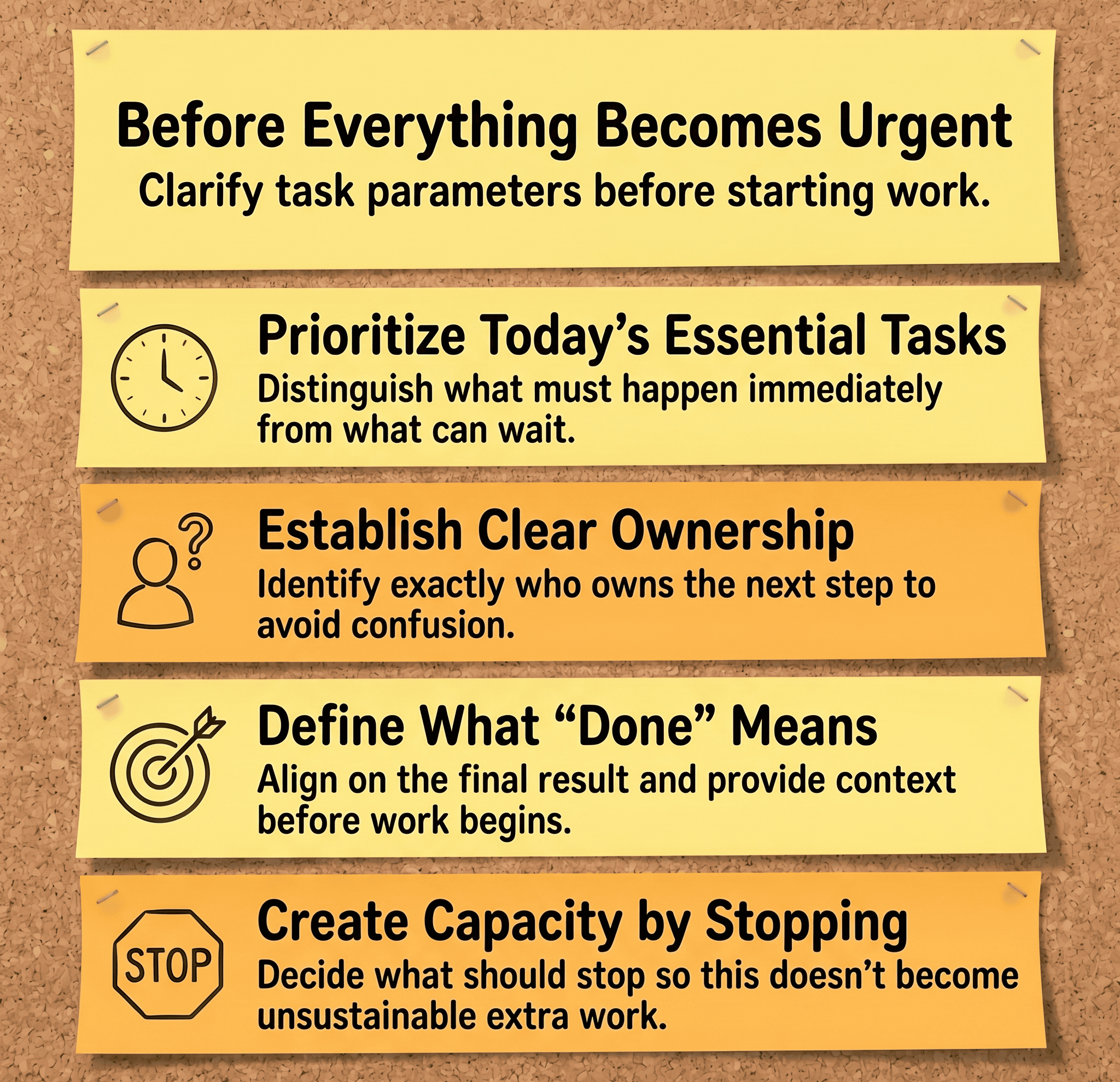
A manager’s version of communication isn’t just “being available.” Available can turn into everyone wandering in and out of your day with half-formed emergencies. Communication is setting enough context that people aren’t guessing all week. What’s the priority? Who owns what? What can wait? Exactly what does “good enough” look like? What needs approval before someone burns hours making the wrong thing look beautiful? That last one is painfully common.
Someone gets a vague request like, “Can you clean this up?” They guess. Then the manager sees it and says, “Oh, I actually meant something else.” Now everyone is annoyed, and technically nobody did anything wrong. The expectation was just too foggy from the start.
Good managers don’t remove every bit of confusion. That would be nice, but also practically impossible. They do try to keep confusion from spreading.
Everything Can’t Be Urgent
They also have to be honest about urgency. If every request gets treated like a full-on crisis, people stop believing the urgency. Teams learn to either live in panic mode all the time or just ignore the panic because it’s become background noise. And neither one is a great option.
A manager with real leadership qualities can say, “This needs to happen today,” and people believe it because they have also heard that same manager say, “This can wait until next week.” That balance matters to teams. It tells the team there is a brain behind the pressure, not just a fire alarm with a job title.
Feedback Shouldn’t Come as a Surprise
Feedback is another place where managers either build trust or worse, lose it.
People can handle direct feedback better than most managers think. What wears people down is delayed feedback, mystery standards, and the dreaded “we need to talk” after the problem has been collecting dust for two months. At that point, the employee is not just hearing the feedback. They are replaying every interaction they’ve had since March and wondering when the hidden trial really began.
Useful feedback is usually smaller and sooner. “This part is working.” “This part is off.” “Here’s what I need next time.” No courtroom drama. No dramatic pause. Just enough honesty for the person to adjust things while there is still time to.
New Tools Still Need an Actual Plan
Then there is change, which is where a lot of workplace leadership gets tested.
New tools show up. A new software. New AI features. Revamped reporting systems. New “simple” workflows that somehow require three new training sessions, two passwords, and a spreadsheet named FINAL-final-use-this-one. Managers don’t have to pretend every change is amazing. Please don’t, actually. Your team can smell fake excitement from across the room.
But managers do have to help people understand what the change is supposed to solve. Why are we using this? What stays the same? Does anything actually change? Who is responsible for learning it first? What should the team stop doing, so this new thing doesn’t just become another layer of work? …That last question gets skipped a lot.
A new tool without a changed workflow is usually seen as extra homework with a login screen.
Managers are also the ones who have to set boundaries around the mess. Not cold boundaries. Useful ones.
“We are not answering this after 6 unless it is actually blocking tomorrow.”
“Please bring the full context before asking for a decision.”
“Do not send clients a workaround until we agree on the real answer.”
Tiny lines like that keep work from turning into a tangent-filled group text.
Steady Beats Impressive
This part of management doesn’t always get praise, because when it works, things just feel right. People know what matters. They know where to go with questions. It’s better for everyone when they’re not constantly walk on eggshells while trying to read your mood.
For managers, leadership qualities are less about proving you belong in charge and more about making work comfortable enough that people can actually get it done. Clear priorities. Timely feedback. Realistic urgency. Better context. Steadiness when the plan changes again.
There’s no need for perfection. Just stay steady enough that the team isn’t using half of its energy trying to decode management before doing their job.
The Leadership Qualities That Transfer Well
Some parts of work don’t transfer very cleanly:
- A company-specific database from 2014? Probably not…
- The exact way one boss liked their weekly report formatted? Sadly, it may be burned into your brain forever, but it’s not always useful.
- The internal language from a job where every simple task had a dramatic acronym? That can stay over there.
But some things transfer very well:
- The ability to make a messy situation a little clearer.
- The habit of always following through.
- The judgment to know when something calls for a quick answer or when it actually needs five more minutes of thought.
- The ability to give someone useful context before handing them a problem with no map.
Those are the leadership qualities that tend to follow you wherever you go.
Jobs Change. Patterns Usually Doesn’t.
A student group project, a retail shift, an office role, a warehouse team, a healthcare desk, a remote job, a management position… they all look different from the outside.
The work, though, all has some of the same problems that keep showing up, just wearing different outfits.
People are unclear about priorities. Someone assumes everyone else knows the plan. A task gets passed along with half the needed information missing. A small issue sits too long and becomes bigger, louder, and now somehow everyone’s problem by Thursday.
This is why portable leadership matters. You may not know the new system yet or may not even know every person’s name yet. You may still be figuring out where the shared files live. But you can still bring habits that help: ask what the finished version should look like, repeat back the priority, send clean updates, notice the missing step, admit when something is unclear before the deadline is already looming. That stuff moves with you.
Pay Attention to What You’re Trusted With
One of the easiest ways to find your strongest leadership qualities is to look at what people keep giving you to handle. Not what’s in your official job description. The real-life day-to-day stuff.
Are you the person people ask to explain confusing instructions? Do coworkers come to you before they send a tricky email? Do you usually calm down fuming customers? Catch the missing details? Train new hires? Organize… everything; or the one who says “Okay, let’s figure out what actually has to happen first”?
It can be easy to overlook or not recognize your own leadership qualities… just because they feel too natural. You think, “Well, I’m just good at keeping things organized.” Absolutely; that’s useful. Very useful, actually. Organization is a life-saver in a workplace where three people are working from three different versions of the same document and the whole team is too afraid to ask which is the right one.
The same goes for being calm under pressure; good with details; easy to work with; direct, without being rude; or willing to ask the question that saves everyone from a bad assumption. Those aren’t just personality extras. They are work habits people build trust around.
Some Qualities Need Updating
There is one annoying catch here: a habit that got you through one job can be ‘out of place’ in the next one.
If you came from a place where nobody communicated, you may explain everything twice, and then try to explain the explanation. If you worked somewhere too disorganized and learned to treat everything like an emergency. Or, if asking for help used to get you judged, you may try to figure out everything alone until your brain feels like a browser with 17 tabs open and two of them are playing sound.
Those habits make sense. And they probably came from somewhere with good intentions. But good leadership also means noticing when an old survival habit has turned into extra friction.
Maybe… the next stage of your career asks you to speak up sooner. It asks you to stop rescuing every process manually. It asks you to let someone else own a piece of the work without hovering over it like a nervous airport parent. Or, it asks you to say, “I need more context,” instead of pretending you can magically guess what everyone meant.
That’s still growth. Just the backstage stuff that people don’t see.
Keep the Focus Clear
The point through all of this is pretty simple: leadership qualities aren’t locked into a title, age, industry, or career stage.
Leadership is how you handle unclear work or how you communicate when something changes. It’s how you treat people when pressure rises, and whether or not people can trust you to do what you said you would do.
Examples can change over time, and the wording changes too… A student might talk about organizing a project. New workers might talk about taking a first pass at a process. For career changers, explain how you trained people, resolved conflicts, or even kept details clear throughout busy days. Managers can explain their processes of prioritizing, giving feedback, and helping a team adjust to a new tool… without turning the rollout into a second full-time job.
All different stories. Still the same focus.
Leadership Qualities are Built in the Moment
Leadership qualities can sound like something you are supposed to collect and display on command.
Communication. Initiative. Judgment. Adaptability. Trust. Problem-solving. Follow-through.
Nice words. Useful, even. But they can start to feel flat if we only talk about them like resume decorations. In real work, they are usually much more ordinary than that.
They pop up for a student when the group project is drifting and someone finally asks what everyone is actually doing. When a new employee asks for clarification before accidentally building the wrong thing for three hours. When a mid-career worker realizes the thing they “just” do every day is actually what keeps the team from falling apart a little.
They show up when a manager says what matters first, gives feedback before it turns into a whole event, or admits that a new tool will only help if the workflow around it makes sense too.
“Small Stuff” Is the Best Proof
Most leadership examples don’t come with flashy or dramatic lighting.
They happen in regular moments. The clear hand-off. A hard conversation. Those customer issues. A small missed detail caught early. The tense meeting that gets calmer because someone asked a useful question instead of adding more noise.
That is why leadership qualities are worth paying attention to at every career stage. Not because everyone needs to act like a future executive. They matter because work gets easier when people communicate clearly, follow through, stay steady, and notice what needs attention before it becomes a much bigger problem.
And those habits are buildable: Practice giving clearer updates. Ask more focused questions. Get comfortable saying, “I’m not sure yet, but I do know…” And stop burying your best examples under the word “just.” Pay attention to what you’re already trusted with and use that.
You Have More Leadership Qualities Than You Think
If you’re trying to explain your leadership qualities to someone else on a resume, in an interview, at a performance review… or heck, even just to yourself, start with real examples.
- Where was something unclear?
- When did someone rely on you?
- Where did you help the work move forward?
- Where did you stay calm when it would have been easier not to?
- When did you make the next step easier for someone else?
That’s where your best examples are hiding. Not the “I single-handedly transformed everything” version. The practical versions, that actually happened.
Leadership grows from those moments. Small choices. Awkward questions. The follow-ups nobody witnessed. The decisions to give people a little extra context to save confusion. Over time, those choices become a pattern that people remember. Because it made working with you easier, clearer, steadier, or even just more fun.