
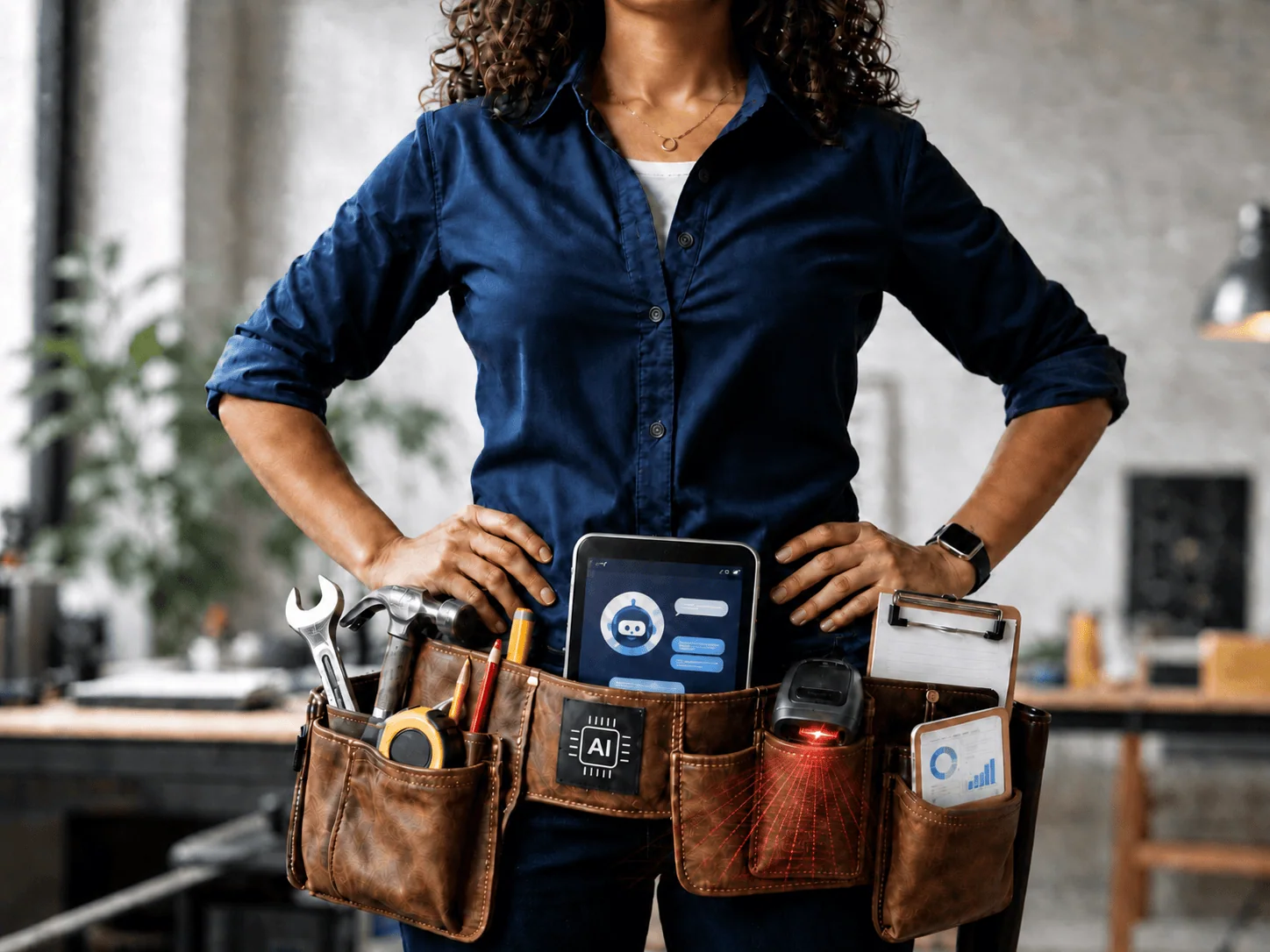
‘AI this,’ or ‘AI that’ is the career trend nobody can ignore right now. It’s showing up in job postings, team meetings, software updates, interview questions, and more than half the advice people hear about “future-proofing” their careers. And honestly, it makes sense, people with real AI skills can: work faster, organize messy information, learn new tools quicker, and take some of the busywork out of their day.
So, this is not an argument against AI at all. It is more of a potential caution-flag.
Don’t avoid AI. But… Avoid becoming dependent on it.
There is a strange growing tension building in the current job market. We are all being told to learn AI, chase AI, build with AI, manage AI, consult on AI, and reshape their careers around AI. But, AI is getting better and better at the same jobs people are being trained to do with it. Not at all to say every AI-related job is doomed; people should just be a little cautious about putting their entire future into one basket, especially when that basket is being reshaped every couple weeks.
The real question is: What happens if too many people stop building other skills because AI looks like the only smart direction left? What happens to trades, repair work, care work, the hands-on problem solving, and the basic practical knowledge that still keeps daily life from falling apart?
A future built solely around prompts may be faster. It may even be more efficient. But it may also be more fragile than we see.
AI Skills Are the Career Trend for a Reason
To be fair, AI is not getting all this attention for no reason. It’s not some random career fad people invented on LinkedIn because they needed something new to post about. Companies really are trying to figure out where AI fits, what it can replace, what it can speed up, and how much money it can save.
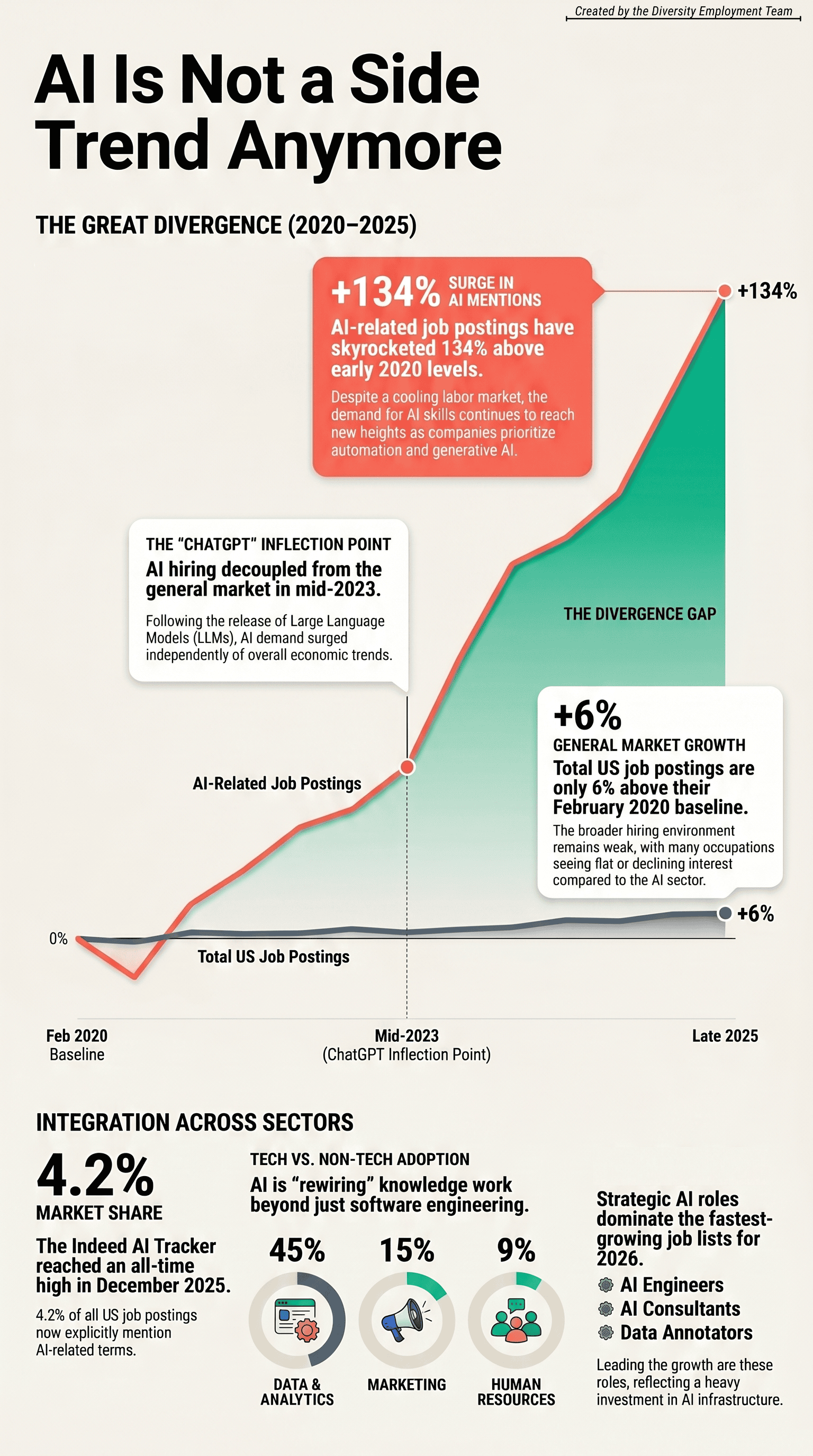
That’s why the job market keeps pointing in the same direction. LinkedIn’s 2026 “Jobs on the Rise” list showed a continuing momentum for jobs like AI engineer, AI consultant, and data annotator, which says a lot about where companies are placing their bets right now. Indeed has also reported that job postings mentioning AI at the end of 2025 were about 134% higher than February 2020’s levels… Even while total job postings were only 6% up respectively. So, yeah, the AI signal is real.
AI Skills Are Not Just in Tech Jobs Anymore
And it is not just the obvious tech jobs anymore. That is probably the bigger thing to notice. AI is creeping into HR, marketing, finance, customer service, recruiting, benefits, analytics, and regular old office work. A person does not have to be building models to feel the shift. Sometimes it is as simple as: this job now expects you to use AI to write faster, summarize faster, research faster, sort data faster, or make a messy process look cleaner than it did before.
That part matters. Because for a lot of workers, “AI skills” does not mean becoming a machine learning researcher. It means knowing how to use the tools well enough that you are not the person still doing every task the slowest possible way.
Useful Does Not Mean Everything
So, yes, learn AI. Absolutely. Ignoring it would be a strange career strategy at this point.
But that is also where the caution starts. When one skill category becomes the answer to everything, people can start treating it like the whole map instead of one very powerful tool on the map. AI is useful because it can touch almost every kind of work. That does not automatically mean every worker should build their whole future around it.
The Problem: Trends Get Crowded Fast
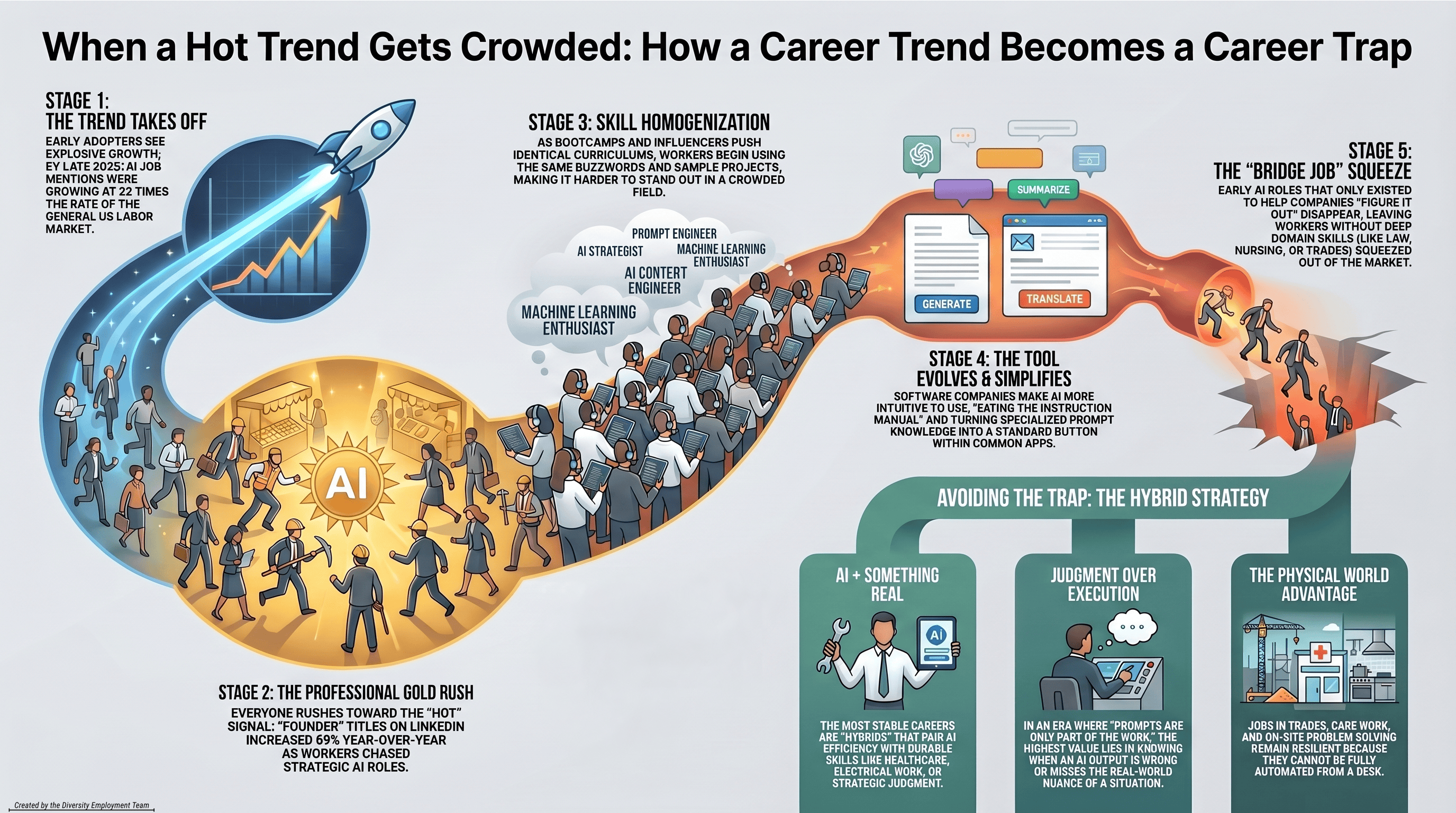
There’s this thing that happens when one career trend gets hot enough. At first, it looks like a shining new opportunity. Then everyone hears about it. Then every course, bootcamp, hiring guide, social media thread, and “future-proof your career” post starts pointing everyone in that exact same direction. That doesn’t make that direction wrong…
It just makes it crowded.
And crowded career paths can get pretty tricky. When only one type of job feels in demand, people who were told to: learn the same tools, use the same buzzwords, build the same sample projects, and chase the same job titles, now, are all standing in the same line. Some of them will absolutely do well. But a lot of people can end up with nearly identical skills, competing for jobs that keep changing while they’re still playing catch up.
The AI Skills Basket Keeps Changing
That is the part that makes AI different from some past career trends. It’s not just a growing field. It’s built around tools that are also growing, shifting, and absorbing more work as they grow.
So, when someone says, “Just get into AI,” the obvious follow-up should probably be: Which part?
Building it? Selling it? Training other people on it? Managing it? Cleaning data for it? Writing prompts for it? Plugging it into HR software? Using it to speed up marketing reports? Explaining it to executives who heard three terms on a podcast and now want a companywide strategy by Friday?
All of those can be real and substantial work. Some of it may even be great work. But it’s not all equally enduring work.
That is where the “basket problem” starts. Workers are being told to put more and more energy into AI, but AI itself keeps changing the shape of the basket. The skill that looks valuable right now may still matter five years from now; or it very well may become a checkbox inside a tool everyone now has.
Chasing the Trend Is Not the Same as Building a Career
This doesn’t mean people should up-and-ignore the trend. That would probably end up being a bad read. AI is absolutely changing work, and pretending it is not won’t make you any safer.
Building a good career takes more than whatever is hottest this year. It needs judgment. A bit of common knowledge. And some kind of real-world usefulness that doesn’t disappear the second a new software update rolls out. AI can absolutely be part of that. It may even become a basic layer of most jobs, just like the internet, email, or spreadsheets did.
But if everyone builds their future around the same tool, and that tool keeps learning how to do more of that work, we can, at least, admit there is some real risk there.
Not panic. Not doom. Just… some risk.
What Happens When AI Gets Better at AI Work?
This is where the whole AI career conversation gets a little awkward.
A lot of today’s advice sounds something like: learn AI now, because people who know how to use AI will replace people who don’t. And, sure, there’s probably truth in that. A worker who knows how to use better tools usually has an advantage over someone refusing to learn them.
But there’s another part of the sentence people don’t always finish. What happens when AI gets better at helping people use AI?
Because it’s not some far-off sci-fi question. That’s basically the direction these tools are already moving. Every new version gets a little better at writing, coding, organizing, summarizing, researching, planning, explaining, designing workflows, and walking people through complicated tasks. Which is impressive. Great, even.
But it also means some of the work built around “knowing how to use AI” may not stay special forever.
Some Jobs May Be Bridge Jobs
There are a lot of companies that get stuck at “Okay… How do we actually use this stuff?” They need people who are curious, willing to poke around, try and learn the tools, notice what breaks and how to fix it, and then explain the whole thing without making everyone feel like they accidentally walked into a tech conference.
That’s real work. But… it may just be bridge work.
Meaning, it helps companies get from the old way of working to the new one. Bridge work can be valuable, but it’s not always going to be permanent. Once the system is built, once the templates are made, once the training wheels come off, the number of people needed to keep it running starts to look a lot different.
That is the part worth sitting with for a second.
Because if a worker spends years becoming “the AI person,” but the tools become easier for everyone to use, then that worker may need something deeper underneath the AI label.
The Tool Might Eat the Instruction Manual
There is a funny little problem with being useful mainly because a tool is confusing.
The more confusing the tool is, the more people need guides, trainers, prompt experts, consultants, explainers, and hand-holders. But the whole business model of most software is to become easier, smoother, faster, and less annoying to use.
AI is no different.
Right now, there is value in being the person who knows how to get better answers out of the tool, or how to set it up so it stops acting weird. That is useful. But software companies are not trying to keep these tools confusing forever. A lot of today’s “special knowledge” may eventually just become part of the button.
The tool might eat the instruction manual.
And when that happens, the worker who only knew the instruction manual may have a problem. The worker who knew the field, the customer, the machine, the patient, the law, the building, the team, the process, or the actual real-world problem? That person is in a much better spot.
AI Skills Need Something to Attach To
That is why “learn AI” is not bad advice. It is just incomplete advice.
Learn AI, yes. But learn it in relation to something. Learn how AI changes recruiting. How it helps electricians estimate jobs. Learn how it supports nurses without getting in their way. Or how it can help a small business owner write better emails, track expenses, plan inventory, or stop drowning in admin work.
That kind of AI knowledge has more weight behind it.
Because the real value is not just knowing the tool. It is knowing what the tool is supposed to help with.
And that may be one of the biggest differences between a trend and a career. A trend can teach someone which button to press. A career teaches them why they are pressing it in the first place.
Meanwhile, the Physical World Still Needs People
This is the part that gets easy to forget when every career conversation starts drifting toward software.
The physical world doesn’t stop needing people.
Sinks still leak. Wires still need to be run. Air conditioners still break in July, which should honestly be considered an emergency-level event in some states. Cars still need repairs. Roads crack. Buildings age. Patients need care. Kids need teachers. Older folks need compassionate help. Homes, hospitals, warehouses, schools, restaurants, farms, and construction sites don’t run on prompts (yet?), they’re run by people.
AI can help with a lot of things around that work. Scheduling, estimates, training, paperwork, inventory, safety checklists, customer messages, all of that. Great. Use it.
But someone still has to show up.
Not Everything Can Be Automated From a Desk
That is that weird imbalance in the current career conversation. There’s so much attention going toward jobs that happen on screens while a huge part of daily life still depends on work that happens in rooms, trucks, yards, clinics, kitchens, crawl spaces, and job sites.
And those jobs are not minor.
They’re the reason the lights turn on, the water runs, the building is safe, the patient gets helped, and the broken thing becomes less broken. There is a real kind of intelligence in that work too, even if it does not always get talked about like intelligence. You have to notice what is wrong, test a guess, use your hands, read the situation, adjust, and sometimes figure it out with imperfect information.
Which, funny enough, is exactly the kind of skill people keep saying the future will need.
These Jobs Are Not “Fallback” Work
That is another thing worth saying out loud. Trades, repair work, care work, maintenance, construction, farming, and hands-on service jobs should not be treated like the backup plan for people who did not “make it” into tech.
That whole idea is tired anyway.
A person who can fix the thing everyone else is standing around staring at has real value. A person who can care for another person in a high-stress moment has real value. Someone who understands how a building, machine, animal, workplace, or system actually works has much more value.
And that value gets more obvious as more people spend their days vibe coding in front of the same screen, using the same tools, chasing the same digital skills, and forgetting how much of life still has to be handled outside the screen.
AI Skills Can Help the Work. It Cannot Replace the World.
This is where the balance matters.
AI can absolutely make physical-world jobs better. A plumber could use it to write estimates faster. An electrician could use it to explain repair options to a customer. A nurse could use it to reduce some paperwork. A contractor could use it to plan materials, organize schedules, or clean up the admin side of the business.
That is the good version. The risky version is when people start acting like the digital layer is the whole thing. It isn’t.
The work underneath still matters. The hands-on knowledge still matters. The ability to walk into a messy, real situation and figure out what is actually happening still matters. And if everyone is staring at AI as the only “future-proof” path, we may end up undervaluing the exact workers who keep the future from falling apart.
When Every Basic Question Becomes a Prompt
There is another piece of this that is harder to measure, but it feels connected.
It’s very easy to get used to. And it is easy to see how that happens. The tool is sitting right there. You ask. It answers. You move on with your day. Helpful? Absolutely. But after a while, that little habit of stopping for ten seconds and trying to reason it out yourself can get… a little rusty.
But, if every tiny question becomes a prompt, people can slowly lose the habits of: Trying first. Looking closer. Making a guess. Testing the obvious thing. Using what they already know before reaching for help. That habit matters way more than it gets credit for.
The “How Do I Cut a Tomato?” Problem
This is where a silly example starts to say something bigger… Asking AI how to cut a tomato isn’t a moral failure. We have all looked up basic things. But that little instinct, the need to ask before trying, can spread into other parts of life and work.
So, the real concern is not that people use AI to learn things we should already know. The concern is that workers may get really good at asking for answers… While getting worse at building the kind of practical sense that helps them survive when the answer is not instant, clean, nuanced, or on a screen.
AI can support that kind of thinking. But it probably should not be the first attempt.
The Safer Career Strategy: AI Skills + Something Else
“AI should add to a skill, not replace one.” Is probably the most useful way to think about it. AI should not be your whole career plan. It should be something that makes the career plan stronger.
That sounds like a small difference, but it is a pretty big one. There is a real gap between “I know how to use AI” and “I know how to use AI inside work that actually matters.” One is a tool skill. The other is a career skill.
Because AI still needs somewhere to go. It needs a field. A problem. A person. A customer. A process. A job site. A patient. A student. A business. Something real to attach itself to.
Without that, “AI skills” can start to feel a little floaty. Useful, yes. But waiting for a purpose.
The Strongest Workers May Be Hybrids
The safer move may not be choosing between AI and everything else. It may be pairing AI with something more durable.
AI + healthcare.
+ electrical work.
+ recruiting.
+ construction.
+ benefits.
+ farming.
+ sales.
+ accessibility.
+ small business operations.
+ literally anything where the person still understands the work underneath.
That is where the value in AI starts to look more stable.
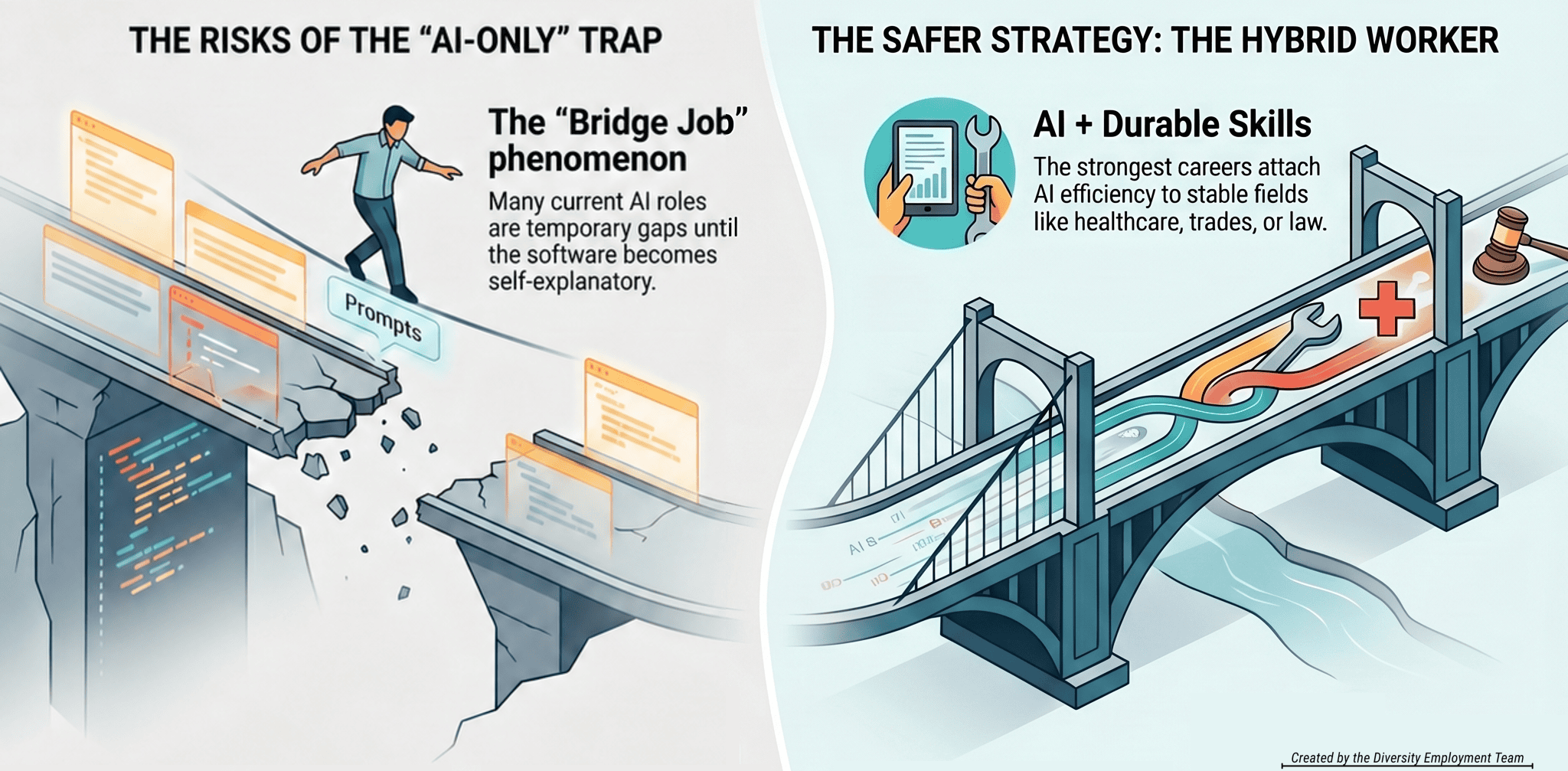
Someone who actually knows the work can usually tell when AI is helping and when it is just making a confident mess. They can spot the answer that sounds nice but misses the point. They know when the real situation is messier than the neat little response on the screen.
And that kind of judgment is not something a prompt can fake very well.
Don’t Just Learn the AI Skills. Learn the Terrain.
This is why the best career advice probably should not be “learn AI” and then stop there.
Learn AI, sure. But also learn the terrain around it.
If you work in HR, the useful skill is not just “using AI.” It is knowing when AI makes the process easier, and when it starts creating problems with fairness, privacy, trust, or compliance. If you work in the trades, it is not about turning the work into tech. It is knowing where the tool can save time with estimates, messages, schedules, and the annoying paperwork that piles up around the real job. If you work in healthcare, learn where it can reduce admin work without getting between people and care. If you run a small business, learn how it can save time without making the whole business feel fake and automated.
The point is not to become less technical. It’s to become more useful.
Because the worker who only knows the tool may be easier to replace when the tool gets simpler. The worker who knows the work, and knows how to use the tool inside it, has a much better shot at staying valuable.
Build Around Something That Still Matters
So maybe the safer question is not, “How do I get into AI?”
Maybe it is, “What useful thing can I get better at, and how can AI help me do it?”
That question changes the whole direction. That keeps AI where it belongs, as part of the plan, not the entire personality of the plan. It still points people toward actual skills, actual industries, actual problems, and actual people.
Which, honestly, may be the safer bet right now. Not avoiding AI. And not worshipping it either. Just making sure it’s attached to something that still matters when the trend cycle eventually moves on.
What Job Seekers Should Watch
At this point, job seekers may need to get a little more skeptical about shiny new job titles. Not negative. Not cynical. Just skeptical enough to ask what the job actually depends on.
Because “AI Specialist,” “AI Strategist,” “Automation Lead,” or whatever the next version is called can sound future-proof. And some of those jobs may be. But a trendy title isn’t the full picture.
A better question is: “What is the person in this job actually doing all day?”
Are they solving a real problem? Actually working inside a field they understand? Are they helping actual people or businesses do something better? Or are they mostly sitting between a confusing tool and a company that hasn’t figured out what it wants yet?
The Difference Really Matters
A good AI-related job should probably get stronger as the tools improve. The worker should be able to move into better judgment, better strategy, better service, better productivity, or better hands-on work. But if the whole job exists just because the tool is confusing right now, that might be more of a stepping stone than a career destination.
So perhaps the thing to watch is not just which jobs mention AI. Watch for which jobs still matter and grow after AI gets added.
It’s a less flashy way to look at the job market, but it is probably more useful. Does the work have something real underneath the AI part? Is there anything there that actually calls for a real person? Because the goal should be to build a career that can bend a little with new and evolving tools.
It’s not the best idea to chase every new tool that shows up. It is a good idea to build enough entrepreneurial skills so that a software update doesn’t throw your whole career sideways.
The Future Still Needs People Who Think Beyond AI Skills
So yes, learn AI. Use it. Get comfortable with it. Figure out where it helps you work faster, think clearer, and handle the parts of the job that used to eat half your day for no good reason.
That is not the problem.
The problem is when AI becomes the whole plan.
A future built around AI alone might look smart for a while. Maybe even very smart. But if the tool keeps changing, improving, simplifying, and taking over more of the work around itself, workers are still going to need something sturdier underneath. A field they understand. A skill they can build on. A trade, a craft, a service, a judgment call, a real problem they know how to solve.
Because the future of work probably does need people who can write better prompts.
Prompts Are Only Part of the Work
The future needs people who know when the prompt is wrong. It needs people who can fix the leak, calm the customer, read the room, care for the patient, run the wire, teach the kid, question the answer, and figure out what to do next when the screen is not enough.
AI may be one of the most useful tools workers have ever had. But it is still a tool.
And the future of work needs more than that.