
Unemployment Benefits by State (2026)
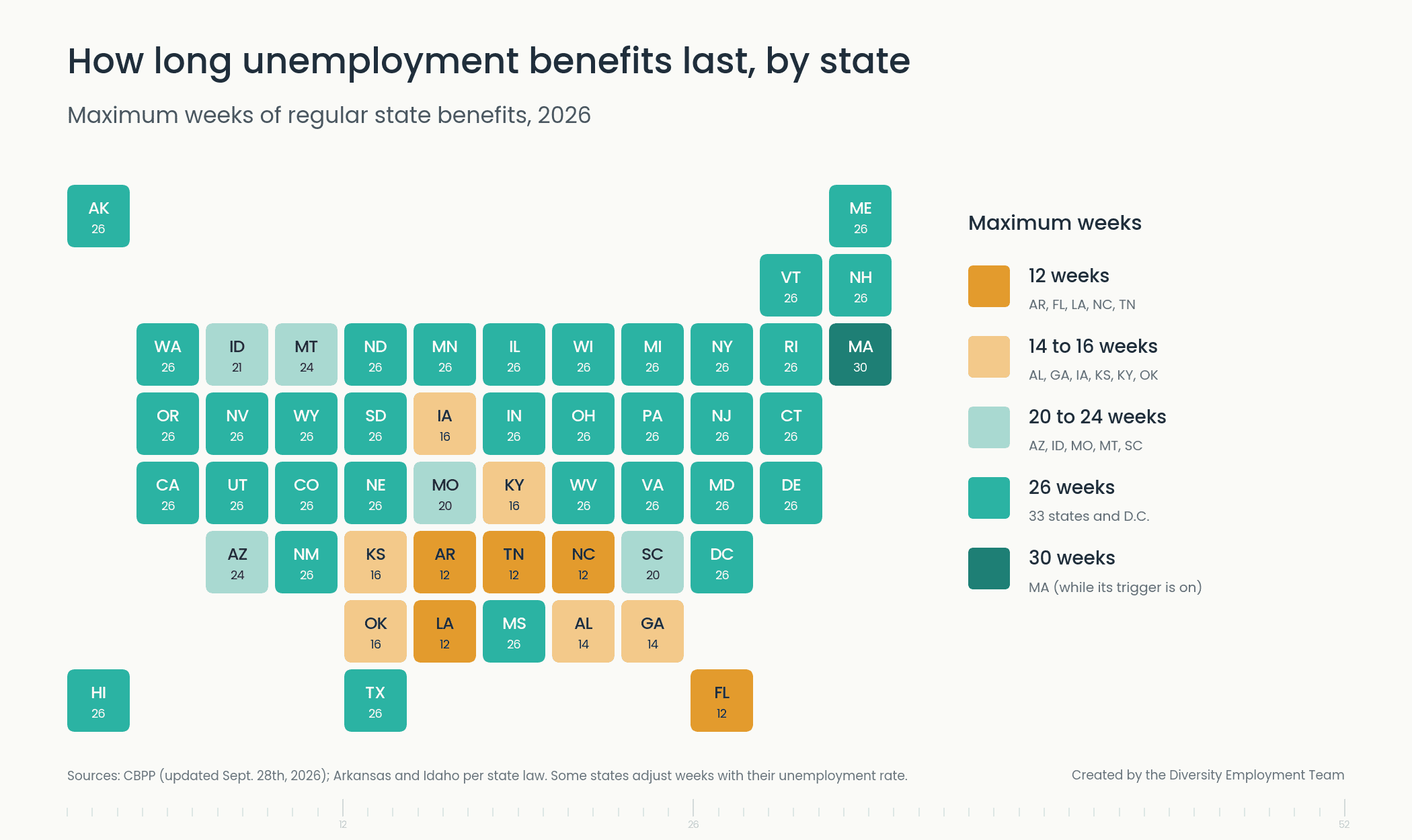
How long unemployment benefits last, and how much they pay, depends almost entirely on where you live. In five states, benefits stop at 12 weeks. In Massachusetts, they can run 30. The most a single claim can pay ranges from about $3,300 in Florida to more than $33,000 in Massachusetts.
The table below shows the rules for every state and Washington, D.C.: The maximum weeks, maximum weekly benefit, how much you can earn part time before your check shrinks, and more, with a link to each state’s unemployment agency.
How to Read This Table
- These are maximums. Your weekly amount and number of weeks depend on what you earned during your “base period,” which in most states is the first four of the last five completed calendar quarters. Most people collect less than the maximum.
- “Most a claim can pay” is our calculation. It’s the maximum weekly benefit times the maximum number of weeks. It leaves out the extra allowances some states pay for dependents.
- Some states move their numbers. States marked with an asterisk adjust their maximum weeks based on the state unemployment rate, so the number can change during the year.
- Your letter is the final word. After you file, your state sends a monetary determination showing your actual weekly amount, total balance, and weeks. Trust that over any table, including this one.
Unemployment Benefits by State, 2026
Scroll or swipe the table sideways to see every column.
| State | Max weeks | Max weekly benefit | Most a claim can pay | Part-time earnings allowed | Waiting week | Min. earnings to qualify | Share collecting (2025) | State agency |
|---|---|---|---|---|---|---|---|---|
| Alabama | 14* | $275 | $3,850 | 1/3 of weekly benefit | Yes | Total base period wages of at least 1.5 times high-quarter wages | 14.7% | File or learn more |
| Alaska | 26 | $370 | $9,620 | $50 and 1/4 of wages over $50 | Yes | $2,500 in the base period, in at least 2 quarters, with $250 outside the high quarter | 23.2% | File or learn more |
| Arizona | 24* | $320 | $7,680 | $160.49 | Yes | About $5,909 in the high quarter (390 times minimum wage) and 1.5 times high-quarter wages in total | 16.9% | File or learn more |
| Arkansas | 12 | $451 | $5,412 | 40% of weekly benefit | Yes | 35 times weekly benefit amount in base period, with wages in at least 2 quarters | 13.9% | File or learn more |
| California | 26 | $450 | $11,700 | Greater of $25 or 1/4 of wages | Yes | $1,300 in the highest quarter, or $900 in the highest quarter and total base wages of 1.25 times that | 38.5% | File or learn more |
| Colorado | 26 | $804 | $20,904 | 1/2 of weekly benefit | Yes | $2,500 in base period wages, or 40 times your weekly benefit amount if that is higher | 25.8% | File or learn more |
| Connecticut | 26 | $721 | $18,746 | 1/3 of wages | No | 40 times weekly benefit rate; minimum $1,760 in base period wages for 2026 | 40.4% | File or learn more |
| Delaware | 26 | $450 | $11,700 | Greater of $10 or 50% of weekly benefit | No | 36 times weekly benefit amount, and at least $720 in base period wages | 23.9% | File or learn more |
| District of Columbia | 26 | $444 | $11,544 | 1/3 of wages plus $50 | Yes | $1,300 in one quarter, $1,950 in two quarters, and total wages of 1.5 times the high quarter | 32.2% | File or learn more |
| Florida | 12* | $275 | $3,300 | 8 times the federal hourly minimum wage | Yes | 1.5 times high-quarter wages, and at least $3,400 in base period wages | 8.3% | File or learn more |
| Georgia | 14* | $365 | $5,110 | $50 | No | Wages in 2 quarters and 1.5 times high-quarter wages, or 40 times weekly benefit across 2 quarters | 17.0% | File or learn more |
| Hawaii | 26 | $868 | $22,568 | $150 | Yes | 26 times your weekly benefit amount, with wages in at least 2 quarters | 38.3% | File or learn more |
| Idaho | 21* | $624 | $13,104 | 1/2 of weekly benefit | Yes | $1,872 in highest quarter, and other base quarters total at least 25% of highest quarter | 20.4% | File or learn more |
| Illinois | 26 | $628 | $16,328 | 1/2 of weekly benefit | Yes | $1,600 in base period, with at least $440 outside the highest quarter | 37.1% | File or learn more |
| Indiana | 26 | $390 | $10,140 | $100 | Yes | $4,200 in base period, $2,500 of it in last 6 months, and total 1.5 times high quarter | 18.9% | File or learn more |
| Iowa | 16 | $644 | $10,304 | 25% of weekly benefit | No | $2,210 in one quarter and $1,110 in another, plus total 1.25 times high quarter | 22.2% | File or learn more |
| Kansas | 16* | $663 | $10,608 | 25% of weekly benefit | Yes | Wages in 2 quarters and total base period wages at least 30 times your weekly benefit amount | 13.5% | File or learn more |
| Kentucky | 16* | $720 | $11,520 | 1/5 of wages | Yes | 1.5 times high-quarter wages, 8 times weekly benefit in last 2 quarters, and $1,500 outside the high quarter | 12.4% | File or learn more |
| Louisiana | 12* | $282 | $3,384 | Lesser of 1/2 weekly benefit or $50 | Yes | $1,200 total in base period, and total at least 1.5 times high quarter | 11.9% | File or learn more |
| Maine | 26 | $649 | $16,874 | $128 | Yes | At least 2 times the state average weekly wage in each of 2 quarters, and 6 times it in total | 29.8% | File or learn more |
| Maryland | 26 | $430 | $11,180 | $50 or less | No | $1,176.01 in highest quarter and $1,800 across at least 2 quarters | 22.5% | File or learn more |
| Massachusetts | 30* | $1,105 | $33,150 | 1/3 of weekly benefit | Yes | $6,300 in base period and at least 30 times your weekly benefit amount | 44.4% | File or learn more |
| Michigan | 26 | $530 | $13,780 | Reduction formula; benefits plus earnings capped at 1.5 times weekly benefit | No | $5,328 in the high quarter and 1.5 times it in total; or 20 times the state average weekly wage | 25.5% | File or learn more |
| Minnesota | 26 | $611 | $15,886 | Weekly benefit reduced 50 cents per $1 earned | Yes | Wage credits of at least 5.3% of state average annual wage (rounded down to $100) | 49.9% | File or learn more |
| Mississippi | 26 | $235 | $6,110 | $40 | Yes | $780 in highest quarter, wages in 2 quarters, and 40 times weekly benefit amount in base period | 15.6% | File or learn more |
| Missouri | 20 | $320 | $6,400 | Greater of 20% of weekly benefit or $20 | Yes | $1,500 in one quarter and total base wages at least 1.5 times highest quarter | 17.3% | File or learn more |
| Montana | 24 | $767 | $18,408 | 1/4 of weekly benefit | Yes | 1.5 times high-quarter wages and 7% of the state average annual wage, or 50% of the state average annual wage | 38.4% | File or learn more |
| Nebraska | 26 | $582 | $15,132 | 1/4 of weekly benefit | Yes | 2026: $5,440 in base period, with $1,850 in one quarter and $800 in another | 18.1% | File or learn more |
| Nevada | 26 | $657 | $17,082 | 1/3 of wages | 1.5 times highest quarter wages, or wages in 3 of 4 quarters; at least $400 in highest quarter | 33.1% | File or learn more | |
| New Hampshire | 26 | $427 | $11,102 | 30% of weekly benefit | Yes | $2,800 in base period, with $1,400 earned in each of 2 quarters | 16.2% | File or learn more |
| New Jersey | 26 | $905 | $23,530 | Greater of 20% of weekly benefit or $5 | No | $310 a week for 20 or more weeks, or $15,500 total, in the base year (2026 claims) | 45.8% | File or learn more |
| New Mexico | 26 | $624 | $16,224 | 1/5 of weekly benefit | Yes | $2,818.70 in the high quarter and wages in at least 1 other quarter | 26.3% | File or learn more |
| New York | 26 | $869 | $22,594 | Up to 10 hours of work if earnings at or below maximum weekly benefit | Yes | $3,500 in one quarter, wages in 2 or more quarters, and total at least 1.5 times high quarter (2026 claims) | 41.1% | File or learn more |
| North Carolina | 12* | $350 | $4,200 | 20% of weekly benefit | Yes | Wages in 2 or more base period quarters, totaling at least 6 times the state average weekly insured wage | 12.6% | File or learn more |
| North Dakota | 26 | $815 | $21,190 | 60% of weekly benefit | Yes | Wages in 2+ base period quarters totaling 1.5 times the high quarter, and a weekly benefit of at least $43 | 34.4% | File or learn more |
| Ohio | 26 | $624 | $16,224 | 1/5 of weekly benefit | Yes | 20 weeks of covered work averaging at least 27.5% of the statewide average weekly wage | 20.3% | File or learn more |
| Oklahoma | 16* | $649 | $10,384 | $100 | Yes | $1,500 in taxable base period wages, and total wages at least 1.5 times the high quarter | 17.4% | File or learn more |
| Oregon | 26 | $902 | $23,452 | Greater of 1/3 weekly benefit or $168 | Yes | $1,000 in base year and total at least 1.5 times high quarter, or 500 hours worked in base year | 34.4% | File or learn more |
| Pennsylvania | 26 | $605 | $15,730 | Greater of $21 or 30% of weekly benefit | Yes | 18 credit weeks, $1,688 in the high quarter, $2,718 in the base year, and 37% of wages outside that quarter | 38.0% | File or learn more |
| Rhode Island | 26 | $777 | $20,202 | 1/2 of weekly benefit | Yes | $3,200 in one quarter and $6,400 in the base period, with 1.5 times high quarter; or $19,200 in total | 45.1% | File or learn more |
| South Carolina | 20 | $350 | $7,000 | 1/4 of weekly benefit | Yes | $4,455 in base period, $1,092 in highest quarter, and 1.5 times high-quarter wages | 14.6% | File or learn more |
| South Dakota | 26 | $575 | $14,950 | 1/4 of wages over $25 | Yes | $728 in highest quarter, and base period wages outside it of at least 20 times weekly benefit | 19.6% | File or learn more |
| Tennessee | 12* | $325 | $3,900 | Greater of $50 or 25% of weekly benefit | Yes | 40 times weekly benefit total; $780.01 average in top 2 quarters; and wages outside the high quarter | 15.3% | File or learn more |
| Texas | 26 | $605 | $15,730 | Greater of $5 or 1/4 of weekly benefit | Yes | Wages in 2+ base period quarters and total base period wages at least 37 times weekly benefit | 25.8% | File or learn more |
| Utah | 26 | $806 | $20,956 | 30% of weekly benefit | Yes | $5,500 in base period, wages in 2+ quarters, and 1.5 times high-quarter wages | 23.1% | File or learn more |
| Vermont | 26 | $751 | $19,526 | 50% of gross wages | No | $3,832 in the high quarter and total wages of 1.4 times the high quarter | 33.2% | File or learn more |
| Virginia | 26 | $478 | $12,428 | $100 | Yes | $3,000 combined in the two highest base period quarters, earned in at least two quarters | 15.8% | File or learn more |
| Washington | 26 | $1,208 | $31,408 | 1/4 of wages over $5 | Yes | 680 hours worked in the base year (no dollar minimum) | 38.9% | File or learn more |
| West Virginia | 26 | $662 | $17,212 | $60 | Yes | $2,200 in base period, with wages in more than one quarter | 24.4% | File or learn more |
| Wisconsin | 26 | $370 | $9,620 | $30 + 33% of wages over $30 | Yes | More than $1,350 in the high quarter, 4 times weekly benefit outside it, and 35 times weekly benefit total | 27.9% | File or learn more |
| Wyoming | 26 | $671 | $17,446 | 50% of weekly benefit | No | Wages in 2 or more quarters, 1.4 times high-quarter wages, and at least 8% of the state average annual wage | 23.2% | File or learn more |
* This state adjusts its maximum weeks based on the state unemployment rate, so the number can change during the year.
Idaho: Idaho resets its maximum weeks each quarter. 21 weeks applies to benefit weeks starting October through December 2026.
Massachusetts: 30 weeks applies while the state’s high-unemployment trigger is on. Otherwise the maximum is 26 weeks.
Left blank because we could not confirm the waiting-week rule from the state’s law or agency guidance: Nevada.
Compiled by Diversity Employment. Current as of October 21st, 2026. Maximum weekly benefits, benefit-week ranges, and part-time earnings rules come from the U.S. Department of Labor’s Significant Provisions of State Unemployment Insurance Laws (July 2026). Maximum weeks come from the Center on Budget and Policy Priorities (updated September 28th, 2026), with Arkansas set to 12 weeks and Idaho set to 21 weeks based on each state’s law. Waiting-week, qualifying-earnings, and agency information comes from each state’s statutes and agency pages. Share collecting is the U.S. Department of Labor’s 2025 recipiency rate. “Most a claim can pay” is our calculation (maximum weekly benefit times maximum weeks) and excludes dependent allowances. Most people receive less, since benefits depend on your earnings history. Always confirm with your state agency.
Frequently Asked Questions
Don’t all states pay 26 weeks of unemployment?
No. 26 weeks is the most common maximum, but 16 states offer fewer, and Massachusetts currently offers more. In most states, the number of weeks you actually get also depends on your earnings history, so even in a 26-week state, you might qualify for less.
Should I file even if I’m not sure I qualify?
Yes. Only your state can decide whether you qualify, and research from the Federal Reserve Bank of Minneapolis found that many people who don’t apply simply assume they aren’t eligible. Filing early matters too, since benefits generally aren’t paid for weeks before you file.
What is a waiting week?
Some states don’t pay for your first eligible week of unemployment. You still file and meet the requirements that week, you just aren’t paid for it. The table shows which states have one.
Can I work part time and still collect?
Usually, yes. Most states pay a partial benefit when you work part time, as long as you report your earnings every week. Each state sets how much you can earn before your check gets smaller.
In most states, your benefits work like a total balance you can draw on during a 52-week benefit year. So a week with a smaller partial payment can leave more of that balance for later.
What happens when my benefits run out?
There’s no automatic federal extension. The federal-state Extended Benefits program only switches on when a state’s unemployment rate crosses certain triggers, and as of October 2026, it isn’t active in any state.
Other help has its own rules. That includes job search and training help through local American Job Centers, food assistance through SNAP, and marketplace health coverage. We walk through all of it, week by week, in our guide to the long job search.
Why is my benefit lower than the maximum?
The maximum weekly benefit only applies to people who earned enough during their base period to hit the cap. Most states calculate your weekly amount from your highest-earning quarter or your total base-period wages, then cap it at the state maximum. Lower or uneven earnings mean a lower weekly amount, and in many states, fewer weeks.
How current is this information?
This page reflects state rules as of October 21st, 2026. Unemployment rules are set by state legislatures and can change, so always confirm with your state’s unemployment agency before making decisions. You’ll find a link to each state’s agency in the table.