

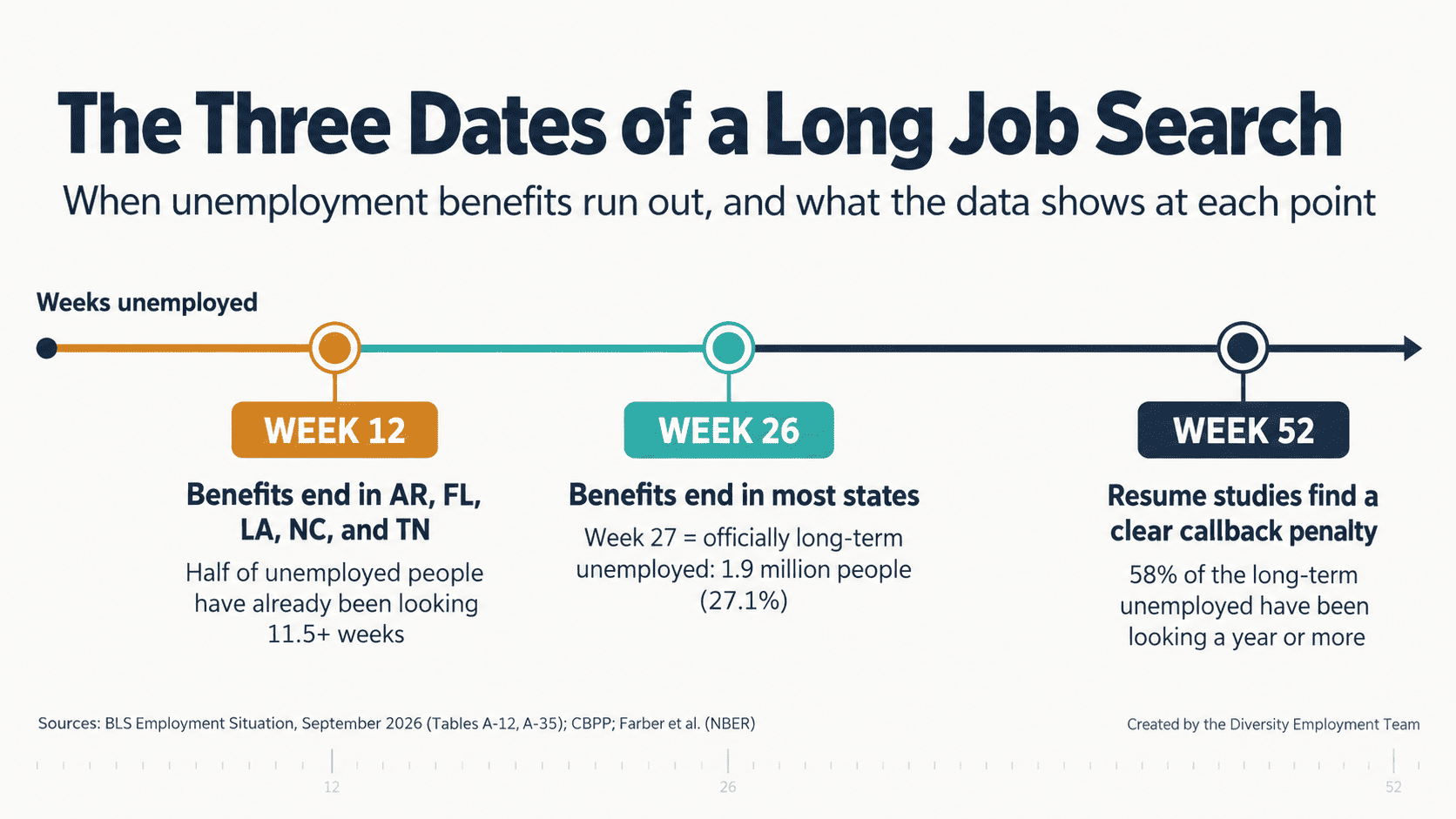
Half of the people who are unemployed right now have already been looking for at least 11.5 weeks. And in five states, unemployment benefits stop at 12 weeks.
Those two numbers come from different places. The first is from the September 2026 jobs report. The second is written into state law in Arkansas, Florida, Louisiana, North Carolina, and Tennessee. Put them side by side, though, and a lot of people are probably running out of benefits right around the halfway point of a typical search.
Three Dates, Not One
The headline numbers look calm. Employers added 29,000 jobs in September and the unemployment rate sat at 4.2%, according to the Bureau of Labor Statistics. Underneath that, 1.9 million people had been looking for work for 27 weeks or longer. That’s 27.1% of everyone unemployed.
Outside of the pandemic years, that share hasn’t been this high since early 2016, based on BLS historical data. And it’s not just people at the six-month mark. 1.12 million of them, or about 58% of the long-term unemployed, had been searching for a year or more, per BLS Table A-35 (not seasonally adjusted).
Most coverage of unemployment talks about one deadline: week 26, when benefits end in most states. A long search actually has three dates worth knowing:
- Week 12: Benefits end in the shortest states, right around when the typical search is still going.
- Week 26: Benefits end for most people. One week later, you’re officially “long-term unemployed.”
- Week 52: The point where research shows employers really start treating time out of work as a red flag, and where the majority of long-term job seekers are now sitting.
Find Your Three Dates
Before anything else, it really helps to know where your own clock stands. Your state, your work history, and your health coverage all set different deadlines, and none of them come with a reminder.
Your Benefit Clock
After you file, most states mail or post a monetary determination. It’s the letter that shows your weekly benefit amount, the total you can collect, and how many weeks that covers. Arkansas’s 2026 claimant handbook describes it that way, and most states work similarly.
Your number might be smaller than your state’s maximum. Most states set each person’s weeks on a sliding scale tied to their earnings history. Only nine jurisdictions give everyone a flat 26 weeks, according to the Richmond Fed.
Your Balance, Not Just Your Weeks
Here’s something that doesn’t get explained much. In most states, what you actually have is a total dollar amount, and you can draw it down during a 52-week “benefit year.” Weeks don’t have to be back to back.
That matters because a week of part-time work usually means a smaller partial payment that week, which leaves more of your balance for later. So the “week 26” cliff can move, depending on what you do in the meantime. More on that below.
Your Coverage Deadline
Losing job-based health insurance opens a special enrollment window for marketplace coverage, and COBRA has its own election deadline. Both windows are short, usually around 60 days, so check the dates on your paperwork early.
Timing also matters this time of year. Open enrollment for 2027 marketplace coverage starts November 1st, 2026. End dates vary by state, so it’s worth checking your state’s marketplace. In most states, signing up by December 15th gets coverage starting January 1st.
Write These Down Today
- Write down your state’s maximum weeks (the table further down has every state).
- Write down your weekly benefit amount and your total balance from your determination letter.
- Write down the date your benefit year ends.
- Write down your health coverage deadline.
- Write down the date your savings runs out at your current spending.
That last one is uncomfortable, but it’s probably the most useful. In the Federal Reserve’s 2025 household survey, 55% of adults said they had three months of expenses set aside. 30% said they couldn’t cover three months by any means, including borrowing or selling things.
Three months is roughly 13 weeks. For a lot of people, the savings date and the week 12 date are pretty much the same date.
Two Reports, Same People
Every month, the jobs report counts the unemployed. Every week, the Labor Department counts people collecting unemployment benefits. They describe the same group of people, but the two numbers almost never get compared.
Who Counts as Unemployed
To be counted as unemployed in the jobs report, you have to be without work, available, and actively looking. Whether you get benefits has nothing to do with it, as BLS spells out in the release itself.
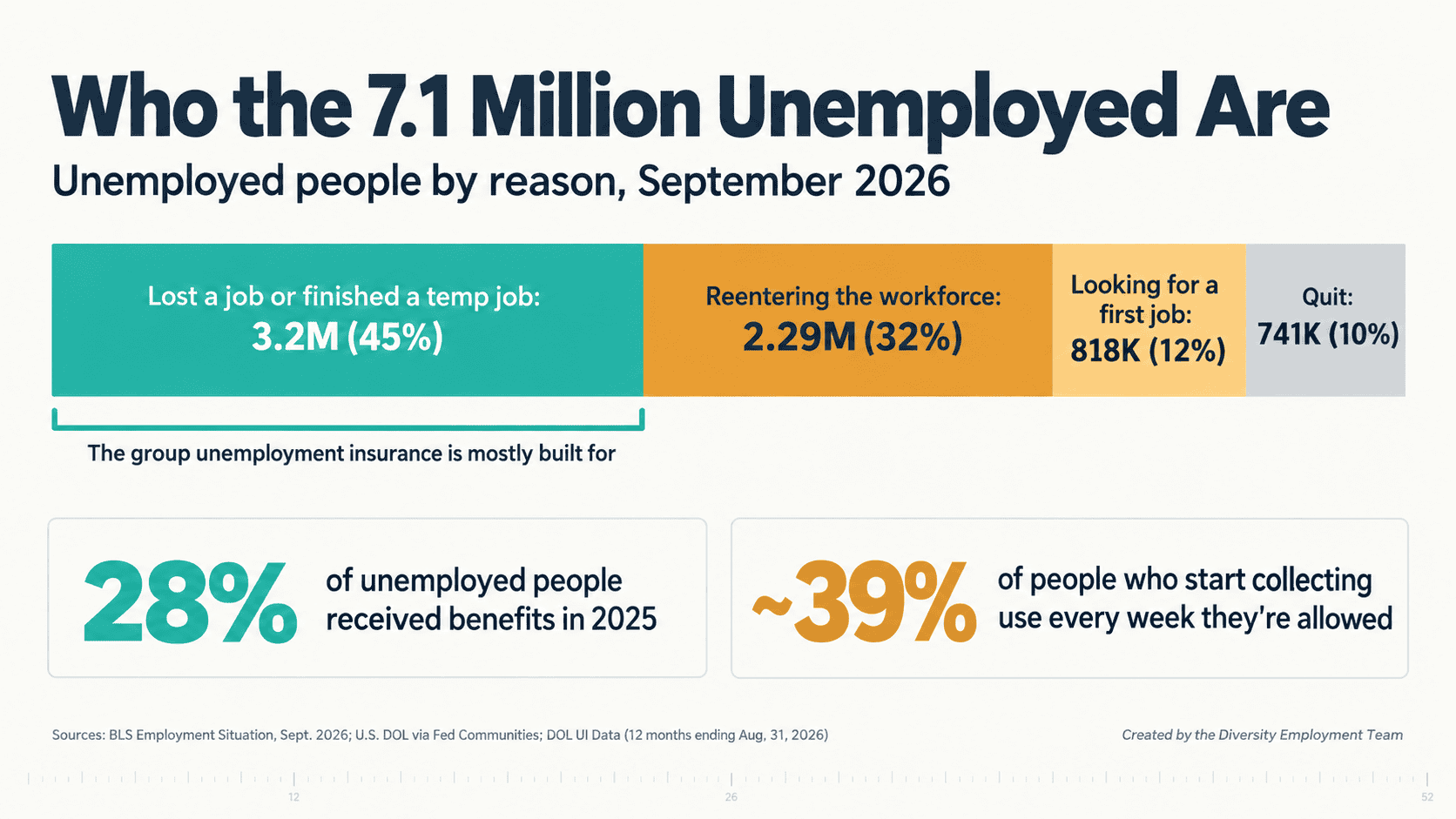
The same report breaks down why people are unemployed, and it’s pretty revealing. Of the 7.1 million unemployed in September:
- 3.2 million lost a job or finished a temporary one.
- 2.29 million were reentering the workforce, often after time off for school, caregiving, or health.
- 818,000 were looking for their very first job.
- 741,000 had quit.
Unemployment insurance is built mostly for that first group. Which means only about 45% of the unemployed fit the basic profile the system was designed around, before any other rule even comes into play.
Reentrants are the group that probably gets overlooked the most. Someone who stepped away to care for a parent or a child usually doesn’t have recent enough wages to qualify, even though they’re counted as unemployed. We dug into how workplace policy treats caregivers in The Caregivers Your Policy Doesn’t Cover.
Who Actually Collects
Nationally, only 28% of unemployed people received unemployment benefits in 2025, according to the Labor Department’s recipiency data. That ranged from about 50% in Minnesota to just 8% in Florida. Our state-by-state table has the rate for every state.
Part of that is eligibility. A Minneapolis Fed working paper roughly estimated that about 46% of the unemployed were eligible in 2024. So a big slice of people who could collect, simply don’t.
The same paper looked at why. Among people who’d recently worked but didn’t apply, nearly two-thirds believed they weren’t eligible. Some of them were probably right. Some probably weren’t. Among the rest:
- 25% expected to be back at work soon.
- 20% had a negative view of the program, didn’t think they needed it, or didn’t want the hassle.
- 9% didn’t know about it, didn’t know how to file, or didn’t finish the application.
The hassle part is real, too. When Minneapolis Fed researchers called state agencies, it took more than 30 minutes to reach a person in 26 states, or they couldn’t reach one at all. 20 states offered their application only in English, per Fed Communities.
People Who Do Collect Unemployment Often Use It All
Over the 12 months ending August 31st, 2026, about 39% of people who started collecting unemployment ended up using every week they were allowed, according to the Labor Department’s UI data dashboard. The average weekly check was $493.
The Richmond Fed found the share of people leaving the rolls because they ran out of benefits, rather than finding a job, more than doubled, from 3.3% of exits in 2022 to 7.3% over the year through June 2026. Their summary is about as clear as it gets: it’s become less likely to lose a job, but more costly if it happens.
Where You Live Sets the Clock
Unemployment insurance is a federal-state program, but states write almost all of the rules. That includes who qualifies, how much they get, and for how long. Those rules are set by state legislatures and debated pretty often, so the most useful thing here is just to know what yours are right now.
Anywhere From 12 Weeks to 30
Most states offer up to 26 weeks. 16 states offer fewer, and one offers more, according to the Center on Budget and Policy Priorities‘ September 28th, 2026 tracker:
- 12 weeks: Arkansas, Florida, Louisiana, North Carolina, Tennessee
- 14 weeks: Alabama, Georgia
- 16 weeks: Iowa, Kansas, Kentucky, Oklahoma
- 20 weeks: Missouri, South Carolina
- 21 weeks: Idaho
- 24 weeks: Arizona, Montana
- 30 weeks: Massachusetts (normally 26, but higher right now because of unemployment in some of its metro areas)
Several of these states tie their maximum to the state unemployment rate, so the number can move. Arkansas confirms its 12-week limit in its own 2026 handbook.
In the 12-week states, nearly half of everyone leaving the benefit rolls is leaving because their benefits ran out, the Richmond Fed found.
The $3,300 to $33,150 Spread
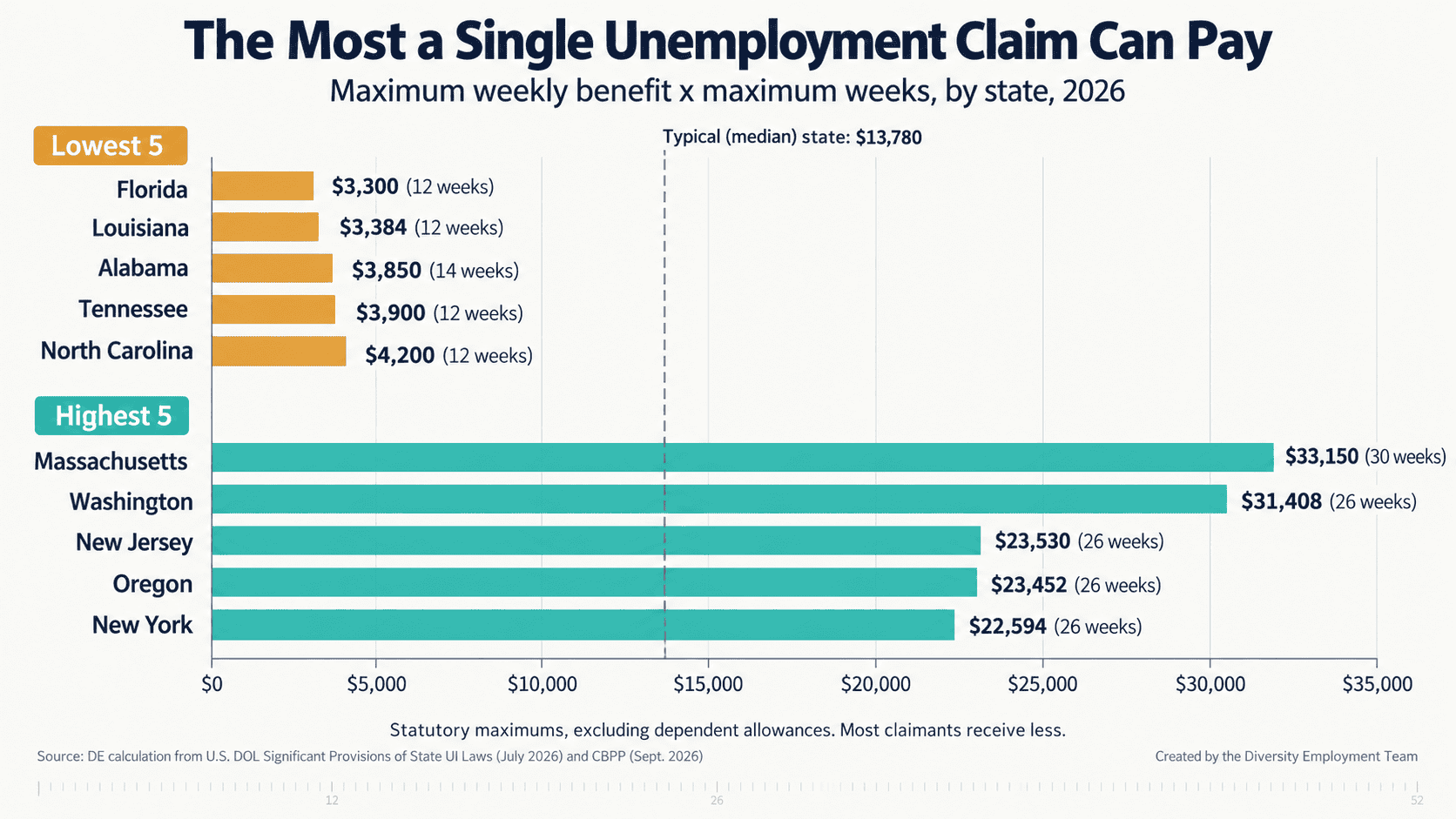
Weeks are only half of it. Each state also caps the weekly check. We multiplied each state’s maximum weekly benefit by its maximum weeks to get the most a single claim can possibly pay. We used the Labor Department’s July 2026 state law summary and CBPP’s current weeks.
The results really vary:
- Florida: $275 a week for up to 12 weeks, or $3,300 total.
- Louisiana: $282 for 12 weeks, or $3,384.
- Massachusetts: $1,105 for 30 weeks, or $33,150.
- Washington: $1,208 for 26 weeks, or $31,408.
The typical state lands around $13,780. Keep in mind these are ceilings. Most people collect less, and the average weekly check nationally was $493.
The Rules That Shrink Benefits Before They Start
Some of the biggest differences happen before you ever collect a dollar:
- How much you had to earn. In 2023, Hawaii required just $130 in base-period wages to qualify, while Arizona required $8,103, per research cited by the Minneapolis Fed. That hits part-time and lower-wage workers hardest.
- Whether caregiving counts as a good reason to quit. Minnesota and Wisconsin recognize leaving a job for family obligations. Michigan, Montana, North Dakota, and South Dakota don’t, according to the Minneapolis Fed.
- Whether you can search only for part-time work. Some states allow it, some only with a part-time work history, and some don’t allow it at all.
The same Minneapolis Fed research notes that Black workers are more likely to live in states with stricter eligibility rules, which is part of why receipt of benefits differs by race. Geography, in other words, ends up doing a lot of sorting.
Every State, Side by Side
The table below shows the maximums for every state. Your own numbers will probably vary, since they depend on your earnings, so treat your determination letter as the final word. You can find your state’s agency through unemployment.gov.
For the full rules in every state, including how much you can earn part time, which states have a waiting week, how much you need to have earned to qualify, and a link to file, see our unemployment benefits by state guide.
| State | Max weeks | Max weekly benefit | Most a claim can pay |
|---|---|---|---|
| Alabama | 14* | $275 | $3,850 |
| Alaska | 26 | $370 | $9,620 |
| Arizona | 24* | $320 | $7,680 |
| Arkansas | 12 | $451 | $5,412 |
| California | 26 | $450 | $11,700 |
| Colorado | 26 | $804 | $20,904 |
| Connecticut | 26 | $721 | $18,746 |
| Delaware | 26 | $450 | $11,700 |
| District of Columbia | 26 | $444 | $11,544 |
| Florida | 12* | $275 | $3,300 |
| Georgia | 14* | $365 | $5,110 |
| Hawaii | 26 | $868 | $22,568 |
| Idaho | 21* | $624 | $13,104 |
| Illinois | 26 | $628 | $16,328 |
| Indiana | 26 | $390 | $10,140 |
| Iowa | 16 | $644 | $10,304 |
| Kansas | 16* | $663 | $10,608 |
| Kentucky | 16* | $720 | $11,520 |
| Louisiana | 12* | $282 | $3,384 |
| Maine | 26 | $649 | $16,874 |
| Maryland | 26 | $430 | $11,180 |
| Massachusetts | 30* | $1,105 | $33,150 |
| Michigan | 26 | $530 | $13,780 |
| Minnesota | 26 | $611 | $15,886 |
| Mississippi | 26 | $235 | $6,110 |
| Missouri | 20 | $320 | $6,400 |
| Montana | 24 | $767 | $18,408 |
| Nebraska | 26 | $582 | $15,132 |
| Nevada | 26 | $657 | $17,082 |
| New Hampshire | 26 | $427 | $11,102 |
| New Jersey | 26 | $905 | $23,530 |
| New Mexico | 26 | $624 | $16,224 |
| New York | 26 | $869 | $22,594 |
| North Carolina | 12* | $350 | $4,200 |
| North Dakota | 26 | $815 | $21,190 |
| Ohio | 26 | $624 | $16,224 |
| Oklahoma | 16* | $649 | $10,384 |
| Oregon | 26 | $902 | $23,452 |
| Pennsylvania | 26 | $605 | $15,730 |
| Rhode Island | 26 | $777 | $20,202 |
| South Carolina | 20 | $350 | $7,000 |
| South Dakota | 26 | $575 | $14,950 |
| Tennessee | 12* | $325 | $3,900 |
| Texas | 26 | $605 | $15,730 |
| Utah | 26 | $806 | $20,956 |
| Vermont | 26 | $751 | $19,526 |
| Virginia | 26 | $478 | $12,428 |
| Washington | 26 | $1,208 | $31,408 |
| West Virginia | 26 | $662 | $17,212 |
| Wisconsin | 26 | $370 | $9,620 |
| Wyoming | 26 | $671 | $17,446 |
* This state adjusts its maximum weeks based on the state unemployment rate, so the number can change during the year.
Idaho: Idaho resets its maximum weeks each quarter. 21 weeks applies to benefit weeks starting October through December 2026.
Massachusetts: 30 weeks applies while the state’s high-unemployment trigger is on. Otherwise the maximum is 26 weeks.
Sources: U.S. Department of Labor, Significant Provisions of State Unemployment Insurance Laws (July 2026), and the Center on Budget and Policy Priorities (updated September 28th, 2026). Current as of October 21st, 2026.
Unemployment Weeks 1 to 12
The first few weeks are where small decisions end up mattering the most later.
File This Week
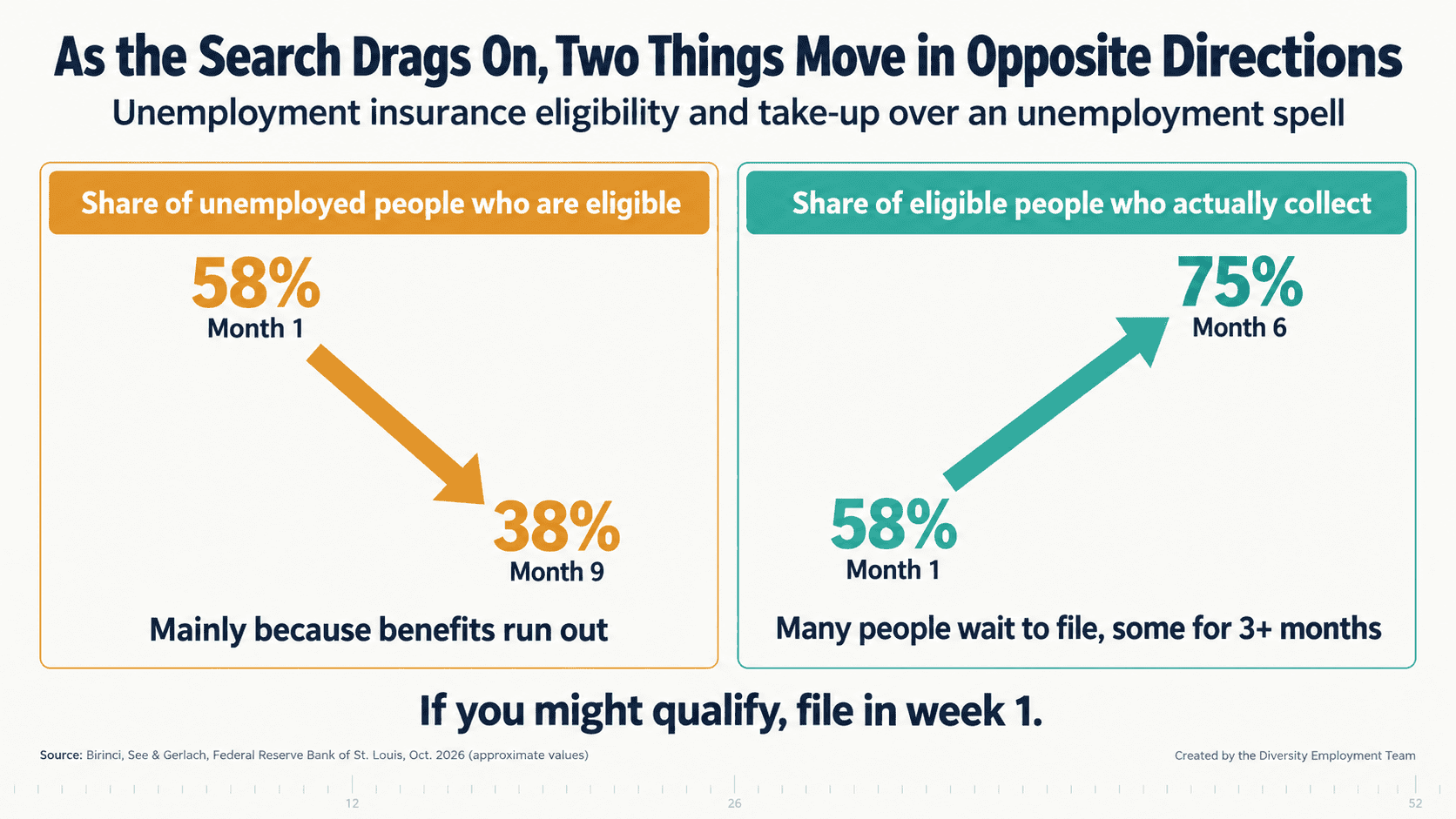
If there’s any chance you qualify, file now and let the state decide. In general, waiting doesn’t help you. A St. Louis Fed analysis found only about 58% of eligible people take up benefits in their first month of unemployment. That climbs to about 75% by month six, and some people wait more than three months to start.
A couple of things to know going in:
- Some states don’t pay your first week. Arkansas, for one, treats your first eligible week as an unpaid “waiting week.”
- Report severance. Severance, pay in lieu of notice, and vacation payouts can delay or reduce benefits depending on your state. Report them anyway. Not reporting is what creates problems.
- Set aside something for taxes. Unemployment benefits are taxable income. Most states let you withhold 10% for federal taxes.
If You’re Denied
Appeal, and do it quickly. Deadlines are short. Arkansas gives you 20 days from the date on the decision letter. Keep filing your weekly claims while the appeal is pending, so you don’t lose those weeks if you win.
It’s also worth knowing that employers can contest claims, and research cited by the Minneapolis Fed found employers with stronger tax incentives contest them more often. A denial isn’t necessarily the last word on whether you qualify.
Widen the Search Early
The market itself is part of why searches run long. There’s about one job opening for every unemployed person, and employers made 5.2 million hires in August against 7.1 million openings, per the latest JOLTS report. LinkedIn says applicants per open role have doubled since the spring of 2022. We looked at why so many applications go nowhere in The Hiring Funnel Is Full.
One of the better-tested fixes is surprisingly simple. In an experiment by economists Michèle Belot, Philipp Kircher, and Paul Muller, published in the Review of Economic Studies, jobseekers who were shown related occupations they hadn’t considered got more interviews. The effect was biggest for people who’d been searching narrowly and had already been unemployed for a few months.
At Diversity Employment, we see the same thing in how people search: a lot of them look for the exact title they just left. Try listing two or three neighboring job titles that use the same skills, and search those too.
When the Savings Runs Out
Build your budget around your total benefit balance, not the weekly check. Then compare it to the savings date you wrote down earlier.
Be careful with retirement accounts. The Fed’s survey found 9% of laid-off adults (who weren’t retired) had cashed out retirement money in the past year, compared with 4% of everyone else. Sometimes that’s simply necessary. Just know the taxes and penalties can take a real bite before you do it.
Weeks 13 to 26
This stretch is where most people start weighing tradeoffs. If you live in a 12-week state, everything in this section probably applies to you a lot sooner.
The Bridge-Job Math
Most states let you keep collecting a partial benefit while you work part time. Each state decides how much you can earn before your check gets smaller, per the Labor Department’s summary:
- Alabama: one-third of your weekly benefit
- Arkansas: 40% of your weekly benefit
- Florida: eight times the federal minimum wage
- Washington: one-quarter of what you earn over $5
Because your benefits are a balance, a smaller partial payment leaves more for later. A bridge job can actually stretch your runway instead of ending it. Just report every dollar you earn, every week.
Gig and contract work is different. It generally isn’t covered by unemployment insurance, so it won’t build toward a future claim the way a regular part-time job usually does. We broke down the tradeoffs in Gig Jobs: Flexible Options, Real Income, and Who They’re For.
How a Bridge Job Reads on a Resume
Here’s where it gets complicated. In a resume experiment by Henry Farber and colleagues, published as an NBER working paper, applicants who were currently working an interim job got fewer callbacks than unemployed applicants. That held whether the interim job was a step down or comparable.
That doesn’t mean skip the paycheck. It probably means thinking about how you present it. An unrelated stopgap job may not need top billing on a resume aimed at your field. A short line explaining the time is often enough.
Training Before the Clock Runs Out
Training can do two things at once: build a skill and, in some states, protect your benefits. Alabama, for example, adds five weeks for people in a state-approved training program, according to CBPP. Many states also relax the weekly job-search requirement during approved training. Check with your state before you enroll.
There are a few places to look:
- Dislocated worker programs. Run through local American Job Centers, these federal programs help laid-off workers with job search and can help pay for training. You can find a center through CareerOneStop.
- Workforce Pell. Since July 1st, 2026, Pell Grants can cover short training programs that run 8 to 15 weeks. States are rolling out approved program lists at different speeds, so availability depends on where you live.
- Employer-paid training. Less of it exists than there used to be, which we looked at in Nobody Wants to Train the Next Generation of Experienced Workers. That pushes more of the job onto you, which is why the public options matter.
Week 27 and the Callback Question
The fear most people have at this point is pretty simple: “Is the time out of work itself starting to hurt me?” The research says the answer is mixed, and the details are actually useful.
What the Resume Studies Found
In a large resume experiment, economists Kory Kroft, Fabian Lange, and Matthew Notowidigdo found callback rates drop as unemployment gets longer, with most of the drop happening in the first eight months, per the study. After that, extra time didn’t keep pushing callbacks down.
The effect was also stronger in tight job markets. When jobs are plentiful, employers read a long spell as a signal. When jobs are scarce, they seem to understand that a long search might just be the market.
The Farber study found something a little different. It found no link between spell length and callbacks for shorter spells, but a clear penalty at 52 weeks. Put together, the time between month six and month twelve looks like the window to push hardest.
Mostly Bad Luck, Statistically
When Alan Krueger and his Princeton colleagues studied the long-term unemployed after the Great Recession, they described them, in a Brookings paper, as essentially an unlucky subset of the short-term unemployed. Their finding was also sobering: only 11% of people who were long-term unemployed in a given month were in steady, full-time work a year later. That’s 2008 to 2012 data, so it’s a warning more than a forecast.
Today’s slowdown is hitting everyone, too. The Richmond Fed found the weekly rate of claimants leaving for a job fell from 9.1% in 2022 to 6.8% over the year through June 2026. If you’re still searching, it’s very likely not just you.
Age Isn’t the Whole Story Anymore
Older workers are usually assumed to have the longest searches. Right now, the numbers are closer than that. In September, 28.3% of jobseekers ages 16 to 54 were long-term unemployed, compared with 28.1% of those 55 and older, per AARP’s monthly data digest.
In full-year 2025 numbers from BLS, the 45-to-54 age group had the highest long-term share of any working-age group, at about 29%. People 65 and older had the longest average search, at 31.4 weeks. Black jobseekers also faced longer searches, with about 29% long-term unemployed, compared with about 21% of white jobseekers.
For people 55 and up, the bigger story may be who stops looking. The labor force participation rate for that group dipped from 37.2% to 36.9% in September, per AARP. And the Farber research found callbacks follow a hump shape by age, lower for both the youngest and oldest applicants.
When an Offer Finally Comes
After a long search, it’s tempting to take the first number offered. Before you say yes, it’s worth reading the offer as carefully as you read the posting. We walked through how in How to Read a Salary Range Like You Wrote It.
And if a new job turns out to be a step down, it doesn’t have to stay one. We covered how to spot when you’re stuck, and what to do about it, in How Do You Know If Your Career Has Stalled?
After the Benefits Stop
When regular benefits end, what’s left depends mostly on federal programs. A few of them changed in the past year.
No Extension Comes by Default
There’s a federal-state Extended Benefits program, but it only switches on when a state’s unemployment rate crosses certain triggers. As of September 28th, 2026, it isn’t on in any state, per CBPP. During past recessions, Congress passed temporary extensions, but those take separate legislation.
SNAP’s New Time Limit
SNAP (food assistance) has a time limit for adults without dependents. Under the 2025 federal law, that rule now covers adults ages 18 to 64, up from 54. People it applies to need to work, volunteer, or join a work program for 80 hours a month to keep SNAP beyond three months in a three-year period, as South Carolina’s Department of Social Services explains. Parents whose youngest child is 14 or older are now included too.
Two practical points: approved training and work programs can count toward the 80 hours, and there are still exemptions. If you’re 55 to 64 and out of work, it’s worth asking your state SNAP office what counts before the three months run out.
Health Coverage
The enhanced marketplace tax credits expired at the end of 2025. For people keeping the same plan, what they pay after tax credits went up 114% on average, according to KFF.
Your income for the year still matters a lot, though. A year with a long stretch of unemployment usually means lower income, which can mean bigger tax credits, or Medicaid in some states. Unemployment benefits count as income. With 2027 open enrollment starting November 1st, it’s a good time to run your numbers.
One catch to know about: starting with 2026 taxes, there’s no longer a cap on how much of your tax credit you may have to pay back if your income ends up higher than you estimated, as Georgetown’s Center on Health Insurance Reforms notes. If you land a job partway through the year, update your income with the marketplace right away so the difference doesn’t show up as a tax bill.
Week 52
About one in six unemployed people has now been looking for a year or more. At the one-year mark, your benefit year ends too. In general, starting a new claim requires new wages in a new base period, which is another reason part-time work during the year can matter. Check your state’s rules before you count on it.
If You’re Supporting Someone
If someone close to you is deep into a search, the three dates above are probably the most useful thing you can help with. Sit down with them and find the actual numbers: weeks left, balance left, coverage deadline, savings date.
A few other things tend to help:
- Offer specific introductions. “I know someone at a company in your field” is worth more than a general “let me know if I can help.”
- Help widen the search. You might notice job titles that fit their skills better than they do.
- Keep the money conversation practical. Ask about the dates, not about how the search is going every time you see them.
Also, watch for someone who quietly stops looking. 5.8 million people want a job but aren’t counted as unemployed because they haven’t searched recently, per BLS. Once someone stops looking, they drop out of the unemployment numbers, and often out of the support systems built around them.
What Comes Next
A long search has a calendar, and most people never get shown it. Your state decides when the first deadline hits, sometimes as early as week 12. Your benefits are a balance you can stretch, not just a clock. The callback research suggests the hardest stretch is between months six and twelve. And with exits slowing for everyone, a long search says more about the market than about the person doing it.
Which brings it back to the dates. Knowing yours probably won’t make the search shorter. It just keeps any of them from showing up as a surprise.
November 6th
This article reflects data available as of October 21st, 2026. The next jobs report, covering October, comes out Friday, November 6th, at 8:30 a.m. Eastern on the Bureau of Labor Statistics website, under “The Employment Situation.” Table A-12 has the long-term numbers and the median search length.
One quirk to watch for: there won’t be an October 2025 number to compare against. That month’s data was never collected because of the federal government shutdown.