

Somewhere in the country this week, someone is submitting their 200th job application. No callbacks. No rejection emails. Just silence, which they’ve learned to take as its own answer by now.
Somewhere else, maybe in the same city, a hiring manager is looking at 300 resumes for one opening and telling anyone who’ll listen that they can’t find anyone qualified.
Both Are Telling the Truth
That’s the part most coverage of the job market gets wrong. It treats “job hunting is brutal right now” and “we can’t find good people” as competing complaints. Which is evidence that one side must be exaggerating. But, they’re not competing at all. They’re actually the same problem wearing two masks, and each side’s attempt to fix its own half has made the whole thing worse for everyone.
At Diversity Employment, we see that applications are up. Actual hiring is down. Trust, on both sides of the table, has fallen off a cliff. And with a strange twist, companies that spent the last decade digitizing their hiring process are bringing back in-person interviews, because they’ve stopped trusting anything else to tell them who they’re actually talking to.
The Hiring Feedback Loop
There are specific parts to the feedback loop that’s making hiring slower, noisier, and less trustworthy. Once you see them laid out, it becomes pretty easy to understand why the loop keeps looping:
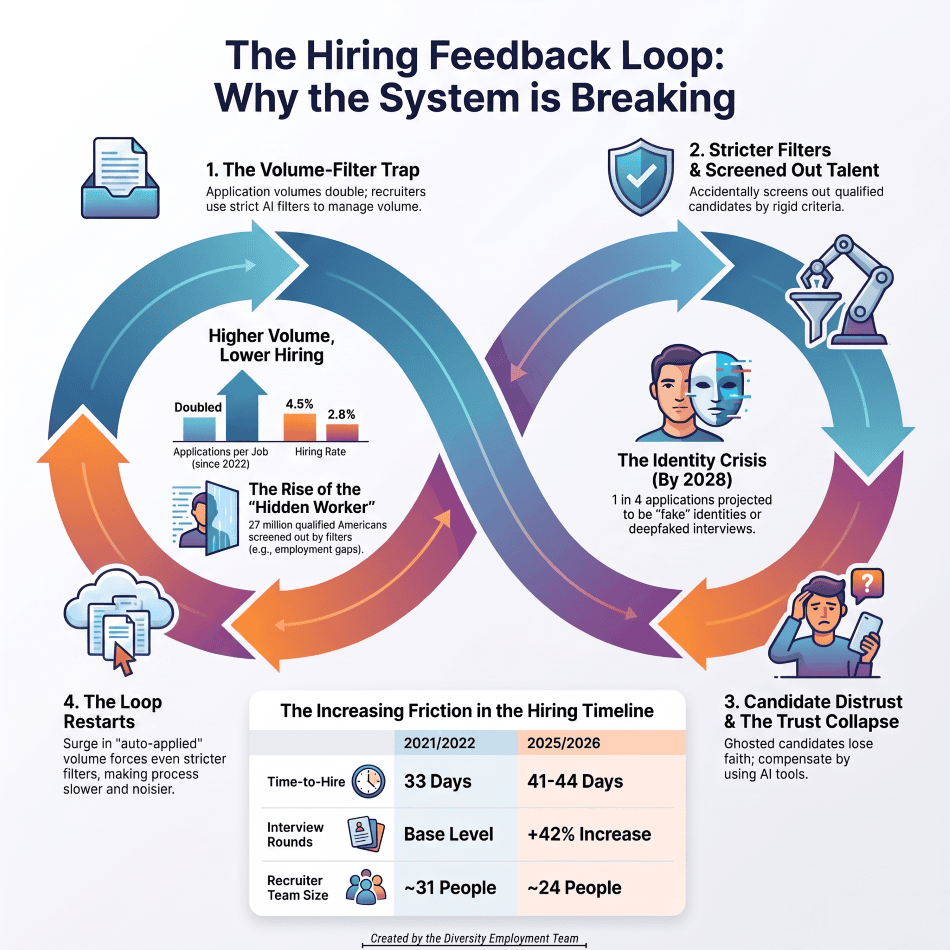
More people apply to more jobs. → Recruiters get overloaded with fewer resources. → Employers use more strict filters to try to control volume. → Qualified candidates get screened out. → Candidates get no responses, then start to distrust the whole process. → Job seekers compensate by applying to even more jobs. → Application volume rises again. → The loop starts all over again.
The Math Isn’t Lying
The volume is real. We start with the volume, because it isn’t in dispute.
Applications, per job opening, have just about doubled since the spring of 2022. The average corporate job posting now pulls in somewhere between 242 and 250 applications. According to data from Glassdoor and Business Insider, that number is up from around 100 just five years ago.
Entry-level postings routinely see 400 or more. On LinkedIn alone, the platform now processes somewhere around 9,500 to 11,000 applications per minute! That’s up ~45% from a year earlier, according to the company.
Hiring Hasn’t Kept Up
None of that volume is translating into faster or even better hiring. The exact opposite is happening. The overall hiring rate, of total employment, fell from 4.5% in 2021 to 2.8% in 2025. Average time-to-hire stretched from about 33 days to somewhere around 41 to 44 days over the same stretch, and most of that isn’t one stage taking longer. It’s more stages: interview rounds per hire are up 42% compared with only three years ago.
So, more people are applying to less genuine openings. And it’s taking longer to fill the ones that do exist. If this were simply an economy without enough jobs, that would be a simple story. It isn’t. Job openings sat around 7.6 million in the spring of 2026; the same volume as unemployed workers. On paper, there are enough jobs and enough applicants. They’re just failing to find each other, and they’re failing in a very specific, mechanical way.
How the Loop Really Works
Recruiters were hit first. Between 2022 and 2025, the average corporate recruiting team shrank by about a quarter (from about 31 people to 24) according to benchmarking from Gem. Over that same period, the number of open applications each recruiter held rose 56%. The number of applications each recruiter reviewed in a year jumped up 2.7 times. With that math and you have less people, each expected to read triple the resumes they were trained to.
Something has to give, and what gives is the reading. Recruiters lean harder on software to make the first cut. Something like 83% of companies now use at least one form of AI to screen applications before a recruiter even sees them.
The Algorithm Myth, What’s Actually True
Here’s where the mainstream version of this story usually gets it backward: That “the algorithm” is arbitrarily deleting qualified people. The claim is that 75% of resumes are rejected before a human ever sees them, traces back to a 2012 marketing pitch from a resume-optimization company. However, they went out of business the following year. There’s no methodology behind it. It isn’t real, or at least nobody has ever shown receipts.
What the actual research says is less dramatic, and more uncomfortable. A joint study from Harvard Business School and Accenture found that 88% of employers admit qualified, highly skilled candidates get screened out of their hiring process. But the cause normally isn’t some rogue-algorithm making an independent call. It’s more often a rule someone set years ago and just never revisited. Nearly half the companies in that study automatically eliminate any resume with an employment gap of six months or longer, regardless of the skills on it. That’s not AI overreaching. That’s just a policy from 2015 still running on autopilot in 2026.
Job Descriptions That Describe No One
Meanwhile job descriptions keep growing before a single application arrives. Ask anyone who’s actually written one: a hiring manager drafts a wish list, a team lead adds a few things they’d personally love to have, HR bolts on the standard boilerplate, and nobody in that process is tasked with removing anything. The result is what recruiters call the purple squirrel problem: A job description demanding a magical “perfect” employee. They don’t exist, they’re dreamed up entirely out of everyone’s individual hopes and wishes.
It happens the worst at the entry level, where roughly 35% of postings labeled “entry-level” ask for actual years of prior experience, and more than 60% of postings do in some tech jobs. New graduates are told, correctly, that entry-level roles matter for building a career… then they’re asked for three years of experience to get one. Unemployment in recent college graduates has exploded to around 5.7%, and a bunch of the grads who do find work are underemployed, they’re working jobs that never needed a degree in the first place.
Skills-Based Hiring? Mostly on Paper
Skills-based hiring was supposed to fix exactly this, and mostly it hasn’t happened yet… even at companies that say it has. 85% of employers claim to use skill based pay and hiring. It makes for a good headline: “No more arbitrary degree walls,” “hire for what people can actually do.” But research from Harvard and the Burning Glass Institute, tracking actual hiring decisions instead of just job-posting language, found that less than 1 in 700 hires were hired based on skill alone. Just under half of the companies that announced they’d dropped their degree requirements did, in name only: new posting, same hiring underneath.
The gap matters more than it sounds like it should, because it feeds the loop directly. A job posting that looks more open than it is brings in way more applications from people who genuinely believe they qualify. If the actual criteria haven’t changed, application numbers climb while hiring stays flat.
Candidates Apply Much Wider
Candidates, for their part, are behaving exactly the way you’d expect them to behave when any single application has something like a 1-in-250 shot. If more volume looks like the only button left, people will smash it. A small industry of AI-powered auto-apply tools, like LazyApply and Sonara, let a job seeker send off hundreds of applications overnight, each customized just enough to slip past a keyword filter. It’s a rational response to an irrational system. It’s also exactly what’s overwhelming the recruiters where the loop started.
Employers respond with more noise
And employers, sensing the coming flood, prepare by adding more noise of their own. Right now, nearly one-in-five to nearly one-in-three are ghost jobs. They’re postings for a position a company has no real plan to fill. The reasons are rarely sinister or malicious. Some might leave a certain listing up to show growth to investors. Some are simply building a pipeline for later. A few, more cynically, keep all jobs posted to remind you that you’re replaceable.
Lawmakers have started to take notice too… Pennsylvania has a bill moving through committee that would require companies to disclose whether or not a posting is a real current opening, and Ontario’s version of the same idea becomes law this year.
Flood, filter, distrust, more flood. Each side’s rational response to the other side’s rational response is what keeps this looping, and nothing in that loop fixes itself.
What Breaks When Nobody Trusts the Signal
Trust has collapsed on both sides. That distrust deserves its own mention, because it’s where this stops being just inefficient and starts getting genuinely unusual.
Almost half of job seekers, 46%, say their trust in the hiring process has gotten worse over the past year; and 42% blame AI specifically. For entry-level job seekers, that number towers in at 62%. On the other side of the table, only 21% of hiring managers say they’re “very confident” that qualified candidates aren’t being wrongly rejected by their own process. Neither side believes the system is working, but neither side is wrong.
The Reversal Nobody Expected
The unusual part is the response. For most of the last fifteen years, hiring technology moved in one direction: Digitize → Automate → Move it online → Make it faster. But that trend just reversed. 39% of hiring managers say they’re now conducting more in-person interviews than they used to. It’s specifically to verify that the person on the call is who their AI-polished application claims they are. It’s way more than a company just being old-fashioned. That’s a company that doesn’t even trust its own hiring process to do the one thing it is there to do.
The Deepfake Endpoint
Yet, they may be right not to trust it. Research firm Gartner projects that by 2028, almost one in four job applicants worldwide will be fake in some meaningful sense: a fabricated identity, a deepfaked interview, a stand-in taking a technical assessment for someone else. 17% of hiring managers already say they’ve run into a candidate using deepfakes. The system built entirely around: processing volume faster, faster applications, faster screening, and faster scheduling has landed somewhere nobody was aiming for. We’ve gotten to a hiring process that can’t be sure who, or what, it’s actually evaluating.
Who the Noise Costs the Most
The folks this loop filters out the hardest aren’t random either, it’s worth sitting with. Because it’s the same mechanism causing the “we can’t find anyone” complaint in the first place.
Harvard Business School and Accenture put an actual number on it: about 27 million Americans they call “hidden workers,” people actively looking for work, capable of doing the job, and consistently screened out anyway, not for lack of skill but because a hiring process built around checking boxes has no box for how they’d demonstrate it. A resume gap from caregiving, a medical leave, a relocation for a spouse’s job, a disability that shows up as a pause in employment rather than a line on a resume, anything. To an “automatic gap filter,” it all reads exactly the same way. Disqualifying.
Age and Disability
Many workers 50 and older say they feel like they’re actually being pushed out of the workforce entirely. According to AARP‘s research, it’s usually for reasons that have nothing to do with capability, and everything to do with their graduation year or a “digital native” phrase in job postings. Meanwhile, workers with disabilities are unemployed at around double the rate of workers without one. That specific gap for disabled workers has stuck around even though remote work, in theory, opened up more jobs they’re well suited for.
The Upside Nobody’s Claiming
None of this requires a good-values argument to really matter to a business, which is worth saying plainly, because the upside sits there, quantified, mostly unclaimed. Research on skills-first hiring finds that genuinely hiring for demonstrated skill, instead of credential, expands the pool of workers without a bachelor’s degree by 9% more than it expands the pool of degree holders. And in some scenarios, it was actually closer to 19 times more. Harvard’s hidden-worker research found something similar from the other direction too. Companies that went around their own filters, instead of just rewriting the job posting, ended up with employees who performed as well, or better than, traditionally sourced hires. Another positive was they tend to stay with the company longer.
The overlooked-talent story and the “we can’t find anyone” story aren’t two different ones. They’re the same. The filters built to manage an unmanageable flood of applications are, by design, catching people whose qualifications don’t fit the exact shape the filter is looking for. Some of them, though, are precisely who you’re trying to reach.
How to Actually Break the Loop
None of this fixes itself, and a better economy won’t do it either. Here’s where to actually start, matched to the specific mechanism causing it.
Audit Your Must-Haves
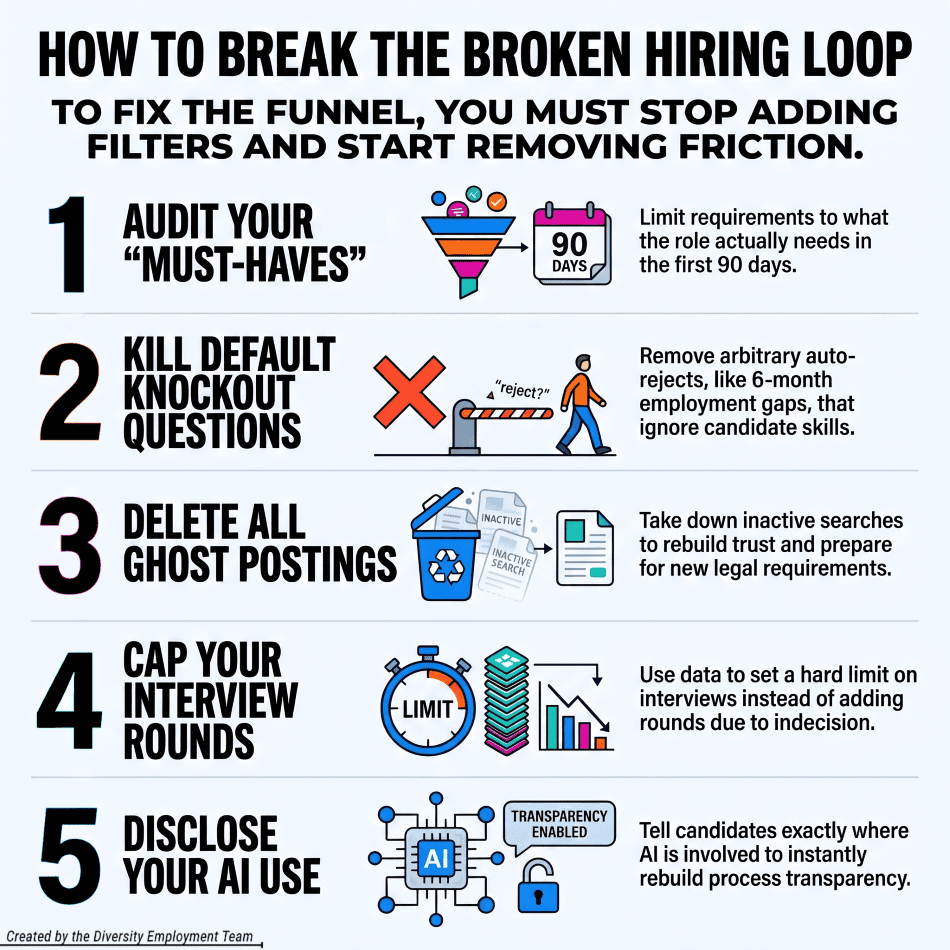
Check them against what that job actually calls for in the first 90 days. Avoid adding what the previous person eventually grew into after four years.
If your job posting looks like a giant wish list put together by multiple stakeholders, you’ve built your own purple squirrel… and then blamed the market for not serving up one.
Check Your Knockout Questions
Find your gap-based auto-rejects and ask when anyone last looked at them. A six-month employment gap disqualifying an otherwise strong candidate isn’t a policy, it’s a default setting nobody’s revisited. If you can’t articulate why that cutoff is six months and not four, or twelve, that’s your answer.
Test Your Skills-Based Claim
If you’ve said publicly that you’re “skills-based,” go check. Pull your last 20 hires and see how many would actually fit the posting as it’s currently written. If most of them wouldn’t have needed to, the policy is probably real. But if it’s the opposite, that posting is just adding noise and inviting applications from people it was never even going to consider.
Kill the Ghost Postings
Take down, or clearly relabel anything that isn’t a real, active search. Beyond the trust cost, which is real, this is becoming a legal requirement in more places every year. Companies might as well get on board now, instead of falling behind and playing catch-up later.
Cap Your Interview Rounds
Set the cap based on your own actual data, not against anyone’s nerves. If your last ten hires worked out fine after round three of job interview questions, adding a fourth one just because a team still feels uncertain is a symptom, not a solution. It’s a major part of why time-to-hire keeps getting longer and longer, even as the applicant pool expands.
Disclose Your AI Use
Say out loud, to candidates, where AI is involved in your process and where it isn’t. It costs nothing, and it’s one of the very few moves shown to actually rebuild some of the trust that’s collapsed on both sides.
Finding the End of the Loop
Somewhere this week, the candidate with 200 sent applications and zero callbacks is going to send their 201st. Somewhere nearby, a hiring manager is going to open their ATS full of hundreds of resumes and feel the same, familiar, dread.
The market isn’t going to fix this for either of them. The U.S. economy added just 57,000 jobs in June 2026 while the labor force actually shrank, and openings have sat flat for months. Nothing about that environment forces any company to change how it screens resumes, writes a job posting, or handles a gap in someone’s work history. Nobody is getting rescued by a sudden boom.
Which means the fix, if it ever comes, is a choice. Companies have to look at their own funnel and understand that adding one more filter simply isn’t the answer, especially because the last several didn’t work either. What a candidate does with their next 200 applications isn’t something you control. What happens to the first one and the following two hundred, when they land in your funnel, is.