

More than half of all job postings now tell you what the salary range is. In August 2026, 51.8% of postings on Indeed listed explicit pay information, the highest percentage since Indeed Hiring Lab’s tracker began in 2020. Connecticut joined the list of states requiring a range in every posting on October 1st, while Virginia and Maine did the same this summer.
That sounds like the end of the guessing game. But a study published this year in the Journal of Applied Psychology suggests the number on the posting is doing something to you before anyone ever talks money.
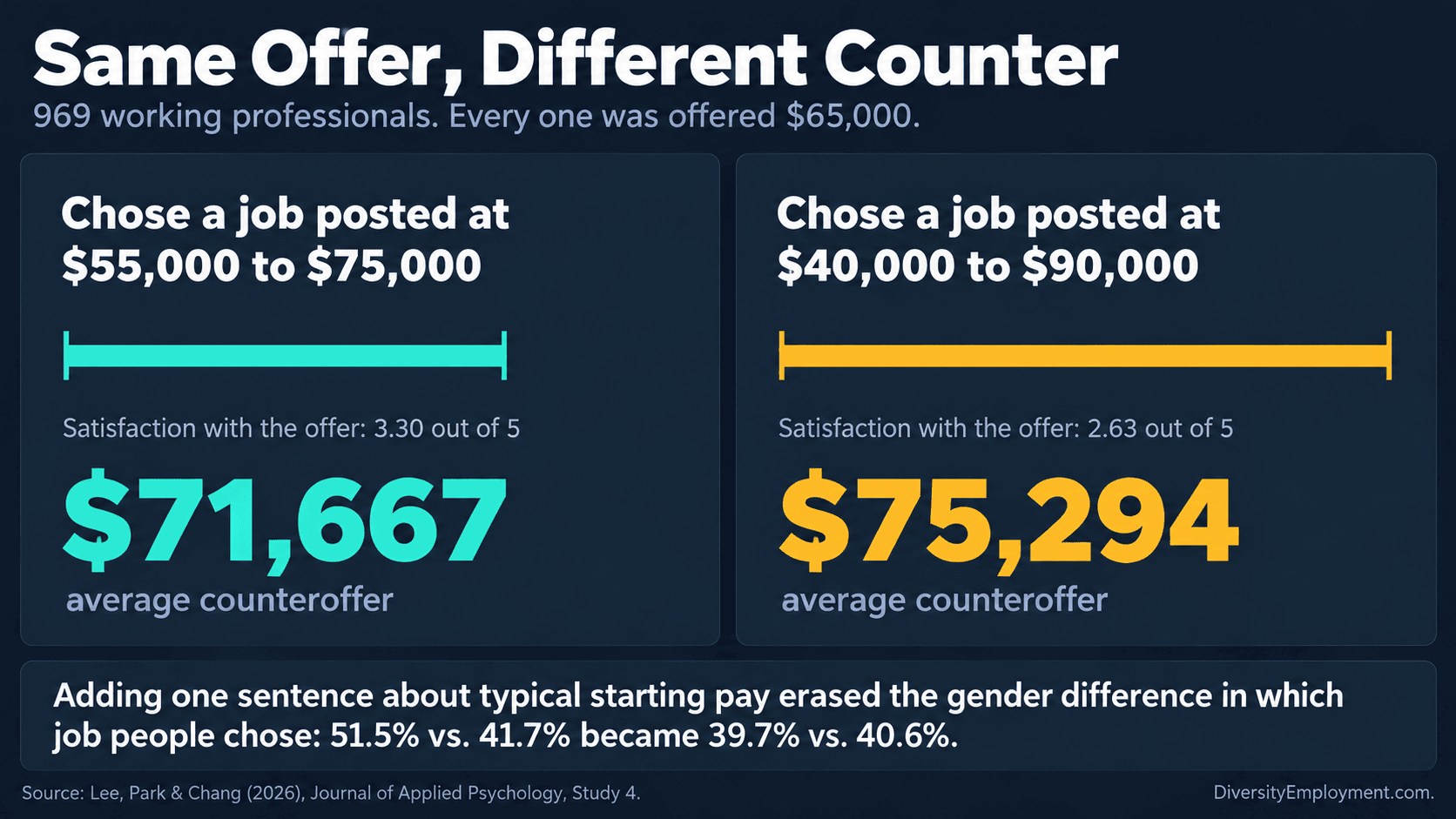
Researchers at Cornell and Sungkyunkwan University gave 969 working professionals the exact same $65,000 offer. Some had picked a job posted at $55,000 to $75,000. Others had picked an otherwise identical job posted at $40,000 to $90,000. The people who saw the tighter range were happier with the offer and asked for less, countering at about $71,700 on average. The people who saw the wider range countered at about $75,300.
Same offer. Same job. Roughly $3,600 apart, and the only thing that changed was the posted range.
Half the Postings, None of the Instructions
Somebody with way more information than you wrote that salary range, for their own reasons. To stay legal, attract the right people, leave room to negotiate, or sometimes just to cover multiple jobs at once.
Nobody hands jobseekers a decoder ring, though. The research, the new laws, and our own look at 444 real postings point to a few ways to read a salary range the way the person who wrote it does.
What the Number Is Really Measuring
A posted salary range usually describes what the employer is willing to pay for the job. What they’ll actually offer you can be an entirely different number. Which is good to know up front.
A Hiring Range, Not the Whole Pay Band
Most employers have a pay band for each position: a minimum, a midpoint, and a maximum. The midpoint usually reflects what an experienced, fully capable person in that job earns. New hires typically start somewhere between the minimum and the midpoint, and move up from there.
California made this distinction explicit in 2026. A change to its law that took effect January 1st now defines the posted pay scale as a good-faith estimate of what the employer expects to pay “upon hire,” as opposed to what the job might pay over time.
Other employers do the opposite and post the entire grade. One national health company notes on its postings that the range covers every position in the job grade the position falls into. That can make a range look huge, $32.01 to $68.55 an hour, for one of its nursing jobs because it describes the whole career ladder rather than just a starting offer.
The Bottom Half Is the Default
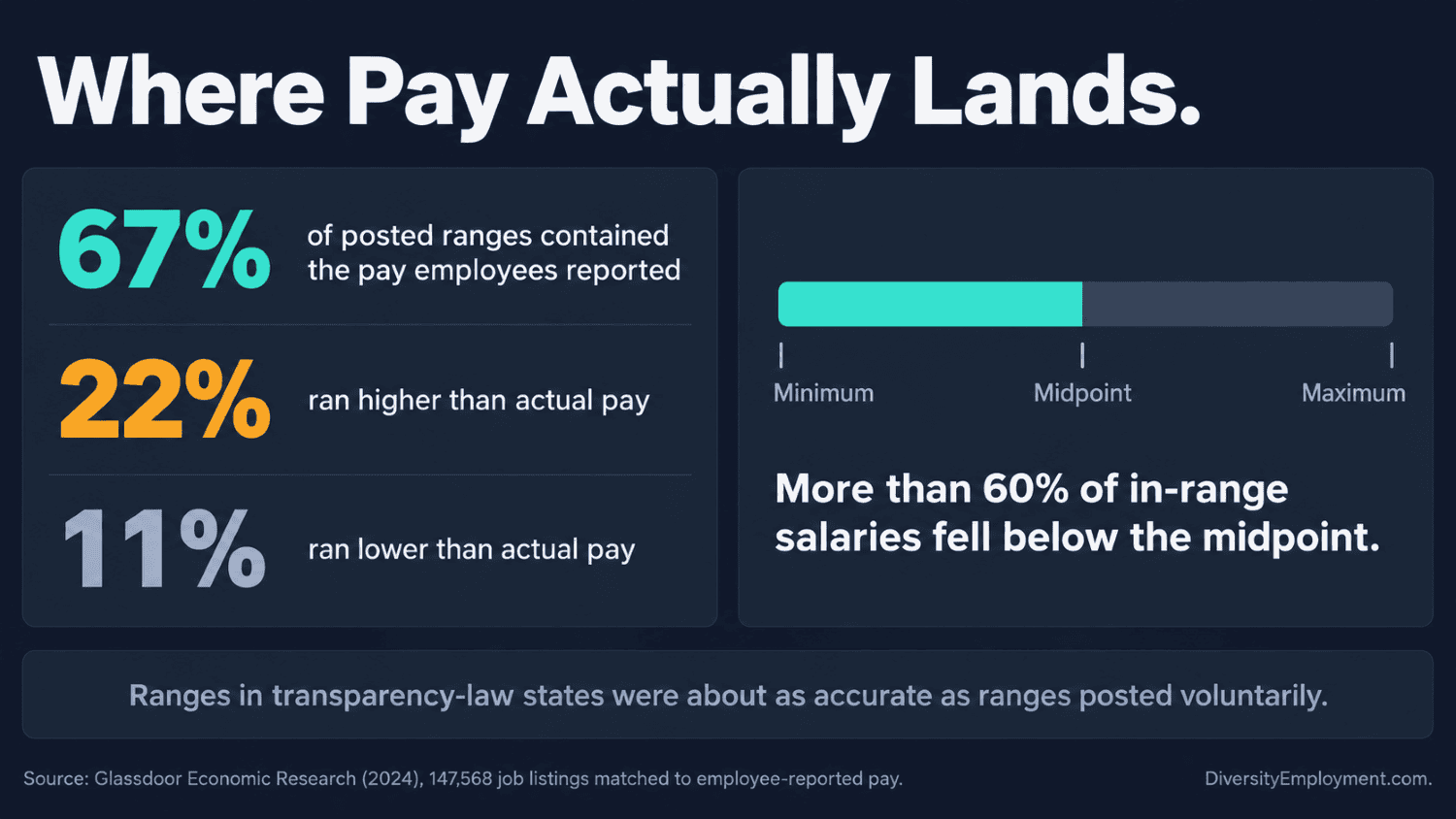
So what do people actually get? The best real-world look comes from Glassdoor’s economic research team, which matched 147,568 job listings to what employees in those same jobs, at the same employers and in the same cities, reported earning.
About two-thirds of posted salary ranges, 67%, actually contained the pay people reported. In 22% of listings, the posted salary range was higher than what people were really paid. And within the ranges that held up, more than 60% of reported salaries fell below the midpoint.
If you picture yourself landing in the middle of a salary range, you may be picturing the exception.
Nobody Has to Pay Inside It
Posting a salary range doesn’t legally bind an employer to it. When economists at UC San Diego and USC studied Colorado’s law, the first in the country, they noted that there’s no requirement that an employer actually pay within the posted salary range, as long as the range was set in good faith.
Glassdoor also found that ranges in states with transparency laws were about as accurate as ranges employers posted voluntarily in states without them. The law gets the number onto the posting. It doesn’t, on its own, make the number more precise.
Created by the Diversity Employment Team
The Four Kinds of Salary Ranges
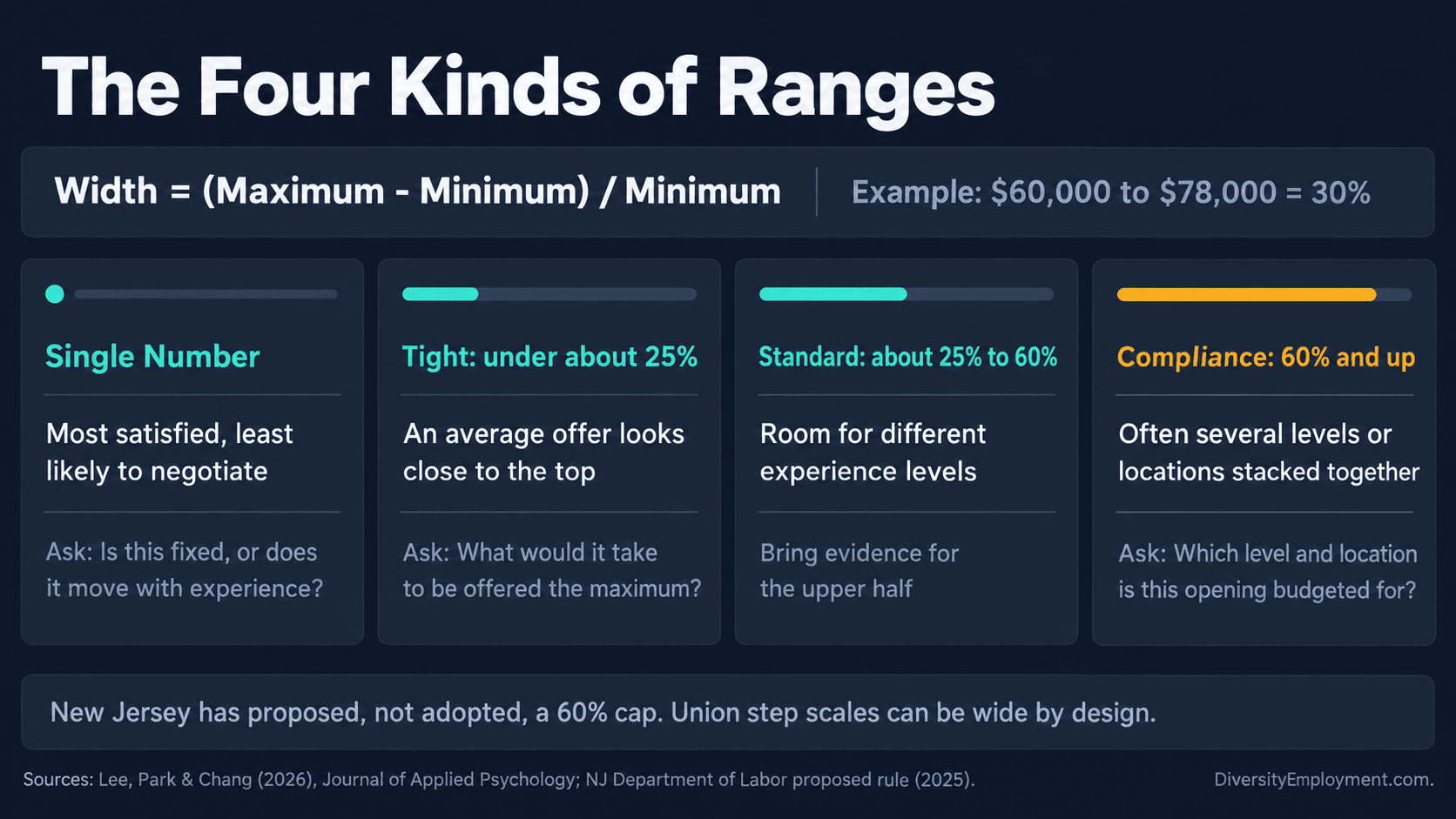
Every salary range you see falls into one of four shapes, and each one tells you something different. To sort them, you only need one calculation: subtract the minimum from the maximum, then divide by the minimum.
A posting for $60,000 to $78,000 has an $18,000 spread. Divide that by $60,000 and you get 30%. That’s the range’s width.
New Jersey’s labor department proposed the only hard numeric line of any U.S. regulator: No posted range wider than 60% of its minimum. That proposal, published in September 2025, still hasn’t been adopted. Though, it’s still a useful yardstick.
The Single Number
Some postings skip the salary range and list just one figure. It feels like the clearest possibility, and that may be the problem.
In the Cornell study’s experiment with college juniors and seniors, the people who chose a job posted at a single number were the most satisfied with an identical offer; and the least likely to try negotiating at all. Less information, it turned out, made people more content.
What to do: Ask directly whether the number is fixed or whether it can move with experience, and what it’s actually based on.
The Tight Range (Under About 25%)
A tight salary range, say $65,000 to $78,000, feels honest and predictable. And it usually is. But it also sets that anchor the study describes. An offer in the middle of a tight range looks close to the top, so it feels like there’s not much left to ask for.
What to do: Treat the top of a tight range as the real target. Ask what someone would need to bring to be offered that maximum.
The Standard Range (About 25% to 60%)
This is where most job postings fall. A salary range like $80,000 to $115,000 usually leaves room for different levels of experience within that same job. Where you land depends on the evidence: Years in similar work, specific skills the posting emphasizes, certifications, and how closely you match what they say they need.
What to do: Map your background against the posting line by line before the first call, so you can make a specific case for the upper half instead of a general one.
The Compliance Range (60% and Up)
Then there are salary ranges so wide they barely mean anything. The Cornell researchers point to a remote software engineering posting from Netflix in 2024 that ran from $100,000 to $720,000. Ranges like that are usually a bunch of different jobs, levels, or locations stacked into one posting simply to satisfy the law.
Regulators are starting to push back on that though. Virginia’s new law and Delaware’s upcoming one both say how wide a range is can actually be considered in deciding whether it was set in good faith. And research cited in the Cornell paper found that very-wide ranges tend to make employers look less trustworthy to applicants.
What to do: Ask which level and which location the specific opening is budgeted for. That one question can usually shrink the range down to a more realistic one.
One Exception Worth Knowing
Some wide ranges are wide for legitimate reasons. Union contracts and hospital pay scales usually post a full step scale, from the first-year rate to the rate after many years of service. One university hospital’s nursing posting ran from $46.97 to $86.17 an hour, an 83% spread, because it listed every step.
New Jersey’s proposal specifically exempts ranges set by a collective bargaining agreement. If you see a wide range at a unionized employer, ask which step your experience places you on. The answer is generally fixed by the contract.
Created by the Diversity Employment Team
We Measured 444 Postings
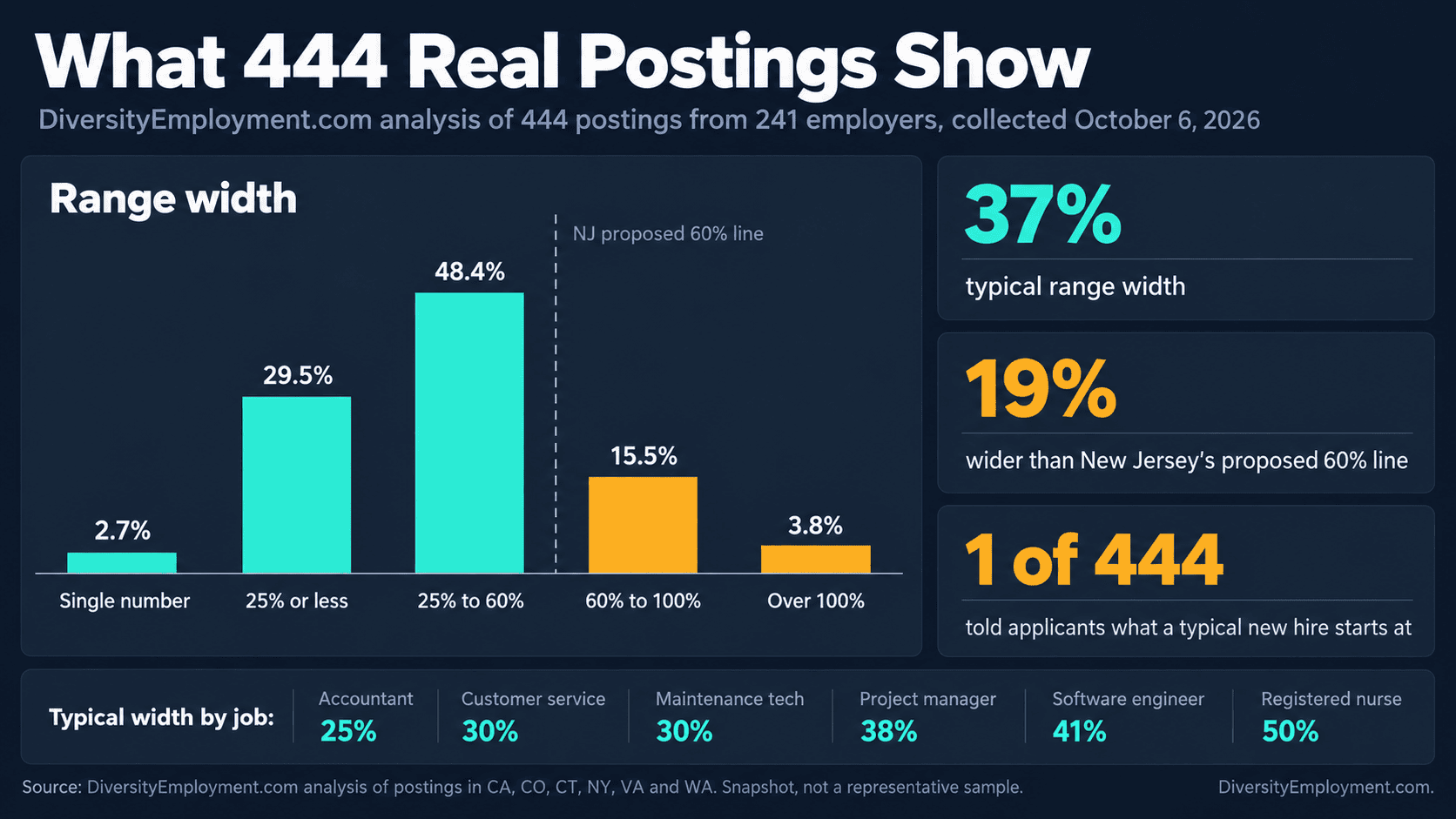
To see what ranges actually look like right now, we collected 444 current postings that included a readable pay range, from 241 employers. They covered six common jobs, across six states with posting laws, from customer service representatives and maintenance technicians to registered nurses and software engineers.
Most Salary Ranges Are Moderate
The typical range was about 37% wide. About 30% of postings were tight, at 25% or less, and just under half fell in the standard 25% to 60% zone. Roughly one in five, 19%, ran wider than New Jersey’s proposed 60% line, and about 4% were more than 100% wide.
In dollars, the typical salaried range spanned about $50,500 wide. The typical hourly range spanned $9.48 an hour.
The width varied a lot by job. Accountant postings were the tightest, with a typical width of 25%. Customer service and maintenance roles sat around 30%. Nursing ranges were the widest at 50%, and a third of nursing postings ran past 60%, mostly because of step scales.
What Almost No Posting Tells You
Out of 444 postings, exactly one told applicants what a typical new hire actually starts at. That posting explained that most new-hire offers fall between the minimum and the midpoint of the range.
Plenty of postings said something like “Starting pay will be determined based on skills and experience.” That tells you how the decision gets made, but not where it usually lands.
That missing sentence may actually matter more than the width of the range itself.
Created by the Diversity Employment Team
What a Salary Range Leaves Out
Even a perfectly honest range usually describes only one piece of what you’ll get paid.
Mostly Base Pay
Most laws require only base salary or hourly wages to be in the salary range. Bonuses, commissions, stock, and shift differentials sit outside that. In our sample, about 60% of postings mentioned some form of pay beyond the base, but that varied quite sharply by job. Roughly three-quarters of software engineering and accounting postings did, against only 35% to 39% of nursing, customer service, and maintenance postings.
Glassdoor found posted ranges were least accurate for jobs with a lot of variable pay, like sales jobs and tipped work. If a job runs on commission or tips, the base range may only be the floor.
Benefits Count as Pay Too
A $5,000 difference in salary can disappear quickly if one employer covers most of your health premium and another doesn’t. Colorado, Washington, New Jersey, Connecticut, and Delaware all require postings to include at least a general description of benefits. Virginia and Maine don’t.
Questions worth asking before an offer: “What share of the health premium does the company cover for employee-only and family coverage?” and “Is there a retirement match, and when does it vest?”
We’ve covered a lot more of what to watch for in a job posting, from vague perks to suspicious ranges, in our guide to job posting red flags.
When the Job Is Remote
Remote job postings are where salary ranges get the most confusing, because more than one state’s law can apply all at once. Colorado’s rule covers remote jobs if the employer has even one employee in the state. Connecticut’s new law covers jobs that report to a supervisor or office in Connecticut, even if the work happens elsewhere. New Jersey’s guidance covers remote jobs open to New Jersey residents, and Delaware’s upcoming law even covers remote jobs offered by Delaware-based employers.
The practical result is that many national employers now post pay for remote roles everywhere, which is why you’ll probably see salary ranges even if you live in a state without a law.
Why One Posting Shows Three Salary Ranges
About 13% of the postings we reviewed listed more than one salary range, usually broken out by location or level. One large bank, for instance, lists separate ranges by city within a single posting. Those tiers usually reflect local labor markets rather than anything about you.
What to do: ask which tier you’d be placed in and whether that tier is based on where you live or where your manager sits. For remote roles, that answer can move your offer by thousands of dollars.
For a state-by-state rundown of which laws apply where, see our guide to pay transparency laws by state.
The Question That Changes the Number
The most useful part of the Cornell study was the fix. In their final experiment, the researchers added one sentence to both postings, telling applicants two things 1. The typical starting salary and 2. Explaining that the final offer would reflect experience, skill level, and responsibilities under standard guidelines.
That single sentence noticeably changed behavior. Without it, women were more likely than men to choose the narrow-range jobs, 51.5% to 41.7%. With it, the difference disappeared, at 39.7% to 40.6%. The difference in counteroffers between genders also disappeared.
But our audit found employers almost never include that sentence. However, nothing stops you from asking for it.
How to Ask It
The best time is early, at the first recruiter screening, before you’ve named a number. Try these:
- “For someone with my background, where do new hires in this position usually start within this range?”
- “What would someone need to bring to get an offer closer to the top?”
- “Is this range for this specific opening, or does it cover several levels of the position?”
These questions don’t commit you to anything, and they’re hard for a recruiter to treat as aggressive. They also fill in the missing piece most postings leave out.
It’s worth asking because very few people walk in knowing. One survey of new hires, cited in that same Colorado study, found that only 23% knew exactly what they’d be paid by their first interview.
Who Gets Left Guessing
Not everyone starts from the same information. A 2024 study in the Quarterly Journal of Economics found that workers anchor their sense of what they could earn elsewhere on what they earn now. People who’d actually see a 10% raise by switching expected only about 1%, and workers at low-paying employers underestimated outside pay the most. The data comes from Germany, but the pattern seems to be a familiar one.
If you’re the first in your family in a professional job, changing careers, or working without a network of peers who’ll tell you what they make, a posted salary range may be the only real benchmark you have. Which makes reading it correctly even more important.
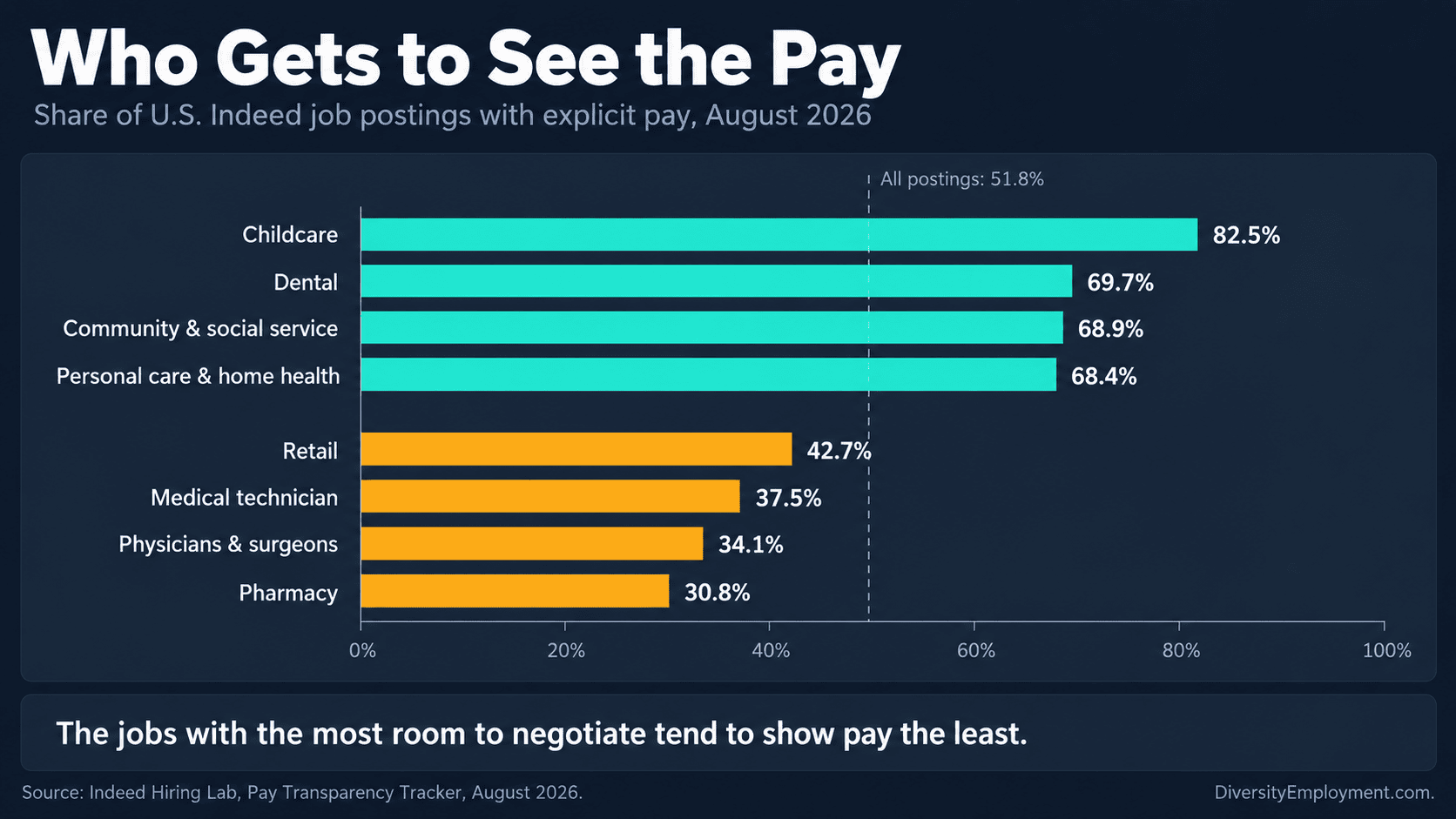
There’s an odd twist in who gets to see pay at all. In Indeed’s August 2026 data, 82.5% of childcare postings listed pay, compared with 34.1% for physicians and surgeons, and 30.8% for pharmacy roles. The jobs with the most room to negotiate tend to show the least.
We’ve written before about how a crowded hiring process filters people out before anyone looks closely, in your hiring funnel is full. Pay information is one more place where the people with the most context have the advantage.
Created by the Diversity Employment Team
Risk Tolerance and the Range You Pick
The Cornell team also ran a real hiring experiment, posting an actual part-time research assistant job to 1,148 job seekers. When the pay was listed as $200 to $300, 79.5% of women applied compared with 68.9% of men. When it was listed as $50 to $450, there was no meaningful difference.
The researchers traced this to risk tolerance rather than gender itself. People who are more cautious about uncertain outcomes, for whatever reason, gravitated toward the more predictable range, and predictable ranges led to people asking for smaller amounts. It’s reasonable to think the same pull affects anyone who simply can’t afford a lowball offer, though the study didn’t test that directly.
Created by the Diversity Employment Team
If You Already Work There
Pay transparency was sold mainly as a tool for jobseekers. But if you’re already employed, your company’s new job postings may be the best point of reference you have.
Your Employer’s Own Postings
When your employer posts your job, or one just like it, you can see what they’re willing to pay a new hire. California’s “upon hire” definition makes that comparison especially clean.
The laws have nudged pay up for people already in their jobs. That same study of Colorado and the other early states found wages rose 1.3% to 3.6% after the laws took effect. Pay rose for both new hires and current employees, though new hires gained more, 1.8% to 3.0% compared with 0.9% to 1.4% across all workers. The authors credit stronger competition between employers, more than employees using salary ranges in raise talks.
If you’ve stayed put through a tight market, we looked at what that may have cost in Low Turnover Feels Great, but Is It Loyalty or Fear?
You Can Often Just Ask
In several states, you don’t have to wait for a posting. California, Connecticut, Massachusetts, Rhode Island, and Maine all give current employees the right to request the salary range for their own position. Maine’s version took effect July 29th, 2026.
Separately, federal labor law protects most private-sector, non-supervisory employees who discuss their wages with coworkers, union or not.
Making the Case
If you’re being paid below the minimum your employer is now advertising for your own job, that may be your strongest argument for a raise. Because it’s your employer’s own number.
Landing somewhere inside the posted range doesn’t necessarily mean you’re underpaid. If the posting covers a whole pay grade, your spot in it may simply reflect how long you’ve been in the position.
Expect to hear something like “we’ll look at it in the next cycle.” When you do, ask what criteria the review will use, and get a date. Some companies are also moving toward paying for specific skills rather than titles, which can give you an even clearer path, as we covered in skill-based pay.
Your Checklist
At Diversity Employment, we see thousands of postings come through every week, and the pay information in them ranges from crystal clear to nearly useless. A few ways to get the most out of whatever job postings you find:
If You’re Looking for a Job
- Calculate the real width. Subtract the minimum from the maximum, divide by the minimum, and sort the range into single number, tight, standard, or compliance.
- Assume the lower half. Plan around the bottom half of the range and treat anything higher as something you’ll need to make a case for.
- Don’t let a tight range shrink what you ask for. An offer near the middle of a narrow range can feel generous when it’s really just average.
- Shrink the compliance range. Ask which level and location the opening is budgeted for.
- Ask what’s outside the base. Bonus, commission, equity, shift differentials, health premium share, and retirement match.
- Ask the typical-pay question. “Where do new hires with my background usually start?” It’s the one piece of information almost no job posting includes.
If You Already Work There
- Check your employer’s current job postings for your own position. Compare your pay to what they’re offering a new hire.
- Request your salary range if your state allows it. California, Connecticut, Massachusetts, Rhode Island, and Maine all give you that right.
- Lead with your employer’s actual numbers. Pay below a posted minimum is your clearest case.
- Get the criteria in writing. If the answer is “next cycle,” ask what will be evaluated and when.
Read It Like You Wrote It
Pay transparency did what it promised in one sense. More postings show pay than ever, wages rose modestly after the laws took effect, and the laws didn’t appear to cost jobs. But a salary range was never designed to be a full answer. It’s the employer’s opening position, written with more information than you have.
The width tells you what kind of range you’re looking at. The bottom half tells you where most people land. What’s missing: the bonus, the benefits, the location tier, all tell you what else to ask. And the one sentence almost no posting includes tells you the question that matters most.
The One Question
The person who wrote the range already knows where new hires usually start. The only thing standing between you and that number is asking for it.
“For someone like me, where do new hires usually start, and what would it take to start higher?”
How we measured: DiversityEmployment.com collected 444 current job postings with a readable pay range on October 6, 2026, covering six roles (registered nurse, customer service representative, accountant, software engineer, project manager, and maintenance technician) in California, Colorado, Connecticut, New York, Virginia, and Washington. 255 postings came from DiversityEmployment.com’s own job board, reported only in aggregate, and 189 came from employers’ career sites through their public job feeds. We included at most three postings per employer for each role and state, removed duplicates, and excluded postings without a readable range. Width is the range’s spread divided by its minimum. Ranges on our own board were similar to the career-site sample for most roles, while software engineering postings on our board ran somewhat wider. This is a snapshot, not a representative sample, and Connecticut (18 postings) and Virginia (36) are too small for state comparisons.