

Two people can take two very different paths to the exact same problem.
The first just accepted a remote-eligible marketing job paying a lot more than anything she could find within an hour’s commute of her house. She lives forty minutes outside a mid-sized city. Even there the “good” jobs in her field max out way below what she’s making now. Remote work didn’t just save her a long commute. It let her compete for, and land, a job that would have required moving somewhere she couldn’t afford just five years ago.
The second has been fully remote for three years at a software company that proudly labels itself “remote-first.” Last month a different teammate, who moved to the city where headquarters is, got the team-lead promotion they were both vying for. He had the same tenure. Comparable output, by every metric either of them could see. The only real difference was his location.
Ask either one, “Has remote work been good for your career?” You’ll probably get two very confident, yet opposite answers. Neither one is wrong. They’re describing two separate things that both just happen to be called “remote work.”
Which One Do You Actually Have?
Before getting into why both of those stories are backed by real data, it’s worth running your own situation through a quick check. There are specific, answerable questions to ask yourself.
- Who got your team’s last two or three promotions, and where did they physically sit? If the answer is “in the office” or “near the decision-maker” chances are it’s not a coincidence. One or two data points aren’t a pattern. Three in a row usually is.
- Are your one-on-ones the only real access you get to your manager, or are they actually available outside the scheduled time too? If a scheduled thirty minutes is the whole relationship, you’re competing against people who get that plus everything unscheduled: the few minutes that spill over after a meeting officially ends, the “got a quick second?” that turns into ten minutes, or the context that nobody thought to write down.
- Were you hired into this remote position because of what you do, or because of how experienced you already were when you were hired? Companies are slowly becoming more comfortable letting experienced people work remote jobs, but much less comfortable doing it for people who still need any real training. If you’re early in your career and working remote, it’s worth taking the time to think about it… And that’s actually the subject of one of the more surprising findings later on.
- Are you fully remote, or hybrid? This is the biggest variable in everything that follows, and almost nobody treats it as one. A lot of the “remote work is bad for your career” advice is really “fully remote work with zero in-person time is bad for your career.” It’s much more specific.
Hold onto your answers. You’ll see why once you see where they come from.
The Job That Got You Hired Doesn’t Care Where You Live
Starting with good news, because there’s a bunch of data behind it.
A 2026 study followed 48 million U.S. job transitions between 2020 and 2024. Each one linked to whether or not the job was ‘remote-eligible’ at the time of hire. People who worked remote-eligible jobs saw income growth about 4% higher than similar workers who moved into fully on-site jobs. They were also roughly 2 percentage points more likely to move up in seniority at the same time. That’s not some fluke in just one industry or one kind of job. The researchers had a control for:
- Prior wage
- Seniority
- Occupation
- Industry
- and Location
The pattern held across all of them.
Gains weren’t handed out evenly either. Workers that were in the lowest tier of previous earnings actually received pay raises near 15 percent, about three times more than the people who were already in the middle or top of the pay scale. And the effect was strongest on people coming out of metro areas with the least amount of existing high-tech jobs. That basically means the farthest places from Austin, Seattle, and the Bay Area. Remote jobs do the most for people who have less access to begin with. That’s the moral of the story of the woman in the intro. Her local market didn’t have the right job. Remote options let her compete for one that was.
Who Gains the Most, and What It Actually Costs
There’s a glaring objection worth taking noting: workers who take ‘remote-eligible’ jobs usually end up at smaller, maybe less prestigious companies with less management and coworkers than fully on-site jobs. That sort of sounds like it would cancel out the whole more money part. But, it mostly doesn’t. When researchers traced where the extra pay actually came from, turns out landing at a smaller or less recognizable employer only shaved off about 2.6 percent off the overall pay effect. Most of the gains came from people moving into higher-paying jobs and more senior ones that they wouldn’t have had access to locally. The “you’ll end up somewhere nobody’s heard of” worry is real… It’s just not as bad as some like to make it seem.
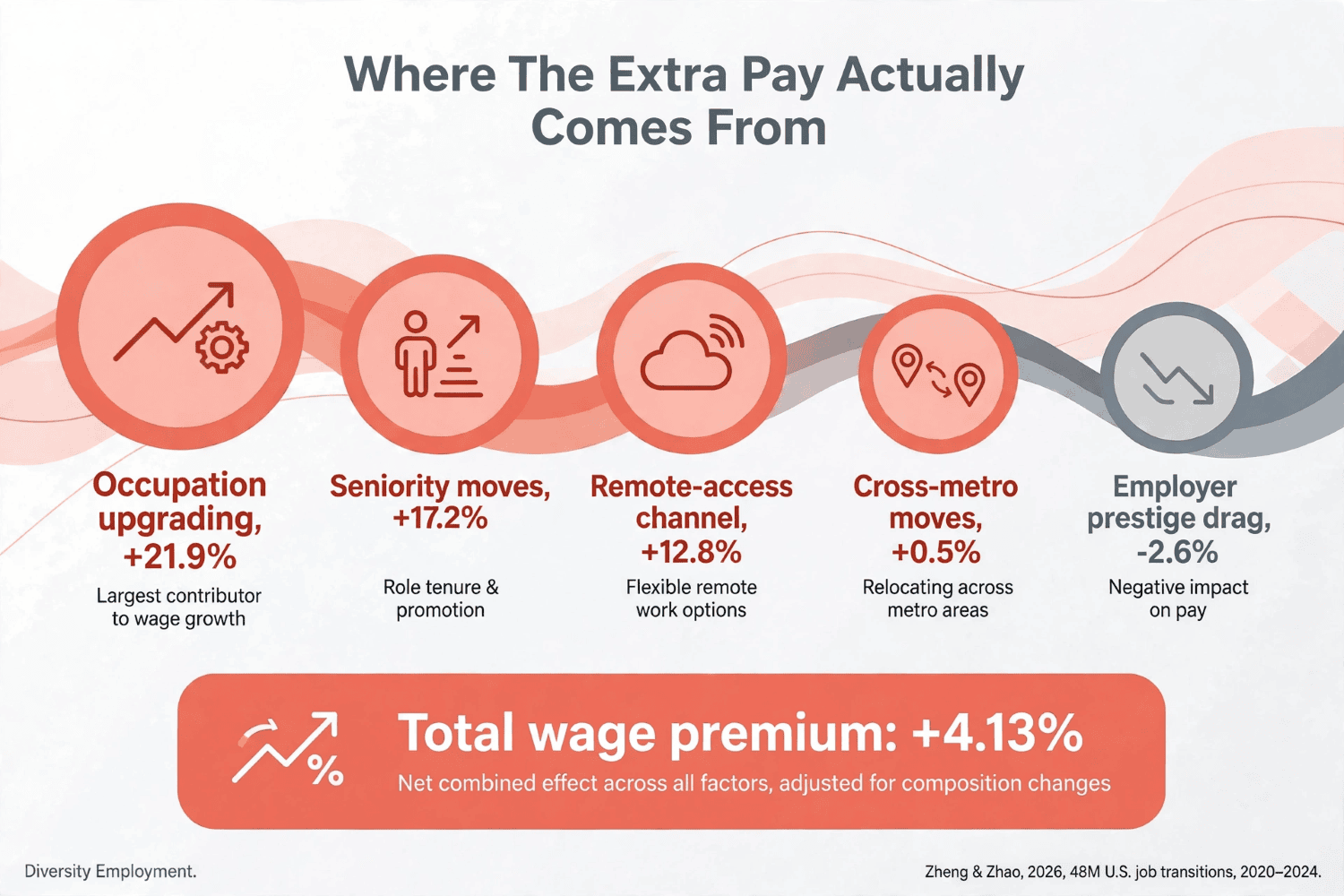
This window is closing, too. ‘Remote-eligible’ job postings only made up a small slice of all job postings tracked over that five-year period, and the amount of jobs offering fully remote work has been shrinking even more as companies lean back into in-office mandates. The workers this study is describing didn’t stumble into an oversupplied market. They actually found one of the harder tickets to get, at the exact moment it started paying off the most.
The Disability Numbers Nobody’s Connected Yet
One particular group has benefited from the shift a bit more obviously than almost any other, and they rarely come up in remote-work coverage at all. Employment went up 12.4 percent between 2019 and 2024 for workers with a physical disability. At the same time employment for people without a disability basically got back to its flat, pre-pandemic, numbers. That’s not just a small coincidence. It’s actually one of the strongest differences labor economists have on record, and it doesn’t match the pattern from any prior recession. Disability employment recovery typically lags overall recovery, instead of outpacing it. Remote jobs removing the commuting and physical-workplace barriers are the top explanations researchers point to, and it’s a reminder that “access” isn’t only about geography.
Sometimes the barrier being removed isn’t just distance from a certain place. It’s distance from the building that was never designed with you in mind in the first place.
Once You’re In, The Rules Change
Now for the other half of the story.
It’s coming at the exact moment employers have the leverage to act on it. By mid-2025, employers had 54 percent of Fortune 100 employees back in the office five days a week. Up from just 11 percent a year earlier. And that’s the direction the most of the largest employers in the country are moving, all at once.

Glassdoor did its own 2026 research from 3.4 million employee reviews, with industry and occupation controls included. On a 5-point scale, it found average ‘career-opportunity ratings’ of 3.16 for fully remote workers, 3.35 for hybrid workers, and 3.67 for everyone else. That difference has been expanding for years. Glassdoor’s read on it is actually pretty blunt: As employers implicitly or explicitly prioritize in-person workers for promotions, remote and hybrid workers are being left behind.
What’s Actually Driving the Rift
Everywhere you look, people call this “proximity bias.” That’s true as far as it goes, but people tend to use it as a shrug-off rather than an explanation. But, what’s actually happening is specific, and checkable.
When people work near each other, they give more feedback on each other’s work. That feedback noticeably drops off once even a short physical distance gets in between them. And that’s according to researchers who studied hiring and mentorship patterns inside a Fortune 500 company. Theirs is an obvious drop in how often someone even looks at your work and tells you how to do it better or differently.
Those same researchers had already found another version of this pattern years earlier. It happened at a company that let some employees choose remote work before the pandemic made the choice universal. In that earlier study, companies promoted remote workers at roughly half the rate of their on-site peers. The rate only narrowed when everyone was sent home, including on-site workers, at the same time. That in itself is a useful detail, because the real cause looks like unevenness. Some people are in the room, some people are not. That’s the exact situation a lot of hybrid and “remote-job-friendly” companies are running back today.
The Stat Everyone Uses, and Why It’s Worth Retiring
You’ve probably seen the numbers that claim people who work remote jobs are “31 percent less likely to be promoted,” than office workers. That stat goes back to a real 2023 analysis of two million white-collar workers. The Wall Street Journal reported it in early 2024. The trouble there is a trifecta of issues. 1. It’s now more than two years old, and still getting republished like it’s a current statistic. 2. It comes from a private company’s internal analysis, without any public procedure anyone can check. And 3. It lumps hybrid and fully in-office workers into one single group. Number three actually matters a lot more than it sounds like it should.
Hybrid Isn’t Remote
The single most useful distinction in this whole topic gets lost constantly. Hybrid work and fully remote work are not the same, at all. The best evidence on this comes from a randomized controlled trial (the gold standard for this kind of question). It ran on 1,612 employees at a major Chinese travel company, and researchers published the results in Nature. Half the group worked five days a week in the office. The other half worked three days in the office and two from home. Two years of performance reviews later, there was no measurable difference in performance ratings or promotion outcomes. None. Meanwhile, resignations among the hybrid group fell by a third. The sharpest drops were among women, non-managers, and people with long commutes.
Distance is the Decider
That’s the piece of the puzzle nearly every ‘proximity-bias article’ skips over. The promotion penalty looks specific to being fully remote. Even just two days a week in a room with your team seems to be enough to avoid it almost entirely. And it still keeps most of the flexibility that made a remote job worth wanting in the first place.
The Workers Getting Squeezed on Both Sides
There’s a third group that usually gets left out, and the newest research on it is genuinely surprising. Unemployment of college graduates under 29 years old averaged 3.1 percent pre-pandemic. It’s risen to 3.7 percent in the years since then. Compared to where it started, that’s almost a 20 percent jump. Over that same time period, unemployment for more experienced college graduates actually dipped slightly.
Researchers at the Federal Reserve Bank of New York went looking for an explanation. And surprisingly their answer didn’t point to AI… They found it was remote work. Researchers used national labor data and proprietary hiring records from a Fortune 500 company. Their estimate was that remote jobs explained 64 percent of the rise in unemployment for young college graduates. That’s more than any other single factor they tested, generative AI included.
If You’re Early in Your Career, or Training Someone Who Is
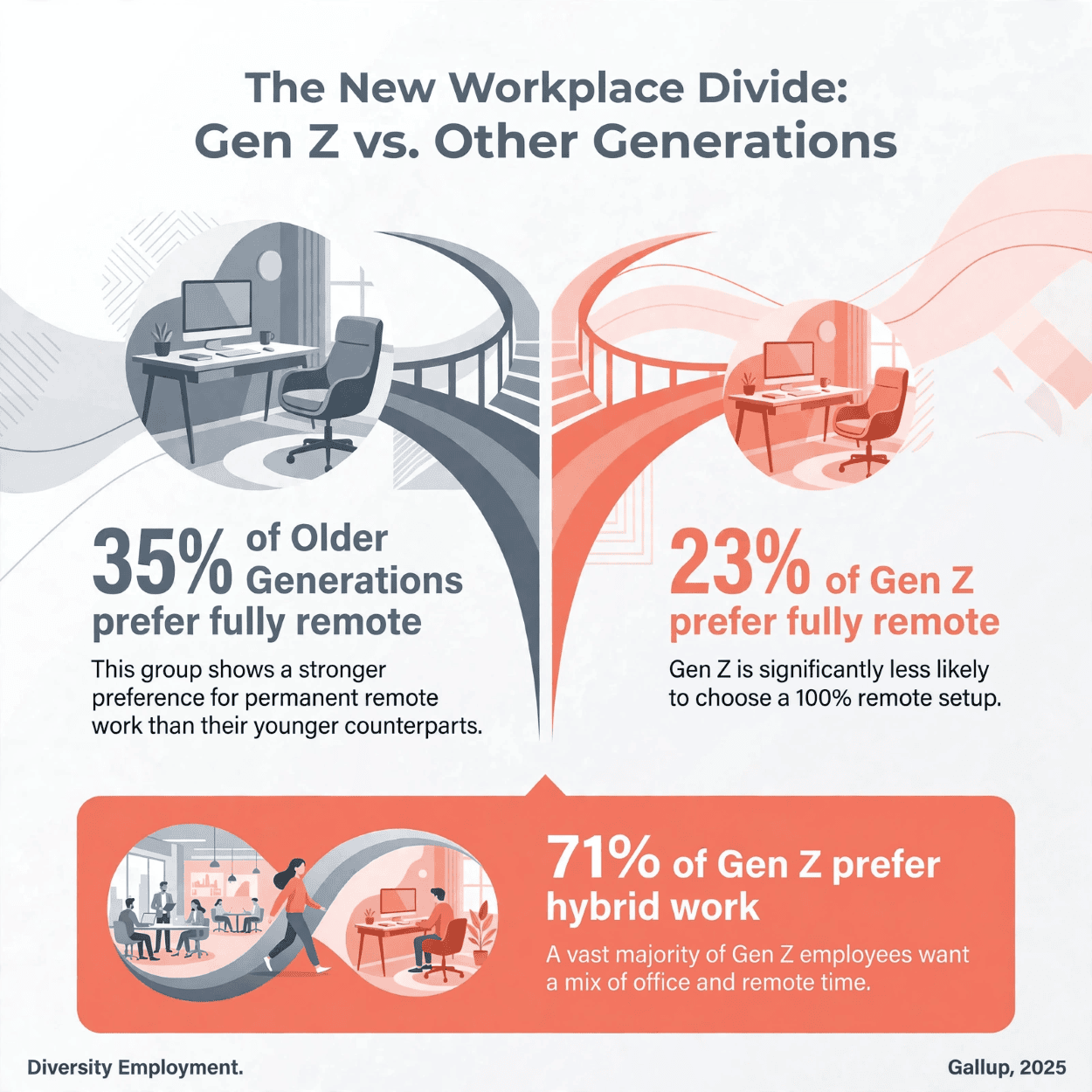
The same thing is going on here, just way earlier in the process. It decides whether someone gets hired at all, not just whether they get promoted later on. Training someone for a remote job remotely is harder than training them in a room face-to-face. Companies seem to be reacting by simply hiring less inexperienced workers in the first place. That same firm researchers studied hired less junior workers when its offices were closed. They went back to hiring them once their offices reopened. But kept only hiring more experienced people for its remote teams, specifically. That’s the most revealing aspect. The company didn’t just freeze junior hiring across the board. It made specific decisions instead. It pulled back only on jobs where it couldn’t put a new hire next to someone who already knew the job.
If you’re early in your career, you may have noticed remote-eligible entry-level job postings feel fewer and far between than they used to. That actually is a real piece of the answer (Worth knowing before you take it personally). Same goes if you’re midcareer and mentoring someone newer, officially or not. Think about how much of your relationship would actually hold up when you’re not face-to-face. You probably didn’t get good at your job by accident, someone was most likely giving you feedback along the way. A video call isn’t going to do the same thing for the person you’re training.
So, What Do You Actually Do with This
Go back to your answers from those four questions in the beginning.
Three things all point in the same direction:
- Promotions being tied to physical presence
- A manager relationship that doesn’t exist outside a scheduled meeting,
- Being fully remote rather than hybrid.
If that’s you, you’re probably closer to the stalled-out second story from earlier. No need to panic though. It’s just a reason to act, in one of three ways: 1. Push for more in-person time, strategically. 2. Document your work. Because nobody’s there to catch you in the hallway to mention it to. Or, 3. Start treating the job search itself as the lever that’s actually working in your favor.
If you’re considering a remote job offer over something local, don’t always assume it’s a downgrade if the company is smaller. Less recognizable doesn’t necessarily mean less desirable. That specific worry, about ending up somewhere smaller and less recognizable, barely costs you anything in real pay. The numbers earlier already showed that. What actually costs more is taking a fully remote job with no real hybrid option or any plans for how you’ll get face time with the people who decide who moves up.
The Choice You’re Actually Making
At Diversity Employment, we’ve noticed that most advice on this topic treats “remote jobs” as a single choice. It’s really two. There’s the choice of which job to take. And there’s the constant choice of how visible to stay once you’re in it. Both choices run under different rules. Workers who do the best long-term seem to be the ones who never confuse one for the other.
Go back to the two people who opened this piece. She’s likely still better off five years from now than if she’d stayed local. The dream job she landed simply didn’t exist where she lives. Then, he’s got the harder conversation to have with himself, because the thing holding him back isn’t the job he took. It’s the fact that he’s still doing it exactly the same way, three years in, while the rules around him subtly changed.