

Most companies already have at least one caregiving focused benefit. Too often though, that perk is based on a family from 1993… a spouse, a parent, and maybe a couple kids. The perks for caregivers usually only cover things like: Parental leave. Backup daycare. Or a dependent care Flexible Spending Account (FSA) that assumes a “dependent” can only mean someone under 13.
All of that’s helpful for parents, sure. But it really doesn’t describe or touch most of the actual caregiving that’s happening anymore.
Policy Just Hasn’t Kept Up
Sixty-three million Americans, which is close to one in four adults, are family caregivers today. That’s according to the 2025 “Caregiving in the US” report from AARP and the National Alliance for Caregiving. It’s the field’s largest and longest-running survey on this subject.
The number is up, 45 percent since 2015, to 63 million. Looking closer at where all that growth is coming from you’ll see the childcare-designed hypothesis fall apart entirely. Caregivers of adults went up from around 40 million to 59 million over that decade. That’s an increase of nearly 48 percent, while the amount of people caregiving for children stayed basically the same. The people in the current workforce with all these new caregiving responsibilities are mostly not new parents. They’re caring for parents, their spouse, a sibling, maybe a grandparent, and sometimes even more than one at a time.
SHRM put caregiving as a top-five workplace policy issue for 2026, that’s the first time it’s ever even made that list. The trend has been growing steadily for years. Now the math behind the benefit’s policy design is finally starting to get caught up.
Math Already Broke the Assumption
The inevitable was easy to see coming, all baby boomers will be 65 by 2030. The Census Bureau’s most recent projections, updated in 2023, puts the point at which Americans 65 and older outnumber Americans under 18 near 2029. That’s a whole five years earlier than their original 2034 estimate, in 2017. So, whatever five-year plan your company is working from right now, that generational crossover will happen inside it.
The workplace cost of this is already measurable, and it’s worth being precise about the number. A lot of very different figures get thrown around under the exact same headline. A peer-reviewed 2023 study in the journal Value in Health, built on nationally representative federal caregiving data, put caregiving-related productivity loss at roughly $5,600 per employed caregiver annually, or about $49 billion in combination. You’ll also see figures anywhere from $17 billion to $264 billion cited elsewhere for what looks like the same statistic. Those discrepancies come from different years, different methodologies, and in more than one case from organizations selling a caregiving benefit platform. Shocker. The $49 billion figure is the one with a transparent, peer-reviewed reasoning behind it, which makes it the number worth anchoring a business case on rather than whichever figure sounds most dramatic.
Employer Data Also Backs This
The benefits data reported backs this up from the employer’s side too. SHRM’s Employee Benefits Survey series shows parental leave is becoming much more desired:
- Paid parental leave rose seven percentage points in a single year between 2025 and 2026
- Paid family leave rose five points in that same timeframe
- Elder care referral services, tracked in that same survey, have sat at a flat 13 percent for years now
- Elder care services or information sit at a minimal 7 percent
Separately, AARP and S&P Global found that 80 percent of working caregivers believe their employer understands childcare needs much better than their understanding of adult caregiving needs. Caregivers without children at home report just 69 percent satisfaction with their company’s support, compared to 89 percent satisfaction for caregivers juggling both child and elder care at the same time. Even the “understanding” employers do have generally tends to be geared specifically towards parenthood.
Nobody needed a crystal ball to see this coming either. It simply required someone to notice that “caregiver” stopped meaning “new parent” some time ago, and that the policies they kept writing or recycling never really caught up.
Your Policy Was Written for a Fictitious Family
There’s an assumption sitting underneath almost every caregiving benefit and every federal leave protection currently in place… “If it’s not your spouse, your parent, or your child, it’s not real caregiving.” Beyond just a cultural attitude, that’s actually written into the law.
Only Three People the Law Sees
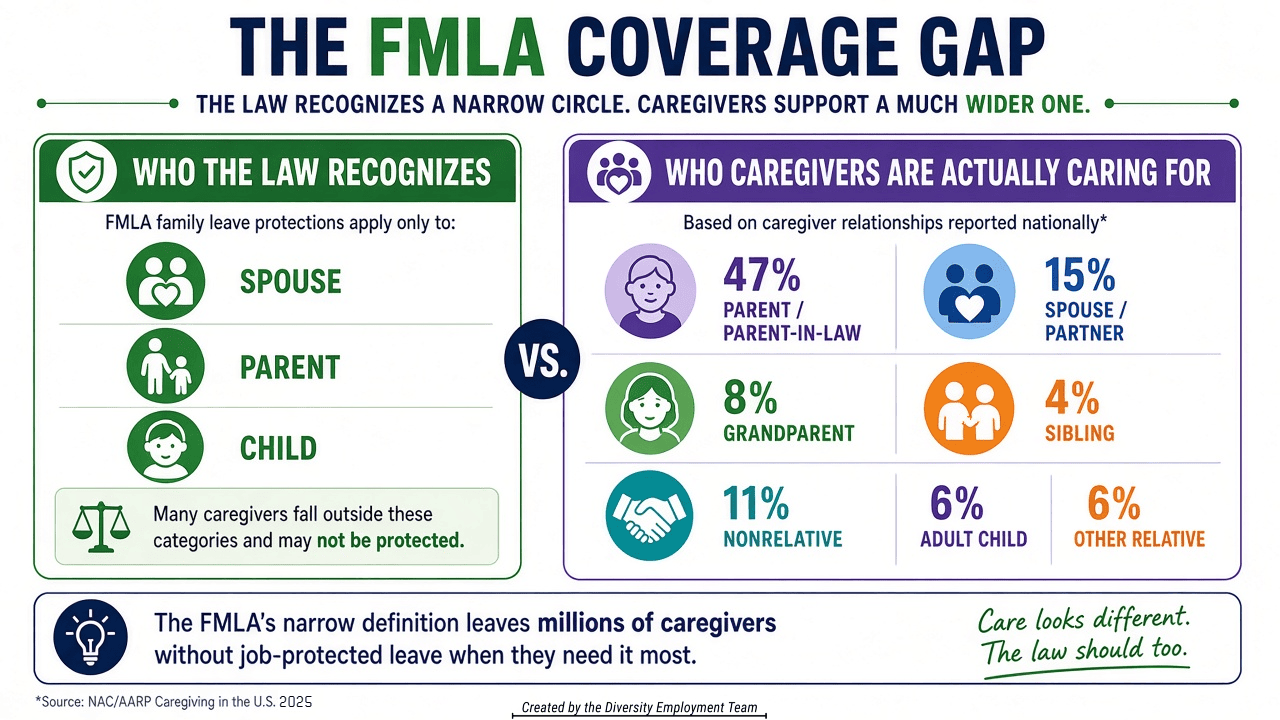
The Family and Medical Leave Act is the baseline federal protection for job-protected leave. It recognizes exactly three relationships: spouse, parent, and child. Not:
- Grandparents
- Siblings
- Parents-in-law
- Adult children without a qualifying disability
- The friend or neighbor who’s been doing hands-on caregiving for years
Compare that to what the 2025 AARP/NAC data actually shows about who caregivers are taking care of and it starts to make less and less sense.
Over One Third of Caregiving Isn’t Covered
Parents and parents-in-law together make up 47 percent of caregiving relationships, and parents-in-law aren’t covered by FMLA at all. Grandparents and grandparents-in-law account for 8 percent. Siblings and siblings-in-law, 4 percent. Nonrelatives, meaning friends and neighbors doing genuine caregiving work, account for 11 percent. Add those together with adult children and other relatives, and well over a third of the caregiving relationships in that survey fall entirely outside what the federal law recognizes as family for leave purposes. Spouses and partners only account for 15 percent of the total, and that’s what most people probably think of when they hear “FMLA caregiving.”
The Courts Are Still Redrawing the Line
Luckily, for employers trying to adapt, this isn’t fully settled. In late 2024, the Sixth Circuit Court of Appeals ruled on Chapman v. Brentlinger Enterprises, a case involving an employee denied FMLA leave to care for her dying sister. Her employer’s position was straightforward:
“The law says parent, spouse, or child, and a sister is none of those.”
The court disagreed, extending the “in loco parentis” doctrine, originally meant for people who raised a child without a formal legal relationship, to cover an adult sibling relationship where the caregiver had effectively taken on a parental role. That case is an active legal argument, happening right now; it’s a sign that the rules many employers have been treating as set in stone are still actively being litigated.
Even where the relationship clearly qualifies, plenty of employees never get their protection anyway. FMLA only applies to:
- Employees at companies with 50 or more workers,
- Who’ve been there at least a year,
- And who’ve logged at least 1,250 hours in that time.
All three boxes must be checked to qualify. By some estimates that leaves about 44 percent of the workforce not qualified, regardless of who they’re caring for. So, the disparity here is about which relationships count, and who is actually even protected at all.
Some States Have Been Proactive
Some states have already stopped waiting for federal law to catch up. California’s paid sick leave now lets employees designate a person of their choosing, not just a legally recognized relative, as covered under the policy.
Connecticut, Hawaii, Maryland, Maine, New Jersey, New York, Rhode Island, Vermont, Washington, and the District of Columbia have all expanded their own family and medical leave definitions to include some combination of siblings, grandparents, in-laws, or even domestic partners. None of it requires new federal legislation either. It just requires a state or company, deciding that its definition of family should catch up to how people actually live rather than an old list written in 1993.
Money Is the Sorting Mechanism
If the legal definition of family determines who’s protected on paper, income determines who actually gets relief in reality. At Diversity Employment, we’ve noticed this is the part of the caregiving conversation that gets skipped over most often, because it’s more comfortable to talk about generational splits or care-type splits than the real income splits.
Who Gets to Buy Their Way Out
The 2025 AARP/NAC data breaks this down cleanly. Caregivers with higher household incomes use paid help 35 percent of the time. Lower-income caregivers use it 24 percent of the time. LGBTQ+ caregivers have the lowest access to help of any kind measured in the survey, paid or unpaid, at 24 percent and 43 percent respectively. Nearly half of all caregivers report at least one negative financial impact from their caregiving responsibilities, and that number climbs sharply for lower-income and LGBTQ+ caregivers specifically. A caregiver with money can hire a home health aide, a meal delivery service, a few hours of respite care a week. A caregiver without it does the labor personally, on top of a job, without much of a, if any, safety net underneath either one.
The career effects of that inequality are exactly the kind of thing a talent strategy is supposed to avoid. AARP and S&P Global’s 2024 survey of working caregivers found 27 percent had shifted from full time to part-time work or reduced their hours directly because of caregiving, 16 percent had turned down a promotion, another 16 percent had stopped working entirely for a period, and 13 percent had changed employers altogether.
None of that shows up in a resignation letter citing caregiving. It happens when a strong performer slowly stops raising their hand for stretch assignments, or a mid-career employee has to leave for a smaller company with more flexibility. And it’s the caregivers with the least financial cushion who are least able to simply wait it out.
Getting Paid Isn’t the Same as Getting Ahead
The clearest evidence that this is actually a structural sorting problem shows up in a data point the 2025 survey tracked for the very first time. Paid family caregivers, people compensated through Medicaid self-direction programs, veterans’ benefits, or state programs, have hit 11.2 million. You might expect getting paid to be a caregiver would put someone in a better financial position than doing it unpaid. But… It really doesn’t. Paid family caregivers are:
- Younger on average
- Far more likely to still be students
- Less likely to hold a bachelor’s degree
- More likely to be Hispanic or Black
- And especially less likely to have health insurance, compared to unpaid family caregivers
In other words, getting paid to give care isn’t a step toward financial security. It’s what people do when unpaid caregiving just isn’t financially survivable.
The Market You’d Refer People to Is Also Breaking
There’s a common reaction in HR conversations about this. If someone can’t manage caregiving and a job at the same time, tell them to hire some help. That assumes there’s enough paid care out there to go around though. There isn’t, at least not at a price most families can actually afford.
PHI, the leading research organization tracking the direct care workforce, put the median hourly wage for direct care workers at $17.36 in 2024, with median annual earnings just under $26,000. Thirty-six percent of that workforce lives at or near the poverty line. Federal analysis found that home health and personal care aides are paid, on average, about $3.15 an hour less than workers in other entry-level jobs like retail or customer service. They’re paid less even though that work requires more technical and interpersonal skill.
There’s Not Much Slack
The home health and personal care field is overwhelmingly staffed by women, people of color, and immigrants. The PHI projects about 9.7 million job openings in direct care between 2024 and 2034, once turnover and retirements are factored in. That’s not a labor market with much slack to spare. It’s the same underpaid and understaffed groups that family caregivers are being told to go hire.
Employers that offer a benefit that supports or even refers employees to backup home care are doing something genuinely useful. They’re just doing it in a market that can’t currently supply what’s being promised. That’s the kind of thing worth knowing before building a benefit strategy around an assumption that paid help is simply a phone call away.
Where This Goes from Here
None of this will smooth over on its own. A 2025 peer-reviewed analysis in Innovation in Aging showed the trajectory of unpaid family caregiving costs through 2060. It found the replacement cost of that unpaid labor will roughly triple by midcentury. It’s currently estimated to be between $96 billion and $182 billion annually. The related opportunity costs, forgone wages, lost productivity, and lost tax revenue combined are projected to grow even faster than the caregiving cost itself over that period.
A Growing Disparity
That same analysis found the problem won’t look the same as it does today. Latino caregivers currently account for roughly a quarter of the replacement cost and a fifth of the opportunity cost tied to dementia caregiving specifically. And they are projected to account for closer to half of both by 2060. Caregiving is already unevenly distributed by income. The data suggests it’s going to get even more unevenly distributed by race as the population ages further.
The timeline is shorter than most benefits planning cycles account for. By 2030, one in every five Americans will be of traditional retirement age, according to the Census Bureau. Companies building a three-year benefits plan right now are building it for a workforce that will look profoundly different by the time that roadmap runs its course.
What to Actually Check in Your Own Policy
Most of what’s broken in this is legal and structural, which can feel like something only Congress or a court can fix. Some of it surely is. But an important part of it is in the decisions your company already controls, at close to zero cost.
Take a Serious Look
Read your own leave and PTO policy’s definition of “family.” FMLA sets a legal floor. It does not set a ceiling. If your company-provided paid leave, bereavement policy, or PTO carryover rules copy the FMLA’s spouse-parent-child list, that’s the choice your company made, not the requirement. Expanding the definition to match how your workforce actually defines family, siblings, grandparents, in-laws, or chosen family, costs very little and closes a very real gap.
Critical Mass, a marketing agency, built a program offering five days of flexible, paid eldercare leave a year, on top of existing vacation and sick time. Specifically because its standard leave categories didn’t cover what employees caring for aging parents actually needed. It’s a small, low-cost example of the same principle: the policy needs to adapt to match reality instead of asking employees’ to adapt to a policy.
Check who’s actually getting your caregiving benefits. If telecommuting, flexible scheduling, and paid family leave are only there for salaried employees, you’ve built a benefit that only reaches the people who already have the most room to manage a crisis, and misses the people most likely to have to reduce hours or leave entirely.
Stop treating a referral to paid care as a complete solution. A backup-care benefit is a useful thing to offer. It’s just not a substitute for flexibility. And it definitely shouldn’t be portrayed like the caregiving problem magically ends as soon as the employee has a phone number to call.
Ask whether your managers know the difference between legal minimums and company generosity. A manager telling an employee “That’s not immediate family, so there’s nothing I can do” may just be repeating an FMLA-shaped assumption that has nothing to do with what your company’s actual policy allows.
Redefining “Family”
None of the individual pieces here are a secret.
- Employers generally know the population is aging.
- HR professionals, mostly, know FMLA is too narrow.
- Benefits teams know eldercare support lags a bit too far behind childcare support.
What’s missing is putting all those pieces next to each other. The current ‘legal definition’ of family already excludes a third of real caregiving relationships. The benefits system mainly reaches the people who need it least, and we have a paid care market that’s too strained to absorb what employers are hoping will help. Fixing any one of those by itself won’t hold. The caregiver your policy doesn’t recognize isn’t a rare edge case you can accommodate with an exception. The data says they’re already the majority you’re actively failing to plan for.