

Applications for commercial electrical apprenticeships jumped more than 70% between 2022 and 2024, according to Quartz. In Chicago, the electricians’ union local gets more than 1,000 applicants a year for just about 200 apprentice spots, and recently got over 4,000.
Then there’s the other number. This year the Department of Labor started publishing how many registered apprentices actually finish, and for the most recent group it measured… More people actually quit than graduated. Of the 198,223 apprentices due to finish in fiscal year 2024, only 92,174 completed. While 95,640 cancelled.
The Advice Is Everywhere
“Just learn a trade” has become the default advice for anyone without a four-year degree. Parents say it, school counselors say it, a whole lot of social media says it, and the “AI can’t swing a hammer” angle has made it even louder.
And to be fair, it’s not all bad advice. Electricians earned a median of $62,350 in 2024, and that field is projected to grow 9% by 2034, per the Bureau of Labor Statistics. Plenty of people build really good lives in the trades.
Getting In, Then Getting Through
The problem is where the advice stops. “Learn a trade” skips two things that probably decide how it goes for you.
The first is getting in. The programs most likely to carry you all the way through are, a lot of the time, the hardest ones to get into. The second is year one, which is when most of the people who quit actually quit, and it’s the one year the official completion numbers don’t fully count.
The Trades Boom Is Real, Just Smaller Than the Headlines
If you’ve read anything about Gen Z and the trades, you’ve probably seen some version of “trade school enrollment is up 1,421%.” It’s a real number. It just doesn’t mean what it sounds like.
Where “1,421%” Comes From
The figure comes from Validated Insights, a higher education marketing firm, and as Quartz pointed out, it’s mostly a calendar effect. Gen Z, born 1997 to 2012, was barely old enough for trade school in 2017. Of course their enrollment exploded once they aged into it.
Look at skilled-trades schools specifically and the picture calms down a lot. In the firm’s own October 2024 report, enrollment at those schools was shrinking about 4.2% a year before the pandemic, then grew about 1.2% a year from 2020 to 2023. Search interest in trade school grew around 10% a year over the same stretch. Lots of people are curious. Way fewer actually sign up.
What Actually Grew
Some of the growth is real, though. Community colleges focused on vocational programs made up 19.7% of public two-year enrollment in fall 2025, up from 15% in 2020, according to National Student Clearinghouse data.
Registered apprenticeships have grown too, to 702,191 active apprentices in fiscal year 2025. But that growth is slowing. Jobs for the Future found year-over-year growth peaked at 6.2% in fiscal 2023 and has been sliding since.
It’s Not One Big Shortage
The demand side is real as well. A new report from the Alliance for America’s Skilled Trades, put together by Jobs for the Future and the Burning Glass Institute, projects about 1.7 million skilled-trades openings every year through 2035, with formal training producing about 55 workers for every 100 needed, as Community College Daily reported.
The same report is careful to say there isn’t one single national shortage, though. It depends heavily on which trade and where. Industrial machinery mechanics rank in the 98th percentile for shortage pressure. Electricians rank in the 85th. That’s worth remembering any time someone says “the trades” like it’s one job.
What the Completion Rate Doesn’t Count
For years, there wasn’t an easy public answer to a simple question: “How many apprentices actually finish?” That changed in March 2026, when the Labor Department published guidance on how completion rates are calculated and launched a public completion rate portal on Apprenticeship.gov.
About Half Finish
Across all industries, about 51% of apprentices finished in the groups due to wrap up in fiscal years 2016 through 2018. Starting with fiscal 2019, it dropped to about 47%, and it never came back, even for groups due to finish years after job sites and classrooms reopened. For fiscal 2024, the rate was 46.5%.
Some industries do a lot better than others:
- Utilities: 66.1% finished
- Manufacturing: 62.5%
- Construction: 44.6%
- Transportation and warehousing: 34.5%
The Alliance report reached a similar place using a different dataset. Of every 100 people who start a skilled-trades apprenticeship, 48 complete it, and 29 are working in a trade occupation within five years of leaving the program.
In Construction, More People Quit Every Single Year
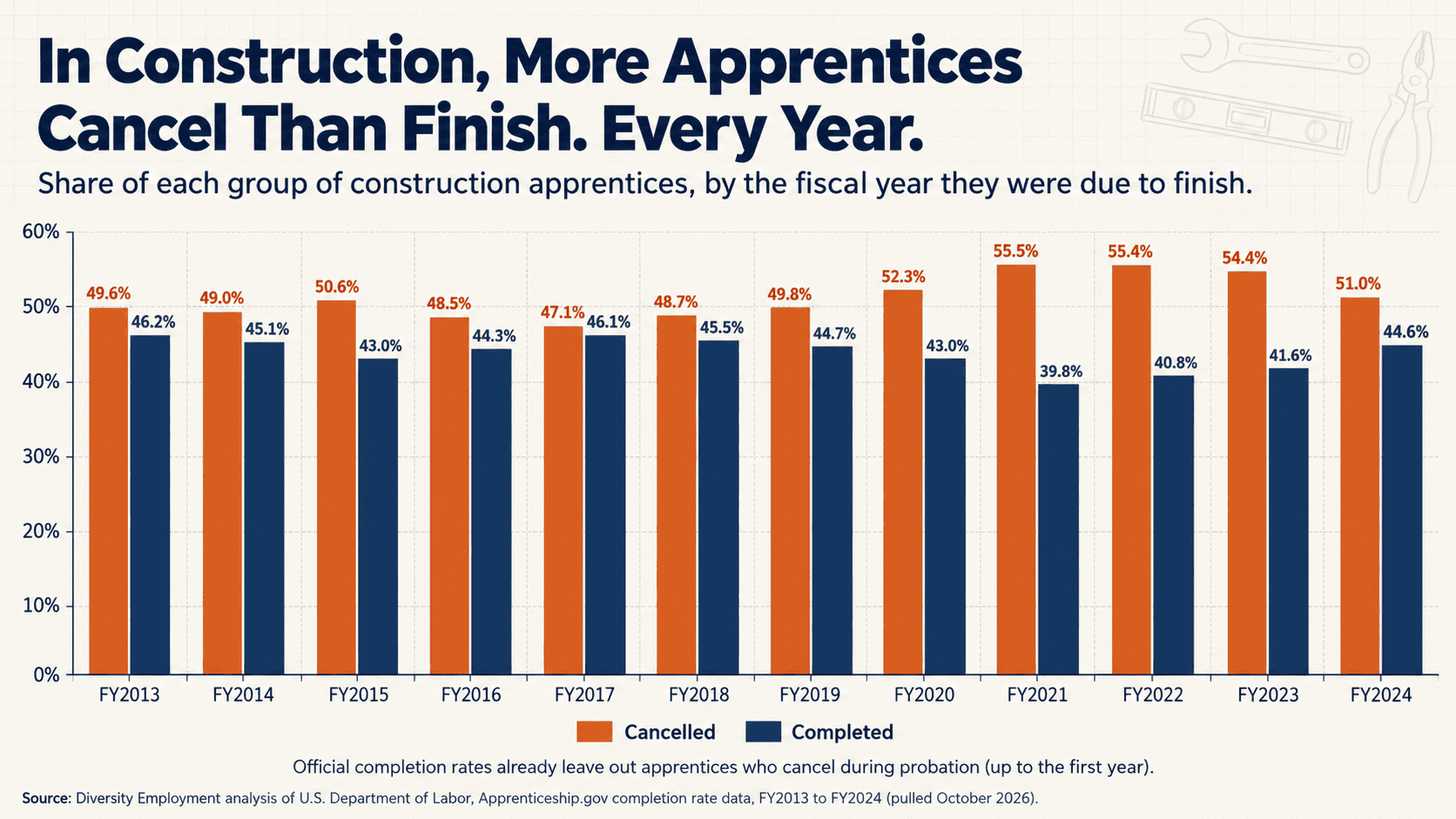
Here’s what stood out when we pulled the construction numbers ourselves. In every group the portal reports, from fiscal 2013 through fiscal 2024, more construction apprentices cancelled than completed. Every year. In fiscal 2024, 51.0% cancelled and 44.6% finished.
And as the whole system grew, so did the number of people walking away. Nationally, cancellations went from 30,716 in the fiscal 2013 group to 95,640 in fiscal 2024. Some of that early number is low because a handful of states weren’t reporting individual records yet, so treat the exact multiple loosely, but the direction is pretty hard to argue with.
Created by the Diversity Employment Team
The Year That Doesn’t Count
Now the part almost nobody mentions. The federal definition of a completion rate leaves out anyone whose apprenticeship was cancelled during the probationary period. That probation can run up to a year, or a quarter of the program, whichever is shorter.
That’s a big deal, because the first year is when people leave. In a study of more than 335,000 construction apprentices, University of Washington researchers found 20.3% cancelled in their first year alone, and the odds of quitting dropped every year after. Jobs for the Future flags days 90 and 180 as the highest-risk points.
So when “more people quit than graduated” shows up in the official numbers, that’s already the flattering version. The people who washed out during probation aren’t in it.
Five Questions to Ask Any Program Before You Sign
None of this means “don’t do it.” It means pick carefully, and ask the questions programs don’t always volunteer answers to. Ask them out loud, and write down what you hear.
- “Of everyone who started, including people who left during probation, how many finished?” The national rate is about 46%, and that’s already leaving out probation quits. Above 60% is strong. If they only quote you a number that skips probation, ask for the other one. You can also check rates by state, industry, and occupation on the Labor Department’s portal, and some states, like California, publish program-level rates.
- “What will I make in year one, and when do the raises kick in?” Get the actual wage schedule, not the journeyman rate.
- “What happens to me when work slows down?” Ask about layoffs, how they handle out-of-work apprentices, and how long people typically wait between jobs.
- “Is there a repayment agreement if I leave?” Plenty of “free” programs come with one.
- “Who’s my mentor, and is there any help with tools, gas, or childcare?” These sound like small things. They probably aren’t.
The Seats That Finish Are the Hardest Ones to Get
Not all apprenticeships are built the same, and the differences show up in who finishes.
Not Every Trade Has the Same Odds
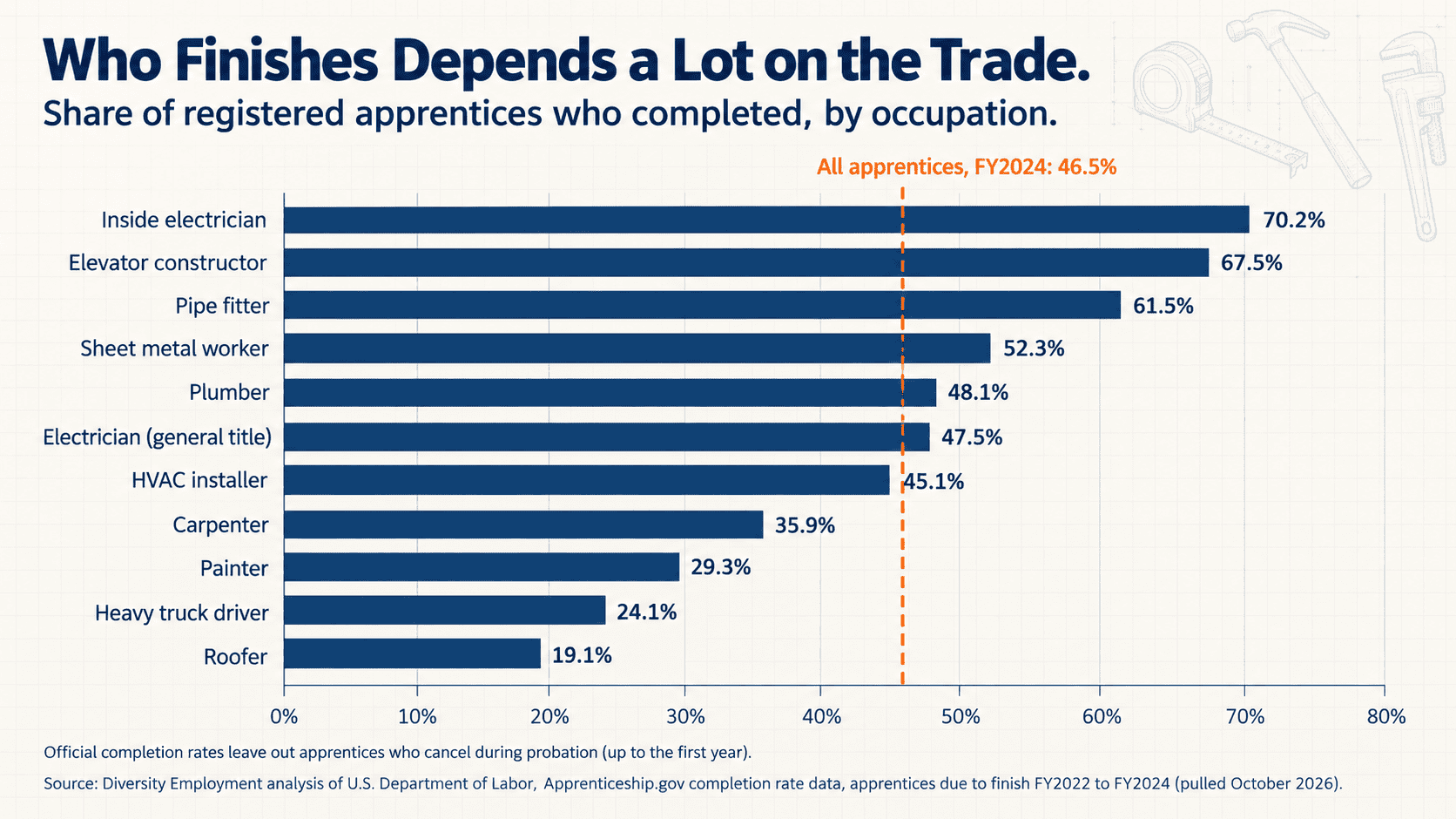
We pulled three years of the Labor Department’s completion data by occupation, covering apprentices due to finish in fiscal 2022 through 2024. Here’s how a few common trades compared:
- Inside Electrician: 70.2% finished
- Elevator Constructor: 67.5%
- Pipe Fitter: 61.5%
- Sheet Metal Worker: 52.3%
- Plumber: 48.1%
- Electrician (general title): 47.5%
- HVAC Installer: 45.1%
- Carpenter: 35.9%
- Painter: 29.3%
- Heavy Truck Driver: 24.1%
- Roofer: 19.1%
Fewer than 1 in 5 roofing apprentices finished. One quick note: the Labor Department files some trades under more than one title, so the electrician numbers depend a little on which label a program used.
Created by the Diversity Employment Team
Union or Non-Union
Sponsorship matters too. In that same University of Washington study, non-union construction apprentices had about 1.77 times the odds of cancelling. An older Aspen Institute analysis of national data found union electrical apprentices completed at 47%, compared with 33% in non-union programs.
Some of that is probably selection. Programs that are harder to get into likely pick people who were more likely to finish anyway. But researchers also point to things union programs tend to do, like rotating apprentices across contractors so they actually learn the whole trade, and keeping them attached to a program between jobs.
The Waitlist Problem
Here’s the catch. The programs with the best odds of finishing are often the ones turning people away. The electrical training center in Ann Arbor, Michigan gets up to 1,200 applicants a year for 30 to 60 slots. One New Jersey local capped its 2025 application window at 100 applications per program.
Programs mostly take apprentices when there’s work lined up for them, so intake rises and falls with the local job picture. Big money is trying to widen the door. Google pledged funding aimed at growing yearly intake for electrical apprenticeships from 19,500 to 30,000, per Quartz. That’s still a lot of people on lists.
If that sounds a lot like the corporate hiring process, it kind of is. We wrote about why the hiring funnel is full for office jobs, and the trades have their own version of it.
Residential Is Shrinking. Data Centers Aren’t.
The construction job market is splitting in two right now. Residential construction has lost 32,800 jobs over the past year, its nineteenth straight month of year-over-year decline. Nonresidential construction added 142,000 jobs over the same stretch, largely driven by data centers.
That matters for completion. Some of the easiest doors to walk through, like roofing, painting, and drywall work, lean heavily residential. They also tend to have the highest dropout rates. So the trades that are simplest to start in may simply be sitting on the shrinking side of the market.
How Getting In Actually Works
For a lot of union programs, especially electrical, the process looks roughly like this:
- An application, usually with a high school diploma or GED and a minimum age
- An aptitude test covering algebra and reading comprehension
- An interview, scored and combined with the test
- A spot on a ranked list, which programs work down as openings come up
- A drug screen before you start
Ranked lists are typically good for one or two years, and you can usually retest after a waiting period. Portland’s electrical training center, for example, lets applicants retest after three months.
A few things that probably help:
- Apply to more than one program. Different locals, different trades, and non-union “merit shop” programs all run their own lists.
- Study for the test. Passing just gets you on the list. Your rank is what gets you called.
- Get a helper job while you wait. Prior experience can earn you credit and a clearer picture of the work.
- Be careful with pre-apprenticeship programs. They can help you get ready, but Jobs for the Future estimates most participants never make it into a registered apprenticeship. Ask whether the program has seats reserved with actual apprenticeship programs.
Why People Actually Leave
The Labor Department doesn’t publish why apprentices quit. When sponsors do log a reason, it’s often useless. In 2011, the reason recorded for 77% of cancellations was simply “cancellation,” the Aspen Institute found. Rhode Island is one of the few places that collects real reasons.
So the best picture comes from surveys and program evaluations. Put together, they point to money, miles, early mornings, and mentors, a lot more than grit.
The First-Year Paycheck
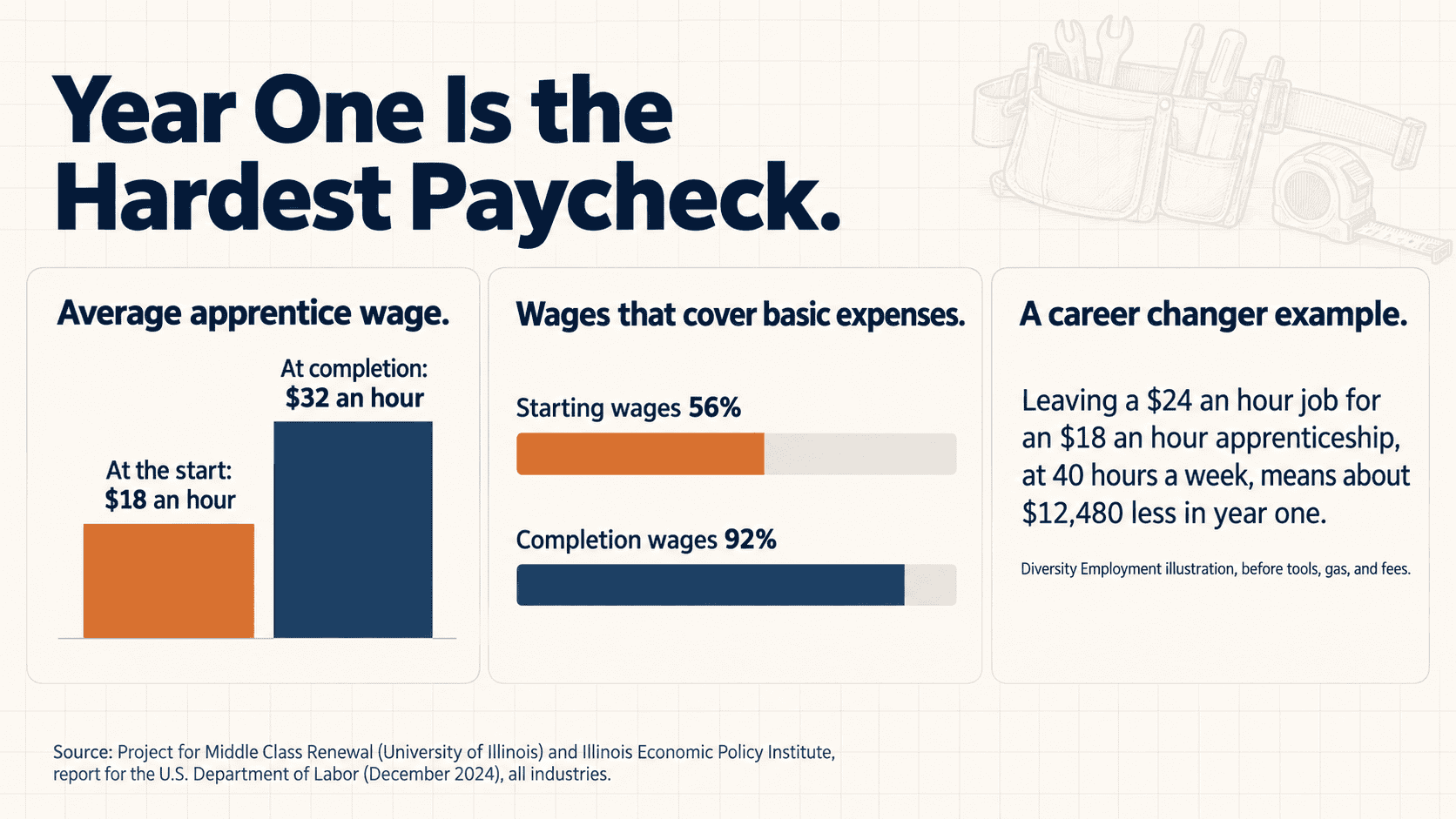
Across all industries, apprentices averaged about $18 an hour at the start and $32 an hour by completion, according to a report done for the Labor Department. Only 56% of starting wages were enough to cover basic expenses. By completion, it was 92%.
In a study of union electrical apprentices by the American Institutes for Research, low wages were the main reason non-completers gave for leaving. More than 40% of the apprentices still in the program said their wages were low, startup costs were high, and they had little or no savings.
That same study found programs with higher tuition and fees tended to lose more people. Which makes sense. The first year is when the pay is lowest and the costs show up all at once.
The Miles
Construction moves. The job site changes when the project ends, and apprentices are expected to get there. 51% of the electrical apprentices in that study said affording travel costs like gas and overnight stays was a challenge.
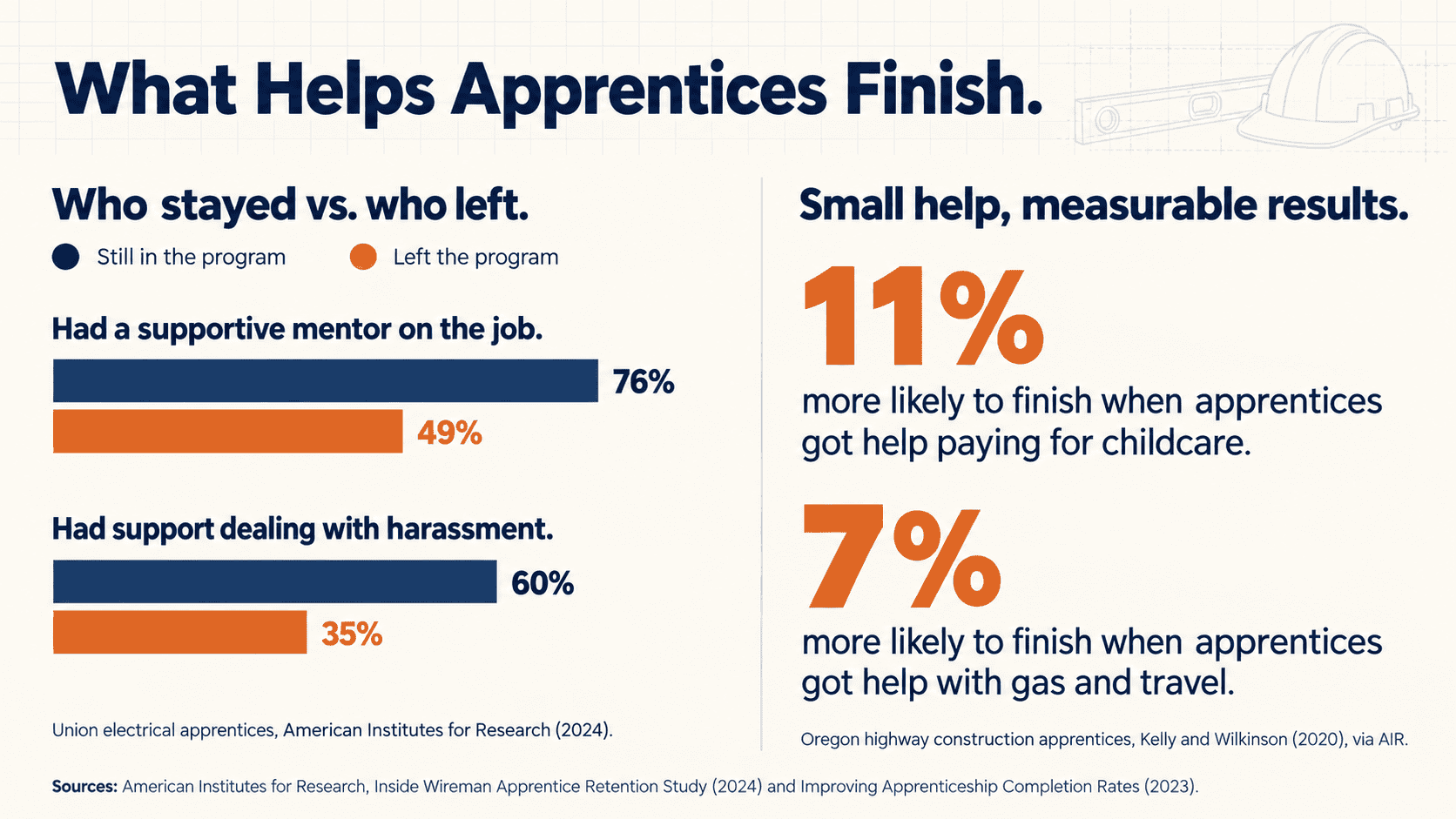
When an Oregon highway construction program helped apprentices with gas and travel, they were 7% more likely to complete, according to an evaluation summarized in an AIR review of the research.
The Mornings
One apprentice in the AIR study described getting up before dawn for a full day of manual labor, then sitting through about three hours of class after work, twice a week. Miss a class and your pay can get held. Now add kids.
34% of apprentices in the study had trouble managing childcare around their work schedules. In the Oregon program, apprentices who got financial help with childcare were 11% more likely to complete. Researchers also found that apprentices with childcare responsibilities sometimes get read as less committed by the people supervising them.
We’ve covered both sides of this before, in how schedules shape whether hourly workers stay and in the caregivers most workplace policies don’t cover. Apprenticeship might be the clearest example of both landing on the same person.
The Mentor You Do or Don’t Get
This one might be the biggest. In the AIR study, 76% of current apprentices said they had a supportive mentor on the job. Among the people who left, it was 49%. Support dealing with harassment showed the same pattern: 60% versus 35%.
The older Aspen research is full of stories about apprentices doing a whole lot of sweeping and very little learning. One electrical apprentice described a coworker who pushed a broom for basically a year, got told not to ask questions, and quit. And one Oregon evaluation found social support raised the odds of finishing more than the financial help it studied.
Created by the Diversity Employment Team
The Head Start Some People Bring
Some apprentices show up already knowing how the trade works, usually because someone in their family does it. Everyone else learns on the fly. In the AIR study, 41% of apprentices said they didn’t really understand that construction work is cyclical, and 37% said they didn’t have a realistic picture of the work itself. Apprentices with prior experience in the trade were noticeably better informed going in.
Researchers have even documented hostility on job sites tied to whether an apprentice comes from a family in the trades. It’s the same unwritten rulebook we wrote about in Gen Z’s lost hidden curriculum, just with tool belts.
Who Finishes
If you’re switching careers in your 30s or 40s, here’s some decent news. In our pull of the Labor Department data for fiscal 2022 through 2024, apprentices ages 25 to 54 finished at 47.3%, slightly better than those 24 and under at 45.2%. Those 55 and older finished at 42.9%.
The bigger differences show up in construction. There, women finished at 32.9% compared to 42.7% for men, and Black apprentices finished at 28.9% compared to 45.2% for white apprentices. Women are only about 5% of construction apprentices to begin with, per the Institute for Women’s Policy Research. Researchers tie these differences mostly to the things above: access to mentors, harassment, and fewer hours of work.
Where you live plays a big factor too. In the University of Washington study, cancellation rates ranged from 28.7% in the Middle Atlantic states to 47.1% in the West South Central region, which includes Texas.
When the Work Dries Up
Construction runs in cycles, and apprentices are usually the first to feel a slowdown. You can’t log on-the-job hours when there’s no job.
What Happened Last Time
During the Great Recession, the Aspen Institute found 55% of construction apprentices who started in 2008 had cancelled by May 2012. For those who started in 2006, before the downturn, it was 44%, even though they’d had years longer to drop out.
Nationally, active apprentices fell from 442,386 in fiscal 2008 to 357,692 in fiscal 2011, according to Labor Department figures. One Milwaukee apprentice summed up the choice pretty bluntly: Sit on layoff and collect a much smaller check, or take a non-union job somewhere else and take care of your family.
Unemployment Benefits Keep Apprentices in the Trade
Here’s a connection that doesn’t get talked about much. In the Oregon highway construction evaluations, apprentices who got unemployment insurance when they needed it, during layoffs or class periods, were more likely to complete. Individual income was the factor most associated with finishing, followed by receiving those benefits.
Research from the University of Utah also found that during downturns, apprentices in union programs tended to stay in their programs longer before leaving.
In other words, the safety net helps decide who’s still around when the work comes back. We wrote about how benefits run out in the long job search, and you can check unemployment benefits state by state before you ever need them.
Reading Today’s Market
Nobody knows for sure what the next year looks like. The economy added only 29,000 jobs in September, and construction is split between a residential slump and a data center boom. That doesn’t mean a slowdown is coming. It just means anyone starting an apprenticeship right now should probably plan for the possibility, especially on the residential side.
Jobs report update: The next federal jobs report, covering October, is due Friday, November 6th. We’ll update this section with the new numbers once it’s out.
The Fine Print on “Free” Training
A lot of union apprenticeships advertise little or no tuition, and that’s true as far as it goes. But many of them come with a contract attached.
Scholarship Loan Agreements
They’re usually called scholarship loan agreements. The training is treated as a loan that gets forgiven as you work for contractors who pay into the program. Leave, or go work for a non-union shop in the same trade, and you may owe it back.
- One Idaho electrical program’s sample agreement values training at $2,500 a year, or $10,000 over four years, with the full balance due on a breach.
- Tulsa’s program asks apprentices to work for a union contractor for five years after finishing or reimburse classroom costs.
- An Indiana program notes you may owe a portion even if you leave during probation.
- In a recent Washington appeals case, a sheet metal program’s loans carried 10% annual interest.
Interestingly, the AIR study found programs that used these agreements tended to lose fewer apprentices. It’s the same basic idea as the stay-or-pay clauses showing up in regular offer letters, just older and better established.
Why the Trades Do This
It comes down to poaching. A program spends years training someone, and another company can hire them away the moment they’re useful. We dug into that exact problem in why nobody wants to train the next generation of experienced workers, and the trades show it in its most literal form.
It’s happening right now. Non-union contractors have said data center projects are poaching apprentices out of their programs, which they say drives exits and makes completion numbers look worse.
Truck Driving and Other Repayment Traps
Repayment agreements aren’t only a union thing. The Consumer Financial Protection Bureau flagged training repayment agreements in 2023 as something that can trap workers in jobs, with trucking among the industries drawing complaints. Heavy truck driving apprentices finished at just 24.1% in our pull of the federal data. If a program asks you to sign anything about repaying training, read it before day one.
Quitting Isn’t Always Leaving the Trade
Not every cancellation is a failure, either. Some people leave because a contractor offers more money now. A Mathematica study found registered apprentices who completed earned an estimated $240,037 more over their careers, and the average across all participants, including people who cancelled, was still $98,718, the Aspen Institute reported.
But that argument only goes so far. Remember the Alliance number: Of 100 people who start a skilled-trades apprenticeship, only 29 are working in a trade within five years of leaving it.
Trade School or Apprenticeship?
People tend to lump these together. They’re really different paths, especially in year one.
Paying to Learn vs. Getting Paid
A trade school certificate usually costs money upfront. An apprenticeship pays you from the first day. An EDsmart Data analysis of College Scorecard data found electrician certificate graduates left with a median of $12,727 in federal loans and earned $36,261 in their first year, rising to $48,864 by year five. That’s a long way from the $62,350 median you’ll see quoted for electricians.
A Certificate Can Be a Door In
That doesn’t make certificates a bad move. Prior training can count toward an apprenticeship, and it seems to help. The Aspen Institute found apprentices who came in with credit for previous training or experience completed at 37%, versus 31% for those without it. If you’re looking at a certificate, ask whether apprenticeship programs near you will give credit for it.
Neither Path Finishes Automatically
The Alliance report found almost the same completion pattern for both paths. Of every 100 students who enter a skilled-trades program at a college, 48 complete and 34 eventually work in a skilled trade. The authors caution that the school and apprenticeship numbers come from different datasets and shouldn’t be compared directly, but the takeaway holds: Finishing isn’t automatic either way.
The New 70% Benchmark
Starting in July 2026, short training programs of 8 to 15 weeks can qualify for federal Workforce Pell Grants, but only if at least 70% of students complete and at least 70% land jobs, per the Education Department, with tuition limited based on what graduates earn. A short course and a four-year apprenticeship aren’t the same thing. Still, it gives you a useful line in your head for what “good” looks like when a program quotes its numbers.
Year One, in Dollars
Every program is different, but here’s roughly what to plan for in the first year:
- Pay: Around $18 an hour on average at the start, and many programs start apprentices at a percentage of the journeyman rate, with raises at set steps.
- Tuition and fees: Anywhere from $0 with a repayment agreement to a thousand dollars or more a year, plus small fees like the $15 application fee Tulsa’s program lists.
- Books: Tulsa’s program puts them at around $650 a year.
- Tools: Most programs publish a required hand tool list. Jot down the list before you buy, and budget a few hundred dollars.
- Getting there: A reliable vehicle, gas, and sometimes overnight stays for distant job sites.
- Childcare: Including early mornings and class nights.
- Layoff cushion: A few weeks of expenses to cover time between jobs, plus knowing how unemployment works in your state.
For career changers, the paycheck is usually the hardest part. Say you’re making $24 an hour in a warehouse. Dropping to $18 at 40 hours a week is about $12,480 less in year one, before tools and gas. Some people bridge that with side work, which we looked at in when you can’t change jobs, you add one. Just know the schedule may not leave much room for it.
Created by the Diversity Employment Team
Where the Money Goes
The federal push behind apprenticeship is mostly built around getting people in the door. That’s simply how the formulas are written.
The Labor Department’s $85 million in state apprenticeship grants this year gives each state a $500,000 base and splits the rest by each state’s share of active and new apprentices, per the grant guidance. How many finish isn’t part of the formula.
A separate incentive program, with about $162 million awarded this summer, pays sponsors through industry groups, and sponsors could start applying for its latest round on November 2nd. The only payment the rules require comes once an apprentice hits 90 days. Later payments vary by group. The fund covering construction and electrical trades for data centers and similar projects, run by Jobs for the Future, pays $3,750 at 90 days and another $2,250 at completion or after 12 months, according to the Signatory Wall and Ceiling Contractors Alliance. At least one other group, for auto repair, pays $1,800 when apprentices complete.
To be fair, publishing completion rates at all is a real step forward, and it’s what made a lot of this article possible. Some states are going further. California pays a $1,000 completion bonus to sponsors of nontraditional apprenticeships, and Rhode Island tracks why people leave, as VoTech News laid out. And Jobs for the Future estimates each one-point improvement in the national completion rate would prevent roughly 3,000 cancellations a year.
Better Advice Than “Just Learn a Trade”
If you’re a parent, counselor, or mentor, you don’t have to stop recommending the trades. The advice just needs a few more words.
Change the Script
Instead of “just learn a trade,” try something closer to: “Which trade? Which program? And how are you going to get through year one?”
Then help with the parts nobody budgets for. Help them prep for the aptitude test. Help them apply to more than one program. Ask about the five questions above together. Maybe cover a set of tools, or a few tanks of gas, or a backup childcare plan for class nights. Small help in year one seems to matter more than almost anything else.
And programs can change too. One Ohio electrical training center rebuilt its orientation and first-year training after looking at where apprentices were dropping out, and now roughly 90% make it through the first year, according to Jobs for the Future’s CEO.
Where to Start
At Diversity Employment, we’d honestly rather send someone into a program they’ll finish than onto a list they’ll age off of. Start with the trade you’re actually interested in, look at local programs, check the completion numbers, and ask the hard questions before you sign anything.
Getting In, Getting Through, and Staying
The trades really can be a great path without a four-year degree. But “learn a trade” is the starting line, not the plan. Getting into a program with good odds, surviving the year that the official numbers skip, having a cushion when work slows down, and reading the fine print on “free” training probably matter more than the decision to pick up a tool belt in the first place.
So the next time someone says “just learn a trade,” the best follow-up is which program, and whether you can actually make it through year one.