

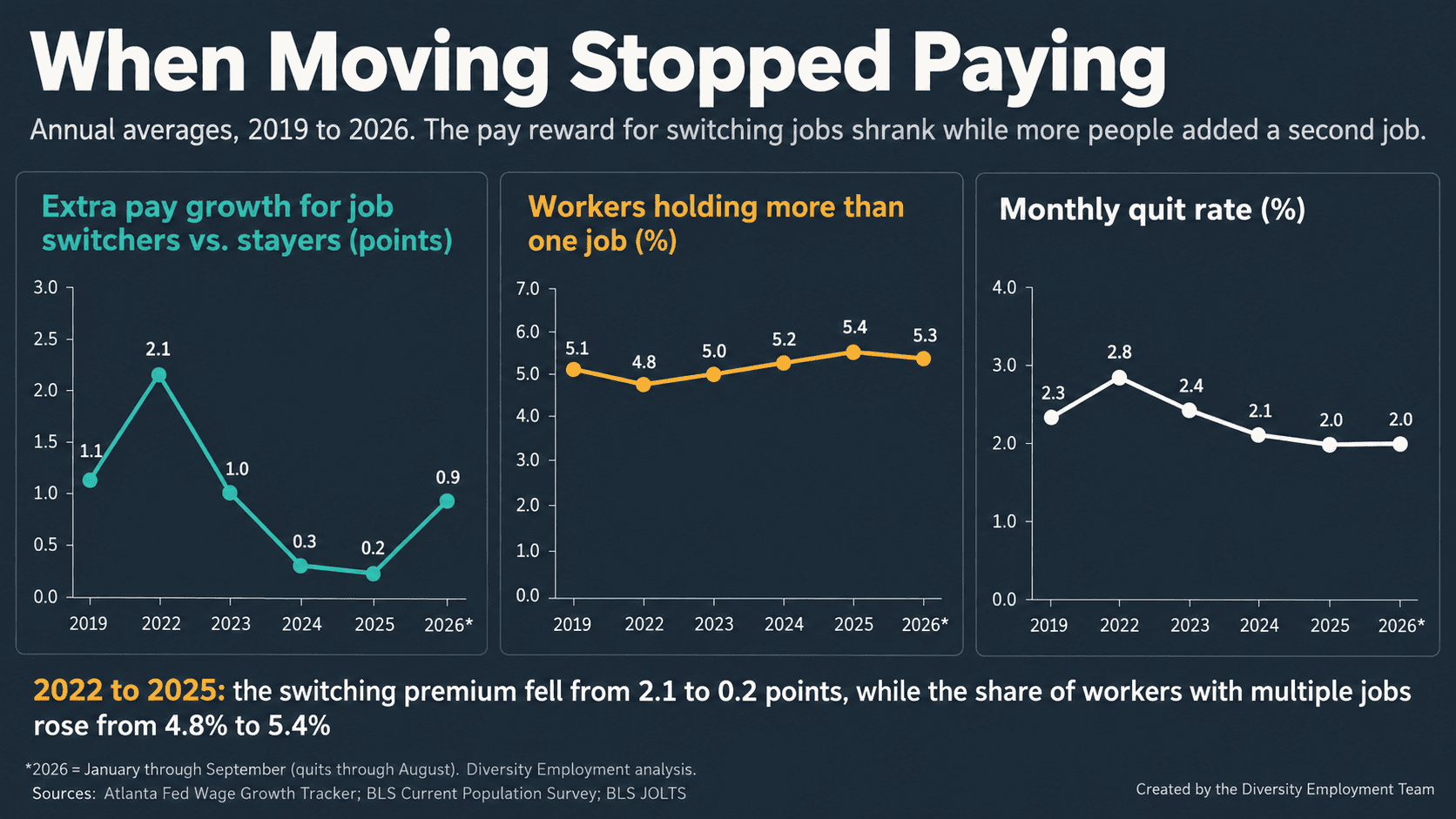
In 2025, switching jobs barely paid anymore than staying where you’re already at. Workers who changed jobs saw their pay grow by only about 0.2 points faster than workers who stayed put. That’s the smallest edge for job moving since 2010. But what about people getting a second job?
The most common second job in America right now isn’t a side hustle. It’s the same job, again. In Indeed’s data, people holding more than one job are most likely a nursing assistant working a second nursing assistant job somewhere else.
Those two facts begin to show a pattern. About 9 million people now work more than one job. And in 2026, nearly all of that increase has come from women.
A Raise From Somebody Else
Think about what that nursing assistant is actually doing. She most likely can’t just get a meaningfully better job offer at another facility right now. But she can get another facility’s wage for part of her week, without giving up the job she already has. That’s a job change done in halves.
Which raises the real question for anyone working two jobs, or thinking about it: “Is this second job solving my problem, or just postponing it?”
The Second Job Comeback, Not Record
In September 2026, 5.5% of employed people held more than one job, according to the Bureau of Labor Statistics. Not seasonally adjusted, that’s 9.0 million people (BLS Table A-16, released October 2nd, 2026).
That sounds like a lot, and it is. But that rate isn’t new territory. It ran between about 6% and 6.5% in the mid-1990s, drifted down to around 4.8% through the 2010s, then fell to 4.0% in April 2020 when the pandemic wiped out a bunch of part-time work. It’s been climbing back ever since the pandemic ended.
Why the Count Looks Like a Record
You may have seen “record” headlines about multiple jobholders. They’re technically right about the technical count, and that count is high mostly because there are simply way more working people than there were in 1996.
The Richmond Fed put it plainly in September 2026: This is a recovery, not a new high. The rate is just about back to where it stood around the turn of the century.
The Real Number Is Probably Higher
The official 5.5% is a floor, though. The monthly survey behind it tends to miss informal and gig work, and people often don’t think of a few delivery shifts as a “job” when a surveyor asks.
- Census administrative records put the rate at nearly 8% in 2018, about 3 points above the survey number for the same year (Census Bureau).
- Indeed found that nearly 16% of its active job seekers already held more than one job at the end of 2025. That’s a group that is already out looking, so it naturally runs higher.
- The honest range is probably somewhere between 6% to 8% of workers.
Moving Jobs Stopped Paying
For a lot of people, the usual way to get a real raise is to leave. For the past couple of years, that move has been getting harder and paying less.
The Switch Premium Nearly Disappeared
The Atlanta Fed’s Wage Growth Tracker follows the same workers’ pay a year apart. Averaging its monthly readings, people who changed jobs saw pay growth about 2.1 points ahead of people who stayed in 2022. In 2025, that edge was about 0.2 points (DE’s analysis of Atlanta Fed data).
It has bounced back some in 2026. In September, switchers were at 4.7% and stayers at 3.4%. Still, the bigger picture didn’t really change much:
- Only 13% of adults started a new job in 2025, down from 15% in 2022, even though the share applying for jobs didn’t move at all (Federal Reserve, Economic Well-Being of U.S. Households in 2025).
- Just 60% of people who changed jobs said the new one was better, down from 72% in 2022.
- The quit rate sat at 1.9% in August 2026, and hires at 3.3% (BLS JOLTS).
If you’ve felt this in your own search, you’re not imagining it. We broke down why applications go out and nothing comes back in the brutal new job market.
The Same Job, Twice
Indeed’s numbers show what people actually did instead. Among active job seekers holding multiple jobs, food prep and service work tops the list at almost 17%, followed by management, driving, and retail. Delivery driver alone is nearly 5% of profiles. Nursing assistant and customer service rep follow at around 3.5% each.
The most common pairing is, again, the same title twice: nursing assistant plus nursing assistant, then licensed practical nurse plus licensed practical nurse. Even setting identical titles aside, the top combo is bartender plus server. These workers aren’t building a portfolio career. They’re picking up the raise the market won’t give them, one shift at a time.
It doesn’t look casual either. In the month before someone starts a second job, their application activity runs about three times the level of a typical Indeed profile. Most people don’t triple their applications just for a little extra spending money.
Why This Happens in a Market Like This One
This doesn’t happen in every bad economy, though. In recessions, second jobs tend to disappear right along with first ones, and Census research shows multiple jobholding actually falls when the economy shrinks.
The swap seems to happen in markets just like the one we have now, where jobs exist, layoffs are low, and moving just doesn’t pay the way it used to. Research from economist Etienne Lalé, published by the Upjohn Institute, found that a poor fit with your main job is a key reason people add a second one. When it’s easier to find a better primary job, fewer people need two.
One honest caveat: The switch premium partly recovered in 2026, and multiple jobholding kept climbing anyway. Pay for moving probably isn’t the whole story. It is a big part of it, though.
What Your Second Job Actually Pays
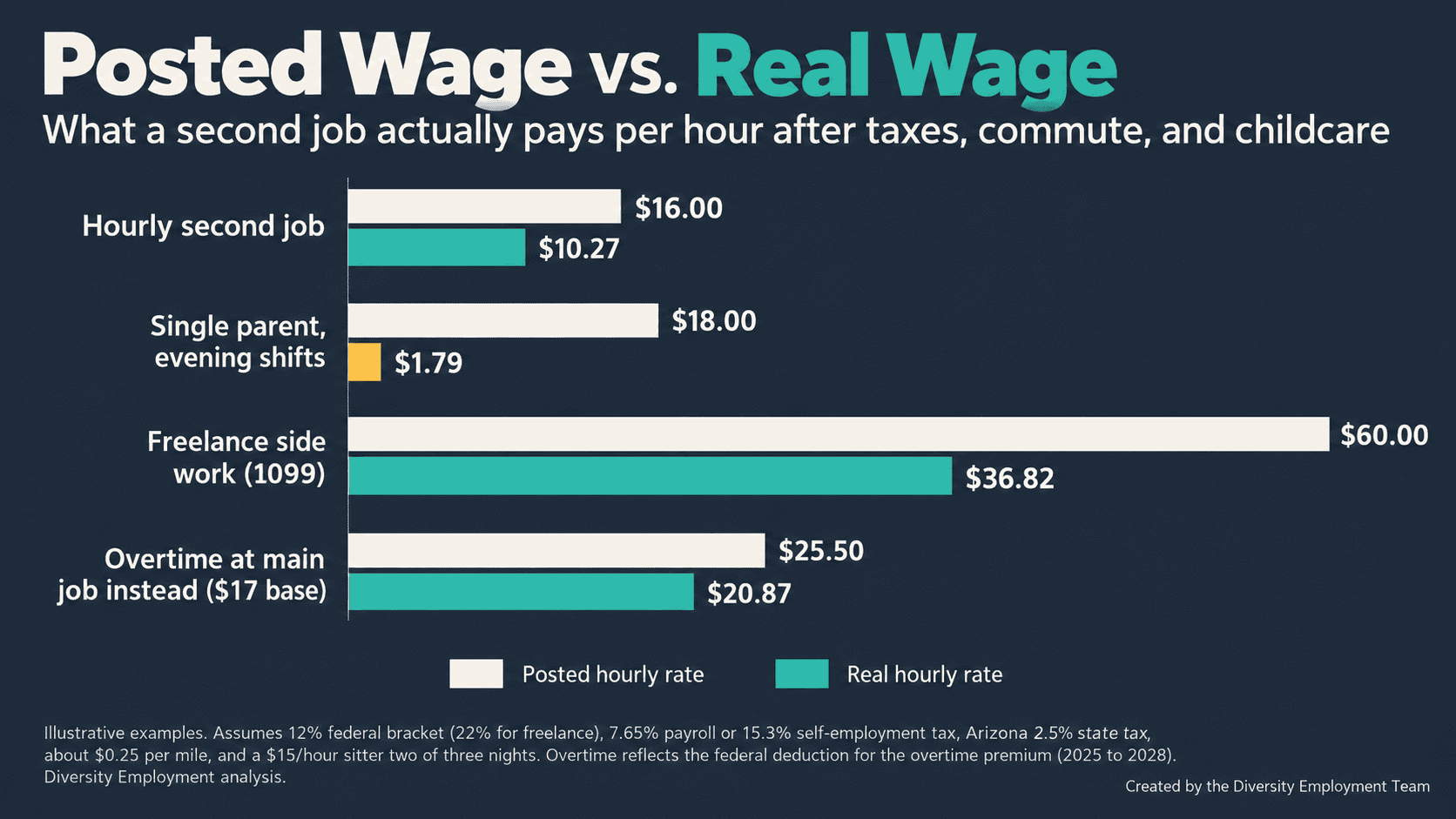
The posted wage on a second job isn’t what you’ll take home per hour. Taxes hit it at your top rate, the commute isn’t paid for, and if someone has to watch your kids while you work it, that bill comes out too.
Run It on Your Own Numbers
Grab a pen and open the posting, then:
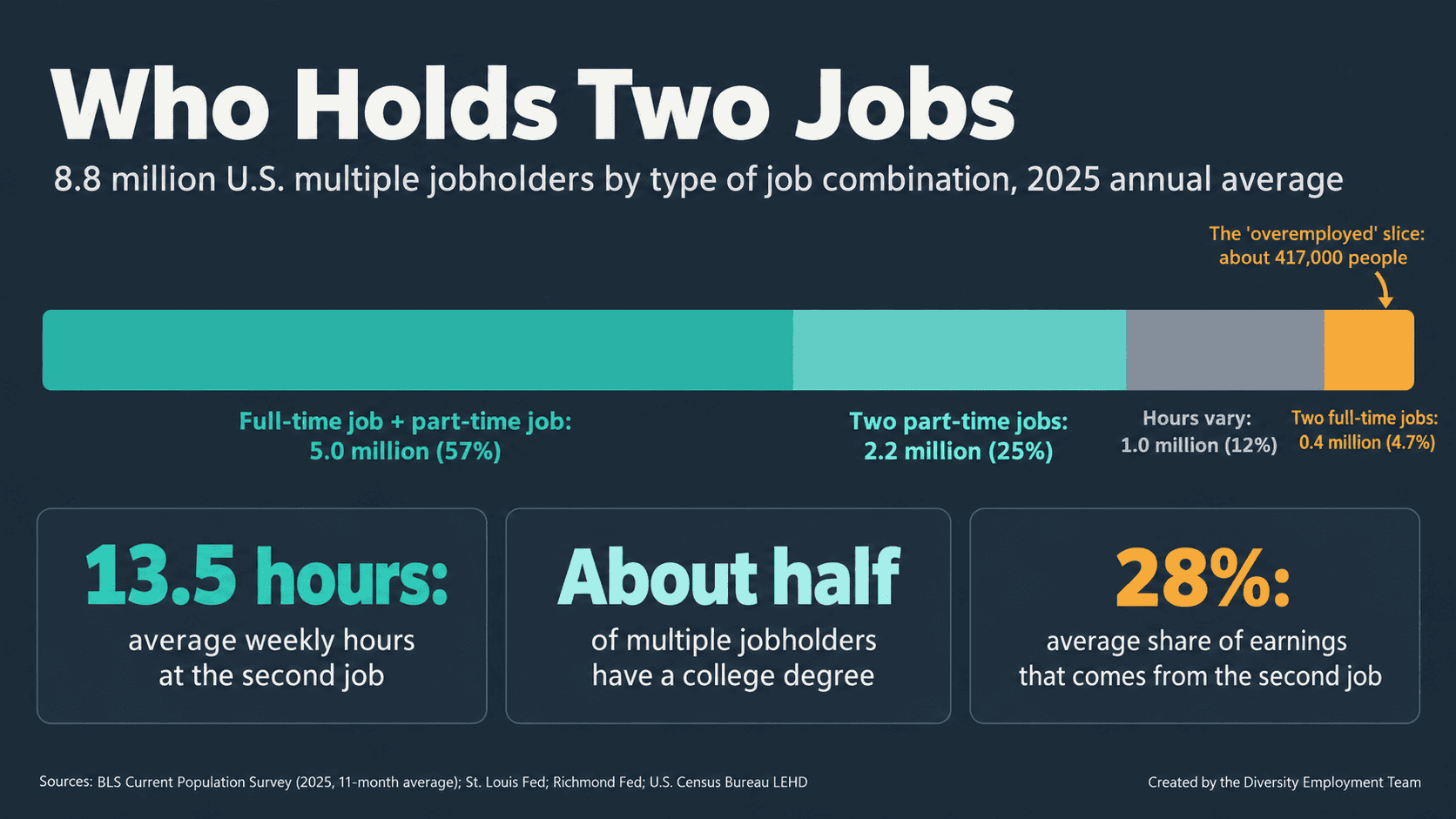
- Write down the posted hourly rate and your expected weekly hours. For reference, people with second jobs work an average of about 13.5 hours a week at them (St. Louis Fed).
- Subtract taxes at your top bracket, plus 7.65% for Social Security and Medicare, plus state tax. Second-job income stacks on top of your main job, so it gets taxed at your highest rate. For freelance or 1099 work, use about 15.3% self-employment tax instead of 7.65%.
- Subtract the commute, both the time (as unpaid hours) and the gas and wear on your car.
- Subtract any care you pay for to cover those hours, like a sitter or extra daycare.
- Divide what’s left by your total hours, commute included. That’s your real hourly rate.
- Compare it to what overtime would pay at your main job, and to what a new job would add to your base pay.
Three Workers, Three Very Different Answers
The same math, run on three realistic setups. These are illustrations, not real people, and the assumptions are ours: the 12% federal bracket for the hourly examples, Arizona’s 2.5% flat state tax, and about 25 cents a mile for gas and wear.
1. An hourly worker taking a part-time second job. The posting says $16 an hour for 13.5 hours a week, three shifts. That’s $216 before taxes. After about 22% in federal, payroll, and state taxes, it’s roughly $168. Take out about $9 for driving and add two unpaid hours of commuting, and the real rate comes out to only about $10.27 an hour.
2. A single parent working evenings. The posting says $18 an hour for 12 hours a week, three evenings. After the same taxes, about 90 minutes of driving, and $9 in gas and wear, that’s about $159. If a grandparent covers one night and a sitter at $15 an hour covers the other two, the sitter costs $135. The real rate comes out to about $1.79 an hour. Paying a sitter all three nights would actually mean losing money on a second job.
3. A salaried remote worker doing freelance work on the side. On top of an $85,000 salary, this worker bills $60 an hour for 10 hours a week as a 1099 contractor. With the 22% federal bracket, self-employment tax, and state tax, roughly 39% goes to taxes, leaving about $36.82 an hour. That’s still solid. The catch is that nobody is withholding any of it, so about $12,000 a year in taxes needs to go out in quarterly payments.
Overtime Might Beat a Second Job
Federal overtime is counted per employer, which a bunch of people don’t realize. If you’re hourly and covered by overtime rules, fifty hours at one job means 10 hours at time-and-a-half. Forty hours at one job and 10 at another means zero overtime, even though you worked the exact same 50 hours.
The 2025 tax law changed the math a little more. For tax years 2025 through 2028, workers can deduct the overtime premium (the “half” in time-and-a-half) from federal income tax, up to $12,500 for single filers and $25,000 for joint filers, with the deduction phasing out at higher incomes (IRS). It doesn’t touch Social Security and Medicare taxes or most state taxes. We covered the rest of the law in our H.R. 1 explainer.
Run the hourly worker from Example 1 through it. If they make $17 at their main job, 10 hours of overtime pays $255. With the premium deducted from federal tax, that nets out to about $20.87 an hour, roughly double the second job’s real rate. Overtime is your employer’s call, of course, not yours. But if it’s on the table, it’s worth asking about before you take a second job.
The Costs That Don’t Show Up on the Paycheck
The hourly math covers the money. A second job also comes with a few costs that don’t show up until later.
The Withholding Surprise
Each employer withholds taxes as if it’s your only job. Both start you at the bottom of the tax brackets, so together they usually withhold too little, until you find out in April.
The fix is Step 2 on Form W-4. You can use the IRS’s Tax Withholding Estimator, fill out the Multiple Jobs Worksheet, or, if the two jobs pay about the same, check the box in Step 2(c) on both W-4s. For 1099 income, nobody withholds anything, so plan on quarterly estimated payments using Form 1040-ES.
No Benefits Come With It
Second jobs are mostly part-time, and part-time jobs rarely come with much. Only 25% of part-time private-sector workers had access to employer medical coverage in March 2025, compared with 87% of full-timers (BLS).
Paid sick leave follows the same pattern. If you get sick, you lose hours at both jobs, and the second one probably won’t pay you for missing them.
The Schedule Has to Fit Twice
About 16% of workers have schedules that change based on their employer’s needs, according to the Fed’s household survey. A second job only works if both schedules hold still. When one changes the week of, the other one usually gets the conflict.
We covered what unpredictable scheduling can cost workers and employers in the $38.9 million reason to rethink how you schedule.
Read Your Agreement Before You Say Yes
Before taking on more work, pull out your offer letter, employee handbook, or employment agreement and look for three things:
- Moonlighting rules, like a ban on outside work or a requirement to disclose it.
- Conflict-of-interest language, especially around working for a competitor, a client, or a vendor.
- Intellectual property clauses that could claim ownership of work you do on your own time, which matters most for freelance and remote work.
A handful of states, including California, Colorado, and New York, limit how far employers can punish lawful off-duty activity, but those laws usually carve out conflicts of interest. This isn’t legal advice, and if your agreement is unclear, it’s probably worth asking HR or an employment attorney before you sign anything new.
Who’s Really Working Two Jobs
“Multiple jobholders” sounds like one group. But it actually covers a few very different ones under a single number.
Two Worlds Under One Number
Indeed’s job seekers with more than one job are mostly hourly service workers: servers, drivers, nursing assistants, cashiers, security officers. That’s the side of the story most people picture.
The other side is the middle. The Richmond Fed found the biggest increase from 2021 to 2025 came from middle-income families earning $50,000 to $150,000, where the rate rose from 4.7% to 5.6%. About half of people with multiple jobs now have a college degree, up from about 35% in the 1990s. And people with two jobs often earn more at their main job than comparable workers with only one.
Gig work fits in here too. If app-based delivery or driving is your second job, we looked at who it actually works for in gig jobs and real income.
The Overemployed Remote Worker
Then there’s the person quietly holding two full-time remote jobs, the one the internet loves to talk about. In the government’s numbers, people with two full-time jobs are just 4.7% of multiple jobholders, about 417,000 people in 2025 (BLS). Some overemployed workers probably hide from surveys the same way they hide from their employers, so that’s very likely an undercount. But nearly every bigger number floating around comes from screened online panels, not national data. For what remote work does for and to careers more broadly, see remote work can expand your career and stall it.
This Year’s Increase Is Women
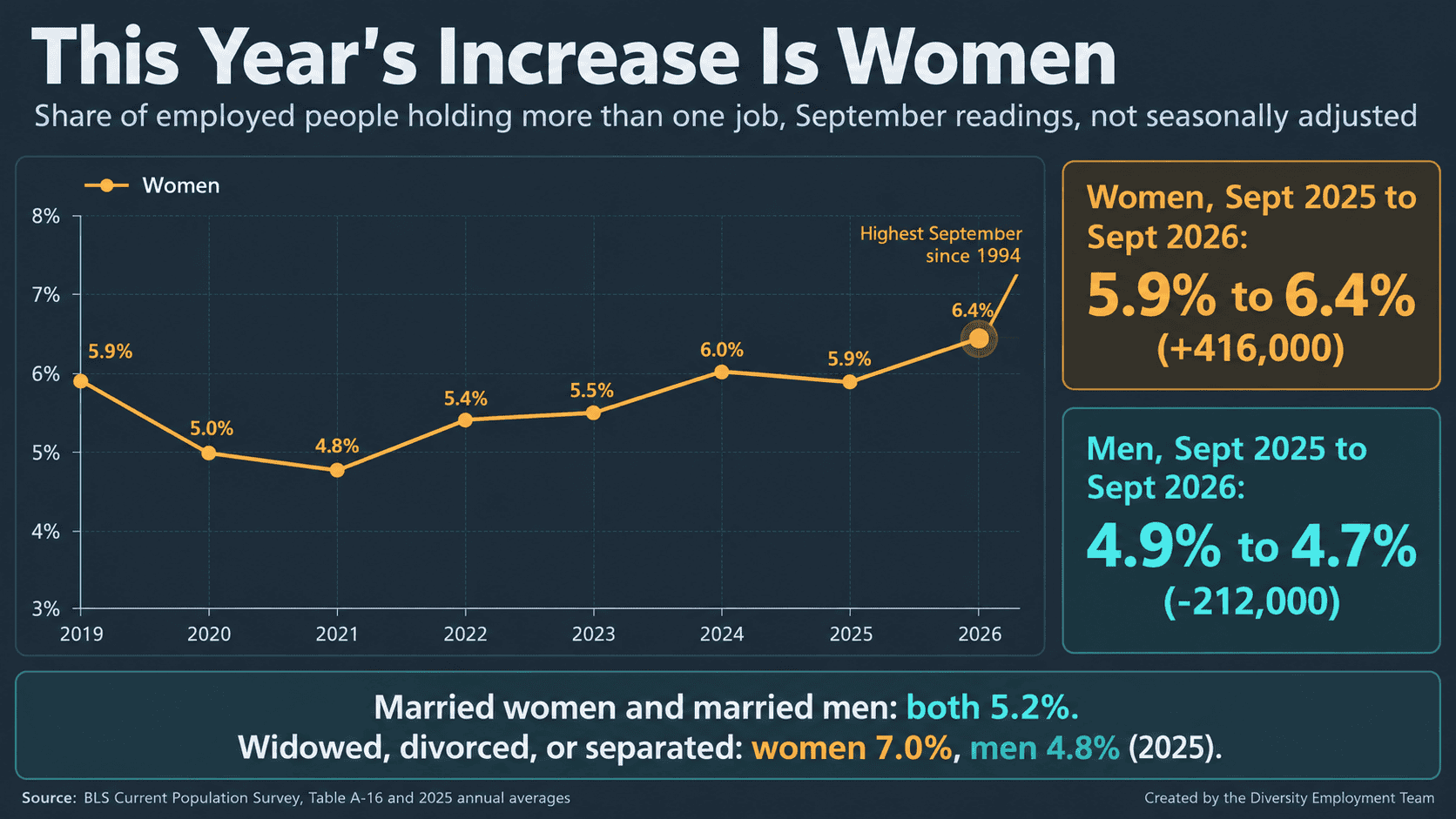
Between September 2025 and September 2026, the number of men holding multiple jobs fell by about 212,000. The number of women rose by about 416,000 (BLS Table A-16, not seasonally adjusted, comparing the same month to control for seasonal swings).
Women’s rate hit 6.4%, the highest September reading since the data series started in 1994. Men’s was 4.7%. Most of the increase among women came from adding a part-time job, either on top of a full-time one or alongside another part-time one. It currently only has five months of data, so it could still shift. But the direction has been pretty consistent since spring.
Often, It’s the Second Income in a One-Income Home
The 2025 annual numbers show where the difference really comes from. Married women and married men hold multiple jobs at exactly the same rate, 5.2%. The divide is among unmarried workers:
- Widowed, divorced, or separated: 7.0% of women vs. 4.8% of men.
- Never married: 6.5% of women vs. 4.4% of men.
For a lot of these households, the second job is doing the work a second earner would do. And for parents, it runs straight into childcare, which costs a median of $1,083 a month among families paying for it (Federal Reserve). That’s exactly why Example 2’s real hourly rate fell apart.
When the Second Job Is Telling You to Move
A second job can be a smart bridge. The problem is the bridge can turn into where you live over time.
The Six-Month Mark
Indeed’s data shows job searching drops sharply once a second job starts, which makes sense. Then it climbs again after about six months. The second job eased the pressure. But it really didn’t take it away.
That fits with other research. Lalé found a typical second job lasts less than three months. And Census data shows a second job adds about 28% to a multiple jobholder’s quarterly earnings. That is some real money… That only keeps coming as long as you keep working the hours.
Signs It’s Postponing the Problem
Your second job may just be buying time more than fixing anything, if:
- You’re still job hunting six months in. The pressure that sent you looking in the first place hasn’t gone anywhere.
- Your second job is the same job. If you’re doing identical work for two employers, the market is telling you what that work is worth, and one of those employers might pay it all.
- The real problem is your main job’s pay or fit. A second job adds income, but it sure doesn’t fix a bad match. If this sounds familiar, our guide on how to know if your career has stalled can help you check.
- Your rest, health, or care arrangements are slipping. Those costs don’t show up on either paycheck, but they can add up heavily.
- Your real hourly rate comes in under your overtime rate. If more hours at your main job would pay better, a second job might end up actually costing you money.
Compare a New Offer to Both Jobs Combined
When you look at a new job, don’t just compare it to your main job. Compare it to both of those jobs combined: Include the hours, the commute, and the benefits. A raise to your base pay keeps paying, and it’s usually what your next-next raise gets calculated from. Second-jobs stop paying you the day you stop working for them.
If you want to see where you stand in the pay range on a new posting before you apply, start with how to read a salary range like you wrote it. At Diversity Employment, we built our job board to connect people with employers who are actually hiring, so if the math says it’s time to move, that’s a good place to start looking.
Protect the Job You Have
If a second job stays for now, guard the main one:
- Keep the schedules from colliding. Give the second job your firm availability up front, and don’t let it creep into hours your main job may need.
- Watch your energy. Showing up worn out to your main job can cost you way more than the second job pays.
- Decide on purpose whether to tell your main employer. If your agreement requires disclosure, do it. If it doesn’t, at least know what you’d say if it comes up.
And if it’s finally time to leave one of them, do it right. Our guide on how to quit a job professionally covers it.
If You Manage People
Some of the people on your team who look settled are probably working somewhere else on nights and weekends. And Indeed’s data suggests many of them are still looking. That’s a retention problem that won’t show up in your turnover numbers until after they leave.
Banning outside work outright doesn’t fix the reason they took it in the first place. And, in fact, in some states it may not even be allowed. Asking why your people need a second job just might work a bit better. We dug into what low turnover can actually hide in low turnover feels great, but is it loyalty or fear?
Two Paychecks, One Question
The pattern is pretty clear once you lay it all out. The job market froze up, and switching jobs stopped paying much. So people found the next closest thing: another employer’s wage, for part of the week. It’s mostly hourly workers and stretched middle-income households, and this year’s increase is mostly women.
Use the Time You’re Buying
A second job pays less than the actual posting says once taxes, commutes, and maybe childcare come out. It skips the benefits and the overtime. And for many people, the relief lasts only a few months before the search starts back up.
None of that makes it a bad choice. It can buy time, and time is money. The question is “What do you do with it?” The best use of those months is probably building toward one better job.
“Is this second job getting me somewhere?” …”Or is it just keeping me where I am?”