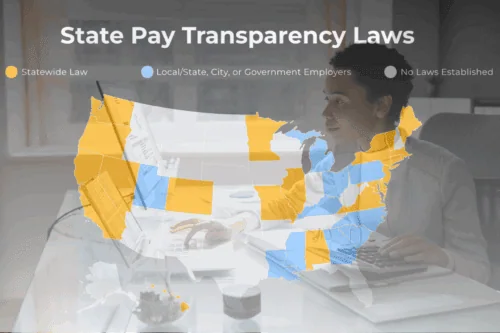

Washington just did something that most states never have. Under a law Governor Bob Ferguson signed in March, nearly every noncompete agreement in the state will be void on June 30th, 2027, including the ones people have already signed. Tennessee, Virginia, Utah, and Maine all added their own limits this year, and 18 states now generally ban or void noncompetes for physicians.
So the noncompete is losing across the board, fast. But in healthcare, the industry where those bans are spreading the fastest, that’s where sign-up bonuses show up the most often in job postings. And HCA Healthcare agreed to pay $2.9 million last year to settle claims that it required newly hired nurses to repay training costs if they left early.
A shrinking number of employers can tell you where you’re allowed to work next. But plenty of them can still send you a bill for going there.
Same Exit, Different Bill
That bill shows up in a lot of different forms. It could be: a training repayment, a signing bonus clawback, relocation money you owe back, a bonus you forfeit. Add a noncompete or a non-solicit, wherever those are still allowed, and the paperwork you sign at hiring can put a heavy price on every possible way out of the job.
Almost everything written about these clauses is compliance advice for employers, one clause at a time. For the person actually signing, though, they really add up to one number… What it would cost to leave?
(Quick note: None of this is legal advice. State laws vary a lot, and several changed this year, so for your own contract, an employment lawyer or your state labor agency gets the final word.)
The Price of Leaving Comes Bundled
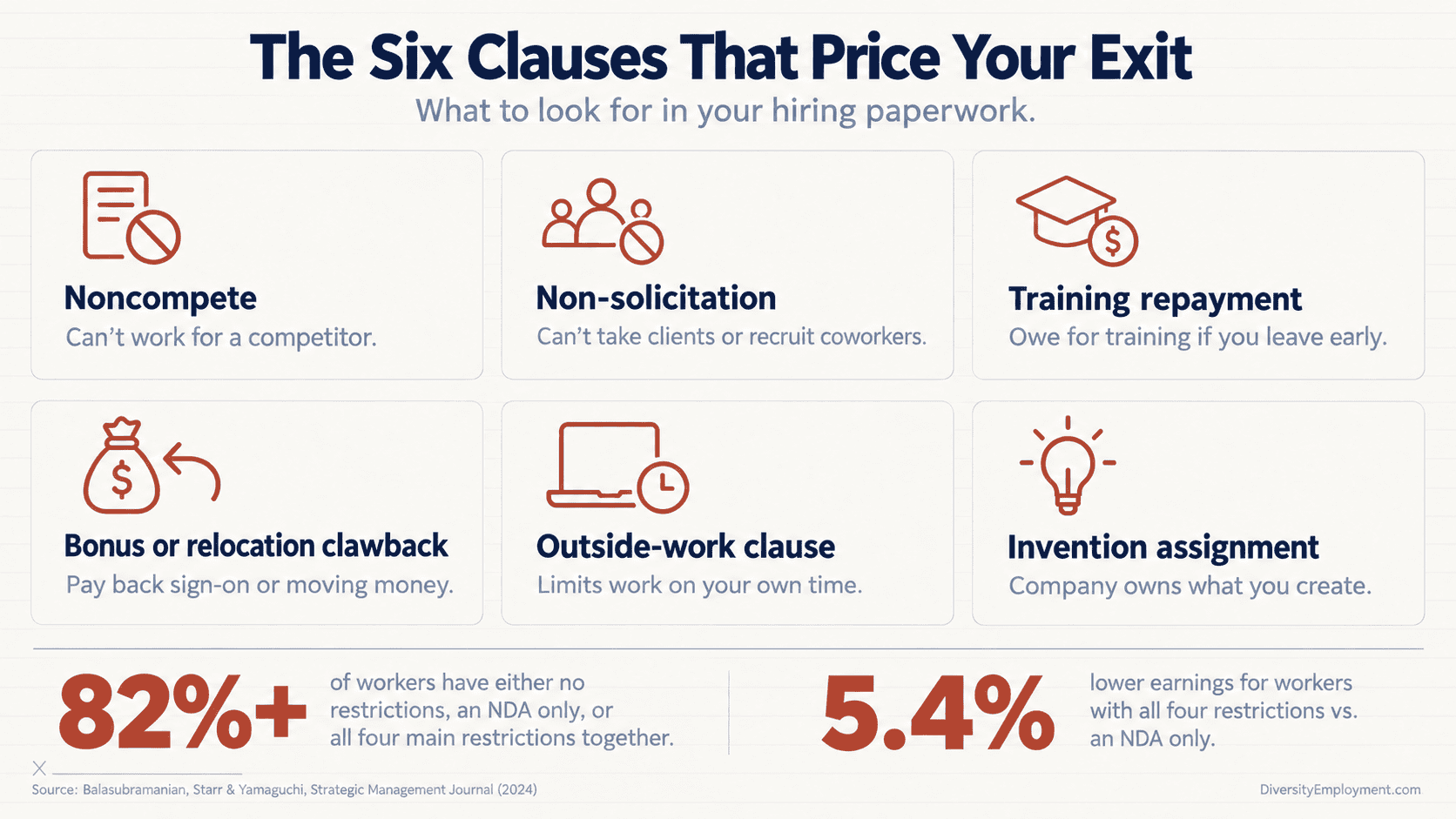
Employers very rarely use just one of these. Researchers Natarajan Balasubramanian, Evan Starr, and Shotaro Yamaguchi surveyed both firms and workers and found that companies mostly use either all four of the common restrictions together, only a confidentiality agreement, or nothing at all. Just those three combinations cover more than 82% of workers.
Six Clauses to Look For
- Noncompete. Bars you from working for a competitor, or starting one, usually for a set time and area.
- Non-Solicitation. Bars you from going after the company’s clients or recruiting your old coworkers once you leave.
- Training Repayment Agreement. You owe the employer for training if you leave before a set date. Critics call it TRAPs, an acronym for “training repayment agreement provisions.”
- Signing Bonus or Relocation Clawback. Some or all of that money comes back out of your pocket if you leave early.
- Outside-Work Clause. Limits what you can do on your own time, sometimes bans any other paid work at all.
- Invention or IP Assignment. Says the company owns what you create, sometimes even the things you build on nights and weekends.
Most people will also sign a confidentiality agreement (an NDA). On its own, that one usually just protects information and doesn’t put a price on leaving, although the OECD notes that a particularly worded NDA can start acting like a noncompete.
Why One at a Time Misleads
The bundle seems to matter more than any single clause by itself. In that same research, employees under all four restrictions earned 5.4% less than employees with only an NDA, and the effect was seen in workers with low bargaining power. The OECD’s 2026 report, drawing on surveys in 14 countries, found 44% of employees report having three or more of these clauses at once.
Which is the problem with reading them one at a time. A single clause can look perfectly reasonable. The full stack is what actually decides whether leaving is even realistic.
Created by the Diversity Employment Team
Check Before You Sign
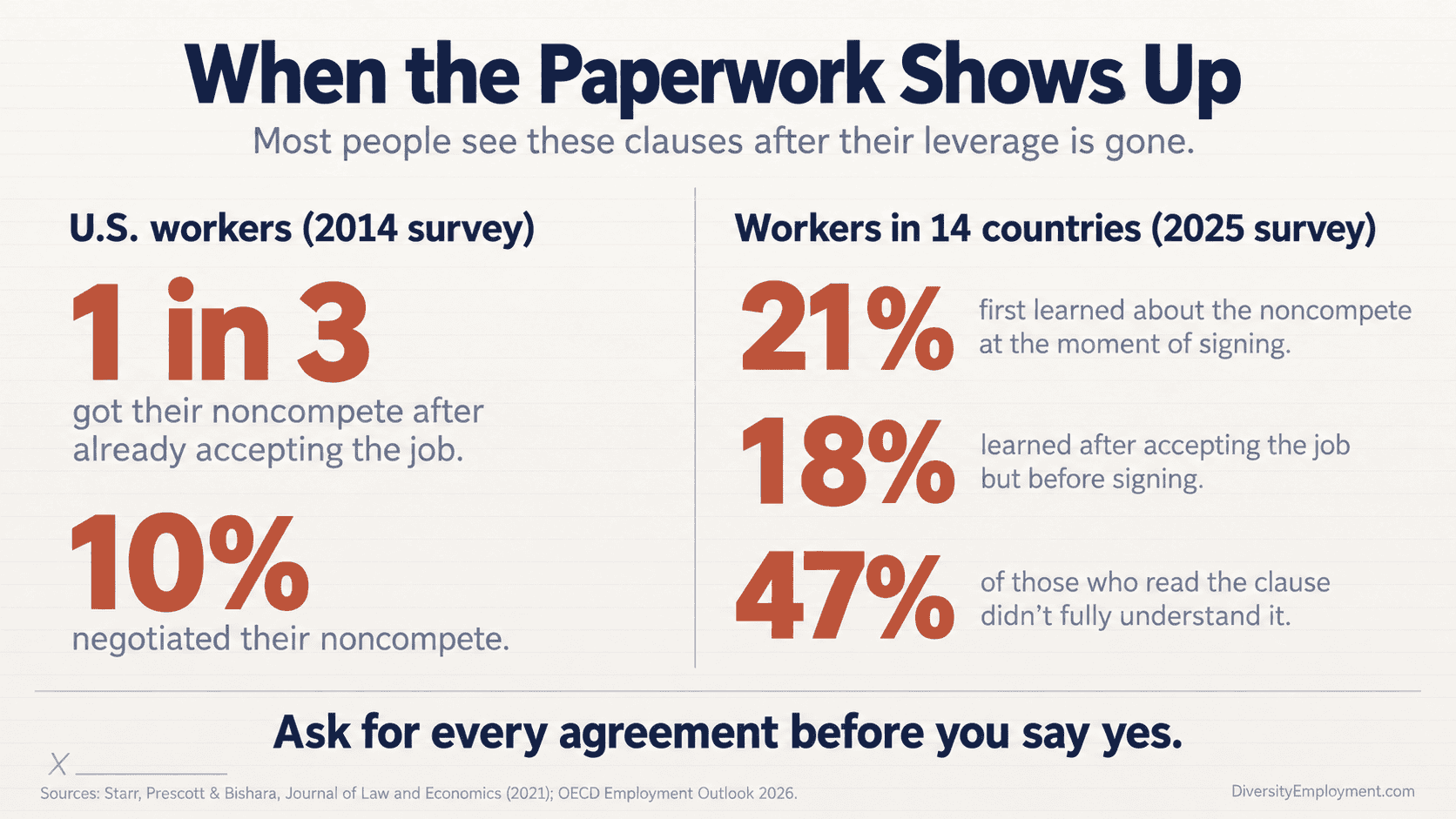
When the paperwork shows up matters just about as much as what it says. In a nationally representative survey of more than 11,000 workers, Starr, J.J. Prescott, and Norman Bishara found that only 10% of employees negotiated their noncompetes, and about one-third were actually given them after they’d already accepted the job. Unsurprisingly, workers who got that late notice were comparatively worse off.
Newer data from the OECD tells a pretty similar story. 21% of workers bound by a noncompete learned about it only at the moment of signing, and another 18% found out after accepting the position, but before having to sign. Even among people who read the clause, 47% said they didn’t fully understand.
Once you’ve said yes, turned down your other options, and maybe even given notice at your current job, your leverage is pretty much gone.
Created by the Diversity Employment Team
Get Every Page Before You Say Yes
Ask for every document you’ll be signing, in writing, before you accept anything. That means the offer letter plus everything else: a noncompete, a confidentiality and invention agreement, a bonus or relocation agreement, or a training agreement. Some states actually require certain clauses to have their own documents, which is one more reason they can show up late.
Something simple works: “Before I accept, could you send me every agreement I’ll be asked to sign, including any bonus, relocation, training, or confidentiality agreements?”
Five Questions for Each Clause
- “What’s the dollar amount, and does it go down over time?” Repayment that shrinks month by month is a very different deal from owing the full amount on day 364.5.
- “Does this still apply if you let me go?” Plenty of these clauses kick in no matter who ends the job.
- “Is this training I could use somewhere else?” A license or certification you get to keep is one thing. Just getting onboarded to the company’s systems is another thing.
- “Which state’s law governs this?” Look for the choice-of-law line, usually near the end of the agreement.
- “Can I take the bonus at the end instead?” If the money is really about you staying, getting paid after you’ve stayed takes the risk off the table.
Some States Already Make Them Tell You
A growing number of states require advance notice of a noncompete now. Colorado requires it before you accept the offer, in a separate document you sign. Massachusetts requires it with the formal offer or 10 business days before you start, whichever comes first. Oregon requires two weeks before your first day, and New Hampshire requires it before you accept. Illinois, Maine, Washington, and DC all have their own versions.
If your state has a rule like this and the employer skipped it, that can affect whether the noncompete holds up at all. The catch: these rules mostly cover noncompetes and some non-solicits, not repayment terms. California is the notable exception for signing bonuses, which now require at least 5 business days to review and a chance to talk to a lawyer.
Why a Voided Clause Still Works
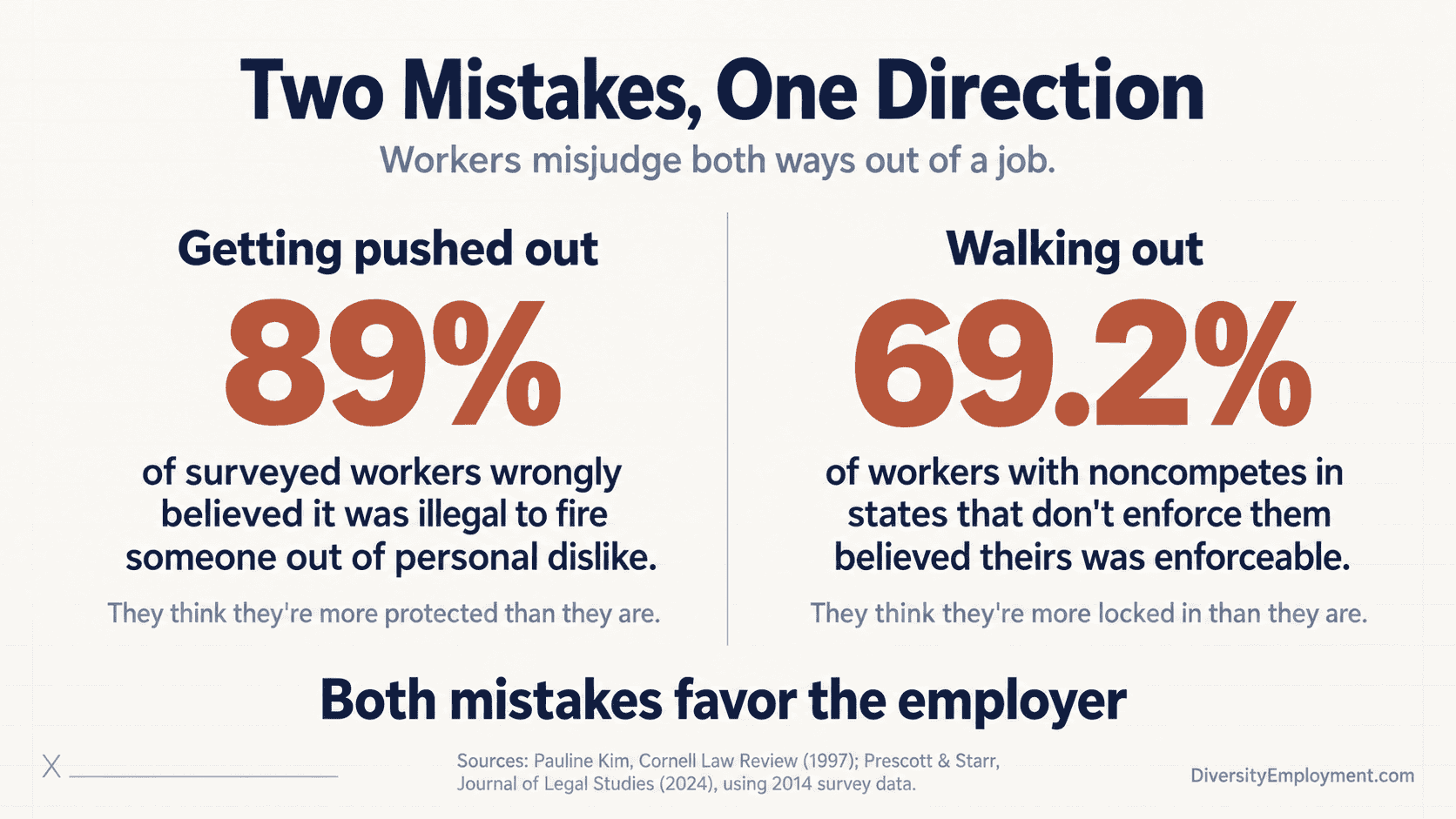
A law only helps people when people know about it. So, when Prescott and Starr studied what workers believe, they found that in states that don’t enforce noncompetes, 69.2% of workers bound by one thought it was enforceable, and another 9.9% didn’t even know.
Workers’ guesses about whether a court would enforce their noncompete or not were basically flat across the country, landing at around 40% to 47% whether or not their state enforced them. And that belief isn’t harmless either. The researchers found that just believing an unenforceable noncompete is enforceable very likely causes people to pass up better jobs.
The Reminder Letter
Part of the reason these beliefs stick is that employers just keep reinforcing them. Among workers who got an offer from a competitor, those whose noncompetes were unenforceable were much more likely to be reminded of them by their employer: 71% versus 32%. Reminders were directly tied to a stronger belief that the clause was real and enforceable.
That’s not just a survey finding, either. According to the FTC, Rollins, (the parent company of Orkin), sent hundreds of threatening cease-and-desist letters to former employees, and even sued them to keep them from working for competitors.
Clauses like these are meant to keep people in jobs they might, sometimes obviously, otherwise leave. That is a big part of why low turnover can look a lot healthier than it really is.
The Same Mistake, Pointed the Other Way
Workers don’t just overestimate how locked in they are. They also overestimate how protected they are from being simply pushed out.
In legal scholar Pauline Kim’s surveys, 89% of workers wrongly believed it is illegal to fire someone out of personal dislike. When she repeated the survey in New York and California, the answers didn’t line up at all with differences in state law, very much like the noncompete beliefs.
So people generally tend to think it’s harder to fire them than it actually is, and that it’s much harder to leave than it is. The one thing they have in common is, both mistakes favor the employer. And both seem to be led by employer behavior: law professor Cynthia Estlund has argued that employers reinforce the firing myth by acting like they need a reason, the same way reminder letters reinforce the noncompete ones.
One honest caveat: These are older surveys, from the late 1990s and 2014. But, they’re still the best data available on what workers really believe.
Created by the Diversity Employment Team
Fired and Still Bound
Most American jobs are at-will, meaning the employer can usually end your job for almost any reason. Many exit costs still apply afterward, which is how someone can be let go and still owe money or even be barred from working in their field.
Some newer laws go straight at that. Since July 1st, 2026, Virginia makes a noncompete unenforceable against someone fired without cause unless the employer pays severance and disclosed it when the agreement was signed. California limits bonus and training repayment when someone is let go for reasons other than misconduct, and New York’s law does the same for signing bonuses and relocation money. That’s question two on the list.
Where the Law Stands Right Now
Everything in this section is current as of late October 2026. These laws are changing month to month, so always check the date on anything you read.
The Federal Picture
The FTC’s nationwide noncompete ban never took effect. Courts blocked it, the agency dropped its appeals, and the rule was formally removed from federal regulations on February 12th, 2026.
The FTC now goes after employers one at a time. In September 2025, it ordered Gateway Services, the country’s largest pet cremation company, to stop enforcing noncompetes that barred workers from the industry anywhere in the U.S. for a year. Those agreements covered nearly all of its roughly 1,800 workers, a majority of them hourly employees like facility laborers and drivers.
Then came Rollins. Who required the vast majority of its 18,000+ workers to sign noncompetes that typically barred them from pest control for two years within 75 miles of where they worked, and the FTC finalized an order in June 2026 requiring the company to stop enforcing them. The agency also sent warning letters to 13 other pest-control companies.
Those orders only bind those companies. But the FTC does take tips at noncompete@ftc.gov.
A Few States Worth Knowing
- California already voided most employee noncompetes. Since January 1st, 2026, it also bans most stay-or-pay terms in new contracts, with damages of at least $5,000 per worker.
- Washington bans nearly all noncompetes starting June 30th, 2027, including existing ones, and its definition includes clauses that make you repay or forfeit money because you went to work somewhere else.
- New York targets training repayment with their Trapped at Work Act. It was amended in February 2026, and the effective date is either December 19th, 2026 or February 13th, 2027, depending on how you read it. The bill’s sponsor’s office has said February.
- Minnesota, North Dakota, and Oklahoma join California as the four states that ban employee noncompetes outright.
- Tennessee voids noncompetes for workers earning under $70,000 a year, as of July 1st, 2026.
- Colorado only allows them for workers earning at least $130,014 in 2026, and only to protect trade secrets.
How to Check Your State
- Search the basics. Try “[your state] noncompete statute” and “[your state] training repayment law.” Tip: Add “2026” so you’re not reading something outdated.
- Find the source. Look for the actual statute, then your state labor department’s or attorney general’s page on it. Law firm alerts are useful for plain-English summaries, but check the date.
- Sort what you find. Most state rules fall into a few buckets: a full ban, an income threshold, occupation rules (usually healthcare), advance-notice requirements, and limits on repayment.
- Compare the dates. Many new laws only cover agreements signed after a certain date, so put your signing date next to the law’s effective date.
- Cross-check. A tracker like the Economic Innovation Group’s state noncompete map can confirm what you found, though the statute itself is still the thing to trust.
When You Live in One State and Work in Another
Remote work makes this messier. California’s law says a void noncompete is unenforceable no matter where it was signed, but courts in other states haven’t always gone along. A Bloomberg Law analysis found employers sidestepping California’s ban by having courts in Massachusetts and Georgia enforce the contract’s chosen state law instead.
So the one line naming which state’s law applies can matter more than where you actually live. That’s question four on the list.
The Bill Moves to Your Wallet
Researchers saw this coming. Prescott, Stewart Schwab, and Starr found that the share of workers reporting a training repayment agreement went from 4.1% in 2014 to 8.7% in 2020, and warned that a noncompete crackdown could push that number higher. They’re careful about the jump, though: the 2020 survey only covered 254 workers, so some of the rise could just be noise.
In that same 2020 survey, training repayment agreements covered an estimated 15% to 20% of workers between the ages 25 and 40.
Healthcare Shows Where This Is Going
The same industry tightening the rules on noncompetes is leaning hard on money. In December 2025, about 3% of all U.S. job postings on Indeed offered a signing bonus, and healthcare jobs had the highest share. That’s down from a peak of 5.6% in 2022, but still above the 2019 average of 1.8%.
Then there’s training debt. HCA required entry-level nurses to complete its StaRN residency program, and until spring 2023 had them sign a repayment agreement as part of their new-hire paperwork. Nurses who left before two years could end up in collections. HCA disagreed with the states’ claims but settled, and says it stopped using the agreements in 2023. Separately, in comments to federal regulators, National Nurses United reported that many nurses surveyed said they weren’t told about training repayment before they started work.
Who Ends Up Paying
Noncompetes reach much further down the pay scale than most people assume. Michael Lipsitz and Starr found the typical worker bound by one is usually paid by the hour, with median pay right around $14. When Oregon banned noncompetes for hourly workers, their hourly wages rose 2% to 3%, on average.
Training repayment cuts the other way… at least in the survey data. Workers with graduate degrees were the most likely to have one, while those with a high school diploma or less were the least likely, at 0% to 2%.
Both things can be true at the same time. These clauses reach almost everyone, and the harshest terms tend to land on the people with the least room to push back.
Underneath all of this sits a bigger question: “Who should pay to train workers in the first place?” That’s covered in Nobody Wants to Train the Next Generation of Experienced Workers.
What a Fair Version Looks Like
Employers have a real case here. Training costs money, but so does losing someone two months after paying them a signing bonus. Starr’s own 2019 research found that more enforceable noncompetes were associated with more employer-provided training.
The trade-secrets argument is a bit shakier. Studies cited by the OECD found that states banning noncompetes didn’t see more trade-secrets lawsuits, and a randomized trial found removing noncompetes did not lead to more sensitive information being shared.
The Fair-Version Test
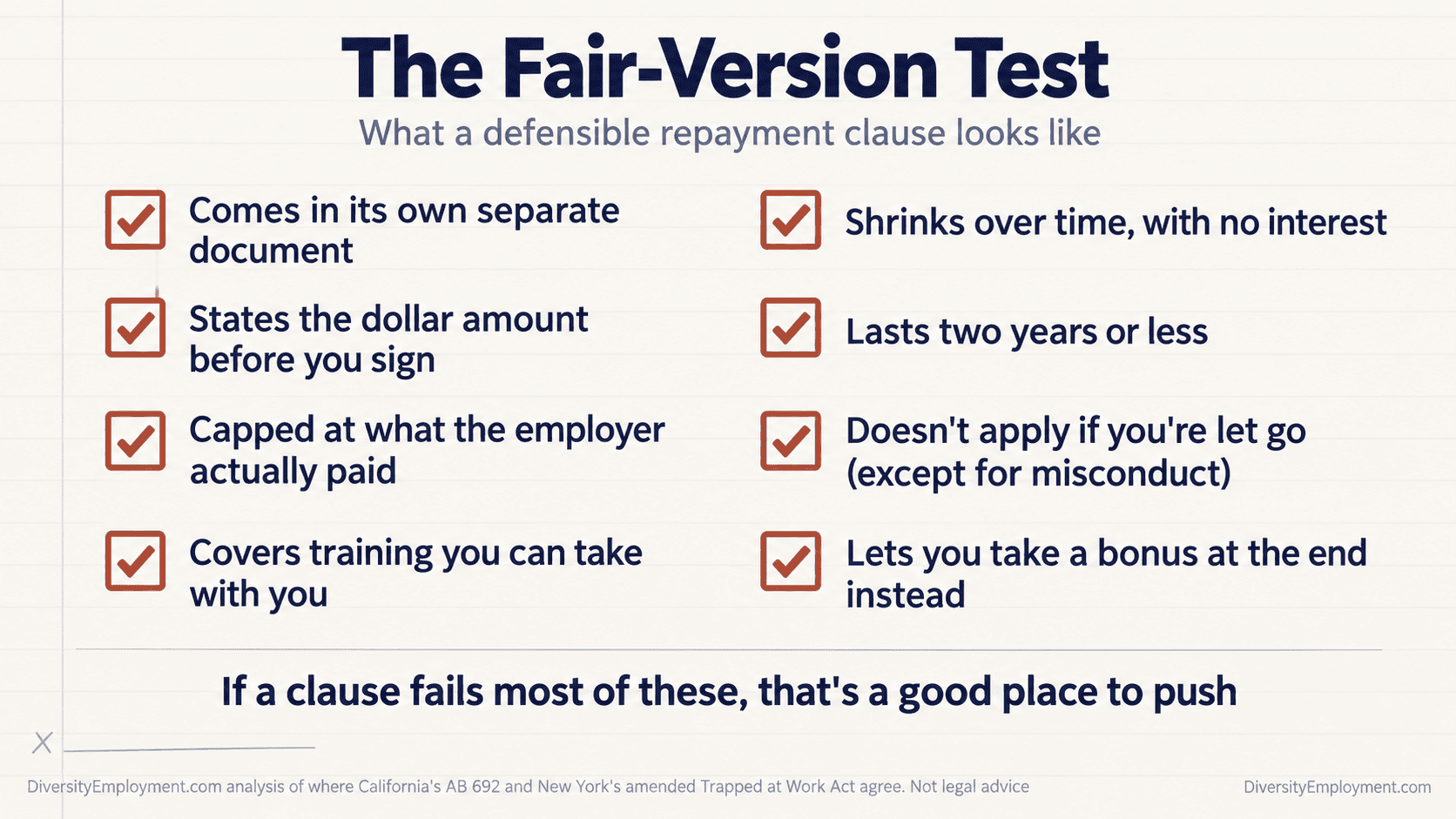
The strictest new laws, especially California’s and New York’s, end up agreeing on what a defensible repayment term looks like. Pulled together, that gives you a checklist that works in any state, even one with no law at all. A fairer repayment clause:
- Comes in its own separate document, not buried in the offer letter
- States the exact dollar amount before you sign
- Doesn’t exceed what the employer actually paid for the training
- Covers training you can take with you, like a license or certification
- Shrinks over time, with no interest and no lump-sum demand when you leave
- Lasts two years or less
- Doesn’t apply if you’re let go for reasons other than misconduct
- Lets you take a bonus at the end of the period, instead of up front
That list is our own synthesis of where the new laws agree, not a legal standard everywhere.
Created by the Diversity Employment Team
Training You Can Take With You
The transferable part can matter a whole lot. New York’s amended law specifically says employer-specific training and mandated safety or compliance training don’t count as a transferable credential. If the “training” is learning the company’s software or sitting through required safety modules, it’s hard to argue you’re walking away with something worth paying back.
What Leaving Could Actually Cost
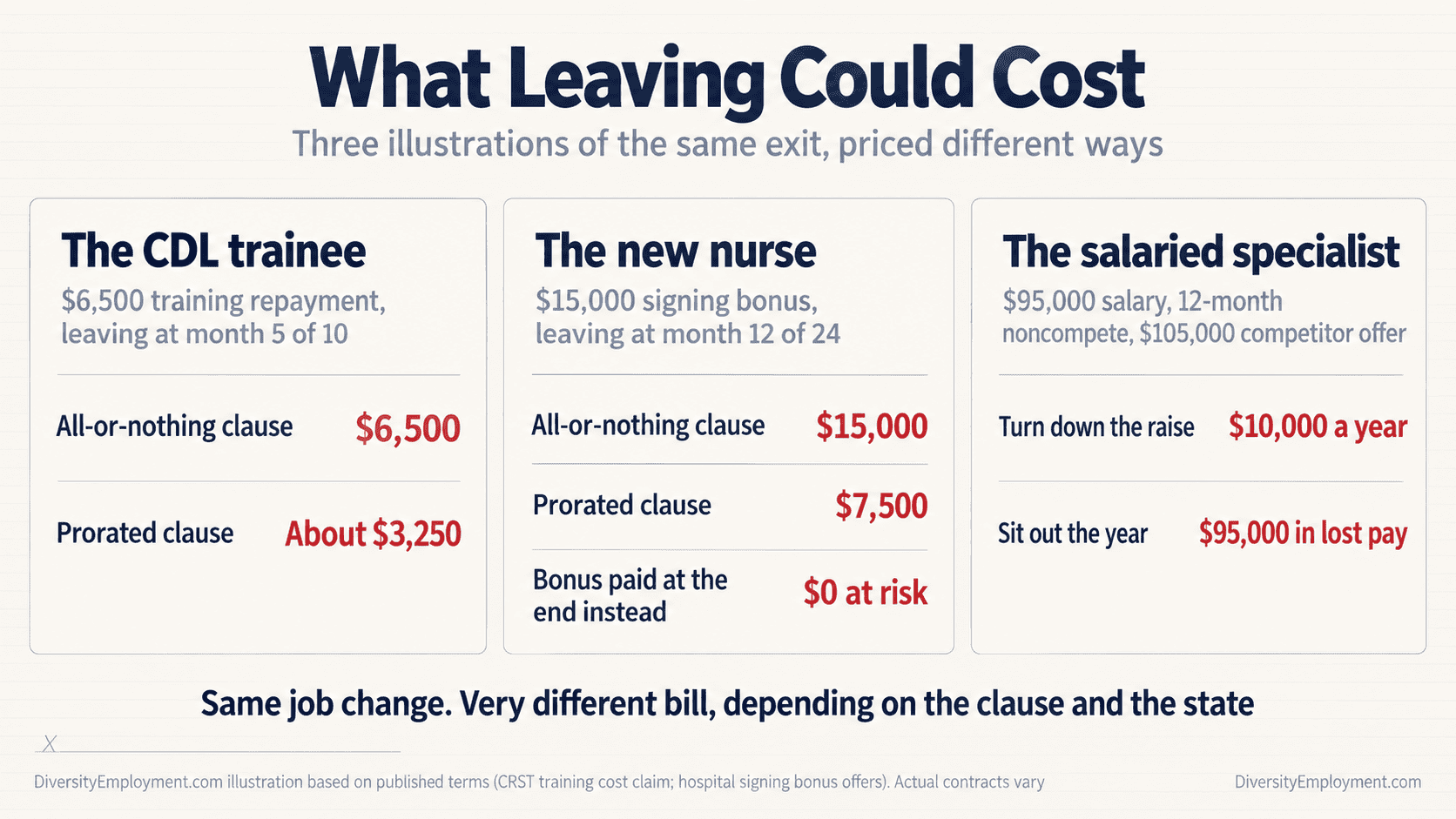
These following three scenarios are illustrations built off of published terms and real-life examples. Actual contracts vary, so treat the numbers as a way to run your own math, not as a prediction.
The CDL Trainee
Trucking is one of the oldest homes for training repayment. CRST has claimed its CDL training costs $6,500, and drivers who quit in fewer than 10 months still owed the money. One lawsuit claimed CRST paid the schools it contracted with no more than $2,500.
Say a driver leaves at month five. Under an all-or-nothing clause, that’s $6,500 owed. If the repayment shrinks evenly, it’s about $3,250. And if it’s capped at what the training actually cost, it could be a lot less than either. Under California’s new law, a clause like this signed in 2026 is likely void unless it meets that state’s strict transferable-credential conditions, and New York’s law will narrow it too once it takes effect.
The New Nurse With a Signing Bonus
Some hospitals have offered nurses $15,000 signing bonuses. Picture one tied to a two-year commitment. At month 12, an all-or-nothing clause means paying back the full $15,000. A prorated clause means $7,500. If the nurse could take the bonus at the end of the two years instead, there’s nothing at risk at all. So, check whether you’d owe the pre-tax amount, since that can be more than what actually lands in your bank account.
To be allowed in California, a bonus clause signed in 2026 has to be prorated, interest-free, and optional to defer. And it can only be collected if the nurse quits or is fired for misconduct. Once New York’s law takes effect, it will still allow repayment if the nurse resigns, but generally not if the hospital lets them go for any reason other than misconduct.
The Salaried Specialist With a Noncompete
Now take an account manager earning $95,000 with a 12-month noncompete. A competitor offers $105,000. If she honors the clause, she either turns down a $10,000 raise or sits out a year and loses $95,000 in pay.
Where she lives can change everything. Her noncompete is void in California, Minnesota, North Dakota, and Oklahoma. It’s also void in Colorado (under $130,014), Oregon (under $119,541), and DC (under $162,164), according to 2026 threshold figures. In Washington, she’s under the current threshold of about $126,859, and the clause goes away entirely in 2027. Over in Illinois or Tennessee, she clears the income floor, so it comes down to whether the clause is reasonable. In Virginia, for agreements signed since July 2026, if she’s fired without cause and wasn’t promised severance up front, it can’t be enforced.
Created by the Diversity Employment Team
How to Negotiate
These clauses are negotiable much more often than people think, especially before you’ve officially accepted the job. A few moves to try:
- Ask to strike it. This works especially well for a noncompete on a job without access to trade secrets. In the Rollins case, the FTC pointed out that narrower client non-solicitation terms were available to protect customer relationships.
- Narrow it. Shorter time, smaller area, a named list of competitors, or limits tied to your actual position.
- Make repayment shrink. Monthly proration, no interest, as well as no lump sum due the day you leave.
- Cap it at real cost. Ask for the actual dollar amount and a cap, in writing.
- Take the bonus later. Or ask to roll it into base pay, which keeps paying you every year. Our guide to reading a salary range like you wrote it can help with that conversation.
- Ask for garden-leave pay. If a noncompete has to stay, ask to be paid during the time you’re sitting out.
- Carve out side work in writing. If you have a side job or a personal project, get it named as an exception. More people are adding a second job instead of changing jobs, and outside-work clauses can get in the way. Eleven states already limit employers from claiming inventions you create on your own time with your own equipment.
At Diversity Employment, we think these clauses deserve the same attention, if not more, people give to the salary line. They’re a major part of any job offer.
If You Already Signed One
Don’t panic. A lot of people are walking around with clauses that simply wouldn’t survive in court. Then again, some people have clauses that absolutely would.
- Don’t assume it’s enforceable. Remember that 69.2% number. Plenty of people believe they’re bound when they aren’t. Double check.
- Gather copies and dates. Write down when you first saw each document, when you accepted the offer, and when you signed everything. Timing can be the difference under notice laws.
- Check your state. Use the steps in How to Check Your State above, and pay attention to effective dates.
- Don’t ignore a letter. A cease-and-desist isn’t a court ruling, but it’s worth having a lawyer look at before you respond to it. Our piece on legal advice basics covers how to find help without overpaying.
- Know who to contact. An employment lawyer, your state attorney general or labor department, and specifically for noncompetes, the FTC at noncompete@ftc.gov.
- Leave cleanly. Return equipment and don’t take any files. Trade secrets law still applies even where noncompetes don’t, so quitting professionally protects you, as well as your reputation.
Know What You Signed
The noncompete is losing ground state by state. But the price of leaving keeps showing up in other ways: A bundle of clauses handed over after you’ve already said yes, terms written so nearly half of the people reading them can’t fully understand, and ones backed by beliefs that usually go in the employer’s favor, whether the law does or not.
The Cheapest Protection
Knowing turns out to be the best tool. In Prescott and Starr’s study, among workers with unenforceable noncompetes, 51% of those who weren’t told the law said it would factor into taking a better job. Among those who were told, it was only 26%.
That’s part of why Washington will require employers to tell workers in writing that their noncompetes are void, and why the Gateway and Rollins orders required the same. The law is getting better. Reading the paperwork, asking those five questions, and running the math before you sign anything still does most of the heavy lifting.