
In 1996, a law professor surveyed 337 people filing for unemployment in St. Louis and asked them a simple question: “Is it legal to fire someone because the boss doesn’t like them?” 89% said no. They were wrong. It was legal in Missouri then, and it’s legal in 49 states now.
Twenty-two years later, a federal survey asked workers something different: “Do you qualify for job-protected leave under the Family and Medical Leave Act?” 27% said yes when, based on their own answers about their jobs, they actually didn’t.
Different decades, different laws, same exact direction. People tend to believe they’re much more protected at work than they actually are. And then, when it finally happens to them, a lot of them swing to the opposite belief: “Well, it’s an at-will state, so there’s really nothing I can do.” And both of those can cost you.
The Short Version
In one sentence: Your employer can fire you for no reason, a bad reason, or even a mistaken reason, but not an illegal one. That last part carries a lot more weight than people tend to realize, and it’s where most of worker’s real protection is.
Quick note: This is general information, not legal advice. Laws vary by state and they do change.
What At-Will Actually Means
At-will is a default setting. If nothing else applies, either side can end the job at any time, without notice, and without giving a reason. You can quit on a Tuesday afternoon. Your employer can let you go the same way.
No Reason Isn’t the Same as Any Reason
That default setting does sit under a whole stack of rules that can override it:
- Federal and State Laws that ban firing someone for who they are (race, sex, age, disability, religion, and more) or for doing something the law protects.
- Contracts and Union Agreements that require a good reason or a whole process.
- Court-Made Exceptions that vary by state, including firings that violate “public policy,” handbooks, or promises that courts treat as an implied contract. In a minority of states, there’s a duty of “good faith and fair dealing.”
Some states have even written the at-will rule into statute. Arizona is one: Under A.R.S. 23-1501, any promise that limits an employer’s right to fire you has to be in writing to count.
The One State That Opted Out
Montana is the only state that has really walked away from at-will. Under its Wrongful Discharge from Employment Act, once you’re past probation, an employer generally needs “good cause” to fire you. Probation there is long, though, it’s 12 months by default since 2021, and an employer can even stretch it to 18 months, according to the Montana Association of Counties.
The surprising part is how Montana got there. When the law passed in 1987, a lot of the support came from businesses. Montana courts had been handing out big jury awards in firing cases, and the law traded the at-will default for a cap on damages, as the Niskanen Center has documented. Today a worker who wins can recover up to four years of lost wages and benefits, but usually not much more beyond that.
Puerto Rico and the U.S. Virgin Islands also have their own versions of just-cause rules. Everywhere else, at-will is the starting point.
Test Yourself
Here are the firing scenarios from that 1996 St. Louis survey, by law professor Pauline Kim, and how often people got them wrong. Try them before you tap to see the answers.
| The Worker was Fired… | Legal for At-Will Employers? | Got it Wrong (1996) |
|---|---|---|
| Because the boss didn’t like them |
Tap to revealYes |
89% |
| Because the employer mistakenly thought they stole |
Tap to revealYes |
87% |
| To hire someone cheaper for the same job |
Tap to revealYes |
82% |
| For reporting a coworker’s theft to the boss |
Tap to revealGenerally Yes |
79% |
| Because there wasn’t enough work |
Tap to revealYes |
19% |
| For poor performance |
Tap to revealYes |
8% |
| For refusing to take part in illegal billing |
Tap to revealNo |
10% |
| For reporting fire code violations to the government |
Tap to revealNo |
9% |
Source: Pauline Kim, “Bargaining with Imperfect Information,” Cornell Law Review, 1997. Survey of 337 unemployment claimants in the St. Louis area, 1996. Percentages rounded.
Look at the pattern. People knew the clearly illegal firings were illegal. Where they went wrong was treating unfair firings the same as illegal ones. Kim also found that even when the handbook said the company could fire people “at any time, for any reason,” 63% still believed the cost-cutting firing was illegal. The disclaimer barely moved anyone.
Was It Illegal? Five Questions to Ask
If you’ve just been let go and you’re trying to figure out whether something was off, unfair isn’t the test. One employment lawyer answering a fired worker online put it pretty bluntly: “Wrongful Termination” legally means unlawful, not wrong, or rash, or unfair. These five questions can get closer to what is actually true.
1. “Does It Connect to Who I Am?”
Federal law bans firing someone because of race, color, religion, sex (which includes pregnancy, sexual orientation, and gender identity), national origin, age if you’re 40 or older, disability, and genetic information. Most of those laws apply to employers with 15 or more workers (20 for age), but many states cover smaller employers and even add more, like marital status or, in some places, political activity.
The hard part here is proof. A feeling usually won’t get you very far, and lawyers will tell you that pretty quickly. What tends to matter are the comments made, someone outside your group treated better for the same thing, being replaced by someone very different from you, or an employer whose story keeps changing.
2. “What Happened Right Before?”
Retaliation has been the most common type of charge filed with the EEOC every year since fiscal 2010. It means getting punished for doing something the law protects, like complaining about discrimination or harassment, requesting an accommodation, taking protected leave, or filing a workers’ compensation claim.
Timing is evidence. A firing that might have been fine in March can look very different if it happens a week after you’ve complained to HR.
Retaliation is also easy to miss, even when it’s sitting right there. One almost viral Reddit post was about a worker fired after winning an office costume contest. The worker asked whether the costume firing was legal (it probably was, sadly). But buried in the setup was a detail almost nobody picked up on… Coworkers who had complained to HR about harassment were being fired within about a week. That’s the part that might have been a real legal problem.
3. “Was I Doing Something the Law Protects?”
A bunch of everyday activities are protected, and most people don’t know about them until after the fact:
- Talking About Pay with Coworkers. Under the National Labor Relations Act, that’s protected whether or not you’re in a union. Asking your boss for a raise on your own is a different thing, though, and usually isn’t protected.
- Jury Duty and Court Appearances. Federal law protects federal jury service, and most states protect state jury service. Many also protect workers who answer a subpoena as a witness.
- Refusing to Break the Law, or reporting violations to the government (safety, wage theft, and fraud are the most common ones).
- Coming Back from Military Service. Under USERRA, a returning service member can only be fired for cause for up to a year after coming back, depending on how long they served.
- Lawful Off-Duty Activity, in Some States. Colorado and New York protect a wider range of legal off-the-clock activity. California protects off-duty cannabis use for most jobs. Montana added protection for legal speech, including on social media, in 2023. Connecticut protects employees’ free speech as long as it doesn’t interfere with the job.
4. “Was There a Promise in Writing?”
A contract with a set term, a union contract, or an offer letter that promises something specific can override at-will employment. In some states, even a handbook can too, especially one that lays out a step-by-step discipline process without a clear at-will disclaimer. Government jobs usually come with their own civil service or union rules too.
Pull out everything you signed. People skip this step more than any other one.
5. “Am I Getting What I Already Earned?”
At-will covers whether you keep the job. It doesn’t cover money you already earned:
- Your Final Paycheck has a state deadline, and some states will add penalties when it’s late.
- Earned Vacation counts as wages in states like California, Colorado, and Montana.
- Retirement Benefits. It’s illegal under federal law (ERISA Section 510) to fire someone to keep them from vesting in a benefit plan.
- Mass Layoffs. The federal WARN Act generally requires 60 days’ notice for big layoffs at employers with 100 or more workers. New Jersey goes even further: Under its updated law, covered layoffs come with mandatory severance of one week’s pay per year worked, even when notice is given, and you can’t sign it away without approval from the state, or a court.
Medical Leave Is Where It Gets Real
When we read through public posts from people who’d been fired, one pattern stood out. “No reason” firings were common, but they were rarely where the law got involved. The posts that looked most likely to be actually illegal clustered around medical leave, disability, and pregnancy. Someone fired the day they came back from surgery, a parent let go right before approved leave, a worker fired days before qualifying for FMLA.
That lines up much better with the bigger picture. In recent years, disability has been the second-most-common basis for EEOC charges, right behind retaliation.
Only About 1/2 of Workers Have FMLA
The Family and Medical Leave Act gives up to 12 weeks of job-protected, unpaid leave. A lot of people assume they have it. At the same time, many don’t. According to the Department of Labor’s 2018 FMLA surveys:
- Only 56% of employees are eligible.
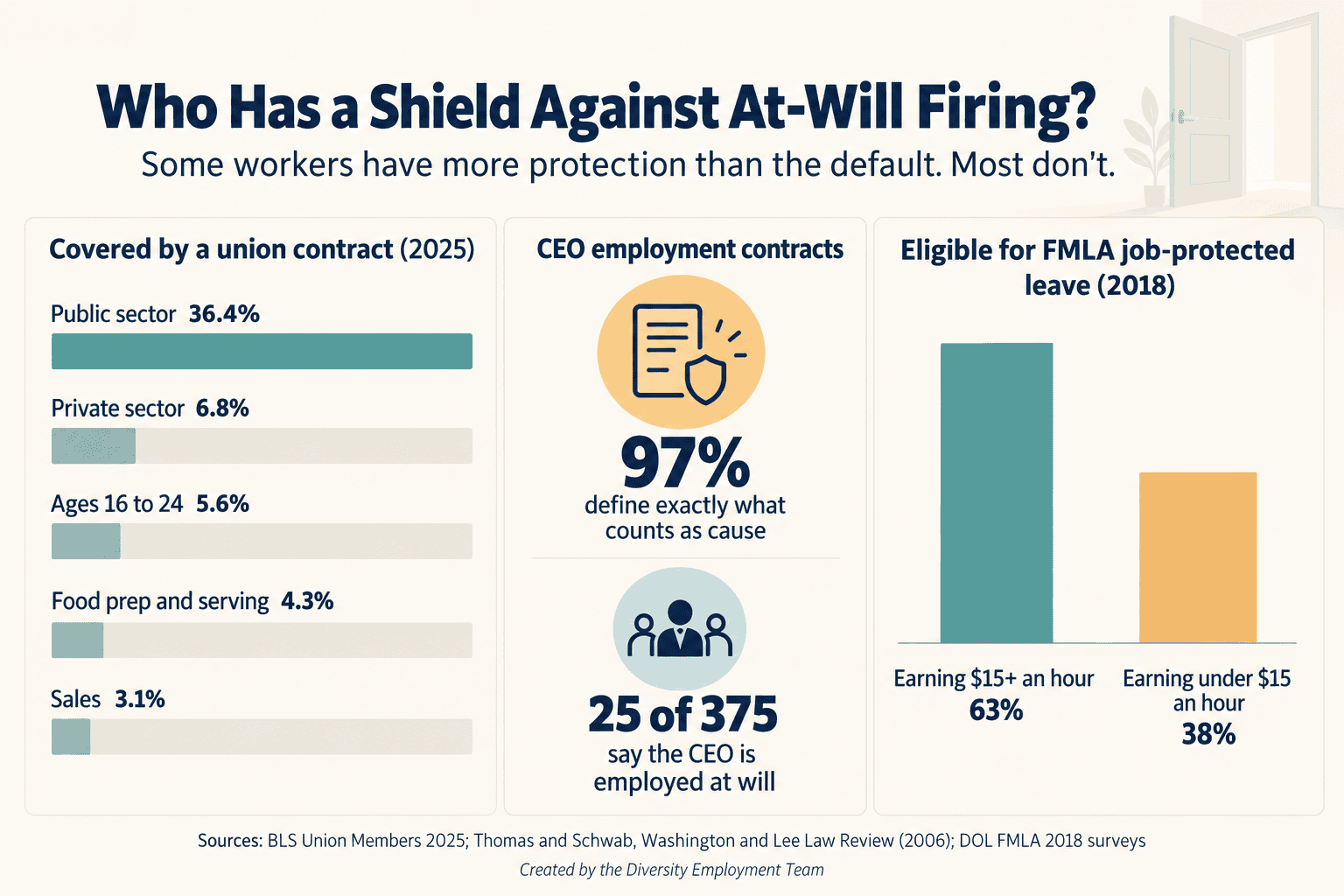
- Just 38% of workers earning under $15 an hour qualify, compared with 63% of those earning more.
- 43% of employees in single-parent households qualify, compared with 63% in two-parent households.
- 21% of all employees miss out only because they haven’t been at the job 12 months or haven’t worked 1,250 hours in the past year. Another 15% miss out only because their worksite is too small (fewer than 50 employees within 75 miles).
And another knowledge problem shows up here too. Among workers without a high school diploma, 95% believed they were eligible… Only 44% actually were.
So the people most likely to need job-protected leave, the lower-wage workers, single parents, and anyone new to a job, are the least likely to have it. They’re also the most likely to think they do. FMLA also only covers caring for a spouse, child, or parent. That leaves out a lot of the people workers are actually caring for these days. We dug into that in our piece on the caregivers most policies don’t cover.
When FMLA Runs Out (or Never Applied)
This is the one most people, and honestly a lot of online answers, get wrong. If FMLA runs out, or you never qualified, that doesn’t automatically mean you have no protection, technically.
The Americans with Disabilities Act covers employers with 15 or more workers, and the EEOC’s guidance says unpaid leave can be considered a “reasonable accommodation” for a disability, including for someone who isn’t eligible for FMLA, or has already used it up. In the EEOC’s words, simply complying with the FMLA “Does not necessarily meet an employer’s obligation under the ADA.”
Extra Protection Can Overlap
There are limits. An employer doesn’t have to pay you for the leave. But it does have to actually consider it. One question posted from Surprise, Arizona, in February 2026 is a good example: A man recovering from triple bypass surgery had been out longer than FMLA covers and was then let go. A Phoenix employment lawyer who answered explained that once FMLA runs out, the ADA can pick up where it left off if the condition counts as a disability, and a serious heart condition most likely would. That could mean more unpaid leave, time off as needed for appointments and flare-ups, or even working from home. The catch: The employer only has to offer those if they don’t cause “undue hardship,” and still let the person do the core parts of the job.
Pregnancy has its own federal protections too, including the Pregnancy Discrimination Act and the newer Pregnant Workers Fairness Act, which requires reasonable accommodations for any pregnancy-related limitations.
Why So Many People Get This Wrong
None of this is new either. What’s actually surprising is how little it has changed over time.
Thirty Years of the Same Mistake
Kim followed up her St. Louis survey with workers in California and New York, and found nearly the same answers in all three states, even though their laws were vastly different. Things you’d expect to help, like being in a union, having hired or fired people yourself, or years of work experience, had very little effect on getting the answers right. Her explanation: People confuse what feels fair with what the law actually says.
A national survey from the mid-1990s, reported in the book What Workers Want, found 83% of workers believed, wrongly, that it was illegal to fire someone for no reason.
Then that question changed shape. In a 2015 and 2016 online survey across six states, law professor Arden Rowell asked people to judge a plain statement of their state’s at-will rule. 62% got it right. That’s a lot better than Kim’s numbers, but it probably says more about the specific question than about people learning the law. Recognizing the phrase “at-will” is one thing. Believing it applies just because your boss doesn’t like you is a whole other thing.
And the 2018 FMLA numbers show the same habit with a different law. We also haven’t found a single study since then that repeats Kim’s firing scenarios.
What People Ask Today
At Diversity Employment, we read through more than 100 public posts and threads from people asking about a firing, mostly from the past few years. We pulled from: lawyer Q&A boards, Reddit, Blind, Glassdoor’s community boards, Ask a Manager, and LinkedIn. It’s not a survey, and it leans toward people who already suspected something was wrong. But the patterns were pretty darn consistent:
- Getting Blindsided was the Most Common Complaint. Roughly 4 in 10 of the posts we coded described being let go with no warning at all, sometimes even after getting a good review.
- “Unfair Means Illegal” was the Most Common Mistake. That’s followed by the belief that an employer legally has to give you warnings or a performance plan first. (They usually don’t.)
- Very Few People Assumed Their Firing was Actually Legal. Most people really weren’t sure. A big share, however, were convinced before they asked that it was illegal.
- The Word “At-Will” Usually Came From the Answers, Not the Employer. In the posts we read, HR rarely said it. Lawyers and commenters said it a lot more.
- The Real Legal Trouble Showed Up Around Leave, Disability and Pregnancy. That’s where the questions go from grey areas, to covered under specific laws.
A few situations that came up, paraphrased:
- A worker was told “budget restructuring” out loud, but “personal computer use” in writing, and then they got denied unemployment.
- Someone fired one day before their probation ended asked how to explain a six-month job on their résumé moving forward.
- A worker who’d been let go actually got a letter from the state, saying their former employer had reported they quit on their own.
The Mirror Image
There’s a flip side to all this. When people get fired, they generally tend to overestimate just how protected they are. When they want to leave, they also tend to overestimate just how stuck they are. Both mistakes just so happen to favor the employer.
The clearest example is noncompetes. In the states that don’t enforce them, about 70% of workers who signed one still believe it actually is enforceable, according to research by J.J. Prescott and Evan Starr. We dug into that in our piece on noncompetes and the cost of quitting. That same feeling of being stuck shows up in quit rates too, which we went over in our piece on whether low turnover is loyalty or fear.
Two weeks’ notice works the same way. It’s just a custom, not a law. In most states your employer can accept your notice, then turn around and end your job that same day. One Reddit poster summed it up pretty well: The company lets people go with zero notice, but expects two weeks from everyone else.
And the two issues are starting to overlap. A new Virginia law, SB 170, took effect July 1st, 2026. For agreements signed or renewed after that date, a noncompete can’t be enforced against someone fired without cause unless the employer pays severance or another payment that was disclosed when they signed. In Virginia, how you were let go can now decide whether you’re free to work for a competitor.
Probation Is When Everyone Is At-Will
If there’s one stretch of a job where almost nobody has protection, it’s at the beginning.
- In Montana, the one just-cause state, probation can last up to 18 months.
- New York City’s fast-food just-cause law, in effect since July 4th, 2021, applies after a 30-day probation.
- Even federal jobs work this way. In February 2025, roughly 24,000 federal probationary employees were let go in a matter of weeks. Probationary federal workers actually have far less appeal rights than permanent ones.
New hires are also the people most likely to miss FMLA, since you need 12 months on the job just to qualify.
Protection Seems to Move the Screening Earlier
When it gets harder to fire people, employers seem to get much choosier up front. A 2025 Upjohn Institute working paper on New York City’s fast-food law found signs that young workers became more likely to be let go during the 30-day probation window. The authors call the results ‘suggestive.’ Older research by economists Adriana Kugler and Gilles Saint-Paul found that stronger wrongful-discharge rules lowered the odds that unemployed job seekers got hired, compared with people already working. That’s the group with breaks on their résumé and no current employer vouching for them.
The Word Does a Lot of Work
Kim found that when an offer letter mentioned a 90-day probation period, most people assumed firing them after that period required a reason. Outside of Montana, union contracts, and government jobs, probation usually has no legal meaning for a private employer. It’s much more of a management tool.
When the Probation Label Backfires
A few courts have turned it around on the employer. The pattern is pretty consistent: The handbook says you can be fired at any time during probation, and a court reads that as a hint that the rules change once probation is over.
- 1982, California. In Walker v. Northern San Diego County Hospital District, the hospital’s handbook said it could fire probationary employees at any time during probation. The court said that wording could suggest the hospital no longer had that right afterward, and sent the question of whether the worker could only be fired for cause to trial.
- 2007, Connecticut. In Defontes v. Mayflower Inn, the handbook called the first 90 days a “Probationary-At-Will Period.” A worker fired without explanation after those 90 days got his case in front of a jury, because the judge said the handbook might have implied he could only be fired for cause after that point.
- 2015, Massachusetts. In O’Rourke v. Hampshire Council of Governments, a public employer’s personnel manual said probationary employees could be let go without cause, listed specific reasons for firing anyone after that, and had no at-will disclaimer. A federal judge let the director’s claim that he could only be fired for cause move forward.
None of these meant the worker automatically won. They just got the chance to argue it. And the risk mostly shows up when the handbook is missing a clear at-will statement. If you were let go after probation, though, it’s worth pulling out the handbook and the offer letter, and reading exactly what they said about it.
The Résumé Question
This was the single most common question in the probation posts we read: “Do I put it on my résumé?”
There’s no perfect answer, but a few things seem to hold up. Background checks confirm dates, so hiding a job you list other places can backfire. If the job gave you real experience, it’s probably worth including. And a short, neutral sentence (“it wasn’t the right fit, and here’s what I learned”) usually works better than a long explanation or a complaint about a former boss.
Who Actually Has Protection?
If at-will is the default, the next question is… Who gets out of it? The answer mostly comes down to bargaining power.
The Top Negotiates Its Way Out
A study of 375 CEO employment contracts at large public companies by law professors Randall Thomas and Stewart Schwab found that 97% defined exactly what “cause” meant, usually narrowly, things like fraud or willful misconduct. Only 25 of the 375 said the CEO was employed at will. And about half promised 2 or 3 years of salary if the CEO was let go without cause. In the authors’ words, “Overwhelmingly, the CEO contracts around the at-will default.”
Union and Public Jobs
Union contracts almost always include a just-cause clause and a grievance process. But according to the Bureau of Labor Statistics’ 2025 union data, only 11.2% of wage and salary workers are covered by a union contract:
- 6.8% in the private sector, compared with 36.4% in the public sector.
- 4.3% in food preparation and serving, 3.1% in sales and 4.6% in personal care.
- 5.6% of workers ages 16 to 24, and 6.6% of part-timers.
- 4.5% in Arizona, compared with 22.5% in New York and 26.0% in Hawaii.
Construction and extraction jobs sit higher, at 17.4% coverage, something worth knowing if you’re thinking about a career path into the trades.
The Rough Math
Put it together and we estimate that at most about one in five U.S. workers has anything close to just-cause protection. That’s our own rough range: union-covered workers (16.5 million), plus non-union government workers with civil service protection, plus Montana’s private sector past probation, New York City fast food and people with individual contracts. Some of those pieces are estimates, so treat it as more of an upper limit. The other four in five rely on the at-will default plus the anti-discrimination, retaliation, and leave laws.
If You Work for the Government
Public employees with “for cause” protection have a constitutional right to notice and a chance to respond before they’re fired, under the Supreme Court’s Loudermill decision.
That protection has been shrinking, though. Several states, including Arizona in 2012, have moved new state hires to at-will. Temporary and contract government workers usually never had it.
For federal workers, a new OPM rule finalized in 2026 removed the standard firing procedures for positions moved into “Schedule Policy/Career,” and as of September 2nd, 2026, appeals of probationary firings and layoffs go to OPM instead of the Merit Systems Protection Board.
The practical takeaway: Don’t assume a government job means civil service protection. Check your actual appointment type, ask HR what appeal rights come with it, and get the answer in writing.
One LinkedIn post from a former temporary state worker in South Carolina put the cost plainly: She was working two jobs just to recover from losing one. That’s a path a lot of people know, and we explored that in our article on second jobs.
The Reason You’re Given
The reason your employer gives you, or doesn’t, can end up mattering a lot more than you’d expect. It shows up in your unemployment claim, any legal claim, and in what you’ll tell your next employer.
Nobody Has to Tell You, Mostly
In most of the country, an employer has no legal duty to explain a firing. But there are exceptions people rarely hear about:
- Service Letter Laws. A handful of states make employers give a written reason if you ask. In Minnesota, you have 15 working days after being fired to ask in writing, and the employer has 10 working days to give you the “truthful reason.” Missouri requires a request by certified mail within a year, for workers at companies with 7 or more employees who worked there at least 90 days. Montana, Nevada and Washington have their own versions.
- Separation Notices. In Georgia, employers have to give a separation notice that states the reason you’re leaving, on your last day.
- New York City Fast Food. Covered employers have to give a written explanation of the “precise reasons” within 5 days, and those become the only reasons they can defend later.
Even where it’s not required, it’s worth asking. Something simple works: “Can you send me the reason for my termination in writing?”
Why the Story Matters Later
If you ever have a discrimination or retaliation claim, the employer’s stated reason will be the center of it. And when that reason shifts, courts and the EEOC treat it as possible evidence that the real reason was something else. The Supreme Court said in Reeves v. Sanderson Plumbing that a jury can treat an employer’s dishonesty about its reason as evidence against it.
That’s why “restructuring” in the meeting and “performance” in the paperwork is worth writing down, the same day.
Unemployment Is Where It Gets Tested
For unemployment benefits, the label matters a lot. In general, being laid off or fired for something other than “misconduct” won’t disqualify you. Quitting without good cause usually will, according to the Labor Department’s comparison of state laws. “Misconduct” usually means something more serious than just not being good at the job. The details, like how much you can get and for how long, vary a lot from state to state. Our state-by-state guide to unemployment benefits lays out how each one works.
Employers have a reason to fight claims, since in most states their unemployment tax rate depends partly on how many former workers collect. That’s how you get posts like the one from a worker who’d been let go and then got a letter saying the company’s outside HR firm reported they quit. If the state denies you, appeal and ask for a hearing. It’s often the first time an employer has to put its reason on the record. We went deeper on the benefits side in our piece on the long job search.
“Quit or Be Fired?”
Sometimes an employer offers you the chance to resign instead of being let go. It can look better on paper, but resigning can cost you unemployment benefits in most states. Before you agree, ask what they’ll say to the unemployment office and to future reference checks, and get it in writing.
If things get so bad you feel forced out, that may count as “constructive discharge,” which some courts treat like a firing. Arizona has a specific rule here: Under A.R.S. 23-1502, you generally have to give your employer written notice and 15 days to respond before you can claim constructive discharge over working conditions (the rule doesn’t apply to outrageous conduct like assault or threats).
Your First 30 Days
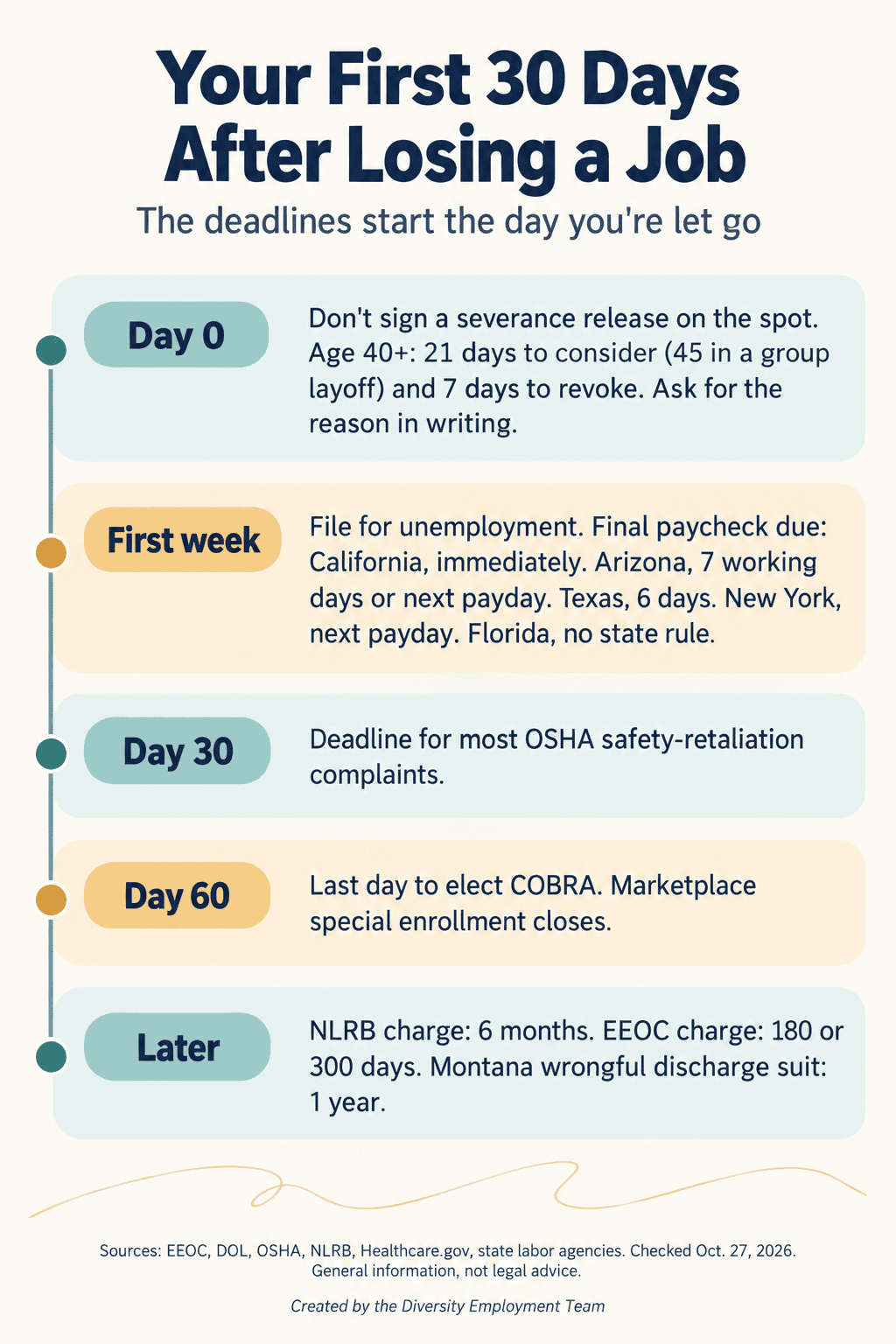
The first month after a firing has more deadlines in it than most people realize, and a few of them are surprisingly short.
In the First Few Hours
- Don’t Sign Anything on the Spot. If you’re 40 or older and they offer severance in exchange for a release, federal law gives you at least 21 days to consider it (45 in a group layoff) and 7 days to change your mind after signing, under the Older Workers Benefit Protection Act. In California, anyone gets at least 5 business days and must be told they can talk to a lawyer. Everywhere else, it’s still okay to say, “I’d like to take this home and review it.”
- Ask for the Reason in Writing.
- Write Down What Happened while it’s fresh. Who was in the room. What was said. The dates of any recent complaints. And any leave requests, or performance reviews.
- Keep Copies of Your Own Stuff, like pay stubs, your offer letter, any reviews, and your personal messages. Just don’t download any confidential company files… That can create a whole new legal problem.
Within the First Week
- File for Unemployment Right Away, even if you’re not sure you qualify. Let your state decide that.
- Check Your Final Paycheck Deadline. There’s no federal rule, so it depends on your state. California requires it immediately, with penalties for each day it’s late. Arizona requires it within 7 working days, or by the end of the next pay period, whichever comes first. Texas gives employers 6 calendar days. New York allows until the next regular payday. Down in Florida there’s no state rule.
- Ask About Unused Vacation and whether your state requires it to be paid out.
- If You Have Stock Options, check your exercise deadline. Many companies give about 90 days after you leave, and it’s easy to miss.
In the First Month
- Health Coverage. If your employer had 20 or more workers, you can usually keep your plan through COBRA. You have 60 days to elect it and 45 days after that to pay, but it can cost up to 102% of the full premium. Losing job-based coverage also opens a 60-day window to enroll in a Marketplace plan. Compare both before the window closes. Dropping COBRA later doesn’t reopen it. (The larger Marketplace subsidies from recent years expired at the end of 2025 and still hadn’t been restored for 2027 coverage as of early November 2026, so check the current numbers.)
- Agency Deadlines. These vary a lot:
- 30 Days for most OSHA safety-retaliation complaints.
- 6 Months for an NLRB charge (for example, being fired for discussing pay).
- 180 Days for an EEOC charge, or 300 days in states with their own similar law.
- Some state agencies give longer: 3 years in California and New York, 2 years in Illinois.
- 1 Year to sue under Montana’s wrongful discharge law.
When a Lawyer Is Worth Calling
Not every bad firing is worth a lawyer. These are the signs when it probably is:
- The firing came soon after a complaint, a leave request, an injury claim, or a pregnancy announcement.
- You’re in a protected group and the reasons don’t seem to add up, or keep changing.
- You were on, or just back from, medical or family leave.
- You’re being offered severance in exchange for a release, especially if you’re 40 or older or part of a group layoff.
- You had a contract, a union agreement, or a written promise.
Many employment lawyers offer a free or low-cost first consultation and work on contingency, meaning they get paid only if you recover something. State bar referral services and the National Employment Lawyers Association are good places to start.
The Employer’s Side
At-will has real defenders, and their argument deserves a fair hearing. Because there is a case for flexibility.
The argument goes like this: If firing is cheap, hiring is less risky, so employers are more willing to take a chance on someone with a gap, a record, or a thin résumé. There’s even evidence behind it. A study by economists David Autor, John Donohue, and Stewart Schwab found that when state courts started treating handbooks and promises as implied contracts, state employment rates fell by 0.8% to 1.7%, though the effect faded over time. Autor separately found the same exception explained up to 20% of the growth in temp staffing from 1973 to 1995, as employers looked for workers they could let go more easily. And the Kugler and Saint-Paul findings suggest stronger protections can make it harder for unemployed people to get back in.
What Happened Where There was Just Cause
The evidence from places that actually require just cause is more mixed. In Montana, the court decisions of the early 1980s seemed to slow job growth, but after the 1987 law capped damages, a 2005 study found employment growth returned to its earlier pace. In New York City, fast-food employment rose 18% between the law’s first full quarter and the end of 2024, according to a December 2025 report from the city comptroller, who supports the law. That report doesn’t try to prove cause and effect, though, and the Upjohn research found little evidence the law improved job stability for the groups it was meant to help.
Internationally, the U.S. is an outlier. The OECD’s 2026 Employment Outlook says required notice and severance for a worker with four years on the job ranges “from no compensation in the United States to six months of pay in Türkiye.” The debate keeps going here too. Ithaca, New York, is weighing a just-cause ordinance this fall, and a New York City just-cause rule for rideshare drivers was put on hold by a federal judge in July 2026.
What At-Will Doesn’t Let Managers Do
If you manage people, at-will is actually less of a shield than it sounds. One startup lawyer on LinkedIn summed up where firings generally turn into claims: No documentation. Reasons that shift after the fact. And timing that comes right after a complaint or leave request. That’s a good checklist:
- Document the Problem Before the Conversation Happens.
- Keep the Reason the Same in the meeting, the paperwork, and the unemployment response.
- Check the calendar. If the person just complained, asked for leave, or filed a claim, slow down and talk to HR or counsel first.
It’s also why a lot of big companies don’t let store managers fire people on the spot, even in at-will states. At-will describes what the law allows the company to do. It doesn’t mean every manager gets to use it unchecked.
The Default and the Fine Print
“At-will” sounds absolute, and that’s the problem. It gets heard as “they can do whatever they want” or “they need a good reason,” and neither is true.
What It Comes Down To
The protections are real, but they mostly depend on timing, paperwork, and deadlines: what happened right before, what you were told and when, what you signed, and how fast you act. The people with the strongest job security mostly negotiated for it, through a contract or a union. Everyone else has the default, plus whatever they know to ask for.
So if it happens to you, ask for the reason in writing, don’t sign anything that day, file for unemployment, and write down what happened before the details fade. And if someone tells you “it’s an at-will state,” that’s where the conversation starts, not where it ends.