

I’ve personally automated a lot of my job at this point, and I’m not alone. More and more people are finding ways to get their tedious and time consuming tasks done much faster, and even automatically. Unlike some of those doing it in secret, my bosses know about all of it and are ‘there for it.’ My weekly newsletter took about 18 hours to build into a templated and automated workflow. Now it saves me around 12 hours a week, so it paid for itself within two weeks. Articles that used to take 3 to 5 workdays of research, drafting, and polish now take a fraction of that. All told, my workload takes about an eighth of the time it used to. The best part, for me, is that I always have more to do.
The Hours Have to Go Somewhere
It’s a great outcome for me. But take that exact same move, the same tools, and the same hours saved, then drop it into a different job… It can look a lot less like a win. It might even end up feeling like training your replacement.
The difference usually comes down to two things: What happens to the hours AI frees up? And who actually gets to decide that.
Three Places Your Saved Hours Can Go
When AI cuts a 10-hour task down to 2, those 8 hours don’t just disappear. They generally tend to go one of three places:
- More of the Same. Your faster output becomes the new normal, and then more work simply keeps coming.
- Fewer People. If there’s only so much work to go around, that same work now needs less hands to deliver it.
- New Work. The time goes into something that wasn’t getting done before, and that something should add value.
Most AI coverage argues about whether AI is good or bad for jobs. But, that’s probably the wrong question. The same tool can land you in any of those three spots, again, depending on what kind of work you do, and who’s above you.
The Ceiling Test
Economists have been studying the difference between #2 and #3 for a long time, and it mostly comes down to demand. James Bessen, an economist at Boston University, put it plainly in a 2018 working paper for the National Bureau of Economic Research: “The effect of artificial intelligence on jobs will similarly depend critically on the nature of demand.”
In everyday terms: Does your work have a ceiling? Or more exactly: “If my work got twice as fast, could anyone turn the extra time into something worth paying for?”
Every job does have some ceiling, eventually. Even content hits a point where too much of it stops bringing in new eyes. What really decides is how far away that point is, and whether the people above you have a plan to use the room in between.
What a Ceiling Looks Like
Bessen’s favorite example is cloth. In the early 1800s, a lot of adults owned about one set of clothes. When machines made fabric cheaper, people bought way more of it, and then textile jobs grew. Once closets were full, cheaper cloth didn’t sell much more. That’s when the machines started cutting jobs instead.
ATMs followed that exact same pattern too, just quite a bit slower. Bessen found the number of tellers in a typical urban bank branch fell from 20 to 13 between 1988 and 2004. But ATMs made branches cheaper to run, so banks opened 43% more of them with teller jobs holding up for years.
Then online and mobile banking did what ATMs couldn’t, and people stopped needing to physically walk into a branch at all. The Bureau of Labor Statistics now projects teller jobs will fall 13.2% between 2025 and 2035. The ceiling shows up eventually.
Jobs With a Ceiling
The BLS released its 10-year projections on August 27th, 2026. Here’s a few of the occupations expected to lose the most jobs:
- Customer Service Representatives: down about 141,800 jobs (-5.3%)
- Bookkeeping, Accounting, and Auditing Clerks: down about 85,600 (-5.6%)
- Data Entry Keyers: down about 33,600 (-25.5%)
- Payroll and Timekeeping Clerks: down about 25,400 (-15.9%)
- Claims Adjusters and Examiners: down about 20,600 (-5.5%)
Look at what those jobs mainly handle: tickets, invoices, data fields, paychecks, and claims. They all have a finite amount of work that can be done. A faster claims adjuster doesn’t simply create more car accidents to process.
The BLS even says so in its write-up of how it factors in AI to employment projections. On claims adjusters: “More insurance-related work can be done with fewer employees, reducing employment demand.” So, if you work in one of these jobs, it doesn’t mean you need to panic or start job hunting tomorrow. It just means your ceiling may be closer than it looks from the inside, and it’s probably worth knowing about where it is.
Jobs Without One
Same agency, different job. The BLS projected software developer jobs to grow 17.9% from 2023 to 2033, in part because “increased productivity from the use of AI may lower prices and increase demand for software products.” Cheaper software means people want more of it. For a while…
Radiology is probably the best-known prediction that totally missed. In 2016, AI pioneer Geoffrey Hinton said, “People should stop training radiologists now. It’s just completely obvious that within five years deep learning is going to do better than radiologists.” Instead, the 2026 residency Match offered a record 1,241 diagnostic radiology positions. The Mayo Clinic’s radiology staff has grown about 55% since 2016, according to The New York Times, while it runs more than 250 AI models. Faster reads seem to have made more scans worth ordering.
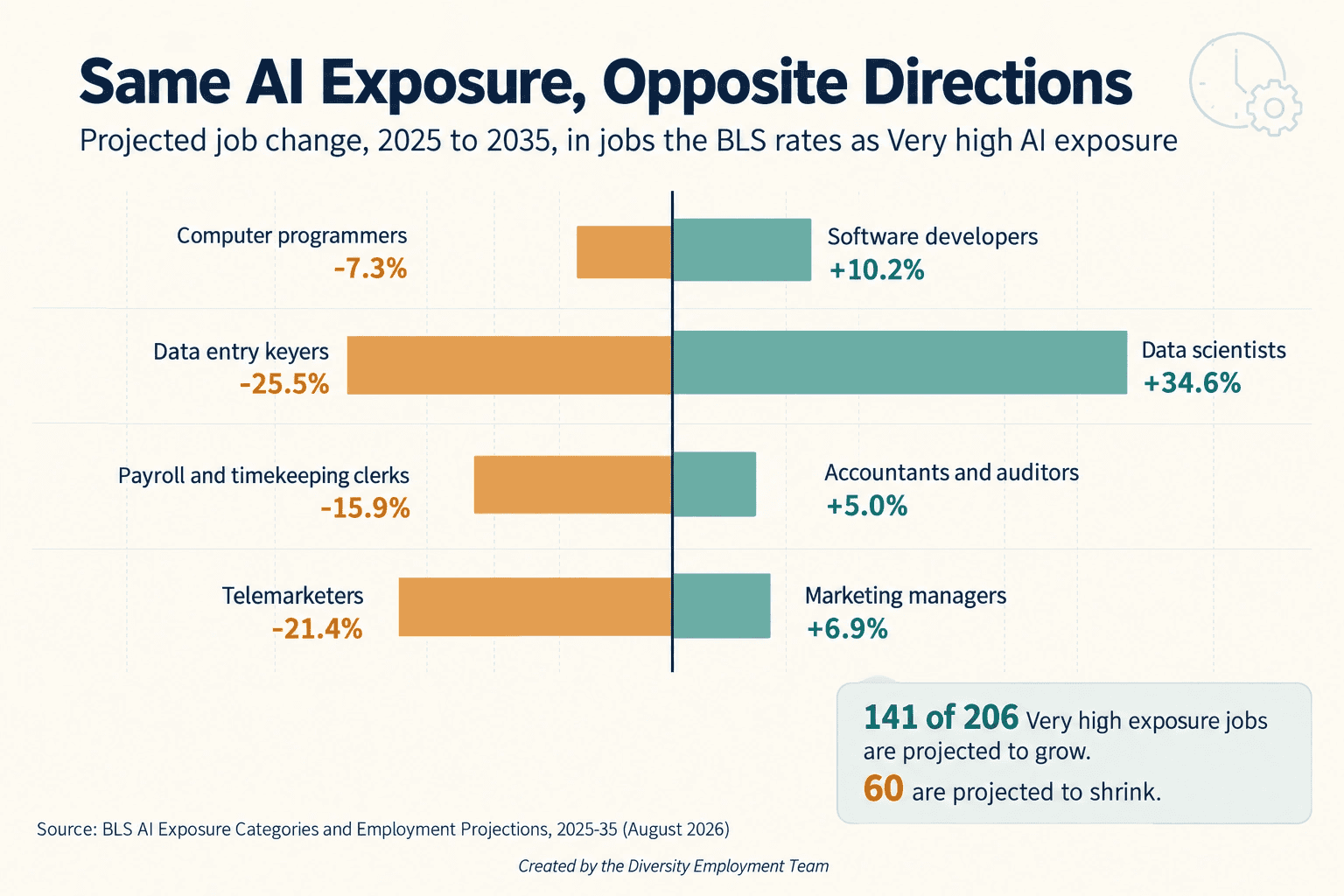
Same AI Exposure, Opposite Directions
Along with its August 2026 projections, the BLS rated every job it tracks by how exposed it is to automation and AI, from ‘Low’ to ‘Very high.’ We lined those ratings up against the BLS’s 10-year projections. Of the 206 jobs rated ‘Very high,’ 141 of them are still projected to add jobs by 2035. Only 60 are projected to shrink.
The split lines up almost pair-by-pair:
- Software Developers: Up 10.2%. → Computer Programmers: Down 7.3%.
- Data Scientists: Up 34.6%. → Data Entry Keyers: Down 25.5%.
- Accountants and Auditors: Up 5%. → Payroll and Timekeeping Clerks: Down 15.9%.
- Marketing Managers: Up 6.9%. → Telemarketers: Down 21.4%.
Same AI and automation exposure, trending in opposite directions. The growing jobs are the ones that tend to decide what work gets done. The shrinking ones mostly process a set amount of it.
The BLS is careful to say an exposure rating “does not imply job loss,” and its projections weigh a lot more than just AI. But the pattern is pretty hard to miss.
Who Holds the Shrinking Jobs
The same file shows who’s standing on each side. About 80% of the growing ‘Very high’ exposure jobs typically require a bachelor’s degree or more. Among the shrinking ones, nearly half generally only require a high school diploma or less.
When you count the actual people instead of just their job titles, it gets even more lopsided. About 21 million people worked in those 60 shrinking jobs in 2025, and close to 8 in 10 of them were in jobs that typically require a high school diploma or less. The average shrinking job paid a median of around $55,600 a year, compared to about $83,100 for the growing ones.
So the people with the most to lose from hitting a ceiling are also the ones with the least amount of easy exits. That’s a lot of call center, billing, and office support work, the kind of job that’s usually a first step-up for people without a degree, or a network.
Same Task, Different Ceiling
Here’s where it gets personal for anyone who writes, sorry. After OpenAI launched ChatGPT, freelance writers on Upwork saw their monthly earnings drop 5.2%, according to researchers Xiang Hui, Oren Reshef, and Luofeng Zhou. A separate study published in Management Science found that writing and coding job posts even fell 21% within just 8 months.
Those clients were buying a set number of blog posts. Once AI could write even some of them, they simply needed less writers.
I write content too, and AI has done close to the opposite for me. Our site doesn’t need a fixed number of articles. Good content still brings more readers, and we’re nowhere near the point where it stops. Again, we see the same task. Much different ceiling.
Check Your Own Job
None of this tells you for sure what’s coming for your specific job. But a few honest questions can probably tell you which direction you’re facing:
- Ask the Ceiling Question. “If I did twice as much of this, could anyone actually use it?” If yes, and someone has a plan for it, your freed-up time can turn into more value. If the honest answer is no, every hour AI saves is an hour nobody needs to pay for.
- Figure Out Who Decides Where Your Hours Will Go. If it’s you, or a manager with a plan for growth, that can be a good sign. If nobody has said anything, the fall-back will most likely be more of the same work.
- Look at Who’s Being Hired Below You. “Is anyone still getting hired into the job I had 3 years ago?” That’s usually where replacement shows up first.
- Ask “What’s Next if My System Runs Itself?” Writing down your entire workflow so that AI can handle it can be either a handoff, or a farewell. The difference is whether there’s actually a next thing for you to do that’s worth the time.
- Count the Babysitting. Keep track of how much time goes to fixing, re-prompting, and double-checking AI’s output. Hours saved on paper aren’t always really hours saved.
Replacement Rarely Looks Like a Layoff
When people picture AI taking over jobs, most of them picture some mass layoff email probably written by AI. The data points somewhere different so far though…
Researchers at Stanford’s Digital Economy Lab, led by Erik Brynjolfsson, have been tracking payroll records from ADP covering millions of workers. Their latest update, through June 2026, found employment for 22- to 25-year-olds in highly AI-exposed jobs now sits about 19% below where it would be had it kept pace with their less-exposed peers. Experienced workers don’t show a comparable drop.
The way it’s happening matters even more. In the researchers’ words, the decline works “primarily through reduced hiring of young workers rather than increased separations.” The drops mostly cluster in jobs where AI substitutes for people. Where AI mostly helps people do their work, employment stays flat or even starts rising. The authors are careful to call these early warning signs though, not proof of cause.
So the person automating their job usually keeps it. The openings below them are what starts to disappear. And entry-level jobs are how a lot of people without connections, degrees, or a family network get their foot in the door in the first place. It’s the same pipeline problem behind why nobody wants to train the next generation of experienced workers. Skip the junior hires long enough, and there’ll be nobody left to become senior.
“I Need Less Heads”
Salesforce CEO Marc Benioff said it out loud on The Logan Bartlett Show in late August 2025: “I’ve reduced it from 9,000 heads to about 5,000, because I need less heads.” That was his customer support team, which is about as textbook as a ceiling job can get.
Benioff has described the other side too. Earlier that year, he told Fortune his salespeople could only cherry-pick which leads to call back: “Thousands of leads, tens of thousands of leads, hundreds of thousands of leads have never been called back.” With AI agents, he said, “Every lead can be followed up on.” That’s work people simply never had the time to reach.
Salesforce later pushed back on headlines saying it had laid off 4,000 people, describing it as a restructuring handled through redeployment, unfilled jobs, and attrition. Which kind of proves the point. A company can have 4,000 less support jobs without a single layoff headline.
Writing the Manual
Some workers can see it coming because they’re asked to help. In reporting by TIME in May 2026, laid-off Oracle employees said they had been told to document their workflows to train the company’s AI before losing their jobs. One former employee put it this way: “We were training AI to replace us, but the AI is the only way we can get through our workload.” Oracle declined to comment.
In China, MIT Technology Review reported on April 20th, 2026 that tech bosses are pushing workers to write detailed workflow manuals so AI agents can take over their tasks. It got so common that an engineer built a tool called “Colleague Skill,” a half-joking project that turns a coworker’s chats and files into a manual of their duties. A product manager in Beijing, Koki Xu, answered with an “anti-distillation” tool that rewrites those manuals into vaguer, less useful language on purpose. Her video about it got more than 5 million likes.
Although across the world, a 27-year-old worker in Shanghai, Amber Li’s words hit home for a lot of people right now: “I don’t feel like my job is immediately at risk… But I do feel that my value is being cheapened, and I don’t know what to do about it.”
When the Math Was Wrong
Sometimes companies guess the ceiling wrong. In July 2025, Commonwealth Bank of Australia cut 45 call center jobs, saying a new voice bot had reduced call volume by 2,000 calls a week.
The Finance Sector Union showed calls were actually going up, with team leaders pulled onto the phones and staff working overtime. The bank reversed the cuts and apologized, admitting its assessment “Did not adequately consider all relevant business considerations,” according to Bloomberg. Again, not here at home, but we see the same thing happening all around the world… Which, I guess, is even more concerning.
Why So Many People Keep It Hush-Hush
If automating your job can go three different ways, it makes sense that a lot of people would hide it.
In a 2025 survey by IT firm Ivanti, 32% of employees who use generative AI at work said they keep it a secret from their employer. The top reasons: 36% liked having a sort-of “secret advantage,” and 30% were worried their job might be cut. A global study from KPMG and the University of Melbourne went even further: 57% of employees said they hide their use of AI and present AI-generated work as their own. Aside from the studies, we’ve all seen ‘AI slop.’ It still makes it through sometimes. So, we can deduce that people are, for sure and sometimes even fully, putting their name on unchecked AI work.
What People Ask
At Diversity Employment, we read through nearly 100 public posts and threads, about 60 of them were from people who had automated some or all of their own work, or were worried someone would. We pulled from The Workplace Stack Exchange, going back to 2013, and Hacker News comment threads from 2023 on. It’s not a survey, and it leans heavily toward programmers and tech workers.
A Few Patterns Stand Out
- The Question is Way Older Than ChatGPT. Most of the Stack Exchange threads came before 2021. The most-viewed one, a 2017 post asking whether it’s unethical not to tell your employer you’ve automated your job, viewed more than 550,000 times. AI didn’t invent this dilemma. It just moved it within reach for people who can’t write code.
- Most People Weren’t Asking How. They already had automations running. They wanted to know what to do next: tell their boss, ask for a raise, or keep quiet?
- The People With the Least Leverage Worried the Most. A temp worker at a $15/hr office job automated half of it, then let it slip that they could automate the rest. The VP wanted the whole division’s ordering and billing automated, the temp said that “would effectively replace my job.” They asked for a permanent spot first, but were told to look around and keep working on it on the side. Two logistics workers at $13/hr said they were building a program to automate their company’s processing operation. So far, that only got them a $1 raise and the CEO’s promise that they’d be “taken care of” afterward.
- Running Out of Work Was a Real Outcome. One worker took over a job someone had for 10 years, and found that most of it could be automated. They asked what to do when nobody could give them more work. That’s the ceiling, described from the inside.
- AI-Era Posts Split Hard. One commenter called automating your job the ‘best career move there is’: “Nothing looks better for moving up than this.” Another put it bluntly the opposite way: “You don’t want to automate your job, I don’t want to automate my job, but the shareholders want to automate both of our jobs.”
The Baseline Trap
One Reddit post that hit about 4,000 upvotes, covered by the Daily Dot in September 2026, told the story most people are afraid of. The poster automated about half their job with a script (not AI, but same idea), told their manager, and wound up inheriting half the workload of a senior colleague who had quit. Their summary: “My automated output just became the baseline expectation.”
Another post, on a workplace forum for workers in India, asked whether to tell a manager about automating 60% of the work. The poster’s worry: “If I tell this to my manager then he will increase the workload on all of us.” Stuck in a catch-22.
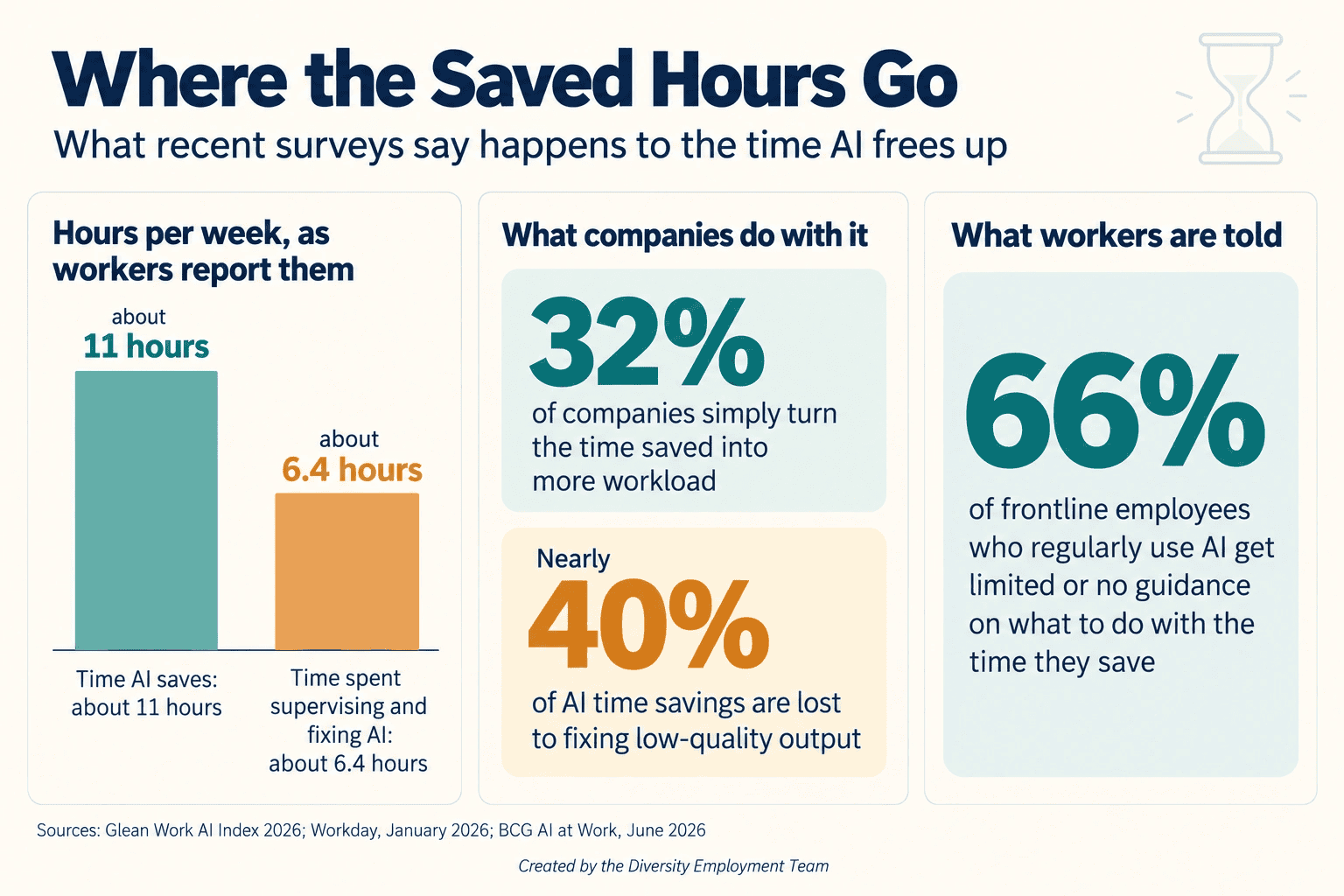
The surveys suggest that fear isn’t paranoia. In Workday’s January 2026 research, 32% of companies simply turned employees’ AI time savings into more workload. Glean’s Work AI Institute surveyed 6,000 workers and found that for lower performers, saved time tends to get “reabsorbed into more of the same work.” And a June 2026 Boston Consulting Group survey found 66% of frontline employees who regularly use AI get limited or no guidance on what to do with the time they save.
Not All of the Saved Time Is Real
The same Glean survey found workers believe AI saves them about 11 hours a week. They also spend about 6.4 hours a week feeding it context, supervising it, and cleaning up after it… which Glean calls “botsitting.” Workday’s numbers point in the same direction: Nearly 40% of AI time savings are lost to rework.
So, you can see why hiding it is understandable. The downside is that if nobody knows you freed up time, nobody’s going to give you something better to do with it either.
What It Looks Like When It Goes Right
Now for my setup, because it’s the version where the hours go in option #3, and I’m pretty familiar with it.
Here’s where just a bit of my extra time went:
- Back-Stock. I always have a few finished articles ready to go, so our blog stays current and the newsletter never scrambles.
- New Ideas. The Opportunity Atlas map we just launched exists solely because I finally had the time to build it.
- Creative Work. Memes, cartoons, short videos, and social media that bring more people to the site.
- Social Listening. Way more time to spend reading and understanding what people are actually struggling with, then covering it.
My infographics now show up in Google Image search, and our rankings keep climbing the more closely my AI systems follow the guidelines I’ve built and iterated. Next up for me is automating a system for our quarterly journal, which should save me about 2 full weeks of work every quarter. All this to say, automation can be an awesome tool when the time goes into something that wasn’t getting done before, and when those somethings add real value.
The Honest Part
Some afternoons my computer is running a workflow while I watch a video, or read a new study. I don’t lean on that often, and I make sure there’s always something finished to show. But I can absolutely see why people with a boss breathing down their neck would keep most of their automations to themselves.
If I handed over a written guide to my workflow, someone else could probably run most of it within a day or two. That’s the exact same thing Oracle’s workers and those engineers in China were asked to do… So, why didn’t my version end the same way? Partly because my work is a long way from its ceiling, so more output keeps being worth something. But mostly because of what my bosses trust me with. They’ve seen me show up with a plan for getting something done before anyone asked for one, and over time, they’ve gotten used to that.
Mostly Trust Based
The systems I built aren’t really what makes me, specifically, hard to replace. Someone else could run any of my systems. What seems to matter more is adaptability, being the person who can figure out the next system, which is a big part of why AI skills alone aren’t enough. And there’s actually a funny paradox in that. The better I get at comprehensively writing down and automating yesterday’s work, the less anyone really needs me for it, and the more they seem to trust me with whatever comes next.
I am aware this is just my situation, and it could be very different for the same job with a different management team. That kind of trust isn’t permanent, either. Leadership changes, budgets get tight, and priorities shift around. It’s a good spot to be in for sure, but it’s not a guarantee. What decides how these stories end is mostly whether the people at the top see freed-up capacity as something to grow with, or something to cut.
Some Are Cutting for What AI Might Do
The decision isn’t always based on results. In January 2026, Thomas Davenport and Laks Srinivasan surveyed 1,006 executives for Harvard Business Review and found AI-related layoffs were happening “Almost completely in anticipation of AI’s impact,” not because of what AI had actually delivered.
A March 2026 working paper using the Duke CFO Survey of about 750 firms found something similar on the productivity side. Executives said AI raised their productivity about 1.8% in 2025. However, their revenue numbers implied closer to 0.6%.
None of this means a job collapse is underway. The Stanford researchers found “No evidence of widespread, economy-wide job displacement.” But Lisa Cook, a Federal Reserve Governor, warned in February 2026 that “Job displacement may precede job creation,” meaning the painful part can show up some time before the new jobs do.
If You Manage People
- Decide Where the Saved Hours Go Before Your Team Has to Guess. If you don’t give a clear plan, they’ll most likely just hide the time they’re saving.
- Check the Real Volume Before You Cut. Commonwealth Bank assumed a ceiling that wasn’t there and had to walk it back. Don’t be Commonwealth Bank.
- Keep Hiring at the Bottom. Skipping entry-level hiring can look efficient this year, but then leave you with nobody to promote or hire in five.
The Hours Decide
AI didn’t decide whether I was automating my job or training my replacement. The room left in my work did, and so did the people above me and what they want to build with the extra time.
For a lot of jobs, the real honest answer will probably be a mixture of both. Some tasks really will need fewer people. Others will open up work that nobody had time for. The workers who come out ahead seem to be the ones who know which is which in their own job, and who can answer two questions before they’re asked:
“If this ran without me, what would I be doing instead?” & “Does anyone above me have that answer already?”