
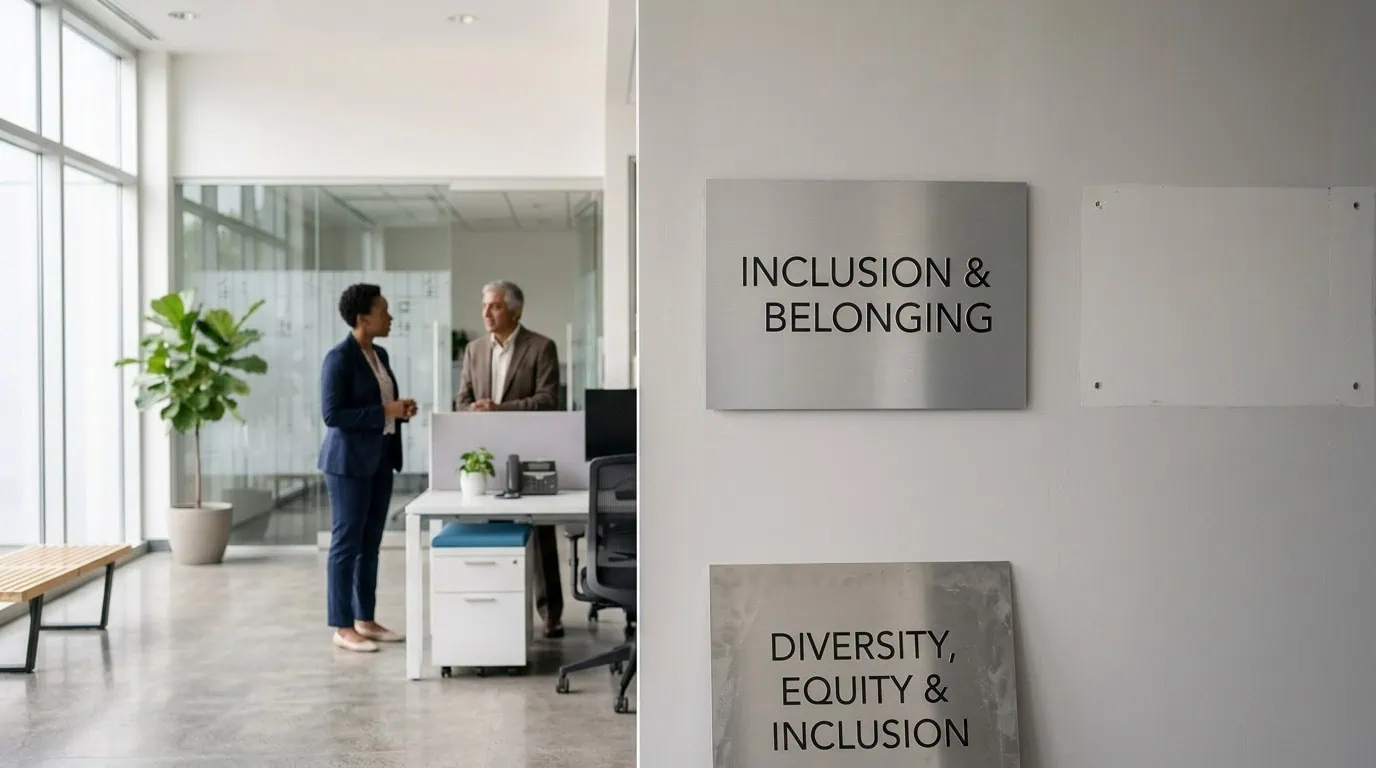
A job seeker opens a company’s careers page in 2026 and finds nothing. No diversity report, no representation numbers, no statement of commitment. Two years ago that page had all three. She closes the tab and crosses the company off her list.
Inside that same company, a program manager is running the mentorship pipeline she built in 2022. Same budget, same headcount, same participants. The page it used to live on came down in February on advice from legal. Nothing else about the work changed.
Both of them are behaving sensibly. That’s the problem. The signals job seekers spent a decade learning to read stopped tracking the thing they were supposed to measure, and almost nobody announced it. If you’re looking for an employer that will treat you fairly, or you’re an employer trying to prove you will, the old playbook doesn’t work anymore. This guide is about what replaced it. For the broader foundations, our Ultimate Guide to Diversity covers the underlying concepts this piece builds on.
What Actually Changed in the Law
Start here, because most of the confusion downstream comes from people guessing at this part.
The orders and the enforcement shift
Executive Order 11246 had been on the books since 1965. It’s what required federal contractors to run affirmative action programs, and on January 21, 2025, Executive Order 14173 revoked it. Contractors now have to certify they aren’t running DEI programs that break federal antidiscrimination law. That certification has teeth. Three months later a second order told federal agencies to stop building enforcement around disparate impact, the idea that a neutral-looking policy can still discriminate if the outcomes come out lopsided.
A federal court in Maryland blocked parts of this in early 2025. That didn’t hold. The Fourth Circuit vacated the injunction in February 2026 and the provisions took effect nationwide.
Then it went further. Executive Order 14398, signed March 26, 2026, tells agencies to write a clause into federal contracts banning what it calls racially discriminatory DEI activities. Implementation started that April. Contractors have to produce records proving compliance, and a false certification can trigger False Claims Act liability, which is the kind of exposure that gets a general counsel’s attention in a way a policy memo never will. Nineteen states and the District of Columbia sued in June 2026, arguing the contract language is too vague to actually comply with. That case is still pending. The order is in effect while it’s litigated.
The EEOC moved the same way. It rescinded its longstanding Title VII guidance on permissible affirmative action on June 30, 2026, and its enforcement plan through fiscal 2029 names DEI programs that use race or sex in employment decisions as a priority target. The agency has since filed and settled cases on exactly that theory. It’s also proposed scrapping EEO-1 demographic reporting altogether, though that’s still a proposed rule rather than a final one, so employers should plan to keep filing.
One more piece gets overlooked. In Ames v. Ohio Department of Youth Services, decided in 2025, the Supreme Court held that plaintiffs from majority groups don’t face a higher bar when they bring a Title VII claim. Reverse discrimination suits got easier to file. Companies noticed.
What is still completely legal
Here’s the part that gets lost in the noise, and it’s the part that matters most if you’re trying to judge an employer. None of this outlawed caring about fairness. It narrowed one specific thing: using someone’s race or sex as an input into an employment decision.
Private employers can still recruit wherever they want, including at schools and job fairs they weren’t bothering with before. Employee resource groups are fine if they’re voluntary and anyone can join. So are mentorship and development programs open to everybody. Pay equity audits aren’t just permitted, several states including Illinois and California require them. Accessibility and disability accommodation runs on the ADA, and none of this touched the ADA. You can also still collect demographic data about your own workforce.
What carries real risk is narrower. Programs where eligibility itself is restricted by race or sex. Hiring quotas. Mandatory diverse slate requirements. Executive pay tied to demographic targets. Sixteen state attorneys general drew much the same line in February 2025, though that was a coalition of Democratic-led states making a legal argument rather than a neutral federal ruling, and it’s worth reading it that way.

So the honest summary is a lot narrower than the headlines suggest. A company can still do most of what it was doing. It just can’t use protected characteristics as a decision input, and it’s doing all of it under an enforcement posture that starts from the assumption of bad faith.
Companies Changed Their Words More Than Their Work
Faced with that, most large employers did the cheapest available thing. They edited the website.
Roughly 63 of the Fortune 100 have altered or removed public-facing DEI language since the summer of 2024, according to HR Brew, and most of that came after the November election. Mentions of DEI in S&P 500 annual filings fell 68 percent in a single filing cycle, per an analysis Fortune reported in August 2025. Board disclosure went the same way. The Conference Board counted 98 percent of S&P 500 companies reporting board racial and ethnic composition in 2024, and 66 percent a year later.
Even the scorekeepers lost their sources. The Human Rights Campaign’s Corporate Equality Index has been the standard reference on LGBTQ+ workplace policy for years, and Fortune 500 participation in it dropped 65 percent in the 2026 edition. HRC’s own read was that companies stopped reporting, not that they necessarily stopped the policies.

That distinction is the whole ballgame, and the company-by-company record backs it up. Meta dissolved its DEI team outright. Google eliminated its diversity hiring targets. Amazon wound down programs it described as outdated. Those are substantive changes. But CVS renamed its function Inclusion and Belonging and kept going. Workday stripped its representation targets out of its annual filing while keeping its chief diversity officer and its programs. Intel cut the language from its filing while its website still described inclusion as a core priority. And employee resource groups, the most visible day-to-day expression of this work inside most companies, largely survived the whole period.
The jobs data shows a real contraction, but a bounded one. Revelio Labs went through employment records across 8.8 million employers and found DEI-titled roles peaked at just over 20,000 in early 2023. More than 2,600 of them, about 13 percent, were gone within two years. That’s a meaningful cut. It isn’t an extinction.
Employees feel the difference even when they can’t see what caused it. Half of workers told The Conference Board in February 2026 that their employer’s diversity efforts had a positive personal impact, down from 57 percent a year earlier. The same research turned up a stranger gap: 71 percent of executives said their company had put more resources into this work, and only 41 percent of employees agreed. Leadership and staff are looking at the same company and seeing different things.
Why the Old Signals Stopped Working
Put those two facts together and you get the practical problem.
For about a decade, a reasonable job seeker could use public commitment as a proxy for private behavior. A company that published representation numbers, scored well on an external index and said the right things in its annual report was more likely than not to be a better place to work if you weren’t the default hire. The proxy was imperfect, but it pointed the right way, and it was free to check.
That proxy broke. It broke in both directions at once.
Companies with real, functioning programs went quiet because their lawyers told them public commitments create discovery exposure and enforcement attention. Meanwhile a company that never did much beyond a landing page lost nothing by deleting it, and a company that wanted credit for work it wasn’t doing could leave the page up, since the page was always the cheap part.
Silence means almost nothing now. Noise means almost nothing. The signal you were reading was never the work itself, it was a company’s willingness to talk about the work, and the cost of talking changed.
Public sentiment didn’t swing anywhere near as hard as corporate messaging did, which is its own tell. In October 2024, Pew Research Center still had 52 percent of US workers calling a focus on diversity at work a good thing, down from 56 percent in early 2023. The share calling it a bad thing went from 16 to 21 percent. That’s a softening, not a collapse. Companies moved much faster and much further than their own workforces did, which suggests they were answering to legal risk and political pressure rather than to employees.
How to Read a Company Now
You need evidence that was expensive to fake and that a legal department has no reason to scrub. That rules out nearly everything on a careers page. Here’s what it leaves.
Look at who is actually there. Pull up the leadership page and the LinkedIn employee list. Not the stock photography, the actual named people in actual senior roles. Composition is the one thing a company can’t quietly rewrite, and it reflects a decade of decisions rather than this quarter’s messaging. Age is part of that read too, and our piece on bridging generations at work covers what a genuinely multigenerational team looks like.
Ask about tenure, not intentions. How long do people in this role usually stay, and who was the last person promoted into the level above it? Retention and promotion are where fairness either shows up or doesn’t. Our guide to building a career as an underrepresented professional goes deeper on reading those patterns from the outside. A hiring manager who can’t answer either question is telling you something.
Check whether the infrastructure survived. Do the employee resource groups still exist, do they still have a budget, and does anyone senior actually attend. Is there still a person whose job includes this work, whatever their title says now. A program that got renamed is in far better shape than one that got dissolved, and asking directly is the fastest way to tell them apart.
Read the benefits, which nobody sanitizes. Parental leave for all parents, caregiving support, scheduling flexibility, mental health coverage, accommodation processes. All expensive, all documented, all still perfectly legal. Nobody quietly deletes a benefits page. If the substance is real, this is usually where it shows.
Ask a current employee something specific. “Is it inclusive?” just invites a reflexive yes. Try asking what happens when somebody disagrees with a senior person in a meeting, or how the last reorg got handled. You’ll learn more from either answer than from anything the company has published about itself.
Notice whether you can be yourself in the interview. This one is harder to audit and matters more than the rest. Plenty of workers still manage their identity at work, adjusting how they speak, what they mention, how much of their life comes into the room with them. Employment Hero has written well on what it actually means to respect individuality in the workplace, and the distinction it draws is a useful one to carry into an interview. A company that wants the version of you that fits a template usually gives that away early, if you’re watching for it.
None of these checks require a company to say a single word about diversity. That’s the point of them.
The Same Problem, From the Employer’s Side
If you’re hiring, the mirror image is happening to you, and it’s worse than most employers realize.
The candidates you most want to reach have learned to discount public commitments, because public commitments got cheap. So if you kept your programs and deleted the page, you’re getting no credit for the programs. And if you deleted the programs but kept the page, you’re carrying legal risk for a reputation you no longer have.
A few things follow from that.
Audit the gap between your filings, your careers page and what your managers actually do. Inconsistency is the specific thing that generates both candidate distrust and enforcement interest, and a lot of companies right now have a website that no longer describes them in either direction.
Move your claims from intentions to facts. “We are committed to an inclusive culture” means nothing to a skeptical candidate, and a regulator can read it as an admission. “Our average tenure is 4.6 years and 40 percent of our senior managers were promoted internally” is checkable, legally boring and far more convincing.
Keep the practices that were never in question. Broad recruiting outreach, open-to-all development programs, pay equity audits and real accommodation processes are all still lawful, all still effective, and all things you can describe plainly without a compliance review first.
And be careful about over-correcting. Legal exposure runs both ways now. The same enforcement environment that scrutinizes a race-restricted fellowship also covers a manager who starts making sloppy decisions because he thinks the rules stopped mattering. Structured interviews, documented criteria and consistent evaluation were always the actual defense, and they still are. For employers building this out from the policy level, a well-drafted EEO policy is still the foundation the rest of it sits on.
About That Business Case
One more thing, because this guide used to repeat a claim that deserves better handling.
For years the standard argument for workplace diversity was financial, and it rested largely on McKinsey’s Diversity Matters research. The most recent edition came out in November 2023, covered 1,265 companies across 23 countries, and reported that companies in the top quartile for executive team gender diversity were 39 percent more likely to outperform financially than those in the bottom quartile.
That finding hasn’t held up cleanly. Jeremiah Green and John Hand tried to replicate it on S&P 500 data and published what they got in Econ Journal Watch in March 2024. They found no statistically significant relationship between executive racial and ethnic diversity and six separate measures of financial performance. They also raised a causation problem that’s hard to wave off: profitable, well-run companies have more slack to diversify their leadership in the first place, so the arrow may point the other way.
The same caution applies to BCG’s widely quoted finding that diverse companies earn 38 percent more revenue from innovation. That study covered 171 companies in Germany, Switzerland and Austria, and BCG itself wrote that diversity and innovation don’t affect each other directly.
So the strongest claim you can actually defend is a narrower one. Inclusion clearly affects how people experience their work. Catalyst’s 2019 research on inclusive leadership put 35 percent of an employee’s emotional investment in their job down to feeling included, and the chain running from inclusion to engagement to retention is well supported. What nobody has established is that changing the demographics of an executive team causes profits to go up.
This matters for a practical reason. If you’re a job seeker, an employer that justifies fairness purely as a profit strategy has handed itself an exit the moment the spreadsheet stops cooperating. The companies that held their ground through 2025 and 2026 mostly didn’t do it because of a McKinsey chart.
Where Representation Actually Stands
It’s worth being clear-eyed about the baseline here, because the celebration and the backlash both tend to overstate how far any of this got.
Fifty-five women run Fortune 500 companies in 2026. That’s a record. It’s also 11 percent. Eleven Black CEOs run Fortune 500 companies as of February 2026, another record, and roughly 2 percent. Women working full time earned about 82 cents on the dollar in 2025, up from 77 cents in 2000, per Bureau of Labor Statistics data analyzed by MyPerfectResume and reported by SHRM.
Our guide to gender diversity in the workplace goes further into where those numbers come from. The trend line doesn’t run one way either. The share of newly elected S&P 500 board seats going to women fell from 43 percent in 2022 to 36 percent in 2025. Momentum was already slowing before the legal environment changed, and it slowed more after.
Whatever else the last two years did, they didn’t happen at the end of a finished project. Pew went back into the field in March 2026 and found 83 percent of Black adults, 74 percent of Asian adults, 72 percent of Hispanic adults and 58 percent of White adults still saying it matters that companies promote racial and ethnic diversity. Public opinion hasn’t moved anywhere near as far as corporate communication has.
Frequently Asked Questions
Is it illegal for a company to have a DEI program in 2026?
No. What got legally risky is using race or sex as a factor in an employment decision, which covers quotas, race-restricted programs and demographic-based compensation targets. Recruiting broadly, running employee resource groups anyone can join, offering mentorship to everybody, auditing pay, accommodating disability: all still lawful for private employers.
If a company removed its diversity page, should I assume the worst?
No, and it’s the most common mistake job seekers are making right now. Plenty of companies pulled the language on legal advice and left the programs running. Others deleted a page that never had anything behind it. You can’t tell which from the page. Look at leadership composition, retention, promotions and benefits instead, and ask people who work there.
What should I ask in an interview instead?
How long people stay in the role. Who was promoted out of it most recently. Whether the employee resource groups still have a budget and whether anyone senior shows up. What happened in the last reorganization. Specific questions get you answers you can weigh. Asking whether the culture is inclusive gets you a yes.
Does the research still show diversity improves business performance?
Weaker than it’s usually presented. McKinsey’s correlation between executive diversity and financial outperformance failed independent replication in 2024, and reverse causation is still a live explanation for whatever correlation is there. What holds up better is the link between inclusion, engagement and retention. That’s a real business outcome. It just isn’t the same claim as higher profits.
Do these executive orders apply to my employer?
Directly, they bind federal agencies and federal contractors. If your employer holds federal contracts, the obligations are concrete and current. If it doesn’t, the orders still reach you sideways, through EEOC enforcement priorities and through a general legal climate that has employers restructuring programs nobody ever specifically prohibited.
To Wrap it Up
The job seeker who closed that tab was reading a signal that used to work. The program manager whose page came down is running work that still exists. Neither of them misread anything. They’re both working from a map that stopped matching the ground sometime in early 2025, and nobody issued a correction.
What that asks of you is more work than it used to take. You can’t outsource the judgment to a corporate statement, an external index or an annual report anymore, because all three now measure a company’s legal posture instead of its behavior. You have to look at who’s in the room, who stayed, who got promoted, and what the benefits actually cover. That was always the better evidence. It just used to be possible to skip it.
For employers, the same shift is an opening most of your competitors are currently missing. Candidates stopped believing statements and started checking facts. If your practices are real, say specific and checkable things about them. If they aren’t, the page won’t save you, and it might cost you.
The companies worth working for in 2026 aren’t necessarily the loudest ones or the quietest ones. They’re the ones where what happens to people over five years matches what got said in the first interview. That was always the thing worth finding. Now it’s the only thing left to look for.
Ready to find one? Join Diversity Employment and start your search with employers worth the scrutiny.