If you’ve ever walked into Tractor Supply and thought, “I could work here; it seems chill…” then this is the deep-dive into the Tractor Supply sales associate job description, you’ll need.
Tractor Supply doesn’t always call the role “sales associate” on paper. On job posts you’ll usually see other titles like:
- Team Member (general sales + cashier + stocking)
- Merchandising Sales Associate (more freight, travel, stocking, planograms)
In most stores, these are your frontline retail roles: ringing people up, helping them find stuff, loading feed into trucks, and answering very specific questions about everything from chicken feed to trailer light wiring.
We’ll break down the Tractor Supply sales associate job description, how it changes by different regions, and what current employees say about the good, the bad, and the heavy lifting.
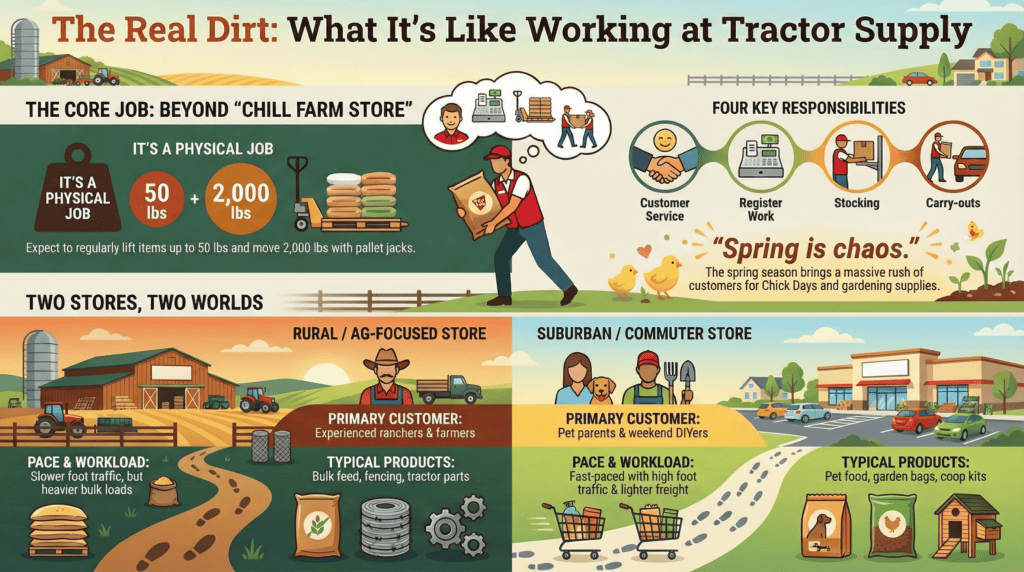
Image created by The Diversity Employment Team
What a Tractor Supply Sales Associate Does
Every official job description for a Sales Associate, Team Member or Merchandising Sales Associate hit the same core themes: customer service, register work, stocking, and a lot of physical labor.
Customer Service and Sales
On a typical shift, you’re:
- Greeting customers as they walk in
- Asking what they’re working on (“new chicks?”, “fixing fence?”, “winterizing the place?”)
- Walking them to the right aisle and section, instead of just pointing
- Explaining differences between brands/feeds/tools
- Suggesting add-ons (post caps, connectors, mineral blocks, etc.)
Tractor Supply calls this delivering a “Legendary Customer Experience.” (Through GURA: G-reet the Customer. U-ncover Customer’s Needs & Wants. R-ecommend Product Solutions. A-sk to Add Value & Appreciate the Customer)
Everything else you do is wrapped around that idea.
Scanning barcodes, sure. But you’re also expected to know at least the basics of:
- Pet food vs livestock feed
- Fencing types and hardware
- Basic tools and small equipment
- Seasonal products (chick supplies, wood pellets, ice melt, irrigation parts, etc.)
- They even mention on their job description “Farming, ranching, pet/equine, or welding knowledge is strongly preferred.”
You do not have to walk in as a farming expert, but having some of a background gives you a leg up… and people on Reddit say it’s something that managers actively look for.
Register and Front-End Work
At almost any store, sales associates will:
- Operate the register/POS
- Process cash, cards, gift cards, coupons
- Handle returns and exchanges following company rules
- Sign customers up for the Neighbor’s Club loyalty program
- Answer the phone, do price checks, call for carry-outs
Official job postings make it clear: every Team Member has to be able to run the register safely and accurately on a regular basis, even if they spend most of their time on the floor.
Stocking, Freight, and “Recovery”
This is where the “chill farm store” fantasy collides with reality.
Sales associates/Team Members regularly:
- Unload trucks (Sometimes very early or late)
- Use pallet jacks and carts
- Transfer freight from pallets to shelves
- Follow plan-o-grams (where specific products go: merchandising, sets, and resets)
- “Recover” aisles. Fronting, facing, and organizing items so it doesn’t look like a tornado hit
- Build and maintain endcaps and seasonal displays
Reddit threads from current/former Team Members repeatedly mention that: freight can be the most physically exhausting part of the job. Especially in understaffed stores where the same few people are always unloading and restocking.
Physical Demands
Job descriptions spell out the physical side clearly:
- Move and transfer up to ~50 lbs regularly
- Push/pull up to ~2,000 lbs with pallet jacks
- Frequent standing, walking, bending, squatting, kneeling
- Climb ladders and work overhead
- Work inside and outside in all weather (loading feed, propane, fencing, etc.)
People who’ve been there bluntly say: If you hate lifting heavy stuff or being on your feet for an entire shift, this job will chew you up.
Animals and “Live Goods”
Depending on the store and season, you may also:
- Help with Chick Days: feeding, watering, cleaning brooders, or answering chick-care questions
- Handle small animals (rabbits, ducks, etc., where allowed)
- Occasionally help with dog wash stations or even pet events
Employees on Q&A sites confirm that Tractor Supply sales associate job descriptions mention “Ability to handle and be in contact with birds/poultry.” Especially during chick season… but that really depends a lot on that particular store’s setup.
The Regional Reality Check
The core Tractor Supply sales associate job description is the same nationwide, but what your day looks like can change a lot by region. Climate, customer base, and local industries all play a big part.
Let’s look at a few major contrasts
Michigan: Snow, wood heat, hunting season, and mud
Michigan stores deal with long winters, icy weather, and huge seasonal surges. This is one of Tractor Supply’s most physically demanding regions because so much customer traffic revolves around heating, winter prep, and hunting season.
Expect to Be Lifting and Loading:
- 40-50 lb bags of wood pellets, stove pipe parts, and bagged heating fuel
- Ice melt, salt, snow shovels, generators, batteries
- Frozen or half-frozen livestock feed bags (heavier than normal dog food)
- Diesel anti-gel, tow straps, plow parts, and winterizing gear
Customer Questions Skew Toward:
- How to winterize cabins, barns, tractors, and campers
- Pellet stove supplies, heater safety and troubleshooting
- Trail cameras, scent control, feeders during hunting season
- Battery issues, tow setups, emergency winter kits
Physical & Weather Conditions:
- You will load customer trucks in snow, sleet, or even 20°F winds
- Parking-lot carry-outs can be wet, slick, icy, and slow
- Heavy freight days + winter inventory = a lot of back-to-back lifting
- Expect wet gloves, cold hands, and feed bags that feel like cement blocks by January
Pay-wise, recent data from Tractor Supply sales associate job descriptions, retail roles in Michigan average around $18 per hour (although ranges vary by store, position, and experience).
Comments from colder region team members echo the same theme: the job isn’t just “ringing stuff up,” you’re moving heavy, sometimes wet or icy bags in bad weather, repeatedly… All shift.
Kentucky: Horses, small farms, and homestead repairs
In Kentucky, stores have a heavy focus on equine owners, hobby farms and rural homesteads.
Expect to Be Lifting and Loading:
- 40-50 lb bags of textured and pelleted horse feed, shavings and stall mats.
- Fencing panels, T-posts and wire spools for pasture and paddock repairs.
- Heavy minerals, supplements, fly sprays, grooming gear.
- Chicken coop kits, rabbit hutches, small livestock gear for backyard farms.
Customer Questions Revolve Around:
- Horse nutrition, pasture turnout, stable bedding.
- Fence repair/replacement (a major recurring issue in this region).
- Tractor/tiller fluids for farm equipment, hitches and trailer parts.
- Predators, livestock shelters and DIY rural build-outs.
Physical & Weather Conditions:
- Moderate climate with seasonal rain; muddy yards, wet feed bags make the job heavier.
- Lots of loading into trucks/trailers for customers working farms or homesteads.
- Outdoor freight work mixed with indoor floor duty; you’ll use a lot of muscle every shift.
According to Indeed, a Team Member in Kentucky at Tractor Supply Company was estimated at $21.93 per hour in certain postings. On ZipRecruiter, the “Team Member” label in Kentucky averaged $46,179 annually (≈ $22.20/h) for some jobs. But a Reddit user reports that part-time Team Member rates sit around $13.14/h… After three years in the same position in that region.
Nevada: Heat, dust, irrigation, and ranch/outdoor focus
Nevada stores sit on the opposite end of the climate spectrum than Michigan. Extreme heat and dry conditions shape almost everything about daily customer needs, freight work, and outdoor loading.
Expect to Be Lifting and Loading:
- Irrigation parts (PVC, drip line, connectors, wyes, filters)
- Stock tanks, shade tarps, fly control for livestock
- 40-50 lb feed bags in 100°F-115°F outdoor conditions
- Salt blocks, minerals, and cooling supplies for ranch animals
Customer Questions Focus On:
- Cooling animals in extreme heat, preventing heat stress
- Fixing/repairing drip irrigation systems (huge in Nevada)
- Trailer wiring, hitches, cargo straps for long highway hauls
- Dust control, fencing for hard/rocky soil, predator issues
- Water storage, desert gardening, and backyard poultry in dry climates
Physical & Weather Conditions:
- You’ll load customer vehicles in intense sun and desert heat
- Heat exhaustion risk is real. Hydration can be life or death
- Freight moves across hot asphalt that can scorch gloves
- Dust and grit are constant, especially on delivery days
Glassdoor salary data shows Team Member pay in Nevada typically starting around $15/hour and up, depending on store and position.
The physical toll is different than say Michigan: no ice, intense heat stress. That means hydration, breaks, and sun protection matter a lot, and your store’s management style will determine whether that’s handled well.
Washington: Rain-soaked yards, backyard farms and hobby homesteads
In Washington State, the mix is wetter, greener, and includes both small farms and suburban-homestead customers doing DIY projects.
Expect to Be Lifting and Loading:
- Soil, mulch, fertilizer bags that get heavier when damp.
- Wet feed bags, bedding, and rain-gear for livestock/poultry.
- Raised-bed garden kits, rain-catchment systems, beekeeping gear (popular in this region).
- Fencing and predator-proofing solutions for rainy-climate yards.
Customer Questions Generally Include:
- Garden prep, composting, soil quality, water drainage.
- Backyard chicken coops, hive kits, small-scale livestock in suburban zones.
- Mud management, runoff issues, tools for wetter farms.
- Weather-resistant fencing, storm prep, outdoor-living gear.
Physical & weather conditions:
- Frequent rain, standing water, muddy parking lots and freight areas.
- Moves inside/outside constantly; you’ll load trucks in rain and may face slippery conditions.
- Gear must keep pace with weather: boots, jackets, handling soaked freight, cold mornings.
According to Glassdoor, in Washington State a Team Member at Tractor Supply had annual salary records around $30,891 (~$15/hour) as a base figure in some postings. More broadly, salary data shows roles like Sales Associate/Cashier at that state ranged around $36 K-$41 K annually in some submissions.
Rural vs Suburban Stores
Aside from climate, store location is one of the biggest factors that determines what your day looks like. A Tractor Supply in rural Kentucky or Michigan feels like a completely different job from one in a suburban Washington or Nevada town. Different customers, different freight, different conversations, and a very different paces.
Rural / Ag-Focused Stores:
These are the “classic” Tractor Supply environments — farm and ranch customers, livestock owners, older buildings, and a slower but heavier day-to-day workload.
Expect to be lifting and loading:
- Large volumes of horse, cattle, goat, and chicken feed
- Gate panels, T-posts, welded wire, field fence, hot-wire kits
- Tractor fluids, diesel additives, grease, chains, pins, hitches
- Bulk orders with 10–25 bags of feed at a time (or more)
- Salt/mineral blocks, stall mats, stock tanks, fencing supplies
Customer interactions differ too:
- More “I know exactly what I need, just point me to the right aisle” customers
- Conversations about pasture rotation, animal nutrition, barn repairs
- Trailer lights, PTO safety, basic tractor troubleshooting
- Farmers calling ahead for full skid or bulk feed pulls
- Requests for carry-outs that involve loading an entire truck bed
What employees say about rural stores:
- The work is physically tougher but the customers can be easier because many are experienced and straightforward
- Relationships matter — you get repeat regulars who trust you
- Expectations for product knowledge are higher, especially with livestock feed and fencing
- Stores tend to be shorter staffed, so multitasking is nonstop
- Truck days often mean moving several pallets of feed before opening
Suburban / Commuter Stores
These stores have a totally different energy — lots of backyard chicken owners, pet parents, casual DIYers, and homeowners who come in on weekends with Pinterest projects and zero idea what they’re doing.
Expect to be lifting and loading:
- Dog food, cat food, training supplies, toys
- Bagged soil, raised-bed kits, fertilizers, décor
- Backyard chicken gear, coop kits, beginner brooder setups
- Pressure washers, lawn equipment, small tools
- Single bags of feed, not pallets — but constant carry-outs
Customer interactions often look like:
- “I have three chicks; what exactly do I need?”
- Endless lawn-care questions (that sometimes turn into therapy sessions)
- Homeowners trying to fix sprinklers, fences, rotting decks, or small engines
- People wandering in for impulse buys during their Target run
- Families browsing pet aisles like it’s a mini PetSmart
What employees say about suburban stores:
- Foot traffic is much higher, especially Saturdays
- Customer questions can be very long, very detailed, and very uninformed
- Expect more time teaching people how things work
- Lots of “weekend project panic” and late-evening rushes
- Freight is lighter but mixed — garden, décor, apparel, pet
- Customer service demands can be mentally draining
How They Compare (Quick Snapshot)
- Rural / Ag:
- Heavy, physical, slower foot traffic
- Ranchers, farmers, hobby homesteaders
- Bulk feed loads, equipment questions, understaffed truck days
- Pellets, large animal feed, fencing, tractor parts
- Suburban / Commuter:
- Fast-paced, constant talking, lighter freight
- Pet parents, DIYers, new chicken owners
- Long conversations, high foot traffic, register rushes
- Pet food, garden bags, décor, coop kits
Employee Reality: “Two Different Companies”
Multiple employees say the same thing:
“Working rural vs suburban at Tractor Supply feels like working for two different companies.”
One store might feel like a farm co-op while the other feels like a hybrid between Lowe’s Garden Center and a pet store.
In short: Suburban stores are lighter but busier: more guests, more talking, more variety, less bulk. Rural stores are slower paced, per customer, but way heavier per hour.
Schedule, Shifts, and Seasonality
A Tractor Supply sales associate daily job description depends on the store’s staffing level, region, and time of year. While the job description looks simple on paper, the actual rhythm of the week can feel completely different from season to season.
Opening Shifts (Usually 6:00-8:00 AM Starts):
Workers Typically:
- Prep registers and count tills
- Restock what sold the night before
- Do safety walks and propane cage checks
- Clean up freight left from truck night
- Help early-morning customers (farmers, contractors, ranchers) looking for feed or tools before work
These shifts are often quieter but more physically demanding because you’re catching up on recovery.
Mid Shifts:
This is the busiest part of the day. Associates rotate between:
- Register work
- Floor help
- Stocking
- Carry-outs
- Drop-everything customer needs
Mid-shifters absorb the most chaos: long lines, big feed loads, phone calls, and non-stop questions all shift long.
Closing Shifts (Often 2:00-10:00 PM or Later):
Closers:
- Recover aisles
- Front shelves
- Restock
- Clean brooders (in chick season)
- Bring in carts
- Close down registers and turn off propane
Employees say closing can be smooth or a total disaster depending on daytime staffing. If the store was hammered all afternoon? You’re basically rebuilding the place from scratch.
Truck Days (Huge Part of the Job)
Most stores receive 1-3 freight trucks per week, depending on store volume and the region.
Truck Days Involve:
- Pallet breakdown
- Moving skids by pallet jack
- Restocking feed, fencing hardware, seasonal items
- Rebuilding endcaps
- Resetting planograms (merchandising shifts are often tied to truck days)
Employees say truck days can feel like “crossfit with forklifts you’re not allowed to touch.”
Understaffed stores? You might only have 2-3 people unloading an entire truck, which might take hours.
Seasonality: Spring (The Super Bowl of Tractor Supply)
Every employee online agrees: Spring is chaos.
It includes:
- Chick Days
- Lawn/garden rush
- Fencing season
- Tax refund projects
- Huge weekend crowds
Expect:
- Constant mess
- Carry-outs every few minutes
- Chick brooder maintenance
- Big-ticket purchases (Tillers, Mowers, Industrial Sprayers)
- Extra long lines
- Overtime or even extra shifts
Spring is where some employees say they “either quit or become seasoned.”
Warm and Sunny Summer
Depends on region, but Typically includes:
- Irrigation (huge in hot/dry states)
- Fly control
- Livestock heat management products
- Outdoor equipment repairs
- Trailer parts for camping/ATV seasons
Summer isn’t as chaotic as spring, but it’s physically brutal in hotter states (Nevada, Arizona, Texas).
Fall Time Preparation
This season brings:
- Hunting gear
- Fencing repairs
- Wood-stove prep
- Chicken coop insulation
- Tractor winterization
- De-icers and cold-weather stock
It’s a steady workload, but it’s the calm before the storm.
The Cold Dark Winter (in Some Places)
Cold-weather states (Michigan, Montana, Minnesota, etc.) get slammed with:
- Wood pellets
- Salt, ice melt
- Generator issues
- Frozen pipes
- Barn heater emergencies
- Icy feed bags that weigh more than the label says
Southern/warm states have lighter winters, but still get holiday pet traffic and pre-freeze panic buys.
Weekend and Holiday Hours
Weekends: Always busy. Tractor Supply’s core shoppers (farmers, hobbyists, homeowners) do their real work on weekends.
Expect:
- Store packed from 9-4
- Long register lines
- Constant carry-outs
- Restocking between customers
Holidays: Influx of customers. People who normally wouldn’t visit might be buying gifts for family and need extra help.
- Black Friday is busy but not big-box-level chaos
- Easter Sunday impacts Chick Days
- Summer holidays like July 4th, bring quick trailer, BBQ, or tool runs
- Christmas brings pet gifting, boots, apparel, or toys for outdoor kids
Skills You Actually Need (and the Ones You’ll Learn on the Job)
The Tractor Supply sales associate job description says: “A high school diploma or equivalent is preferred, but not required. Regardless of education level, Team Members must be able to read, write and count accurately.”
However, certain skills help a lot.
Must-Have Soft Skills
Seasoned employees repeatedly mention that the job goes better if you’re:
- Comfortable talking to strangers and asking follow-up questions
- Patient with people who are stressed, confused, or even overly opinionated
- Good at juggling several tasks at once without getting snappy or forgetful
- Able to keep your cool when the line is long and the store is short-staffed
- Willing to ask coworkers and managers for help instead of guessing or letting things fall apart
Helpful Hard Skills and Knowledge
You can absolutely learn on the job, but it helps if you already know some basics about:
- Farm animals (chickens, goats, horses, cattle, etc.)
- Pet nutrition (dog, cat, small animals)
- Fencing types: T-posts, wire, panels, gates, fasteners
- Common tools and fasteners (wrenches, bits, screws, anchors)
- Trailer wiring, hitches, cargo securement at a basic level
One employee noted that farm background and even basic welding skills are a real plus in many Tractor Supply markets, because you understand the problems the customers actually face.
Pay, Benefits, and Growth
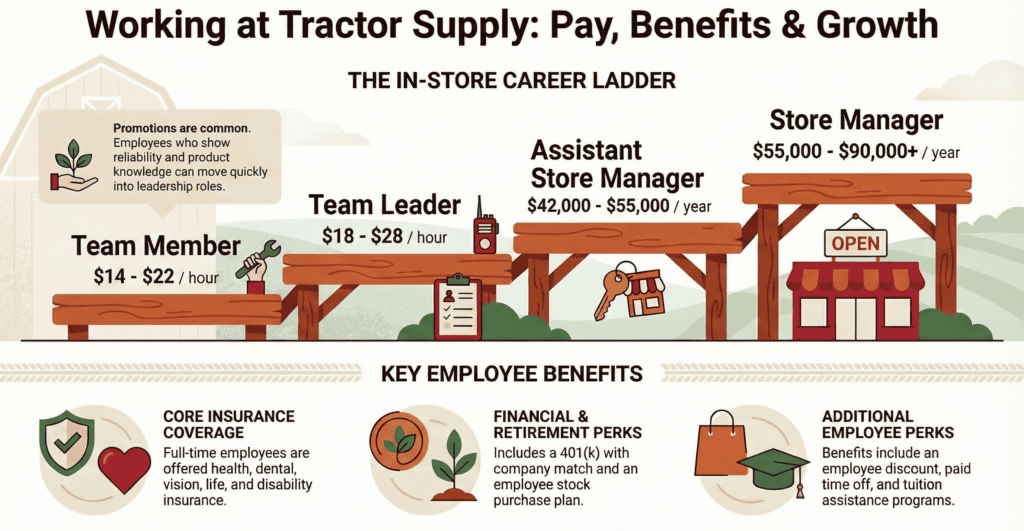
Image created by The Diversity Employment Team
The pay at Tractor Supply depends on a bunch of things: job title, region, store volume, and experience. The company uses several frontline and leadership job titles, each with its own expectations and pay brackets. These aren’t locked-in across the country (a high-cost Washington store pays different than a rural Kentucky one), but the ranges we found reflect typical wages, based on the nationally reported averages.
Team Member
The baseline foot-in-the-door job: register, customer service, stocking, and customer carry-outs. They take on the widest variety of tasks and are usually the first to be trained on every area of the store.
- Typical Pay: Around $14-$18 per hour in most states. High-demand or high-cost markets may run $19-$22/hour. *Some stores offer different pay for heavy-freight shifts or consistent closing availability.
Bilingual Team Member
Same core responsibilities as a regular Team Member, but with added customer support for Spanish-speaking shoppers.
- Typical pay: Usually $1–$3/hour more than standard Team Members. Common range: $16–$20/hour, higher in major metro areas. *These jobs are more common in regions (like the Southwest) with heavy bilingual populations or stores that specifically call for bilingual employees.
Merchandising Sales Associate (aka “FAST Team Member: Field Activity Support Team”)
Travel within an assigned district to complete plan-o-grams, assemble merchandise and fixtures, maintain signage, do cycle counts, and complete store layout initiatives.
- Typical pay: Around $15-$17 per hour in many markets. Slightly lower than frontline register roles, but the physical and travel demands make it no lighter. Some postings list duties across multiple stores/districts… So travel (with your personal vehicle) and overall load are heavier.
Team Leader
A step above frontline roles, Team Leaders help run shifts, train new hires, and take ownership of certain departments.
- Typical pay: Usually $18–$24/hour. Some high-volume stores report $25–$28/hour depending on experience. *Team Leaders are part lead-sales, part freight-support, part supervisor. It’s a true hybrid position.
Assistant Store Manager
This is the first full leadership role. ASMs manage scheduling, freight planning, store standards, opening/closing procedures, and customer escalations.
- Typical pay: Roughly $20–$28/hour. Annualized salaries typically land between $42,000–$55,000. *Bonus eligibility varies by district. ASMs often act as the Store Manager’s right hand and run the store when the manager is off-site.
Store Manager
The top in-store position. Store Managers oversee staffing, payroll, freight, merchandising, customer service, loss prevention, and financial performance.
- Typical pay: Usually $55,000–$85,000/year depending on store volume and region. High-cost markets and high-volume stores may go $90K+. *Bonus and profit-sharing can meaningfully increase total compensation. Store Managers carry the most responsibility, everything from employee morale to shrink reports lands on them.
People say a Tractor Supply sales associate job is fine as a second income, or for someone not supporting a family. While others say they would be “stressed out by everything if I had to live off of the pay at Tractor Supply.”
Benefits at Tractor Supply
While specifics vary by state and full-time/part-time status, commonly advertised benefits include:
- Health, dental, and vision insurance (full-time)
- 401(k) with company match
- Employee discount on store merchandise
- Paid time off and holiday pay for eligible employees
- Life insurance and disability coverage
- Pet insurance options
- Tuition assistance programs
- Employee stock purchase plan (in some regions)
Full-time employees see the most comprehensive package, but many part-timers still receive discounts and certain supplemental benefits.
The Realistic Career Path
One of the biggest upsides of Tractor Supply is that promotions are common, especially in understaffed or fast-growing regions. A typical in-store career ladder looks like this:
- Team Member: Learn the floor, register, freight, and customer service basics.
- Bilingual Team Member (Optional path): Similar work but with expanded customer-service responsibilities.
- Merchandising Sales Associate: Become freight/stocking-focused; deepen product knowledge.
- Team Leader: Start supervising, training, and running parts of the store.
- Assistant Store Manager (ASM): Manage operations, scheduling, opening/closing procedures, freight strategy, and escalated issues.
- Store Manager: Full-store leadership, budgeting, hiring, coaching, and performance responsibility.
Some employees stay in frontline jobs long-term because they like the physical, hands-on style of work. Others move quickly into leadership. Especially if you show reliability, product knowledge, and the ability to de-escalate a frustrated customer when the store is slammed.
What Current Employees Say: Pros and Cons
Tractor Supply sales associate employees tend to fall into one of two camps: Those who genuinely enjoy the work; and those who feel stretched thin by low pay, bad staffing, and overreaching expectations. The internet is filled with brutally honest stories from both sides. Here’s a balanced look at what team members actually say.
Common Positives
Many employees like the work itself: the regulars, the animals, the mix of tasks, and the pace.
“I love my job, love my TSC… Obviously, I’m not here for the money because they don’t pay near enough to survive.” – Team Member
“I really love working with the people I work with… We all pretty much get along and work well as a team.” – Sales Associate
“It’s a good place if you like being busy and you like animals.” – Team Member
“I like TSC as a side job. It’s not boring [there’s] always something to do.” – Part-Time Employee
Main Things on the Positive Side:
- Many stores genuinely have friendly regulars who appreciate the help.
- Coworkers can feel like a small, tight-knit team, especially in rural stores.
- The day moves quickly because the job mixes freight, register, customer service, and carry-outs.
- Employees who already enjoy the “farm/outdoor/homestead” lifestyle tend to fit in immediately.
- The employee discount is a big perk if you own animals.
Common frustrations
“I am a manager… the wages aren’t budging and the hours keep getting cut, while the workload is increasing weekly.” – Assistant Manager
“The pay sucks but that’s retail… You will probably be cross-trained on everything.” – Team Member
“Management is in and out constantly because of how much upper management pushes on them.” – Shift Supervisor
“Truck days are hell. Two people unloading pallets of feed while customers are lining up needing help.” – Team Member
“Understaffed 90% of the time. One person on register, one person on the floor, and a truck shows up.” – Merchandising Associate
Major Frustrations:
- Low pay relative to physical effort. Especially in states with heavy freight (Michigan) or extreme heat (Nevada).
- Understaffing is common, especially mornings and weekends.
- Results in the same few employees handling trucks, carry-outs, register rushes, and customer questions simultaneously.
- Management quality varies wildly by store and district: uplifting teams vs. chaotic revolving doors.
- Physical demands can be rough: constant lifting, outdoor weather, and nonstop movement.
- Policies and expectations are inconsistently enforced, depending on the store.
Bottom Line From Employees
Some people love the job because it fits their lifestyle, part-time work, second income, animals, an exciting and active day. Others say they wouldn’t recommend it as a main-source income unless you’re advancing fast into leadership.
Is the Tractor Supply Sales Associate Job Description Right for You?
A Tractor Supply sales associate job can be a great fit, or the wrong fit, depending on what you’re looking for and what kind of store you land in.
You’ll Probably Enjoy the Job if You:
- Like talking to customers and solving small project problems all day
- Enjoy being active, lifting, walking, and moving instead of sitting still
- Have some interest in animals, farming, tools, or outdoor projects
- Don’t mind getting dirty — mud, dust, feed, rain, snow
- Prefer a workday that flies by because you’re always doing something
- Appreciate a small-team environment with regular customers
You May Struggle if You:
- Need higher pay or rely on one job to support a household
- Don’t want to lift heavy things or work outdoors in heat/cold
- Get overwhelmed when short-staffed days turn into controlled chaos
- Prefer predictable routines instead of constant interruptions
- Dislike juggling multiple tasks at once (register, freight, customers)
- Want a calm, quiet environment… This job isn’t that
Tractor Supply jobs are best for people who like hands-on work, busy days, constant movement, and customers who need real help. It’s physical, sometimes stressful, kinda messy, occasionally chaotic, but can be deeply rewarding for the right personality and lifestyle.
If you enjoy the “life out here” vibe, this job fits like a glove. If you want slow, quiet retail? It’s probably not the right move.