

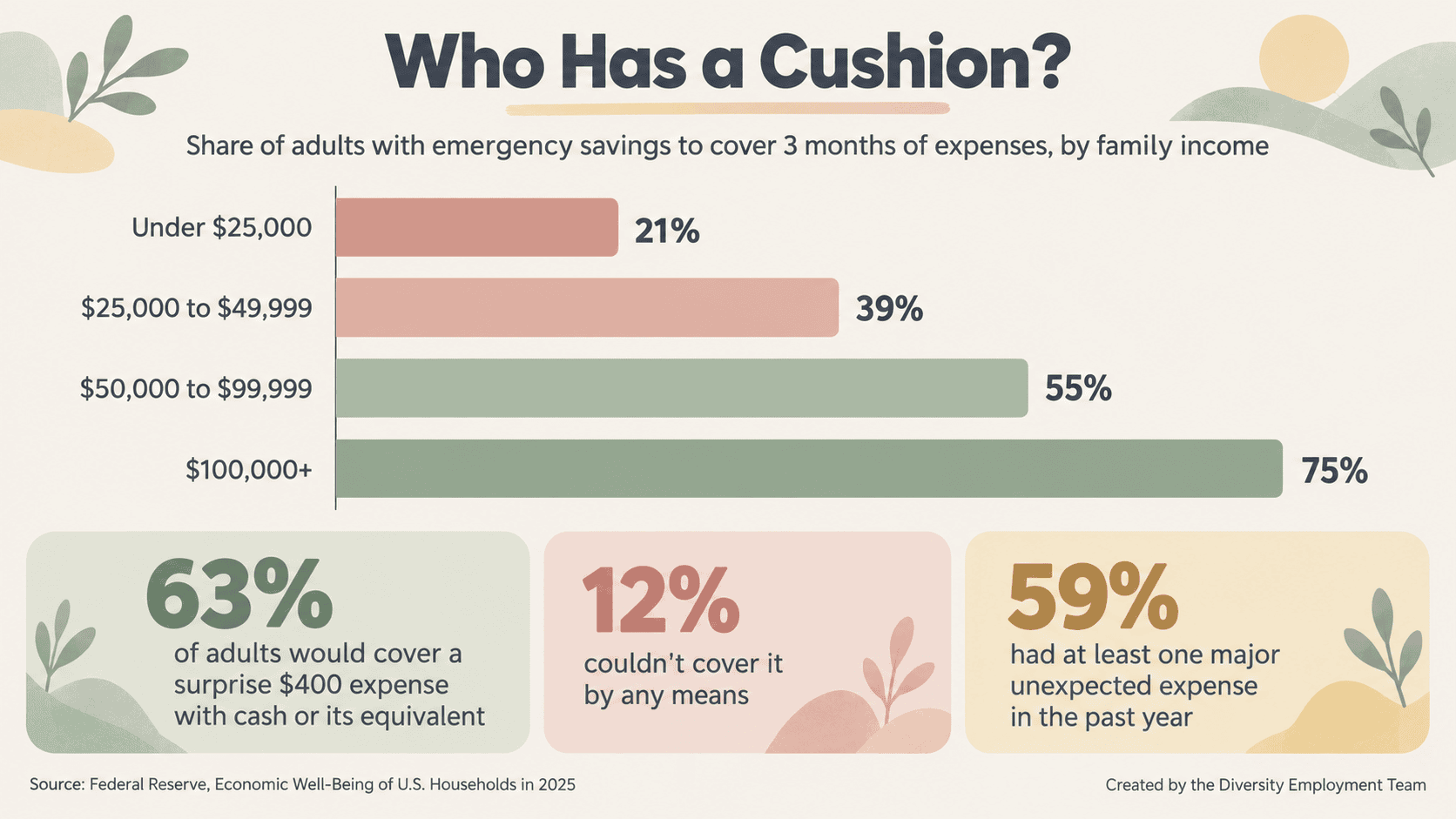
Sixty-three percent of adults say that they could cover a surprise $400 expense with cash. That’s the number most people hear about when talking money. Less people hear about the one that sits right next to it in the same Federal Reserve survey: The most common surprise expense of 2025 was a car repair, and the typical bill ran somewhere between $1,000 and $1,999.
That’s a pretty big distance between the emergency people are ready for and the one that actually happens. And how a household handles it usually says a lot less about the people in it than about how much room they had to begin with.
Two Sets of Rules
If you grew up working class, the rules were mostly urgency, late fees, and “Can we make it to Friday?”
If you grew up with a cushion, the rules were time, options, and “What’s the best move here… Even if it’s not the fastest one?”
Same life moments, really different choices. Once you start noticing it, it’s hard to stop.
Who Has Room to Choose
That cushion lines up, almost perfectly, with income. Just 21% of adults earning under $25,000 had three months of expenses saved, compared with 75% of those earning $100,000 or more. Among adults earning under $50,000, about 4 in 10 said they couldn’t cover even a $100 emergency from savings alone, and 12% of all adults said they couldn’t cover $400 by any means at all.
Meanwhile, 59% of adults had at least one major unexpected expense in the past year. So for most households, something will probably go wrong this year. What really changes from one house to the next is how much room there is to make a good decision when it does.
Created by the Diversity Employment Team
Losing a Job
Layoffs are less rare than they might seem. 7% of adults said they were laid off in 2025, which is up from 6% the year before. And 42% said finding or keeping a job was actually a worry.
When Money Is Tight
The clock starts right away. Rent is due, childcare is due, and the insurance payment comes out tonight. So the job search widens to anything that can start making money this week, since a stretch without a paycheck can scare off landlords and lenders.
You take the first solid offer and tell yourself you’ll work on new skills later, once things settle down.
When There’s a Cushion
The bills are covered for a while. That leaves room to figure out which jobs you actually want, reach out to people you already know, set up a couple of exploratory calls, and maybe even take a short course before interviews start.
There are just more options on the table when this week’s bills aren’t the deadline.
The Safety Net Has Holes
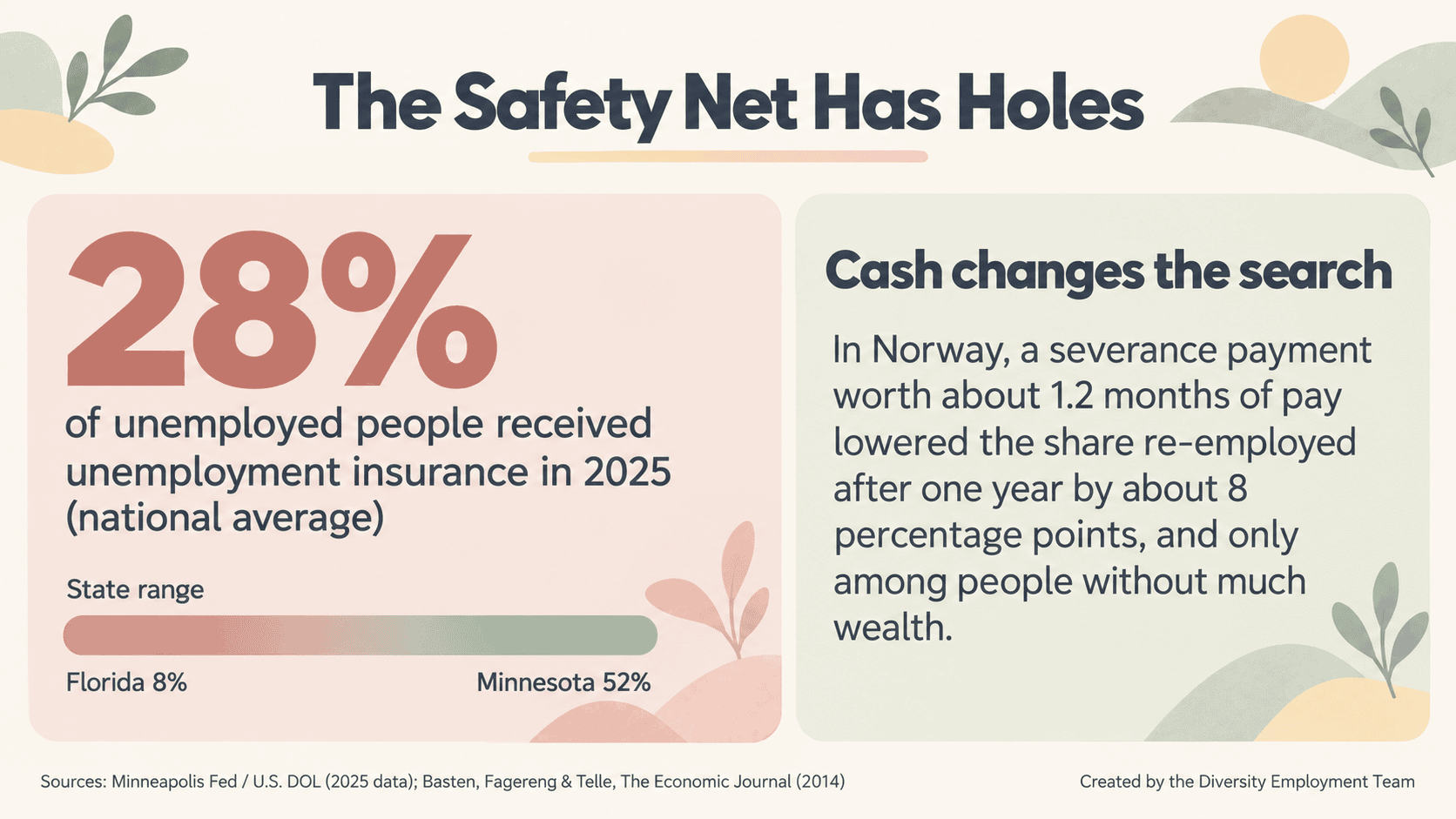
A lot of people assume unemployment insurance will catch them. Often it doesn’t. Minneapolis Fed research put the share of unemployed people actually receiving benefits at just 28% nationally in 2025, ranging from 52% in Minnesota to 8% in Florida.
Having cash on hand really does change how people look for work. Economist Raj Chetty found that most of the extra time people spend job hunting while collecting benefits comes from simply having money to live on, rather than from benefits making work less appealing.
In Norway, researchers found that a severance check worth about 1.2 months of pay lowered the share of people back at work after a year by roughly eight percentage points. The effect showed up only among people without much wealth, which the authors read as cash-strapped workers being pushed to take an offer sooner than they’d otherwise choose.
Created by the Diversity Employment Team
Does Waiting Actually Pay Off?
Honestly, the research is mixed. A study of Austrian job losers found longer searches didn’t improve wages or how long the next job lasted. Meanwhile, a Portuguese study found modest wage gains, mostly among lower-income workers.
That’s actually a good argument for having two plans instead of one.
If Money Is Tight
Write two short plans before you need them:
- The 14-day bridge plan: Jot down jobs you could start right away, with hours, transportation, and childcare noted.
- A 90-day better plan: Write down the jobs you really want, one skill to build, and two people to reach out to.
That way, if a layoff does come, you won’t be making up your strategy at midnight.
Healthcare and Small Injuries
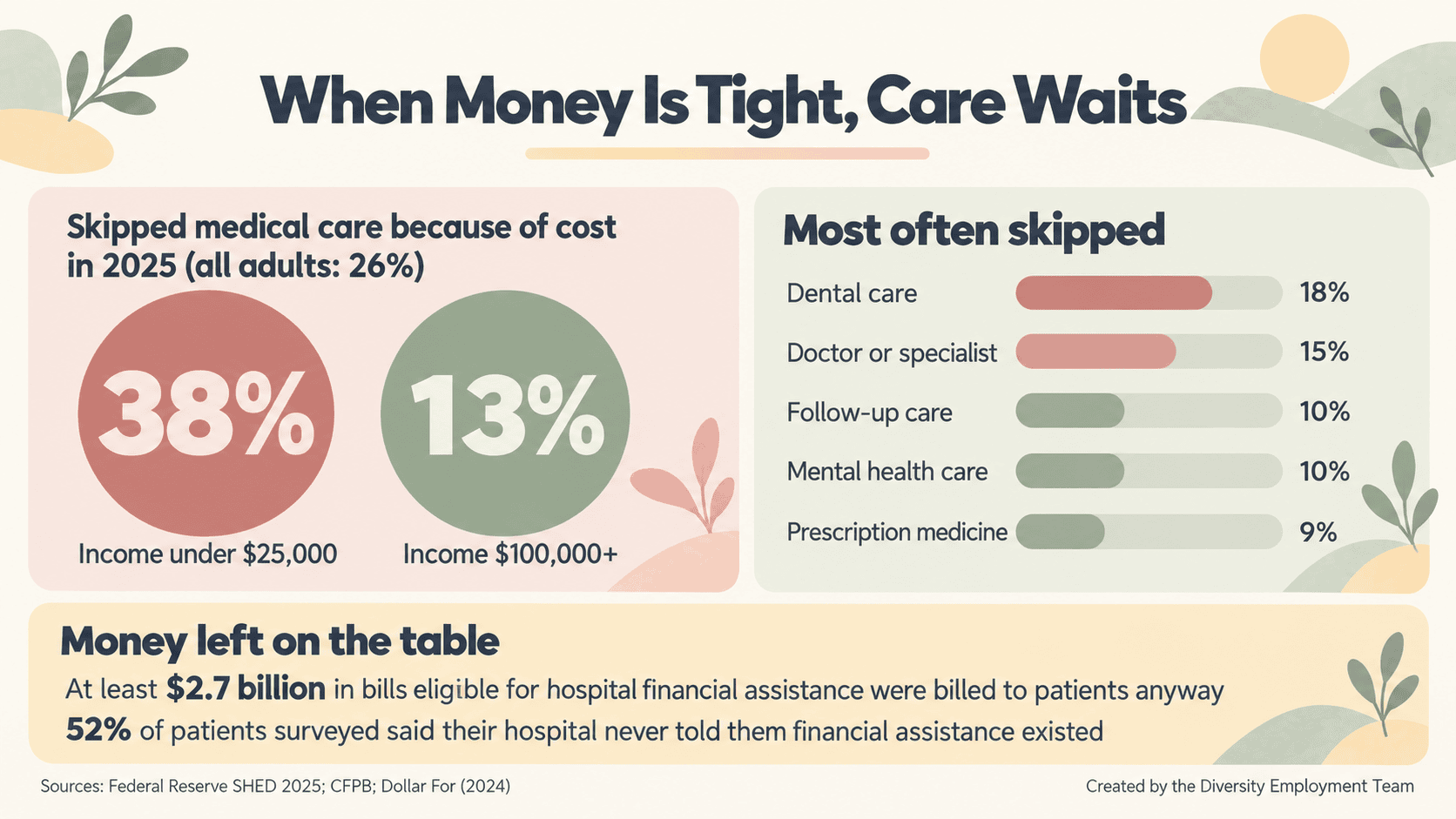
26% of adults skipped some kind of medical care in 2025 because of cost. The split by income is hard to miss: 38% of adults earning under $25,000 went without care, compared with 13% of those earning $100,000 or more.
When Money Is Tight
Most people will look up home remedies first. Because copays are a serious barrier, and so are the unpaid hours a visit can cost. So the problem waits until it’s bad, and by then it usually costs a lot more, all at once.
When There’s a Cushion
You will most likely call the doctor early, take the morning off without panicking about it, and get it handled the first time. Checkups go on the calendar the same way an oil change does.
Help That Goes Unclaimed
Dental care was the most commonly skipped, followed by doctor and specialist visits, and 18% of adults were carrying medical debt. Some of that debt probably didn’t need to exist. Every nonprofit hospital is required to have a financial assistance policy, usually called charity care, offering free or discounted care to patients who qualify. The CFPB has pointed to an analysis finding at least $2.7 billion in medical bills that qualified for assistance but were billed to patients anyway.
Patient advocacy nonprofit Dollar For puts the number closer to $14 billion a year. In its survey of more than 1,600 patients, 52% said their hospital never told them financial assistance even existed. For people with insurance, many preventive services, like cancer screenings and statins for heart disease, generally come with no copay at all.
The Supreme Court upheld that requirement in June 2025.
Created by the Diversity Employment Team
The Move If Money Is Tight
Pick one preventive habit you’ll really keep, like a monthly blood pressure check at the pharmacy or a regular stop at a free clinic. Ask about cash-pay discounts and payment plans before the visit. They’re usually available, they’re just not openly advertised most of the time.
And if a bill comes from a nonprofit hospital, ask for the “financial assistance application” by name. You can usually still apply even after you’ve already been billed.
When the Car or an Appliance Breaks
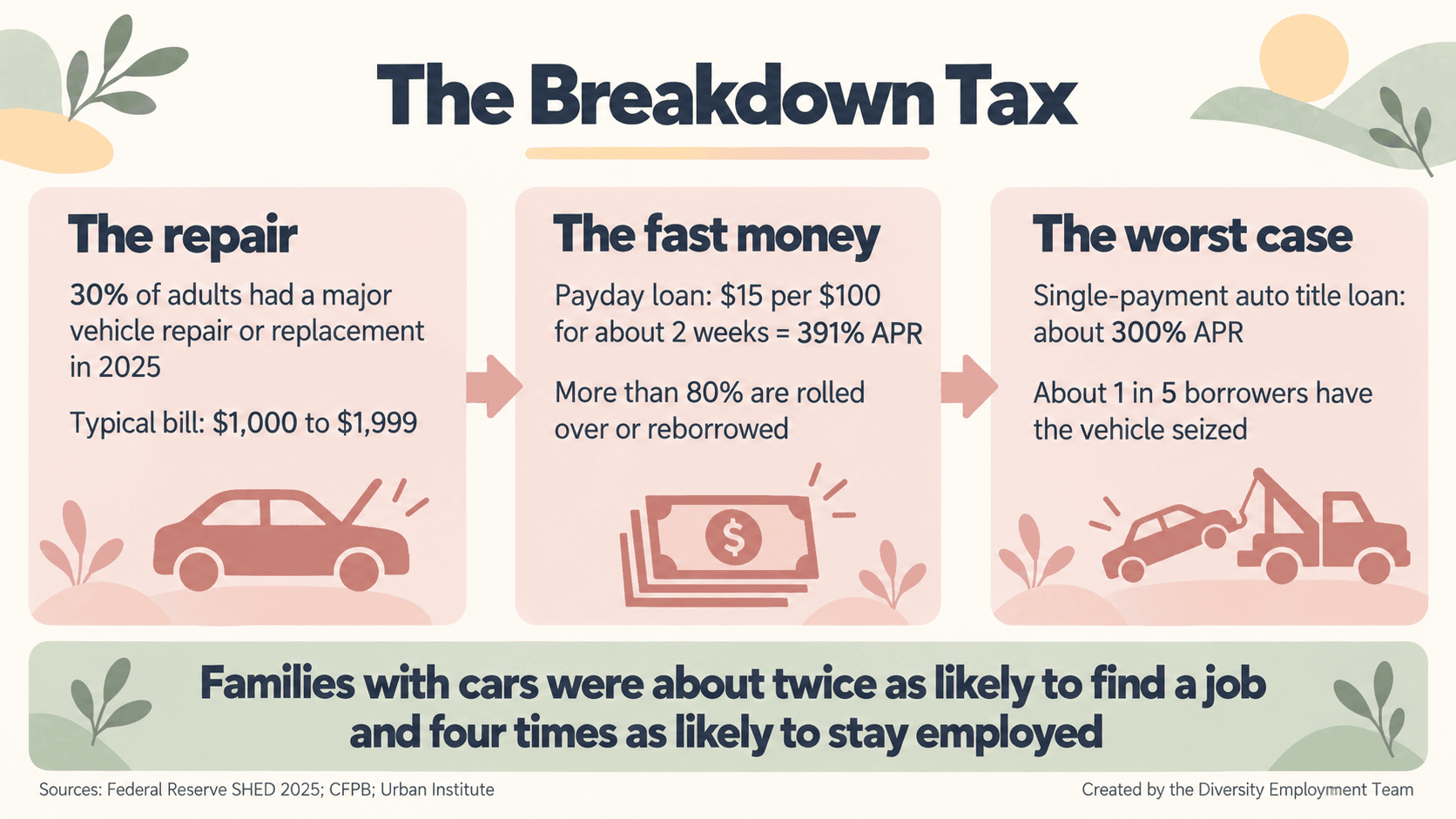
A major vehicle repair or replacement hit 30% of adults in 2025, which was more than any other surprise expense. With a typical bill of $1,000 to $1,999, that’s a long way past the $400 line most surveys use.
When Money Is Tight
People will go with the cheapest fix available and then hope it holds. If the car dies completely, a whole paycheck might go with it. You might take whatever loan gets it running, because you have shifts that are depending on it.
Every delay adds its own cost. Towing, missed hours, interest… It all adds up.
When There’s a Cushion
You replace the part that failed and the two that usually go next, since a car sitting in the shop costs more than the repair. You get a rental or take rideshares for three days, and you’re annoyed about it… But that’s about the extent of it.
What Fast Money Costs
Without a cushion, borrowing gets expensive fast. The CFPB found the typical storefront payday loan charges $15 for every $100 borrowed over about two weeks. That works out to a 391% APR, and more than 80% of payday loans get rolled over or even taken out again.
Single-payment auto title loans run around 300% APR, and roughly one in five of those borrowers ends up having the vehicle taken.
A Vehicle Is the Job
That’s a big deal when a vehicle is how someone normally gets to work. In an Urban Institute study of families in federal housing voucher programs, getting or keeping a car was strongly tied to finding work and staying employed. As the study was reported, families with cars were about twice as likely to find a job and four times as likely to stay employed.
Created by the Diversity Employment Team
One Move If Money Is Tight
Open a separate savings account, name it something like “oh-no,” and set up an automatic $20 a week. It won’t cover everything right away. It can, though, keep two or three small problems from turning into four or five.
It’s also worth checking now, before anything goes wrong, whether a local federal credit union offers a “payday alternative loan.” Those are capped at 28% APR.
Kids, Activities, and School
Every season brings another round of sign-up forms, and how a family answers them tends to add up over the years.
When Money Is Tight
Each sign-up is its own decision: “Can we afford this season?” Extracurriculars get pushed aside by the essentials, and college talk tends to start much later because the calendar is busy just getting through the week.
When There’s a Cushion
Enrichment is just assumed: Tutors, summer programs, application coaches. Smaller advantages show up along the way, too, like a strong network, a solid recommendation letter, an internship through a family friend, or campus visits junior year.
Who Gets to Play
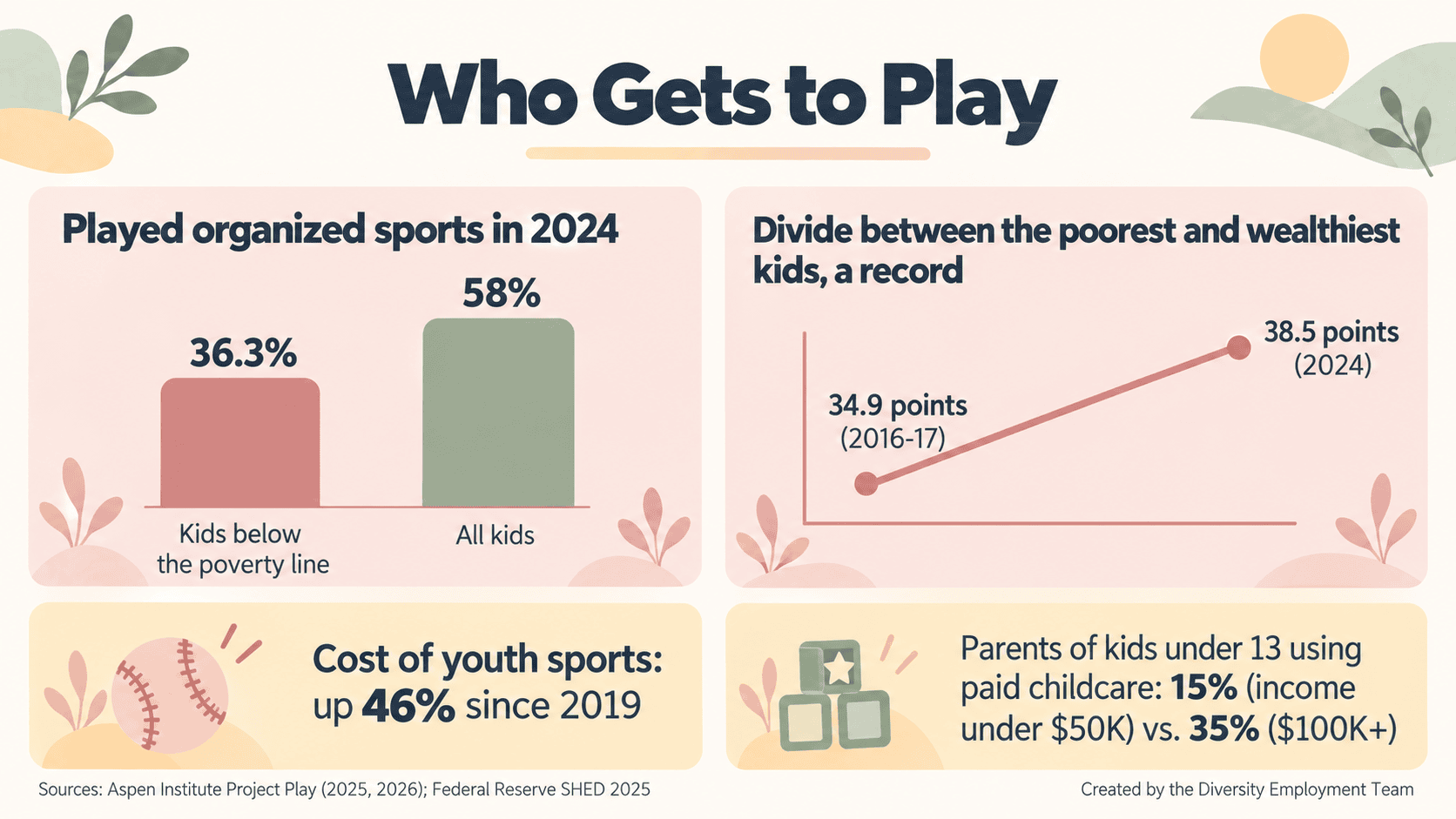
Youth sports are one of the few places this actually gets tracked every year. Using federal survey data, the Aspen Institute’s Project Play reported that 58% of kids played organized sports in 2024, but only 36.3% of kids in households below the poverty line did.
The divide between the poorest and wealthiest kids hit a record 38.5 percentage points, and it got even wider when parents’ education was factored in. Meanwhile, the cost of youth sports is up 46% since 2019.
There was one encouraging detail from the same research: Kids from the lowest-income homes get the most unstructured free play of any group. That’s a real strength, and it’s worth protecting.
Created by the Diversity Employment Team
If Money Is Tight
Pick one area that builds on itself, like a literacy program, a math club, or one scholarship-funded summer program, and stick with it. You can even ask every program director about fee waivers and equipment swaps.
Housing and Where You Live
A record 22.7 million renter households, about half of all renters, spent more than 30% of their income on housing in 2024, and 12.1 million spent more than half, according to Harvard’s Joint Center for Housing Studies. 23% of renters told the Fed they’d fallen behind on rent at some point in the past year, which is up from 17% in 2021.
When Money Is Tight
You pick the place where you can pass the screening today and move in this weekend, since paying rent at two places for a month just isn’t possible. Commute and school ratings still matter, but they have to come after “Will they even approve me?”
When There’s a Cushion
You have the time to really look at schools, transit, crime, and even resale value. You can wait for the right place, pay double rent for a month, or hire movers so the move doesn’t take over your whole week.
Why Neighborhood Matters So Much
There’s a reason people with options look so closely. Research by Raj Chetty, Nathaniel Hendren, and Lawrence Katz on the federal Moving to Opportunity experiment found that kids whose families used vouchers to move to lower-poverty neighborhoods before age 13 earned about 31% more in their mid-20s.
When Money’s Tight
Keep a “next move” folder with your documents, landlord contacts, and photos of the unit from the day you moved in. Then start tracking rent in three neighborhoods a few months before your lease is up, that way you’re not stuck deciding in a rush.
Taking Risks at Work
Changing jobs still tends to pay. In July 2026, the Atlanta Fed’s Wage Growth Tracker showed people who switched jobs earning 4.4% more than a year earlier, compared with 3.6% for people who stayed. And 60% of people who changed jobs in 2025 told the Fed the new one was better overall.
When Money Is Tight
You will probably say yes to overtime and no to unpaid “stretch” assignments, because growth that doesn’t pay this month is hard to afford this month.
You might also stay in a job you’ve outgrown a lot longer than you’d like, since one bad move could take years to recover from.
When There’s a Cushion
You can take a lateral move to work for a great manager, join a smaller team where your name is actually on the work, or start a side project that doesn’t actually need to make money for most of a year.
It Starts Before the First Job
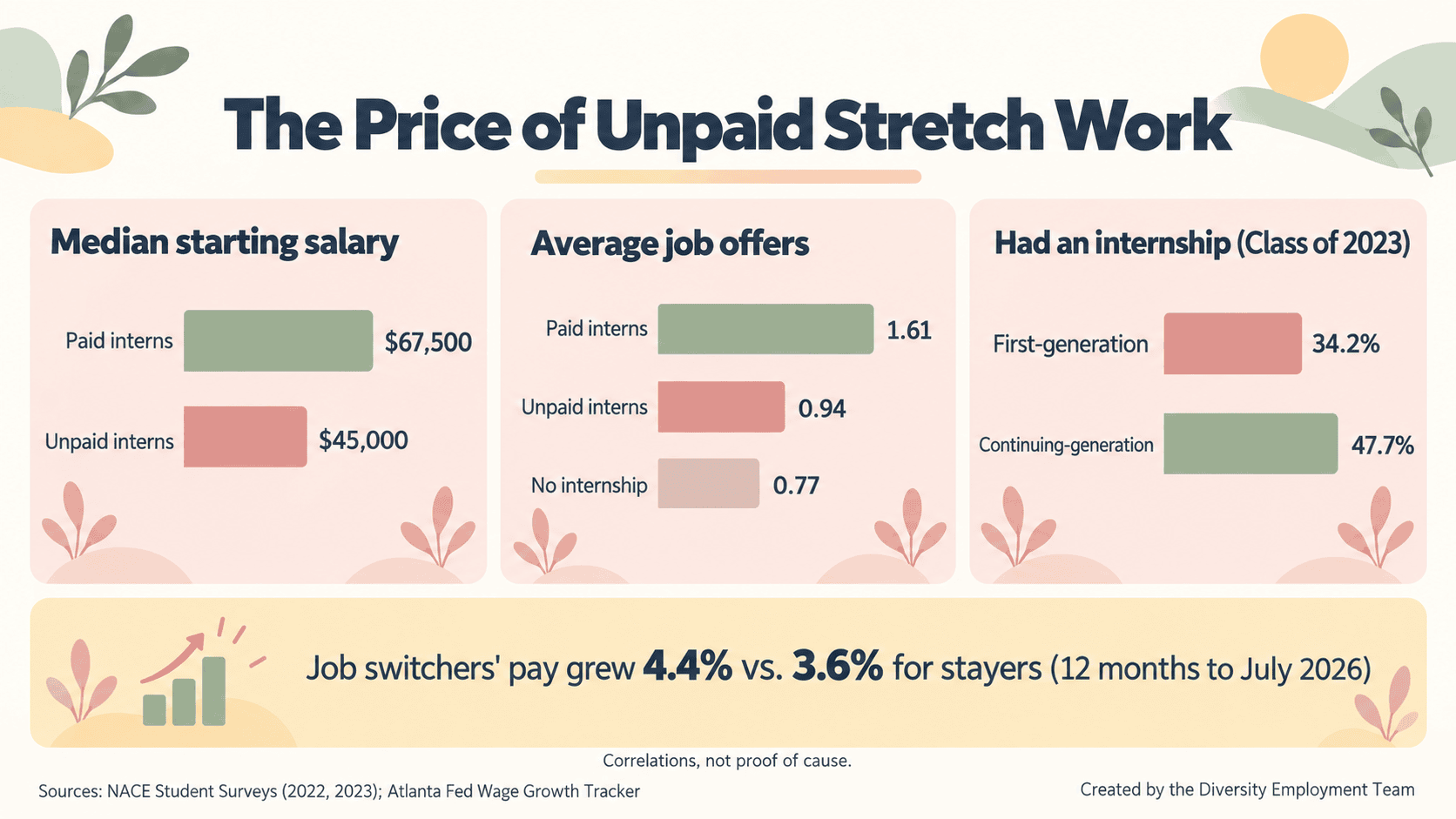
First-generation college students in the Class of 2023 were less likely to have had an internship at all, about 34% versus 48% of students whose parents went to college, according to NACE. The first-gen students who did intern were also less likely to be paid.
That matters. Paid interns reported a median starting salary of $67,500, compared with $45,000 for unpaid interns, and in NACE’s 2022 survey, paid interns averaged 1.61 job offers versus 0.94 for unpaid interns. Some of that probably reflects who lands which internship, though NACE says it has seen the same pattern consistently.
Created by the Diversity Employment Team
Not All of the Cushion Is Yours
Some of the money behind a bold career move isn’t even the person’s own. 47% of adults ages 18 to 29 got help from someone outside their household to pay an expense in the past year, most often a phone bill, general expenses, or rent. From the outside, that kind of help can look a lot like personal confidence.
If Money Is Tight
Put your time into something people can see. Pick one project where the results can be measured and your name is attached to them. And before leaving a job, try to have two offers in hand, even if one of them is smaller than desired.
The Networking Nobody Explains
Most networking advice assumes you already know how it works. But a lot of people were just never shown.
When Money’s Tight
You only reach out when you need a job, so every message feels awkward and super high-stakes. “Offer value first” sounds like you’d need some big favor to give, so you end up sending nothing and that connection stays cold.
When There’s a Cushion
There’s light contact all year long, with no favor attached. Parents showed how introductions, RSVPs, and quick follow-ups work long before high school. By 22, it’s just habit.
Some Networks Come Pre-Built
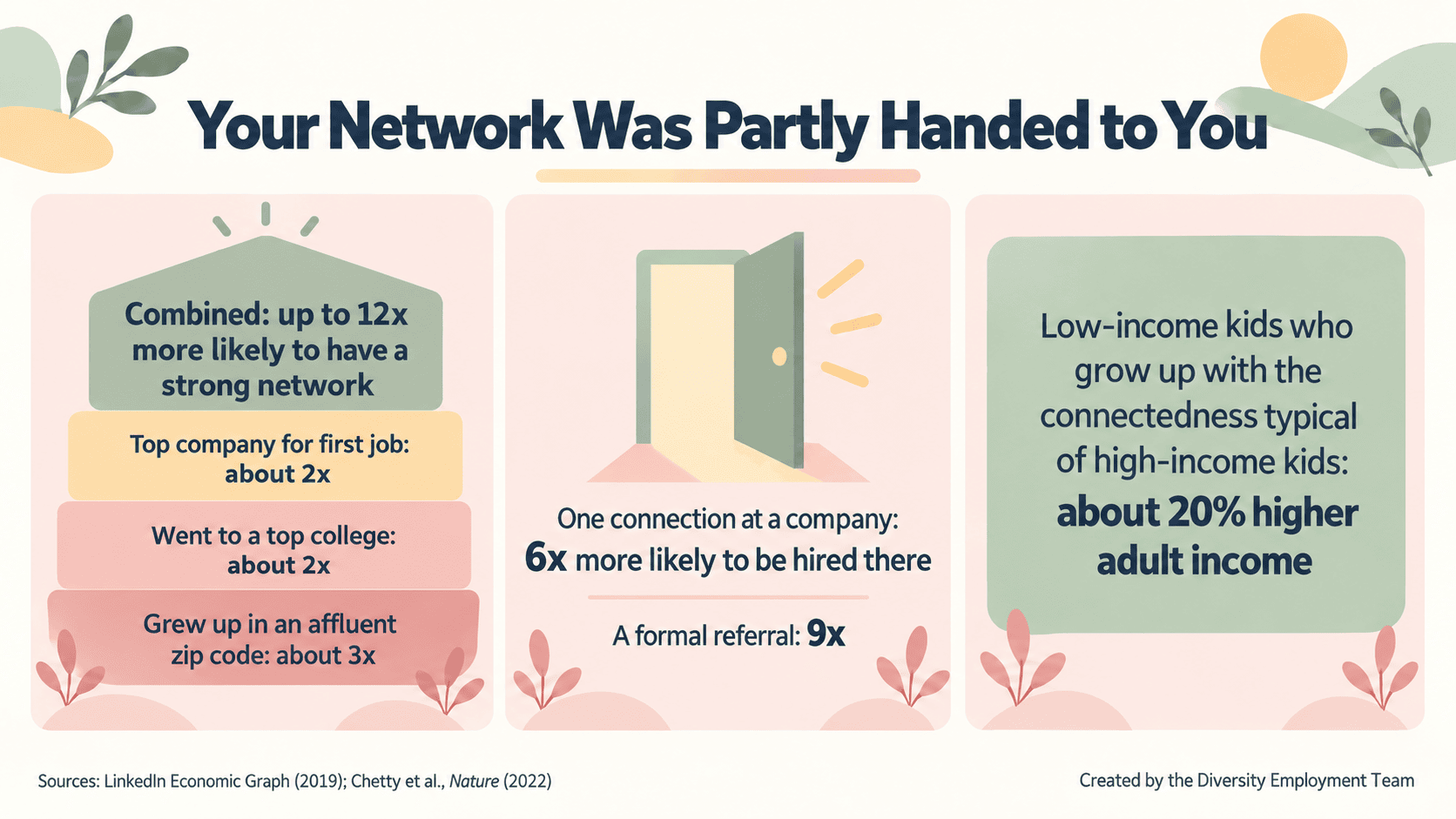
LinkedIn’s own research found members who grew up in an affluent zip code were about three times as likely to have a strong network. Going to a top college roughly doubled the odds, and so did working for a top company in a first job. Stacked together, that’s up to a twelvefold advantage.
The company also found that having just one connection at a company made someone six times more likely to get hired there. A formal referral made it nine times more likely.
The Long-Term Payoff
Raj Chetty and his colleagues, analyzing 21 billion Facebook friendships, found that how many higher-income friends lower-income people have is among the strongest predictors of moving up the income ladder ever measured. If kids from low-income families grew up in counties with the kind of connections typical for high-income kids, their adult incomes would rise about 20% on average.
Created by the Diversity Employment Team
Weak Ties Do a Lot of the Work
Here’s some good news for anyone starting from scratch: The most helpful contacts usually aren’t close friends. A large LinkedIn experiment covering about 20 million people, published in Science in 2022, found that moderately weak ties, people you know a little, were the ones most likely to lead to a new job.
Those are exactly the people a quick, no-ask note once in a while keeps in touch with.
One Move If You’re Tight
Once a quarter, send five short notes that don’t ask for anything. Something like: “Saw your launch, and I really liked [specific detail]. Thought you might like this customer comment we got.” Then:
- After any meeting, follow up within 48 hours with a thank-you, one next step, and a date.
- Keep a simple spreadsheet with each person’s name, when you last reached out, and when you’ll reach out next.
It’s a habit anyone can build, with whatever kind of personality they have.
Thinking Long Term
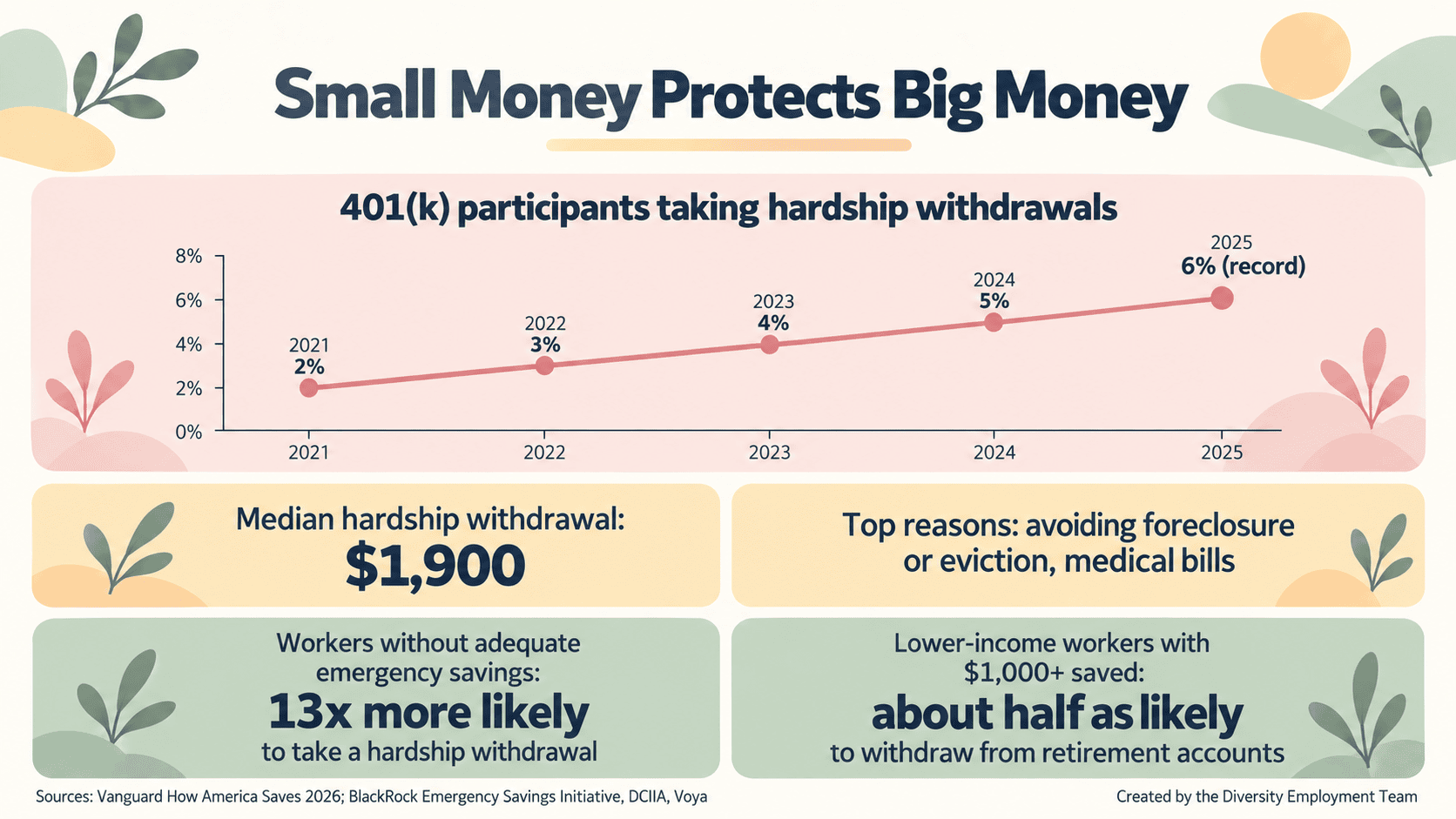
A record 6% of Vanguard 401(k) participants took a hardship withdrawal in 2025, about triple the pre-pandemic rate, according to Vanguard’s How America Saves 2026. The leading reasons were avoiding foreclosure or eviction and paying medical bills, and the median withdrawal was $1,900.
When Money’s Tight
The calendar is filled with due dates and school schedules. Planning years ahead can feel almost like tempting fate.
When There’s a Cushion
You can make riskier bets or ones that take a decade to pay off, like an index fund, a new degree, or just keeping up with relationships over time. You can let the small routines handle a lot of the work.
A Little Savings Goes a Long Way
That’s where even a small “oh-no” fund earns its keep. BlackRock’s Emergency Savings Initiative found lower-income workers with at least $1,000 in emergency savings were about half as likely to pull money from their workplace retirement accounts during the pandemic. Data from partner Voya showed workers without enough emergency savings were 13 times more likely to take a hardship withdrawal.
It also helps when saving happens on its own. Programs that signed people up for short-term savings automatically got more people saving than programs where they had to opt in.
Created by the Diversity Employment Team
If Your Money Is Tight
Pick one thing your future self will thank you for, like an automatic $20-$25 transfer, a preventive checkup every quarter, or a set hour each week for building a skill. Then treat it like a work shift you can’t skip. It’ll probably feel silly at first, then it’ll feel normal, then obvious.
If You Sign the Paychecks
Most of these moves are things one person can do alone. Employers can make several of them a lot easier:
- Make Saving Automatic. Under SECURE 2.0, employers can add an emergency savings account to their 401(k) for non-highly compensated workers. Automatic enrollment is allowed, balances cap at about $2,500 (adjusted for inflation), and the first four withdrawals each year are free. Payroll savings accounts outside the 401(k) can do a similar job.
- Pay Your Interns. Given the salary and job-offer numbers above, an unpaid internship can end up screening for family money as much as for talent.
- Keep Schedules and Pay Predictable. 16% of workers had schedules that changed based on their employer’s needs, and 11% of adults struggled to pay bills in the past year because their income varied month to month.
- Point People to Help That Already Exists. A one-page sheet covering hospital financial assistance, credit union small-dollar loans, and how to file for unemployment could save someone from a payday loan.
Put It to Work This Week
Five small steps that can actually change how decisions get made, plus one for the weekend:
- Monday: Send five no-ask notes.
- Tuesday: Make one useful introduction (“A, meet B, because of X, and here’s why now”).
- Wednesday: Open the “oh-no” savings account and set up the $20 weekly transfer.
- Thursday: Save your ’14-day bridge plan’ and ’90-day better plan’ to your phone.
- Friday: Block off one recurring hour for “future you,” like updating a portfolio, working on a certification, or booking a checkup.
- Weekend: Pull out any recent hospital bill. If the hospital is a nonprofit, ask for its financial assistance application.
Bottom Line
At Diversity Employment, we’d argue these are some of the most important unwritten rules in working life, and some of the least likely to ever be taught. Money in the bank creates options. Pressure takes them away, no matter how hard someone works.
Building Your Own Rules
The good news is that pieces of the “wealth norm” can be learned, and the small versions still work:
- Keeping in touch with people without asking for anything
- Following up fast, with a date attached
- A little money set aside that never gets spent on groceries
- Plans written while you’re calm, before anything goes wrong
- Long-term bets protected by a routine
That’s how people build their own rules when the default ones weren’t written with them in mind.