
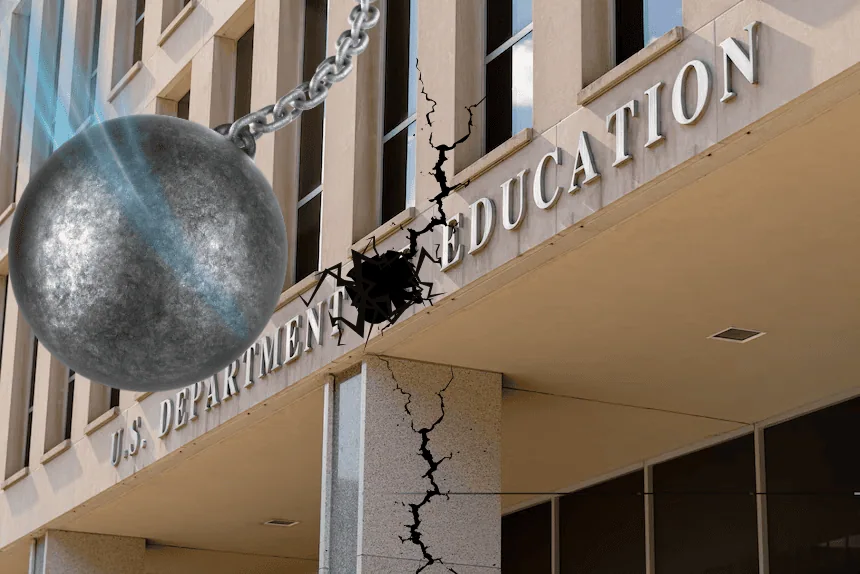
Originally reported by Reason: Will Trump Actually Close the Education Department?
President Trump’s long-held ambition to gut the federal Department of Education took a giant leap forward this week. With the Supreme Court ruling that the administration is allowed to proceed with mass firings, the groundwork is being laid to drastically reduce the size and scope of the DOE… or even potentially dismantle it altogether.
The decision, handed down in a 6–3 ruling, effectively overturned a lower court’s injunction issued by U.S. District Judge Myong Joun of the United States District Court for the District of Massachusetts. Judge Joun’s ruling on May 22nd found that the administration’s actions likely amounted to an illegal attempt to dismantle the department without congressional authorization. The First U.S. Circuit Court of Appeals had upheld this injunction on June 4th. With Justices Sotomayor, Jackson, and Kagan dissented, warning the move allows the executive branch to undermine federal law by cutting essential staff positions. Trump supporters, however, view the ruling as a victory for administrative efficiency and state-level empowerment.
What’s Happening?
At its peak, the Department of Education (DOE) employed over 4,000 people. Under Trump, at least 1,300 of those positions have already been cut. The administration now has legal authority to continue downsizing in the name of “efficiency and accountability,” per Education Secretary Linda McMahon.
The plan? Return education control to states and reduce federal “bureaucracy,” while technically maintaining compliance with existing laws. However, reports indicate that many of the eliminated DEI jobs and positions come mostly from research and oversight units, including data collection, grant auditing, and civil rights enforcement teams, raising some concerns about transparency and effectiveness.
Moody’s Analytics has warned that the reduction in oversight increases the financial risk profile of many school districts, especially in rural or low-income areas that depend heavily on federal grants.
Why the DOE Matters
Critics of the DOE often note that it does not run any schools directly. Instead, it manages federal student loan programs, enforces civil rights protections, and funds research and innovation in K–12 and higher education. It also serves as a national hub for education statistics, policy guidance, and program evaluation.
Proponents argue these roles are critical in ensuring equity across state lines. They cite the importance of centralized civil rights enforcement and the value of consistent, nationwide data in shaping policy. The Department of Education also handles massive financial aid programs:
Some facts:
- 86.7% of full-time undergrads at public institutions receive financial aid.
- 70% of students submit the FAFSA annually.
- The average federal aid per undergrad was $16,360, and $28,420 for graduate students last year.
If these programs are weakened or decentralized, students in different states could face vastly unequal access to aid and protections.
The Conservative Critique
Conservatives have long argued that the DOE is a bloated bureaucracy with little to show in terms of improved outcomes. Common criticisms include:
- Student Loans: Federal involvement is blamed for driving up college costs. Critics argue easy access to aid encourages schools to raise tuition, saddling students with debt.
- Civil Rights Enforcement: Some say the Department of Education’s procedures, particularly Title IX investigations, have created biased due-process-deficient systems on college campuses.
- Academic Results: Despite decades of increased spending, national test scores have remained flat. Eighth-grade math and reading scores are largely unchanged since the late 1970s, and functional illiteracy still affects roughly 20% of U.S. adults.
Frederick Hess called the DOE a “paperwork factory,” questioning whether its $100+ billion budget yields any real educational gains or is just burning funds.
The Bigger Picture
Efforts to abolish or restructure the DOE have circulated since the Reagan era, but no administration has ever come this close. The Supreme Court ruling gives Trump legal cover to continue eliminating entire divisions within the agency. The broader goal is to shift education policy back to states and local districts, reducing what conservatives see as federal overreach.
In practice, that could mean shrinking or transferring programs like Pell Grants, special education oversight, or even FAFSA itself. While the administration insists it will fulfill “statutory obligations,” critics warn that functional execution could break down as key roles are eliminated.
For more context on how the Trump administration is reshaping all federal agencies, see our breakdown of H.R. 1, the ‘One Big Beautiful Bill Act’.
What to Watch
- Student Aid Access: Will federal financial aid be handed over to states, or consolidated into a smaller federal entity?
- Civil Rights Oversight: Without centralized enforcement, how will issues of race, gender, or disability discrimination be addressed in schools?
- Program Integrity: Will remaining staff be able to track fraud, evaluate grants, and ensure compliance with federal mandates?
- Ripple Effects: Could this set precedent for dismantling or downsizing other federal agencies like the EPA or Labor Department?
What’s clear is that the federal role in education is going to shrink dramatically. Whether that results in a more accountable system, or a fragmented one with major gaps and disparities, depends on how this political experiment unfolds.