

“Career catfishing” is the mismatch between what’s promised in a job description or during hiring, and what really happens on day one. Most of the time companies will oversell their culture, benefits, have “hidden” expectations, or call a full-time in-office position “Hybrid.”
We also have the other side of the coin… Job applicants tremendously overselling skills, their education, or past job responsibilities. Some job seekers even just vanish mid-process (ghosting) because they “got something better,” or they decided against the job.
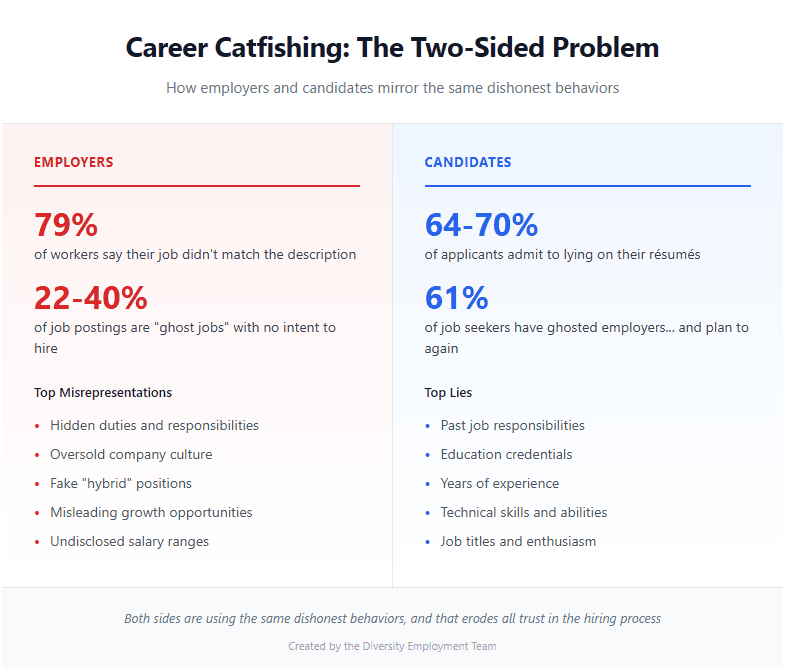
Career Catfishing hurts everyone, it sets unreal expectations and can ruin confidence. Plus, it’s simply a waste of everyone’s time and energy. Unfortunately, it’s spreading as fast as COVID did across the U.S. job market. A recent Monster survey found 79% of workers took jobs that didn’t match the recruiter’s description, and 67% of employees believe they work with at least one person who lied about their qualifications to get the job.
Employers Overselling and “Ghost Jobs”
Workers most often mention unspoken duties and an oversold culture; roughly half said their responsibilities were misrepresented in the job description and one in five said the culture that was promised sure didn’t match reality.
At the same time, “ghost jobs” are becoming even more common: multiple surveys say ~22-40% of job postings may be kept live for months, without real intent to hire. There are a few reasons they do this:
- Gauging the Talent Market: They’ll post a job to just see the quality, and quantity, of available job applicants.
- Company Image: Posting fake jobs can make a company look like it’s growing and being successful, which can impress investors and the public.
- Filling Internal Positions: Sometimes companies have to post a job publicly, to comply with federal laws. Even if they have already decided to promote someone internally.
- Building a Talent Database: Some companies post jobs to get a large amount of potential candidates that they can pull from for future openings.
- Bullying Employees: In some serious cases, ghost jobs are posted to make employees think the company is expanding. It can be used to make people fear for their job or discourage them from leaving. Either way, not good.
“We’re seeing more postings kept up for months with little movement, which erodes trust.” — Greenhouse 2024/2025 job-search research.
Candidates Misrepresenting or Vanishing
It’s not just employers, career catfishing works both ways. Studies show over half of all job applicants admit to lying or would lie on their résumés; some 2024-2025 surveys put the number as high as 64-70%.
Most lie, obviously, to get hired… but getting caught can lead to some serious consequences. You could be looking at a job offer withdrawal, termination, damage to professional reputation, or worse, even legal trouble. Some of the most common things people stretch the truth about are:
- Past job responsibilities
- Education
- Years of experience
- Past job titles
- Exaggerating skills and/or abilities
- Enthusiasm
Ghosting cuts both ways: 61% of job seekers say they’ve just been ghosted after interviews, while recruiters also report more and more job seekers themselves ghosting companies.
The Ghosting Trend
Ghosting needs it’s own section. It has become one of the biggest issues in hiring on both sides. According to an Indeed report, about 61% of U.S. job seekers admit they’ve ghosted at least two employers in the past year, and sometimes even after a bunch of interviews. Many say they had already spent hours preparing and rearranging their schedules, only to stop communication and disappear without notice.
A Problem for Business
Employers are facing the same exact behavior. Almost 9 in 10 hiring managers say job seeker ghosting them has messed up their hiring processes more than once. Recruiters are peeved by the loss of their valuable time, scheduling stresses, and increased burnout in their teams.
Companies lose time or even turn away qualified backups, and even start the onboarding process before realizing their new hire has vanished. ~38% of managers say ghosting wastes potential interview time, and 33% had already, regrettably, turned away other strong applicants. Some organizations now even track ghosting job applicants internally, to flag or block repeat offenders.
Reasons Behind Ghosting
Why are so many people ghosting? For candidates, it usually comes down to fit, pay, or benefits… not poor communication. 70% of job seekers think ghosting is “fair” if the job doesn’t meet their expectations, and more than 60% openly plan to do it again in the future. Interestingly as well, only 23% blamed poor recruiter communication, meaning most ghosting is definitely intentional, not accidental.
Recruiters describe this as “a cycle of silence,” where each side just assumes the other “checked out” first. From the employer’s side, the response? Track ghosting applicants, simplify the hiring process, and make pay ranges honest and clear up front. Because job seekers obviously feel ‘if a company can do it, so can I.’ Honest and genuine two-way communication could break “the ghosting loop,” but neither side seems to want to be the one to start.
Why Career Catfishing is Spreading
Tight Budgets + Public Optics
The recent years’ economy has forced many companies to tighten-up their budgets while still wanting to look strong to investors, clients, and potential hires. The easiest way to project growth? Keep job listings active. Ghost jobs help a company appear stable and possibly expanding, even when it isn’t actually adding any staff. It’s a PR tactic that keeps confidence up… but, ultimately, trust down.
Friction in Digital Hiring
The hiring process has become much faster but much less personal. Algorithms and AI resume filters have replaced the early conversations that used to help build trust upfront. Job seekers can send out hundreds of applications into these digital systems and rarely ever hear back. Employers get buried under mass applications and end up with high turnover, the more they rely on automation.
This result is a never-ending cycle of frustration: the applicants feel ignored and give up mid-process, then employers assume disinterest and quietly move on. The lack of communication is the perfect condition for ghosting, on both sides.
Incentives on Both Sides
We all know the competition right now for jobs, and talent, is fierce. Job seekers exaggerate skills or past titles believing they can ‘learn as they go,’ while employers oversell positions to attract top performers. Both sides are trying to get a better deal, but it usually just leads to disappointment.
Candidates feel misled when their “dream job” turns out to be overhyped, and managers lose faith quickly when new hires can’t deliver what they promised in interviews. Over time, the cycle of these little problems can snowball into a culture of distrust that fuels career catfishing on both sides of the aisle.
Accountability: Job Seekers’
Career catfishing surveys show a majority of applicants admit to stretching their experience, expanding education, or adding skills to secure a job. Some ghost interviews or accept offers knowing they plan to disappear before day one. They might even feel justified doing it, especially when job postings are misleading. But they create expensive disruptions and employer skepticism.
“Fraudulent résumés still slip through, many are never detected.” The consequences can be failed onboarding, probation terminations, or damage to professional reputation. Simply put, both sides lose when honesty becomes optional.
How to Spot Career Catfishing Fast
If You’re a Candidate
The best way to avoid getting career catfished is to ask thought-out and specific questions during interviews. Instead of a vague “what’s the culture like,” question, request to see how the company actually operates day-to-day. Ask what success looks like in the first 30 days and after 90 days. Find out how managers support their teams, and whether anyone has recently been promoted internally. These kinds of details reveal more than any job description can… or ever will.
Do some outside digging, too. Read reviews, check recent team departures on LinkedIn, and confirm that the job posting is dated currently on the company’s own website. Listings that stay up for months without updates, or recruiters who dodge questions about pay, location, or growth paths, are classic red flags.
If you’re an employer
Transparency works both ways.
- List the job’s actual day-to-day expectations, if it is a hybrid or fully on-site position, and most important, pay range up front.
- Always stay consistent; from the initial job posting to the final offer.
- Use realistic assessments: short projects, trials, or skills tests can filter out résumé inflation, even if the job seekers sound like the perfect fit.
Building a solid feeling of trust early reduces turnover, saves money, and strengthens reputations as an equal opportunity employer.
Catch the Catfish
Career catfishing happens where information is withheld and communication isn’t there. Surveys show problems on both sides: fake or placeholder job ads, exaggerated résumés, and ghosting that leaves both parties burned.
The cure isn’t complicated… it’s transparency and communication. Clear job descriptions, honest pay, and expectations backed by continuing conversation make it harder for anyone to mislead the other. Evidence-based hiring, like work samples and real-world critical thinking exercises expose skill gaps early. In a job market full of murky waters, clarity and transparency will be the hook that lands the right catch.