

If the AI powered layoffs in the final quarter of 2025 has taught the labor market anything… it is that the “AI pivot” is no longer just a corporate strategy. It is a tangible, data-backed restructuring of the U.S. workforce.
Following a brutal October that saw job cuts reach their highest level for that month since 2003, mid-December data suggests the trend is not an anomaly but the new baseline. As companies finalize their 2026 budgets, the distinction between “cost-cutting” and “AI automation” has effectively vanished.
A Historic Autumn for Job Cuts
According to the latest data from labor analytics firm Challenger, Gray & Christmas, October 2025 marked a turning point. U.S.-based employers announced 153,074 job cuts in a single month, a staggering 175% increase from the same period in 2024. While “cost-cutting” remains the primary cited reason, Artificial Intelligence has firmly established itself as a leading driver of redundancies.
The Rise of “Hidden” AI Layoffs
In October alone, nearly 31,000 cuts were explicitly attributed to AI, bringing the year-to-date total for AI-specific layoffs to over 48,000. However, labor economists warn that the official “AI” label significantly undercounts the reality.
“When a company announces a restructuring to ‘flatten the organization’ or ‘increase efficiency’ while simultaneously investing billions in generative AI infrastructure, that is an AI layoff in all but name,” notes Sarah Jenkins, a senior labor analyst at Workforce Futures. “We are seeing a direct correlation between heavy capex spending on GPU clusters and headcount reductions in the very departments those clusters are meant to serve.”
Beyond Technology
While technology gets the headlines, the data shows the impact spreading to logistics and warehousing. As “Embodied AI” and advanced robotics move from pilot programs to deployment, warehousing companies announced over 47,000 cuts in late 2025, a 4,700% month-over-month increase. This signals that the blue-collar sector is beginning to face the same automation pressures that have plagued white-collar workers throughout the year.
Engineers in the Crosshairs
Perhaps the most startling data point from late 2025 comes from the tech sector, specifically Amazon. While the retail giant announced nearly 14,000 corporate cuts, Worker Adjustment and Retraining Notification (WARN) notices filed in major tech hubs (California, Washington, New York) revealed a grim statistic: approximately 40% of the affected jobs were engineers.
The “Hollowed-Out” Middle
This contradicts the early 2024 narrative that AI would primarily impact “rote” administrative tasks. Instead, we are seeing a “hollowed-out middle” effect. Senior leadership is retaining expensive principal architects to design systems, and hiring cheaper entry-level talent to manage AI outputs, but the expensive middle layer is being squeezed.
“The data shows that mid-level software engineers (SDE II) and program managers are taking the brunt of this wave,” says Roger Lee of Layoffs.fyi. “Tools like GitHub Copilot and the new generation of ‘Agentic AI’ have emboldened executives to believe they can maintain output with smaller, leaner engineering teams.”
Middle Management Decimation
Gartner’s prediction that 20% of organizations would use AI to flatten their structures is manifesting faster than anticipated. By eliminating the “information gatekeepers,” managers whose primary role is to synthesize reports and oversee workflows, companies are betting that AI dashboards can provide the same oversight at a fraction of the cost.
Reality Check: 2.5% & The “Boomerang”
Despite the aggressive cuts, a counter-narrative emerged in November that suggests companies may be cutting too deep, too fast. A widely circulated study on the “Remote Labor Index” (RLI) revealed a stunning gap between executive expectations and AI capability.
The Failure Modes of Agentic AI
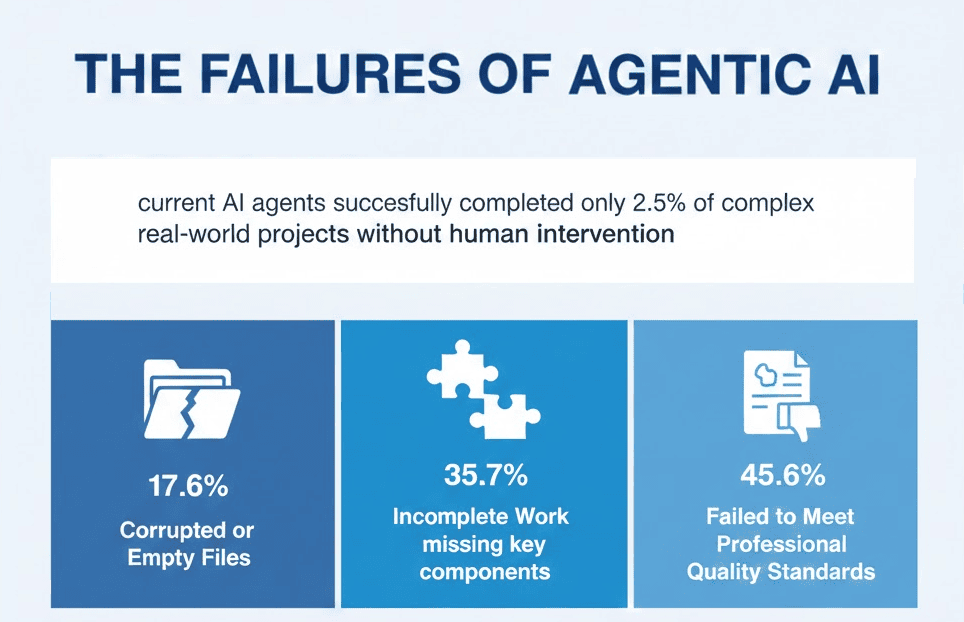
The RLI study showed that current AI agents successfully completed only 2.5% of complex real-world projects without human intervention. The failure modes were specific and concerning for businesses relying on these tools:
- 17.6% of outputs contained corrupted or empty files.
- 35.7% of work was “incomplete,” missing key components requested in the prompt.
- 45.6% of completed work simply failed to meet professional quality standards.
The “Boomerang” Trend
This capability gap has triggered a massive “boomerang” hiring trend. Data from March through November 2025 indicates that 35% of all new hires were former employees returning to their old companies. In the tech sector specifically, this figure spiked to 68%.
Companies are realizing that while AI can generate code or write copy, it lacks institutional knowledge. As a result, firms are quietly re-hiring the very staff they laid off, often at a premium; returning employees are negotiating salary increases of 25-28% on average. This “fire and re-hire” cycle represents a chaotic and expensive friction in the 2025 labor market.
Jobs Most at Risk Heading into 2026
Based on Q4 2025 layoff demographics and hiring freeze data, the following jobs are showing the highest volatility as we enter the new year.
1. Mid-Level Technical Roles
As noted, SDE IIs, data analysts, and QA testers are vulnerable. The industry is moving toward “10x engineers” aided by AI, rather than large teams of distinct specialists.
2. Government & Public Sector
Driven by the new “Department of Government Efficiency” (DOGE) initiatives, federal and contractor roles face their steepest cuts in decades. Over 307,000 positions have been eliminated in 2025 alone. Specific agencies feeling the pressure include the Small Business Administration (SBA), which faced a potential 43% workforce reduction, alongside targeted cuts at the Department of Education and FEMA.
3. Creative & Content Departments
Marketing, technical writing, and graphic design departments have seen hiring volumes drop by nearly 30% year-over-year. The “content mill” tasks have been almost entirely automated, leaving only high-level creative direction roles safe.
4. HR and Recruitment
Ironically, the departments responsible for managing layoffs are themselves shrinking. With fewer hires to process and AI tools capable of screening resumes and scheduling interviews, HR departments are operating with historically low headcounts.
The 2026 Outlook
As we look toward January 2026, the technology is shifting from “Chatbot” assistants to “Agentic” workflows. Deloitte predicts that “inference,” the actual running of AI models to do work, will make up two-thirds of AI compute power by next year.
For workers in December 2025, the message is clear: Efficiency is no longer a metric of success; it is a prerequisite for survival. The safety net lies in “human-in-the-loop” expertise, the ability to fix the 97.5% of tasks that AI agents currently fail to complete. Until the technology bridges that gap, the labor market will likely remain in a volatile state, caught between the promise of automation and the reality of its limitations.
Sources
- Job Cuts Data (October 2025): Challenger, Gray & Christmas, Inc., “October Challenger Report: 153,074 Job Cuts on Cost-Cutting & AI,” November 6, 2025. Link to Report Summary
- Amazon Engineering Layoffs: CNBC & India Today, “Amazon layoffs 2025: 14,000 jobs cut and nearly 40 percent of those were engineers,” November 23, 2025. Link to Coverage
- Remote Labor Index (RLI) & AI Failure Rates: Scale AI & Center for AI Safety, “Remote Labor Index: Measuring AI Automation of Remote Work,” October 30, 2025. Link to Study | Link to arXiv Paper
- Boomerang Hiring Statistics: ADP Research & The Interview Guys, “The Boomerang Boom: 35% of All New Hires Are Former Employees,” November 11, 2025. Link to Analysis
- Government & Industry Layoff Breakdown: Visual Capitalist, “Ranked: U.S. Job Cuts by Industry in 2025,” November 20, 2025. Link to Data
- 2026 Predictions (Inference & Compute): Deloitte, “2026 Technology, Media & Telecommunications Predictions,” November 18, 2025. Link to Predictions
- Middle Management Predictions: Gartner, “AI Predictions Through 2029,” October 24, 2025. Link to Coverage