

If there’s one type of job that exploded over the last few years, and somehow keeps expanding, it’s remote customer service jobs. They’ve quietly become the backbone of how people interact with companies now. And honestly, it makes sense: nobody wants to sit on the phone in a giant office anymore. Companies figured out that plenty of talented, patient people exist all over the country who can help customers just as effectively (if not better) from home.
But what exactly do remote customer service jobs look like today? What do you actually do all day? Do you need experience? Is the pay decent? And, probably the real reason you’re here… Where do you find jobs that aren’t full of job posting red flags, scams, or just soul-melting call center nightmares?
Let’s dig into all of that. I’ll walk you through the real shape of this job, the different flavors it comes in, the tools you use, how the schedule works, and the kind of personality that survives and even enjoys this type of work. And then, of course, we’ll talk about where you can apply today, because opportunities are everywhere. But the good ones hide behind some very noisy diversity job boards.
Here’s everything you need in one place.
Why Remote Customer Support Jobs Are Everywhere
The whole field changed for reasons that feel obvious once you say them out loud:
- People expect help right now. Instant chat, instant email replies, instant ticket resolutions.
- Companies realized call centers were expensive, harsh, and full of burnout.
- Remote hiring opened the talent pool from “within 10 miles of the office” to literally anywhere.
- Customer expectations got way, way higher thanks to Amazon basically redefining what “support” means.
- More and more Millennial and Gen Z workers want flexibility and decent pay; without commuting or micromanagement.
- Companies want (need, to keep up) 24/7 support without an army of night-shift supervisors.
Put all of that together and boom: remote customer service jobs became one of the biggest entry points into the world of remote work.
And they’re not all phone jobs anymore. Actually, far from it. Let’s get into that.
What Remote Customer Service Jobs Actually Are
The phrase “remote customer service jobs” used to make people picture someone with a headset and a blank stare taking angry calls for eight hours a day. And yes, those jobs still exist, but the sector has matured. A modern remote customer service job might include:
- Answer emails. Respond to customer questions about orders, billing, or account access without sounding scripted.
- Handle live chat. Jumping into real-time conversations to solve quick issues while keeping response times low.
- Respond to social media DMs. Replying to frustrated or confused customers on platforms like X, Instagram, or Facebook before a small issue becomes a public one.
- Work inside ticket software. Managing cases in tools like Zendesk or Freshdesk so nothing falls through the cracks.
- Troubleshoot technical issues. Help customers reset passwords, clear errors, or understand why something isn’t working as expected.
- Help customers with their subscriptions. Explain plan tier differences, how renewals work, potential upgrades, or even cancellations; all very clearly.
- Process refunds and issue replacements. Issue refunds or company credits. Reship products when something gets lost, arrives damaged, or late.
- Escalate issues to engineering or management. Flag bugs or repeat problems, then escalate so the right team can investigate.
- Write internal notes so the next rep knows what happened. Document conversations clearly so customers don’t have to repeat themselves five+ times.
Depending on the company, you might never actually touch a phone at all. Plenty of support roles are 100% text-based. Some are mixed. Some give you the option. It really depends on the product, the company, the hours, and your comfort level.
The “Other Stuff”
Now, here’s something people don’t know until they’ve already worked a support job. You aren’t just answering questions. You’re preventing problems.
You write better instructions, fix broken instructions, create help articles, spot trends in customer complaints… all sorts of demanding things.
Support is where the most efficient and smartest process improvements come from, even if no one formally says it out loud.
Different Types of Remote Customer Service Jobs
Remote customer service jobs aren’t one single job, even though their listings make them sound that way. Two listings might sound the same and feel totally different once you start. One could be nonstop messages. Another might be slower, more technical, or mostly written with barely any phone time.
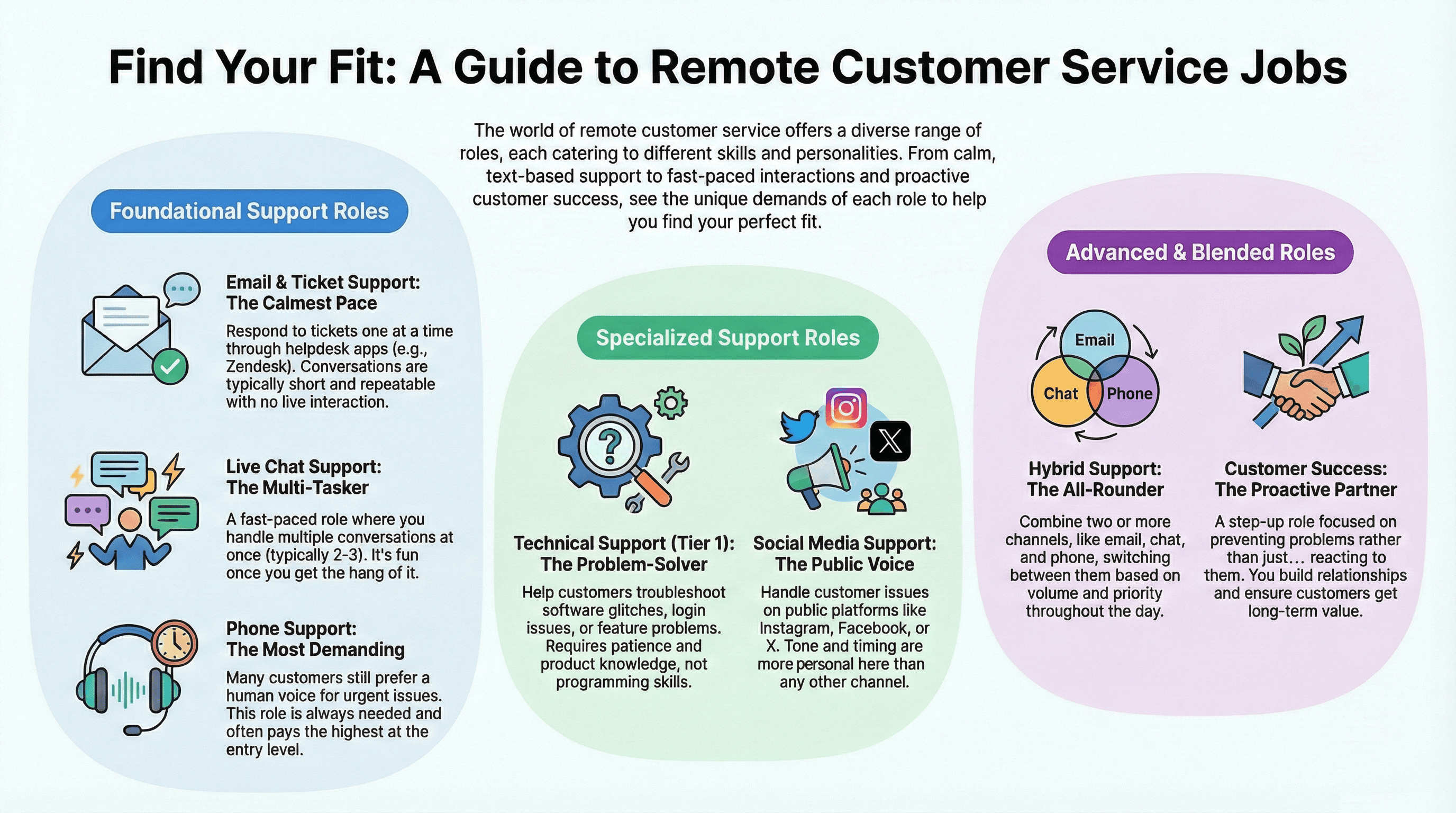
Below are the main types of remote customer service jobs you’ll see most often, along with what they usually involve in real life… Not just what the job description claims.
1. Email & Ticket Support
This is the calmest version of support. You’ll mainly respond to tickets through a helpdesk app; like Zendesk or Freshdesk. There are no calls or face-to-face interaction. Most conversations are short, repeatable, and handled one at a time… Instead of all at once.
Perfect if you:
- Type quickly and don’t mind doing it most of your day
- Like structure. You get a ticket, you work it, you mark it complete, then move to the next one
- Prefer asynchronous communication for answering more on your schedule, not in real time
- Enjoy solving problems without performance pressure, there’s no call timers or live audiences
The work involves reading carefully, interpreting what the customer actually needs (which isn’t always what they ask), replying clearly, and occasionally looping in another department when something goes beyond your access.
2. Live Chat Support
Live chat remote customer service jobs are fast-paced but surprisingly fun once you get the hang of it. You’re usually handling more than one conversation at a time. Two or three chats at once is normal, and five is when you start wondering who approved this staffing model.
Good fit if you:
- Multitask naturally and can keep track of multiple conversations without mixing people up
- Write clearly, because real-time replies still need to make sense
- Can handle people who are impatient because… well, chat makes people impatient
- Stay calm under pressure… Even when three people all say “hello?!?” at once
Live chat remote customer service jobs are especially common in e-commerce and SaaS companies. Those customers expect quick answers. The work is focused on speed, clarity, and keeping things moving without letting the conversation spiral.
3. Phone Support
Dreaded, but… Still common, still needed, and usually the most demanding version of remote customer service jobs. It also tends to pay the highest at the entry level… mostly because not everyone wants to do it. When something goes wrong, a lot of people still prefer hearing an actual human voice.
You’ll use:
- VoIP systems (cloud-based phone software instead of a physical desk phone)
- Call scripts (sometimes), especially for regulated industries or troubleshooting flows
- Escalation workflows are knowing when to pass an issue to a supervisor or specialist
Good fit if you:
- Communicate clearly out loud. You’ll be explaining things without visual cues
- Don’t mind repeating yourself. Many calls ask the exact same questions in a hundred different ways
- Can manage emotions in real time… yours and the customer’s
- Stay steady under pressure, because calls don’t pause when things get awkward
Not every phone role is nonstop frustration. Many are calm, informational positions like appointment scheduling, account updates, or basic troubleshooting. The pace can get pretty intense, but if you think best out loud and stay steady under pressure, phone support generally does pay better than other remote customer service jobs.
4. Technical Support (Tier 1)
This is where remote customer service jobs are where the questions start turning into actual problem-solving or troubleshooting. You help customers work through software glitches or bugs. Deal with login issues, account issues, new device setups, or even features that just aren’t acting right.
You don’t need to be a programmer or know how to code the whole program. You just need to stay curious, be patient, and be willing to really learn the product.
Good fit if you:
- Enjoy problem-solving like tracking down what went wrong instead of just apologizing
- Stay patient, some fixes take a few steps, and customers don’t ever always explain things clearly
- Aren’t intimidated by technology, even if you don’t know the answer yet
- Like learning systems. The product gets easier the more you use it
Tier 1 technical support usually follows guides and internal documentation. When something goes beyond your scope, you escalate it… but you’re often the first person to figure out whether the issue is simple, user error, or an actual bug. People who excel in this sector can even move into more advanced roles like AI red-teaming, one of the best jobs for the future.
5. Social Media Support
When a company replies, “DM us your order number,” that’s real-time social media support. You handle customer issues in public spaces like Instagram, Facebook, TikTok, or X… Tone and timing matter here even more than the actual solution.
You’ll handle:
- Comments ranging from questions, complaints, and even to the occasional random sideways remark
- Direct messages for things like order issues, account questions, or follow-ups
- Public complaints can ruin a brand. You need to calm things down before they snowball publicly
- Brand reputation work is priority, always respond in a way that reflects the company, not just the fastest answer
It’s part customer service, part public relations, part “hey let’s not have a meltdown in the comments section today.” You’re solving problems while making sure the brand still looks composed in front of everyone watching.
6. Hybrid Support Jobs
Hybrid support jobs combine two or more channels. It’s usually email, chat, and occasional phone work. Instead of living in one lane all day, you’re switching between formats depending on volume and priority.
You might answer tickets in the morning, handle live chat during peak hours, and jump on a few calls when something needs a real-time conversation. The mix changes by company and even by day.
Good fit if you:
- Like variety, jumping between different channels can keep the day from feeling overly repetitive
- Adapt quickly and can switch gears without losing focus or momentum
- Communicate well in multiple formats. Writing and speaking efficiently both matter
- Handle context switching well (Remembering details across multiple conversations)
Hybrid remote customer service jobs are common in growing companies that need that flexibility without hiring separate teams for each department. The work can feel busier than single-channel support, but it’s also a great way to build experience fast and figure out which part you prefer working on the most.
7. Customer Success Positions
A step-up from other remote customer service jobs. Here the focus shifts from reacting to problems… to actually preventing them. Instead of waiting for customers to reach out, you check in You guide them. Then make sure they’re actually getting real value from the product or service.
Customer success work mainly involves recurring customers, subscription renewals, onboarding new users, and light basic account management. You’re building relationships and helping keep customer long-term.
Good fit if you:
- Enjoy proactive communication like reaching out before something goes wrong
- Like relationship-based work and getting to know the same customers over time
- Can explain things clearly in a way that helps users understand features and best ways to use them
- Think long-term, because retention matters as much as resolution
Customer success job’s pay is typically higher, as well as with expectations. But the work stays fully remote. If you enjoy support work and want something steadier, customer success often feels like a natural progression.
A Day in the Life
Every company runs their remote customer service teams a little differently, but the rhythm is usually the same concept once you’ve been in the job for a bit.
Tools change, products change, and customers change. But the flow of the day doesn’t change all that much.
Most remote customer service jobs follow a pattern that looks something like this:
1. Log In, Check Your Dashboard
You’ll see:
- Any overnight tickets or other things that came in while you were offline
- Unassigned chats waiting for someone (you) to pick them up
- Messages from supervisors, like updates, reminders, or “heads up” notes
- Any escalations waiting, clean up issues that need attention before they grow
Some days it looks manageable. Some days it looks… not so manageable. That’s normal. Take a breath. Start with what needs to be done first, then start. One task at a time.
2. Prioritize
Most systems categorize and sort tasks automatically, so you’re not guessing where to start.
You’ll see tags like:
- Urgent
- High
- Normal
- Low
You start at the top and work your way down, unless your supervisor pops in with a “Hey can you grab these first?” which immediately reshuffles your plans… and happens more often than anyone admits. You adjust and keep moving.
3. Answer Customers
This is the core of remote customer service jobs day-to-day. Email, chat, phone, whatever your job includes. You solve issues, send refunds, replace items, reset accounts, escalate complicated cases, and write clear notes.
A lot of this work is super repetitive, but the situations aren’t always identical (even though they may be vey close). Clear communication matters here, especially when you’re explaining the same solution to five different people in five slightly different ways.
4. Do the Background Work
Every remote customer service job comes with the boring-but-important administrative stuff that keeps everything running smoothly. It’s not exciting, but it is important:
- Documenting the steps you took, so issues and outcomes are easily followed
- Updating the help center articles when anything changes
- Flagging bugs for engineering or IT teams
- Reporting repeat issues that might symbolize a bigger problem
- Checking macros and/or templates for errors
- Cleaning up ticket queues
- Logging interactions for compliance or audits
Some companies also assign end-of-shift tasks, like removing duplicates from the queue or double-checking pending escalations, so nothing gets missed overnight.
5. Internal communication
Support work is never completely solo. During any given day, you may be bounced between:
- Slack messages
- Supervisor check-ins
- Quick team huddles
- “Who knows the answer to this weird situation?” or “Has anyone seen this before?” conversations
There is almost always that one teammate who somehow knows the answer to everything. They are a national treasure and should be protected! Or… at least bribed with good memes so they respond faster.
6. Breaks (Take Them!)
Remote customer service jobs can be really mentally draining. You shift between problem-solving, empathy, speed, and patience all day long.
Sticking to a consistent break schedule helps keep you sane, and even though it might be easier said than done… It can really make or break the rest of your day.
7. End-of-shift wrap-up
Before your shift ends: you tidy the queue, update your supervisors, finish any of your incomplete notes, and sometimes just hand off lingering cases to the next shift.
The days go fast. And strangely, even the repetitive parts get oddly satisfying after a month or two. Especially when you can see the queue shrink and know you helped.
Skills You Actually Need for This Work
Forget the corporate “ideal candidate” myth. This is what really matters.
Must-Haves
- Patience, because some problems take longer than they should
- Clear writing. Customers need to understand you the first time
- Steady temperament, not every message will be polite
- Comfortable handling frustrated people without absorbing their mood
- Ability to multitask without melting
- Decent typing speed, but even though speed helps… accuracy matters more
- Knowing how to hone in on what went wrong and other problem-solving instincts
Helpful Extras
- Experience using helpdesk shortens the learning curve
- A curious personality (helps with troubleshooting) for those unusual issues
- Ability to explain technical stuff in plain language. Not everyone speaks ‘software’
- Light empathy without taking everything personally
You do not need:
- a college degree
- perfect customer service experience
- a background in retail
- a bubbly personality
The best support reps have some entrepreneurial skills, are calm, observant, good listeners, and not afraid to admit “let me check on that,” and actually following through.
How Much Remote Customer Support Jobs Pay
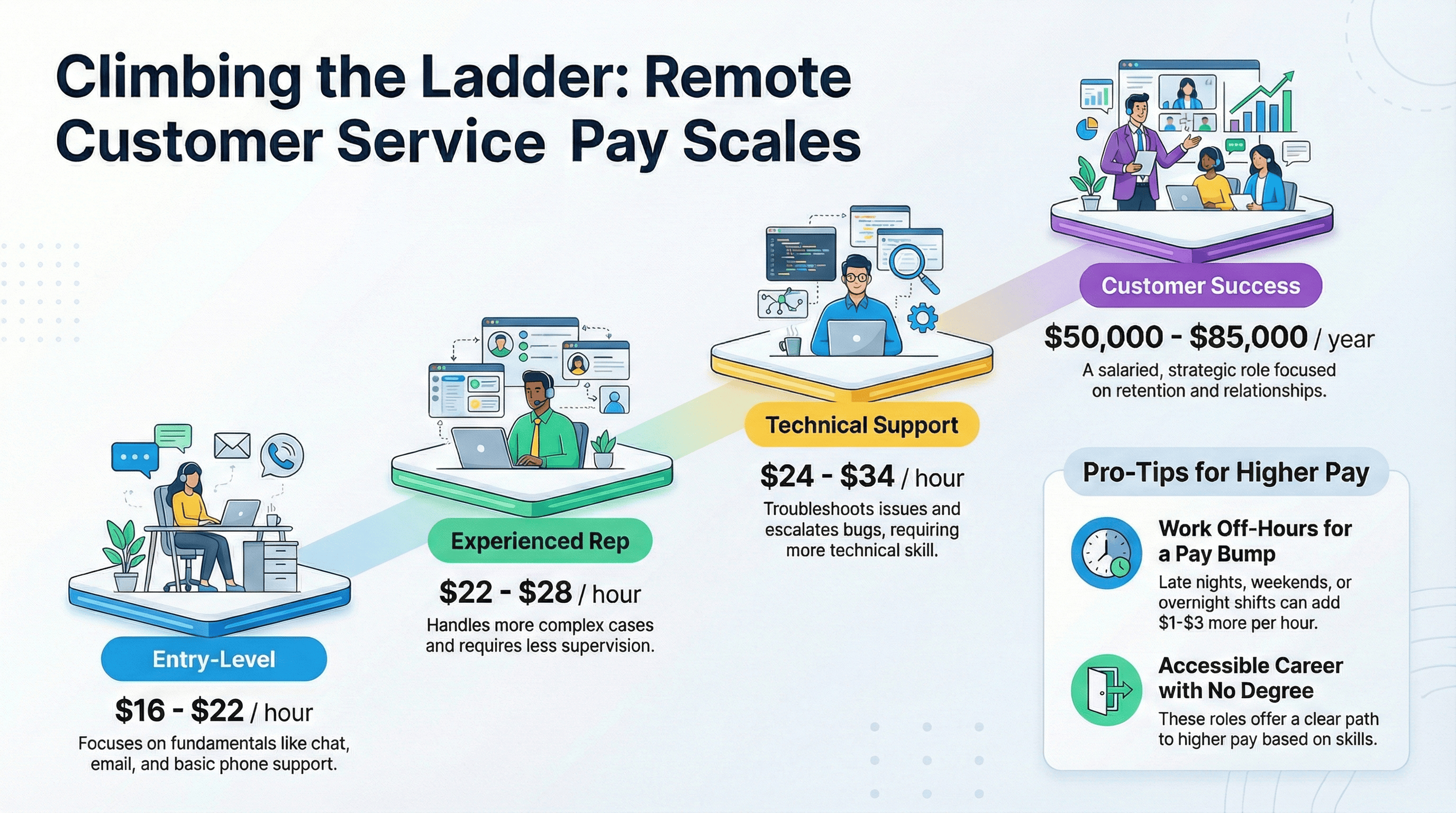
Realistically pay ranges vary a lot by company, product complexity, location, and industry. But this is a snapshot of what remote customer support jobs pay right now. Location matters less than experience and task load, especially for fully remote teams.
Entry-Level
$16-$22 per hour
(chat, email, basic phone support)
This is where most people start. These roles focus on fundamentals: answering questions, handling simple issues, and learning the product. Pay often increases once you’ve proven reliability and speed.
Experienced Support Reps
$22-$28 per hour
With experience comes trust. At this level, you’re handling more complex cases, juggling multiple channels, and needing less supervision. Many companies raise pay here to retain reps who already know their systems.
Technical Support (Tier 1–2)
$24-$34 per hour
Technical positions usually pay more because fewer people want them. You’re troubleshooting issues, following documentation, and escalating bugs — not just responding to questions. Even basic technical comfort can push pay higher.
Customer Success / Account Roles
$50,000-$85,000 per year
Working here you are salaried and focused on retention, onboarding, as well as long-term relationships. They’re far less reactive and much more strategic. You’ll have higher responsibility, higher pay, and much better benefits.
Shift Differentials
Late shifts, weekends, or even overnight shifts can pay $1-$3 more per hour. But these schedules aren’t for everyone… But they’re one of the fastest ways to increase your earnings without changing jobs.
Remote customer service jobs don’t require a degree; which makes these rates competitive for accessible remote work with a clear path to higher skill based pay.
Tools You’ll Use (Nothing Scary, Promise)
Expect to see tools like:
- Zendesk is one of the most common helpdesk platforms (a quick tutorial couldn’t hurt)
- Freshdesk is similar to Zendesk, but it’s usually used by growing teams
- Intercom is popular for live chat and in-app support
- Gorgias is especially common for e-commerce support
- Help Scout is an email-focused support app with a clean interface
- Salesforce is used by larger companies with more complex accounts and needs
- Aircall, PhoneBurner, or other VoIP platforms may be used for phone-based support
- Slack has become the go-to for internal communication and quick question and answers
- Google Workspace or Microsoft 365 should be a given
Any company will train you on whatever they use. You’re not expected you to know everything on day one. You just need to be comfortable clicking around, asking questions when something doesn’t make sense, and not freaking out when something new pops up.
Pros and Cons of Remote Customer Support Jobs
Like any job, remote customer service has real upsides and some trade-offs, too. A lot of the good or bad depends on the company, what the product is, and how support teams are treated by management.
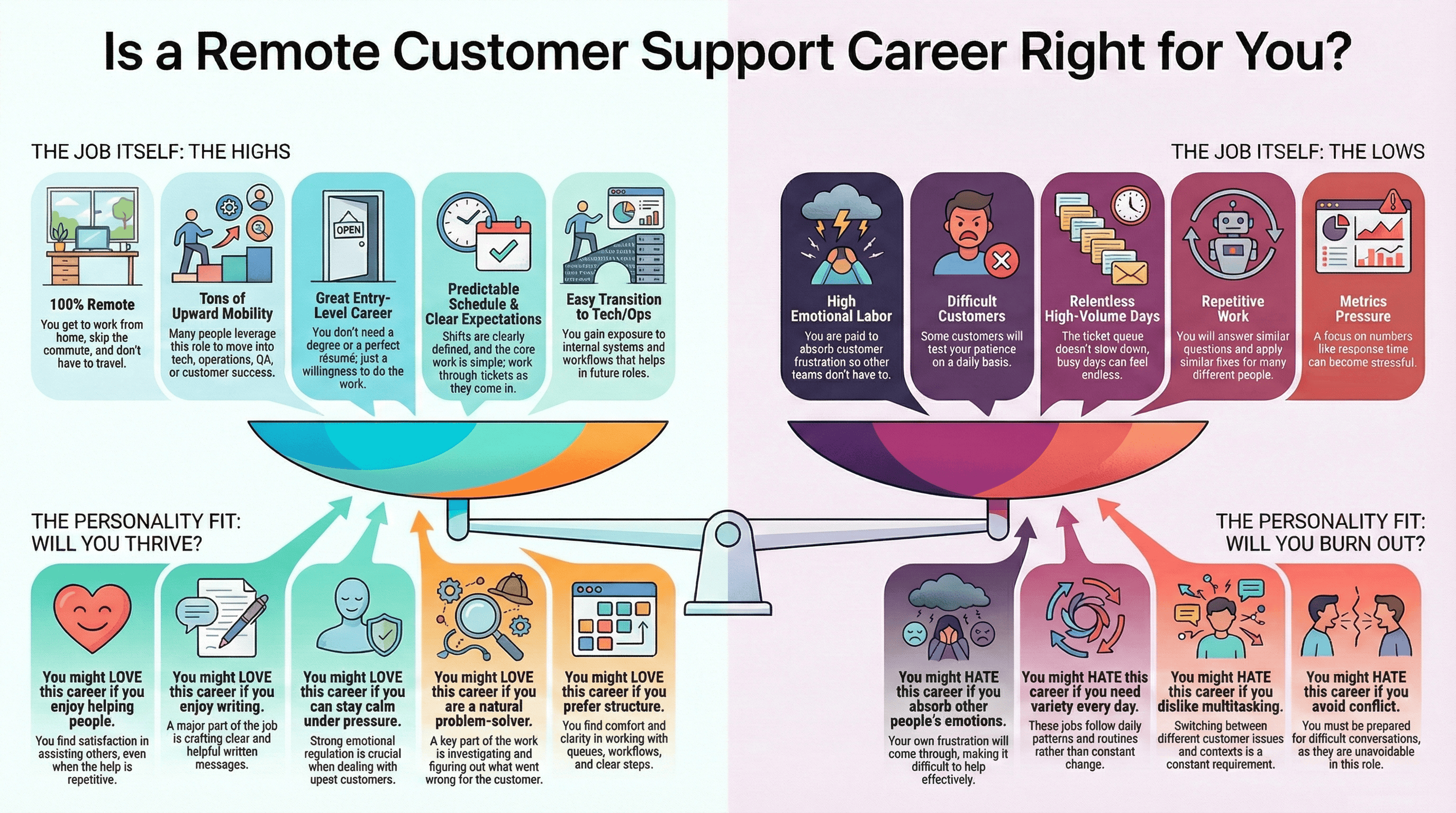
Pros
- They are 100% remote: You work from home, skip the commute, and don’t have to travel
- Great entry-level career: You don’t need a degree or the perfect résumé… just the willingness to show up and do the work
- Tons of upward mobility: Many people move into tech, ops, QA, or customer success
- Predictable schedule: The shifts are usually very clearly defined
- Clear expectations: Tickets come in, you work them, you move on. Plain and simple
- Easy transition into tech or operations jobs: Exposure to internal and new systems and workflows helps
- Work-from-home long-term, if you want: Many people make this their permanent career
Cons
- Emotional labor: You absorb frustration so others don’t have to
- Some customers will test your spiritual limits: Your patience gets exercised… daily
- High-volume days feel endless: To be honest queues never slow down just because you want them to, that’s usually when they’re most full
- Repetition: Similar questions, similar fixes, different people
- Metrics pressure: AHT, CSAT, and resolution time can become stressful if leadership fixates on numbers instead of outcomes
Not all support jobs are created equal. The good companies treat reps like real people who need support, context, and trust. Bad ones treat them like robots with headsets.
Who Thrives in These Jobs
A remote customer service job isn’t for everyone, and that’s not an exclusion thing. It’s just a fit thing. The work rewards certain tendencies and really drains others, so it helps to be honest with yourself before jumping in.
You might love this career if:
- You enjoy helping people, even when the help is repetitive
- You like writing, because clear messages are a big part of the job
- You stay calm even when someone else isn’t. Your emotional regulation really matters
- You enjoy problem-solving, figuring out what went wrong is half the work
- You prefer structure and queues, workflows, or clear steps feel grounding
You might hate this career if:
- You absorb other people’s emotions, your frustration will come through the screen
- You need a job that changes every day. Remote customer service jobs have daily patterns and routines
- You dislike multitasking, switching contexts is constant
- You avoid conflict like it’s radioactive. Be real with yourself, difficult conversations are unavoidable in these jobs
Remote customer service jobs fit certain personalities better than others, and that’s perfectly okay. For the right person: it’s steady, remote, and surprisingly satisfying. For the wrong one it can feel draining… fast. Knowing where your personality lands makes all the difference.
Find Real Remote Customer Service Jobs
This is the part everyone scrolls to… and also where a lot of people get burned.
Remote customer service jobs are popular, which unfortunately makes them a magnet for scammers, outdated listings, and vague “opportunities” that turn into something very different once you click through. Like any virtual assistant job, knowing what to avoid is just as important as knowing where to apply.
How to Avoid the Mess
A real remote customer service job should be boring, in the right ways. Clear expectations spelled out. Clear pay scale and benefits. Straightforward responsibilities.
ALWAYS be cautious if a job listing:
- Asks you to pay upfront for anything. Example: training, software, or “priority placement”
- Promises huge income for minimal work
- Avoids naming the company or product
- Uses vague phrases like “be your own boss” or “unlimited earning potential”
- Pushes you to move the conversation off-platform immediately
Truly legitimate employers won’t rush you on the initial phone call or email, they won’t hide any details, and they won’t need your bank information before an interview. If something feels off… It usually is.
Where to Apply
Once you know what to avoid, finding real roles gets easier. Solid remote customer service jobs tend to show up consistently in the same places.
You can apply through:
- DiversityEmployment.com (Yes! Our job board has them constantly)
- Company career pages: Especially for SaaS, e-commerce, and subscription-based businesses
- Dedicated remote job boards. But, ones that actively moderate their listings
- LinkedIn is best when you search by specific job and filter for remote only (within the past 24hrs works well too)
- Customer-support-specific job sites (The more niche boards usually have better-quality postings)
The real challenge is skipping the boards full of outdated listings and vague promises. Clear, verified job postings save time, energy, and a lot of unnecessary frustration.
Should You Apply?
Remote customer service jobs are one of the most accessible ways to enter the remote work world without having to start from scratch. They offer:
- Stability: Predictable schedules and steady demand
- Growth opportunities: Paths into tech, operations, QA, or customer success
- Reasonable pay: Especially for fully remote, degree-optional work
- Transferable skills: Communication, systems, problem-solving, time management
And unlike many remote job sectors, you don’t need to fill in any AI skills gap or spend thousands on courses or certifications just to be taken seriously.
If you’re ready to explore remote customer service jobs that are actually worth applying to, check out the latest listings on our diversity job board. They’re updated regularly, so you can focus on applying… Not filtering out junk.
Reality Check
Remote customer service jobs aren’t supposed to be glamorous. They are simple, for a reason, once you get the hang of things. They reward people who show consistency and patience. The ability to help people who are frustrated, confused, or just having an overall bad day, helps a lot too.
For the right kind of person, remote customer service jobs or data entry jobs from home can open the door to remote work and even long-term growth. So, are you looking for remote work that’s practical, accessible, and still hiring…? Customer support is one of the clearest and most realistic places to start with. And, one of the easiest places to build from.