

Spend enough time around American politics and you’ll probably think that half the country wakes up every morning wondering how it can ruin the other half’s day.
Immigration. Abortion. Guns. Education. Religion. Healthcare. Civil rights. Free speech. Pick a subject and within about four minutes somebody will explain that the other side has completely lost their mind.
Then you look at what people actually tell pollsters, and things start to get confusing.
Where the Statistics Come From
For this article, we went through recent entries in the AllSides Similarity Hub, which collects survey results showing where Republicans, Democrats and independents report similar views. At Diversity Employment we looked specifically at 2025 and 2026 results, limited our review to polling sources that AllSides rates as Center, and kept only statements where overall agreement was above 55%. The hub itself breaks results out by overall agreement and partisan affiliation. Fifty-four statements made our cut. And some were far from just squeaking past 50%.
The Numbers Don’t Look Like Two Different Sides
Let’s start at the top. Among the poll results we reviewed:
- 91 percent of people preferred freedom of opinion and thought over government control of communication and ‘allowable opinions.’
- 85 percent considered violent crime a serious problem in the United States.
- 84 percent supported exceptions for rape, incest or saving the mother’s life when abortion is restricted.
- Another 84 percent supported pregnancy-resource centers that help women during pregnancy and after giving birth.
- 83 percent supported lowering prescription-drug prices for Medicare recipients and lower-income patients.
- 82 percent said an undocumented person who commits serious crimes should be deported.
- 80 percent supported teaching students about the displacement of Native Americans.
- 77 percent supported teaching about slavery.
Those aren’t questions like, “Do you support happiness, puppies and reasonably priced tacos?” Of course, we all do.
These questions involve the hard stuff: abortion, immigration, crime, healthcare, education and civil liberties. The exact stuff we normally describe as evidence that America has split into two incompatible sides. The individual percentages are interesting for sure. The combinations are even more interesting.
Immigration Gets Complicated Almost Immediately
Take immigration. In one of the results we reviewed, 82 percent agreed that an undocumented person who commits serious crimes should be deported. In another, 68 percent said someone who arrived undocumented as a child shouldn’t simply be deported. Those ideas can coexist pretty comfortably. Commit a serious crime? There should be consequences. Arrive here as a kid because of a decision somebody else made? Maybe that situation deserves different consideration.
It’s not very helpful if you’re trying to break down immigration policy to either “open the borders” or “deport everybody.” But for a regular person answering that question individually… Circumstances matter.
Where the Lines Are Drawn
More in Common found a similar wrinkle after the 2024 election. 70 percent of Americans described the U.S.-Mexico border as either an emergency or major problem, yet 58 percent still supported accepting refugees. Even among Republicans, 88 percent agreed that properly controlled immigration can be good for America.
That sounds less like a country with two opposing immigration ideas and more like a country arguing very loudly over where the lines should be drawn.
LGBTQ Issues Don’t Stay in Their Assigned Political Boxes Either
The same thing happened with two LGBTQ-related results from 2025. 75 percent said transgender women face a great deal or fair amount of discrimination in America. Meanwhile, 76 percent said public schools shouldn’t teach LGBTQ+ history to students in kindergarten through second grade. Someone can believe both things. You can believe transgender Americans experience real discrimination and also believe certain subjects belong later in childhood education. The polls don’t tell us exactly where each respondent would draw that line, and people would undoubtedly disagree once we started defining curriculum in detail.
But apparently millions of Americans have no trouble holding both positions at the same time. Political messaging likes slogans and putting us all in boxes. Actual Americans are much less uniform.
Even Abortion Gets More Nuanced
Then there’s abortion, an issue America has been arguing over for decades. In the results we reviewed, 84 percent supported exceptions for rape, incest or saving the mother’s life when abortion restrictions exist. Sitting at the same 84 percent, Americans supported pregnancy-resource centers that provide pregnancy and after birth support but don’t perform abortions.
That absolutely does not mean America has reached an 84-percent consensus on abortion. Obviously, we haven’t.
It does suggest that plenty of people aren’t looking at the issue using the two options political messaging usually gives them. Someone may support restrictions in some circumstances, insist on exceptions in others, and also want more help available for women who continue their pregnancies. We do live in a rather complex country.
Most Americans Aren’t Walking Party Posters
This might be the biggest problem with how we talk about polarization. Political parties need platforms. Candidates need positions. Advocacy groups need messages that fit on signs, television graphics and donation emails. Regular folks don’t need all that to form an opinion.
A voter can want tougher consequences for violent crime and lower prescription-drug prices. They can support teaching about slavery and Native American displacement while wanting tighter boundaries around what younger children learn in school. They can support religious freedom, campaign-finance restrictions and aggressive efforts to eliminate government waste without experiencing some ideological blue screen.
That’s not inconsistency. It may just be a person deciding what they think about an issue one question at a time.
Pew Found a Very Messy Middle
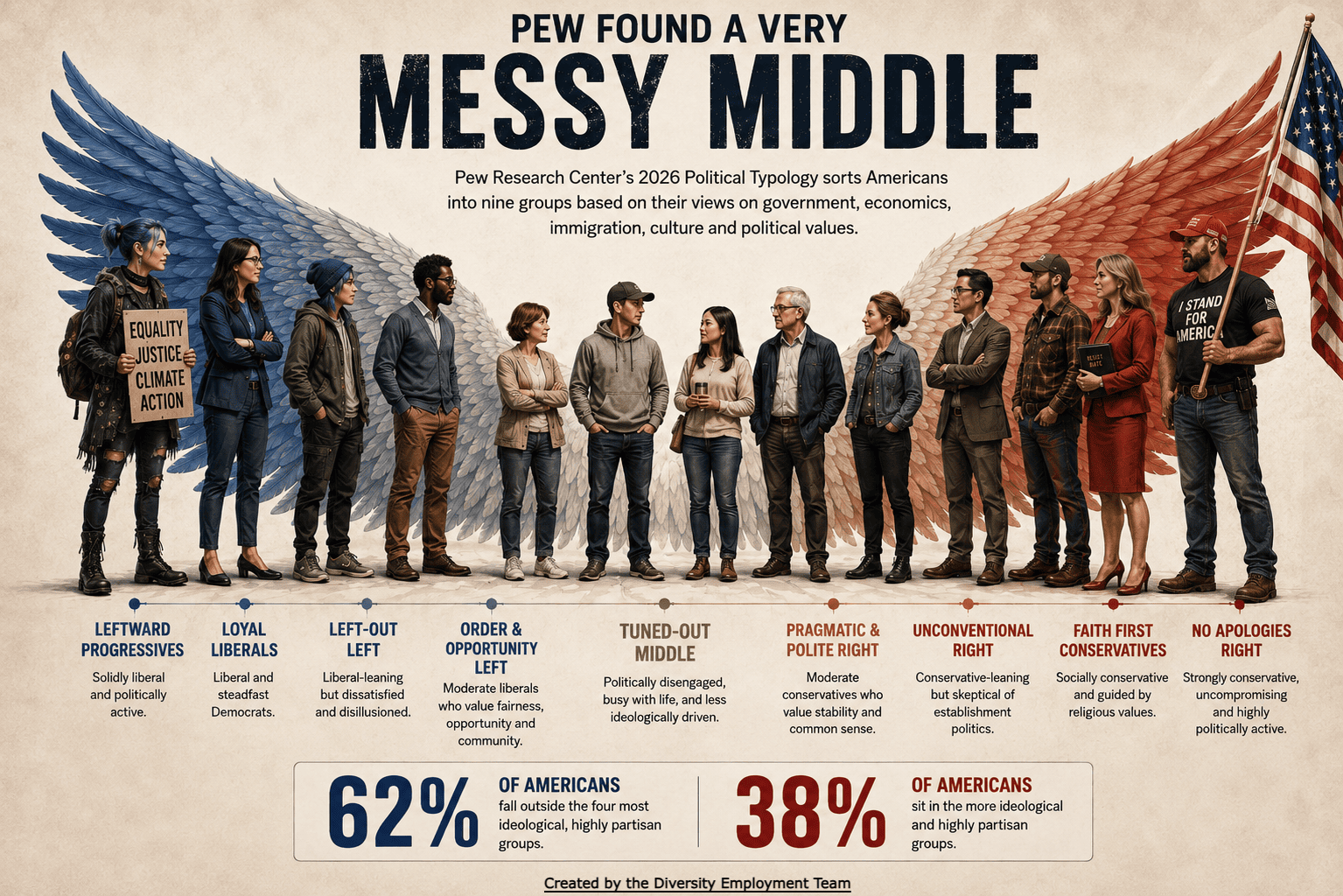
Pew Research Center’s new 2026 Political Typology gives us a much better picture of all that messiness.
Instead of simply dividing Americans into Republicans and Democrats, Pew asked more than 10,000 adults a series of questions about government, economics, immigration, culture and political values, then sorted them into nine political groups.
- No Apologies Right
- Faith First Conservatives
- Unconventional Right
- Pragmatic and Polite Right
- Tuned-Out Middle
- Order and Opportunity Left
- Left-Out Left
- Loyal Liberals
- Leftward Progressives
Only four of those groups, accounting for 38 percent of the public, sit at the more ideological and highly partisan ends of the political landscape. Pew found that most Americans, in both party coalitions, aren’t consistently liberal or conservative.
The Middle Ground
The “middle” doesn’t necessarily mean politically moderate. Pew’s Pragmatic and Polite Right, for example, leans conservative on economics and government but is more liberal on some questions involving race and America’s relationship with the rest of the world. Its Tuned-Out Middle isn’t defined by a carefully calibrated centrist philosophy at all. Many simply aren’t particularly engaged at all with politics.
That’s an important distinction. The giant middle ground of America may not be filled with people saying, “I strictly choose 50 percent Republican and 50 percent Democrat.”
It may be filled with people mostly saying: “Depends. What are we talking about?”
Maybe “Within Reason” Is Doing a Lot of Work
Looking across our 54 similarities, that’s probably the closest thing we can find to a recurring philosophy.
Americans are quite fond of personal freedom. 91 percent supported freedom of thought and opinion over government control. 78 percent think expressing political opinions in conversation is protected speech, while 74 percent said the same about posting political views on social media. 70 percent supported students being allowed to wear religious clothing or jewelry in public schools.
Then start talking about somebody getting hurt and the numbers change direction without much hesitation. Violent crime is a serious problem to 85 percent of people. Domestic violence to 79 percent. And gun violence to 77 percent.
People also showed substantial support for intervention when the problem was obvious. 83 percent supported lowering prescription-drug prices for Medicare recipients and lower-income patients. And 72 percent supported the idea that money in politics is “a very big problem.”
There simply isn’t one grand philosophy hiding in all of that, and trying to invent one would defeat the entire point.
But a rough pattern keeps showing up:
- Let people think, speak and live for themselves.
- Step in when somebody is clearly being harmed.
- Expect consequences for serious wrongdoing.
- Help when the need is obvious.
- Teach people what actually happened.
- Consider the circumstances instead of pretending every case is identical.
Basically: Leave people alone. Within reason. But I don’t think either major party is putting that exact sentence on its platform anytime soon.
The Weirdest Agreement May Be That We Think We Can’t Agree
Now here’s where this gets kind of ridiculous. A 2025 Pew Research Center survey asked Americans whether Republican and Democratic voters merely disagree about policies or whether or not they can even agree on basic facts. And 80 percent said they CAN’T agree on basic facts. And this was impressively bipartisan pessimism: 79 percent of Republicans and Republican-leaning independents said the two sides couldn’t agree on basic facts. So did 83 percent of Democrats and Democratic leaners. We have apparently achieved overwhelming bipartisan agreement that bipartisan agreement doesn’t exist. Fantastic work, everybody.
But that perception has a problem… Researchers have been finding the same thing for years, Americans can be shockingly bad at estimating what people on the other side actually believe.
There’s a Name for That: False Polarization
Political scientists Matthew Levendusky and Neil Malhotra studied what researchers call ‘false polarization,’ which is just the difference between how far apart people think political groups are and how far apart those groups actually are.
Their nationally-representative research found that Americans perceived greater policy differences between partisan groups than really existed. Misperceptions about the opposing party were also larger than misperceptions about one’s own side.
It’s a subtle distinction, and obviously the disagreement is real. But maybe our mental picture of the disagreement is a bit exaggerated.
Who Sees the Clearest
More in Common later explored a similar phenomenon through its Perception Gap research. It asked Democrats and Republicans to estimate what people on the other side believed, then compared those guesses with what those people actually reported believing.
The politically disengaged participants were far more accurate at estimating their opponents’ beliefs than the politically committed groups on either wing. It’s wonderfully annoying; but apparently, paying more attention to politics doesn’t equate to understanding your political opponents any better. Apparently, people paying less attention to politics do a better job guessing what either side actually believes. Go figure.
Confusing the Loudest with Everybody
Another revealing example came immediately after the 2024 election. When Americans were asked what Democrats cared about most, they estimated that LGBTQ and transgender policy was Democrats’ second-highest priority. It was actually 14th.
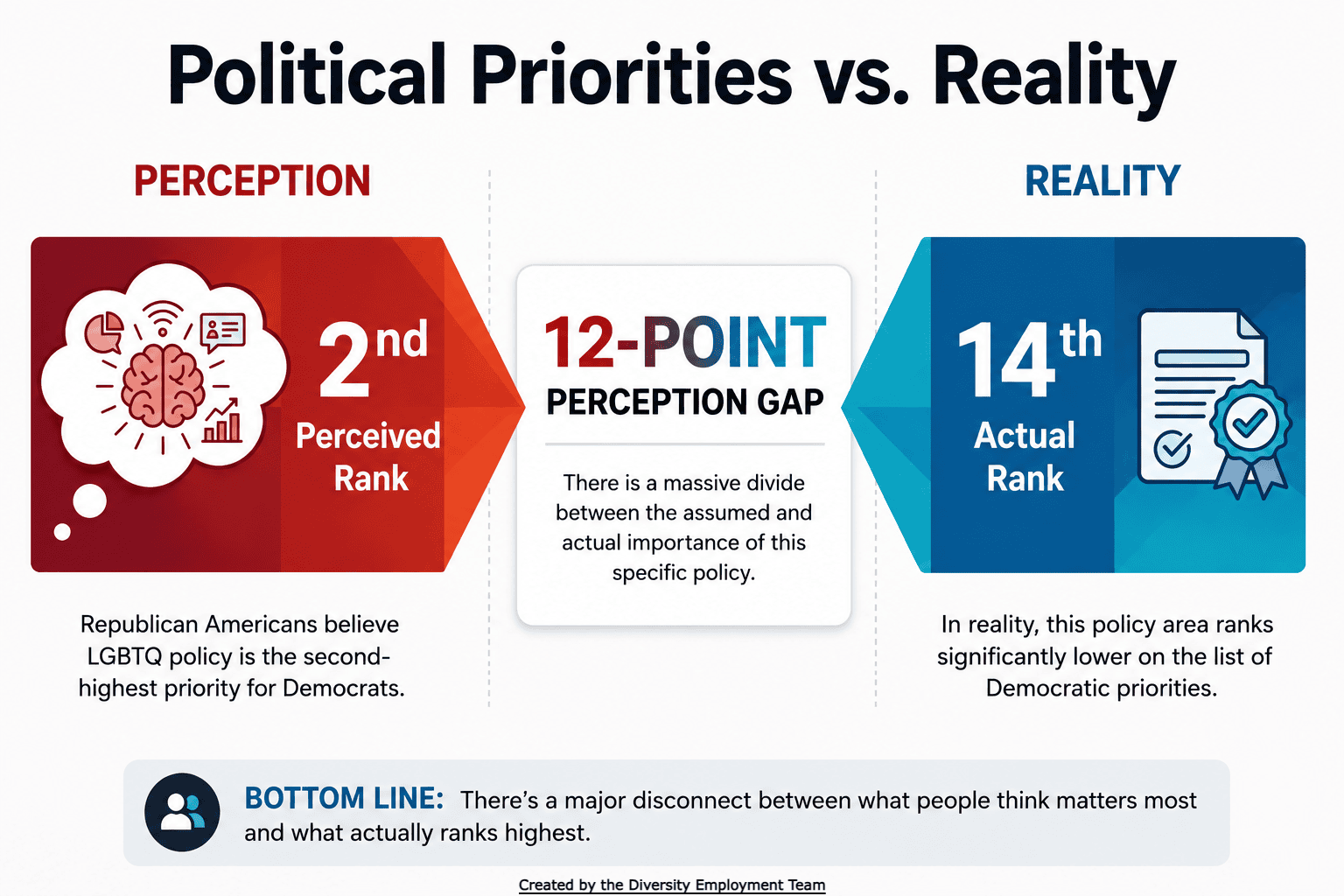
Among Democrats themselves, inflation was the most commonly selected priority. Even among the left-wing group More in Common calls Progressive Activists, LGBTQ and transgender policies ranked sixth. That’s almost a perfect example of the problem.
People Don’t Think in Headlines
The loudest headlines and political fights generally aren’t the things most ordinary voters really spend their day thinking about. But they’re memorable. So, somebody sees a viral video, a political ad, three angry posts and the most unhinged person available for a cable-news panel, and somewhere along the way that person becomes: “Democrats.” or “Republicans.”
Most of us don’t personally know 70 million people from either party. So, we fill in the blanks. And according to the numbers we’re apparently really, really bad at it.
People Actually Think There’s a Lot More Common Ground
This isn’t really a new discovery at all. A Harvard Kennedy School project surveying Americans about rights and responsibilities found that in July 2020, 71 percent agreed with the statement that Americans have more in common than many people think. By May 2021, that number had risen to 88 percent.
Afew years earlier, More in Common’s Hidden Tribes research famously identified what it called the Exhausted Majority, a group representing roughly two-thirds of Americans who didn’t fit neatly into the highly ideological political wings. The name might actually be even more appropriate now.
“Exhausted Majority” Doesn’t Mean “Centrist Majority”
This is another distinction worth making because it’s easy to hear Exhausted Majority and imagine millions of people carefully planted in the same ideological center. But that’s not what the research found.
The groups inside the Exhausted Majority held views all across the political spectrum. What distinguished them was that they tended to be more flexible, more frustrated by polarization, and more willing to evaluate policies based on the situation instead of strict ideological consistency.
That sounds remarkably similar to what starts appearing when we start to put some of our recent results next to each other.
- Strong border enforcement and consideration for someone brought here as a child.
- Recognition of discrimination and boundaries around early education.
- Abortion restrictions and exceptions and support for pregnant women.
- Personal freedom and intervention when somebody is clearly being harmed.
Maybe the vast political middle isn’t so moderate. Maybe it’s just more conditional.
Most People Want More Contact Across Differences
Here’s where this story starts going somewhere unexpected. More in Common spent two years studying how Americans feel about interacting with people who are different from them politically, racially, religiously or economically.
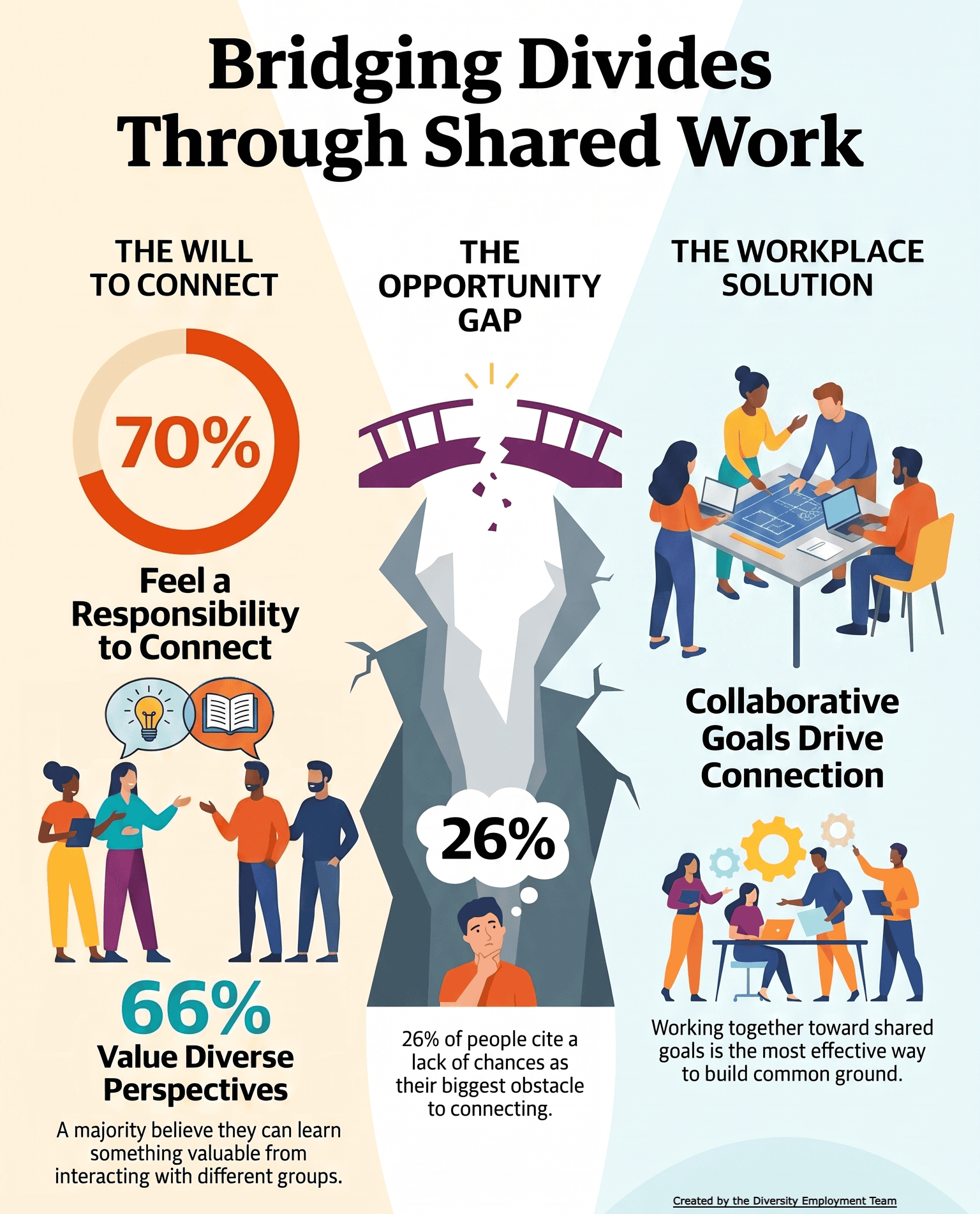
Its 2025 Connection Opportunity report found that 70 percent of Americans feel some responsibility to connect with people whose backgrounds and viewpoints differ from their own. Another 66 percent said they could learn something valuable from those interactions. Those views crossed political lines, although Democrats expressed them more strongly than Republicans.
The Reality of Connecting with Others
So why aren’t we all doing it? The most commonly mentioned hurdle wasn’t “I despise these people.” It was: “I don’t get the opportunity.” 26 percent said that a lack of opportunity was the biggest barrier, more than having a disinterest or believing the other group didn’t want to interact.
Give Us Something to Do Together
The type of interaction people wanted was studied too. Americans were most interested in connecting across differences when they could work together toward a shared goal. They were the least interested in sitting around specifically talking about group tensions.
It makes total sense when you put it like: “Hi, you have different political beliefs than I do. Would you like to sit under fluorescent lights for 90 minutes and discuss our differences knowing we won’t change each others mind?” That’s a hard “no thank you.” But… “Hey, can you help me figure out why this thing isn’t working?” “Sure!”
Shared activity changes the relationship. Because you’re not a conservative and a liberal conducting an exercise in national healing. You’re just two people trying to get something done. And there’s one place millions of Americans still do exactly that whether they want to or not…
Then There’s the Workplace
Researchers at the University of Maryland‘s Robert H. Smith School of Business recently put together a massive dataset linking voter-registration information with worker profiles.
It covered about 24.5 million workers at 534,000 employers from 2012 through 2024. One of the questions researchers wanted to understand was how much contact Americans have with politically different people at work. You can always:
- Choose your friends.
- Follow people online who generally agree with you and unfollow the ones who don’t.
- Pick the podcasts you listen to, the news you watch, the groups you join and, to some extent, the neighborhoods and communities where you spend your time.
You don’t get to interview everyone you’ll be working with about their political beliefs before you take a job.
You Can’t Always Choose Your Coworkers
Imagine. The new hire Carol ends up working three desks away from you. Six months later you find out Carol votes the complete opposite of you. Except… by now you also know that:
- Carol is the person who covered you when your kid was sick.
- You both think the new software is just terrible.
- You’ve spent three weeks collaborating, trying to get the same project finished.
- Neither of you can wrap your head around why the printer insists Tray 2 is empty when you’re both staring directly at the stack of paper in it.
She’s not some abstract representative of those people anymore. She’s just Carol.
With a Grain of Salt
The Maryland researchers are careful here, and we will be too. Because their work does not prove that politically mixed workplaces automatically make everybody less polarized. Research on intergroup contact implies that the conditions surrounding those interactions matter too.
A miserable workplace full of open political hostility probably doesn’t encourage many meaningful conversations. But work does include repeated interaction with people we didn’t personally select, while trying to accomplish the same goal. That’s exactly the kind of interaction the majority of Americans were most interested in.
Diversity Does Something Beyond Demographics
Usually when we talk about workplace diversity, we’re thinking about race, gender, disability, age, religion, sexual orientation, culture, veteran status and other identities or experiences. Political worldview barely ever makes the list. But maybe it doesn’t need to? The most interesting point here is that a genuinely diverse workplace puts workers into routine contact with people and cultures they might never meet otherwise.
You don’t have to agree with everybody. You don’t even have to like everybody. But it’s much harder to turn 70 million strangers into one-dimensional villains when you’ve spent a couple years working beside a few of them and discovered they’re irritating, funny, generous, stubborn, helpful and occasionally completely wrong… Just like everybody else.
None of This Means Polarization Is Fake
America is politically polarized. This is where we need to call it like it really is. Research shows that affective polarization, or the level of dislike and distrust partisans feel toward the opposite political group, has grown in the United States over time.
People genuinely disagree about: abortion, immigration, guns, taxation, government power, foreign policy, funding, race, religion, education and plenty of other things.
Some of those disagreements even seem irreconcilable. That’s what elections are for, specifically because of people who don’t see eye to eye on the same policies. Finding 54 similarities doesn’t erase that at all.
Our Little Experiment Has Limits Too
There’s another limitation to mention. We searched for common ground inside a database literally designed to identify common ground.
The AllSides Similarity Hub isn’t a random sample of every political question Americans have been asked in the last two years. The 54 statements we referenced also come from different polling organizations, different surveys and differently worded questions.
55 Percent Means There’s Still 45 Percent
We know 55 percent doesn’t equal a universal consensus. If 56 percent of Americans agree with something, there are still 44 percent, which is an enormous number of people, who don’t. Even an 80-percent agreement on a broad goal can turn into disagreement pretty quick when somebody has to write the actual policy. “Lower prescription-drug prices” is an easy sell. But…
How? Who pays? What authority does government get? Which drugs? What happens to research incentives? Congratulations! We have politics again.
We Agree More on the Destination Than the Directions
The point isn’t that Americans secretly agree on every policy. We don’t. It’s that when you strip away some of the political packaging, the starting principles aren’t nearly as different as we’d expect.
- Teach children about what really happened in history.
- Protect all people from violence.
- Let people speak their mind.
- Respect religious freedom for all religions.
- Control the border, but recognize that individual circumstances should be treated individually.
- Help people afford necessary medicine.
- Support pregnant women.
- Don’t let huge political donors drown everybody else out.
- Punish serious wrongdoing.
- Don’t let government control what people are allowed to think.
You can reach wildly different policies from some of those starting points. But at least you’re starting from a place of agreement.
The Real Argument May Be Where “Within Reason” Ends
Maybe that’s where American politics actually lives. Not “It’s between people who want freedom and people who hate freedom.” People disagree about:
- Where freedom should stop when it affects somebody else.
- Which policies actually make people safer.
- What children really need and when.
- The very different ideas about what “functioning” looks like.
Those disagreements are still hard, and most likely won’t be solved any time soon. They’re just substantially more solvable problems than good people versus evil people.
Looking at Each Other Through the Wrong Lens
The bizarre thing about polarization is that people’s perception can be a major part of the problem. For example: if I believe you’re extreme, I’m less likely to trust you. → If I don’t trust you, compromise starts looking like surrender. → If compromise looks like surrender, my own side has an incentive to become more rigid. → Then you look at me getting more rigid and conclude you were right about me all along. → Everybody wins. Except, you know, everybody.
The polling we’ve been looking through doesn’t describe some perfectly harmonious America hiding just beneath the noise. What it does describe is noticeably more believable. We are a country full of people with strong opinions, conflicting priorities, inconsistent ideologies and a surprisingly large amount of overlap.
Let’s Meet Each Other Before Deciding We Hate Each Other
What if the person on the other side doesn’t secretly wake up every morning hoping to destroy everything you care about? Maybe they just want their family safe, their bills paid and their rights protected.
They probably want decent schools, and violent people dealt with appropriately. They’d prefer medicine not bankrupt their parents, and they want government to work without taking control of every piece of their lives. And they’d probably appreciate politicians not treating every disagreement like the final battle for civilization.
They may have a very different idea about how to accomplish all of that, and that’s still disagreement. Sometimes it’s a serious disagreement, but it’s much more manageable than assuming half the country wants an entirely different outcome.
Talk to Carol
And if you’re still convinced the other side is completely nonsensical, maybe don’t start by arguing politics with 70 million strangers online.
Start with Carol.
You already have something to talk about… That printer is still broken.