

Most people don’t admit it… But the thought of a bunch of job interview questions either stresses, or weirds, them out. You walk in (or log in), sit down, and suddenly your brain acts like it has never once spoken English. Meanwhile the person across from you has a clipboard and the power to decide your rent situation for the next year.
*Note: The Table of Contents, on the right, can help jump to what you are looking for!
Here’s the part you might not know: Most job interview questions are almost the same everywhere.
Different companies, different industries, yet same handful of prompts.
Stuff like:
“Why here?”
“Why You?”
“What happened the last time something blew up at work?”
“What do you want next?”
Since they all recycle some the same questions, you can actually prepare; without playing a guessing game.
Interviewing in 2025
The one thing that has changed? The setting. Half the time you’re not even physically there anymore; you’re talking to a webcam. You end up trying not to stare at your own face, hoping your Wi-Fi doesn’t drop. Some companies even use AI now and you just record your interview answers, like you’re auditioning for a very boring reality show.
Even with all this new tech, they’re all still looking for the same things:
Can you think?
Can you work with people without creating chaos?
Can you handle pressure without falling apart?
That’s really it.
Everything in the rest of this guide ties back to those questions… Just hidden under different phrasing.
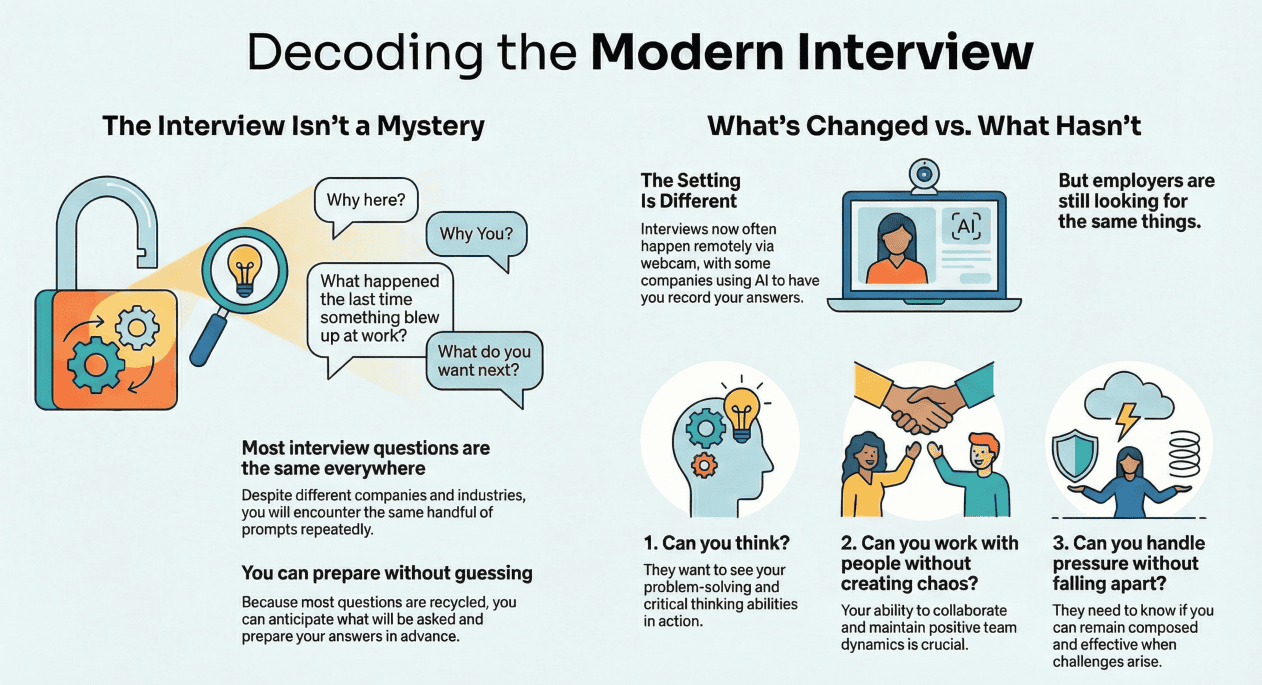
Infographics created by The Diversity Employment Team
Most Common Job Interview Questions (and How to Answer Them)
People sometimes assume every interview is a total mystery, but this early batch of questions is basically the “getting-to-know-you” portion. These are the ones that show up everywhere; different companies, same general idea. They sound basic, but they do a lot of the heavy lifting when it comes to figuring out if you’re the right fit; and that’s why they’re used almost everywhere.
“Tell Me About Yourself.”
This is the one that usually kicks things off. They’re not asking what you’ve been doing since high school, they’re asking: “Give me a quick sense of who you are at work.” Keeping it tight helps. They really just want to know what you’re doing now, a little on how you got there, and where you want to head in the future. Just don’t spend too much time on a single part or end up rambling… A minute or so can be more than enough.
Most people do well sticking to jobs, skills, and the general direction they want next. The ‘present → past → future’ system, that many career coaches and mentors talk about, actually works…
“Here’s what I’m doing now, here’s what led me here, here’s what I’m hoping to do next.”
Keep your childhood pet’s name or your favorite weekend hobby out of the answer… for now. This question’s job is to get a general understanding of who you are, your confidence, how you answer job interview questions, and a bit about what you bring to and expect from work.
“Why Do You Want To Work Here?”
Almost every interviewer uses this one, most of the time early on too. It’s basically a test to see if you know anything about where you applied. If you can point to something specific like a new product, their mission statement, a project they’ve recently announced, their approach to customers, etc. Connect whatever you pick to something you’re good at or actually excited about and you’ll have already done more than most other candidates.
What doesn’t work is giving the same generic line every time. Interviewers can smell those answers from a mile away. Showing you did even five minutes of company research makes a huge difference.
“What Are Your Best Skills?”
This is your chance to kind of show off the stuff you genuinely do well. Don’t list everything, just two or three skills that tie to the job are perfect. What really helps a lot is actually anchoring them with a small, real example; nothing dramatic, just something that shows you actually use that skill.
Maybe you’re organized, and you came up with a tracking system that kept a team on schedule. Maybe you’re great with customers and turned around a tough situation. Pick things that match what the role actually requires and keep it real. Over-polished answers tend to fall flat.
“Tell Me One of Your Weaknesses.”
A lot of people hate this job interview question, and it’s not even technically a question, but it’s a huge piece of the interview puzzle. The best answers are something that really is true but isn’t related directly to the job. It should be a work-related challenge you’re actively trying to improve. Not a generic “I care too much or I’m a perfectionist” fluff or worse… The auto-red-flag answer: “I have no weaknesses…” Hiring managers have heard it all.
You can say something like you struggle with public speaking, delegating, asking for help, or whatever it is… As long as it’s honest. Then explain what you’re doing to get better at the problem, “I struggle with public speaking but I have been reading and watching tutorials on how to get better.” They’re looking for self-awareness and that you’re not complacent being stuck in place. The growth part really matters.
“Where Do You See Yourself in Five Years?”
Skip the “Interviewing YOU!” answer, it’s not clever. They’re not looking for the ‘perfect plan’ either. They want to see if you have direction, and that your direction doesn’t instantly steal you away from the job you’re applying for. It’s best to talk about wanting more responsibilities, getting deeper into the field, learning a new niche, maybe leading projects or stepping into a more advanced version of the job.
The only wrong answers are the ones that suggest you haven’t thought about growth at all or that you plan to bounce as soon as possible.
“Why Should We Hire You?” / “What Makes You The Right Fit?”
This is basically your chance to connect everything you’ve done to what they need. So many people miss the fact that this is actually a shortcut job interview question! They’re basically asking you to make them pick you without having to think about ‘why not.’
Think back to the job posting you applied to. What skills or daily tasks did it mention? Pick two or three of them and talk about how you’ve already done those things successfully. Now is a good time to reference their tools (maybe their CRM or POS systems, for example), their type of clients, their team structure… Whatever lines up. The better you can link your skills to their actual needs, their decision gets easier and easier.
“What Do You Know About [Company]?”
This is a preparation check. Your interviewer wants to see that you’ve at least looked them up enough to talk about… Something. Social media is a great start, see what they’ve posted recently (go a couple back if they’re really frequent posters). Mention maybe an inclusion initiative they’re known for, an EEO Employer award they’ve won, a new product they’re pushing, a shift in brand direction, etc. If there’s something you’re particularly interested in lean on that, it’ll feel more natural.
Mentioning the specific thing you found and why it mattered to you makes you look already invested. A couple “just get up and go” scenarios to avoid:
Mixing them up with another company? Immediately a bad vibe, especially if you mention a competitor.
Saying you don’t know anything? Worst case scenario.
Other Job Interview Questions That Pop Up All the Time
Besides the big ones above, expect to hear things like:
- Your biggest professional win,
- A challenge you handled and how you handled it,
- Why you left your previous job,
- Or a time something went wrong and you learned from it.
These help interviewers see how you behave at work, especially under pressure. Staying honest but not negative is the key. Even when explaining failures or why you left a job, keeping it mature and forward-looking tends to do much, much better.
A Good Rule to Fall Back on: Have one real “failure” story ready. Many employers ask about it directly, like 70%+ of them, and having something prepared keeps you from scrambling on the spot.
The whole point here is getting comfortable telling your own career story in a clear & consumable way. Do that, and you’ve already finished half the interview before they can even ask.
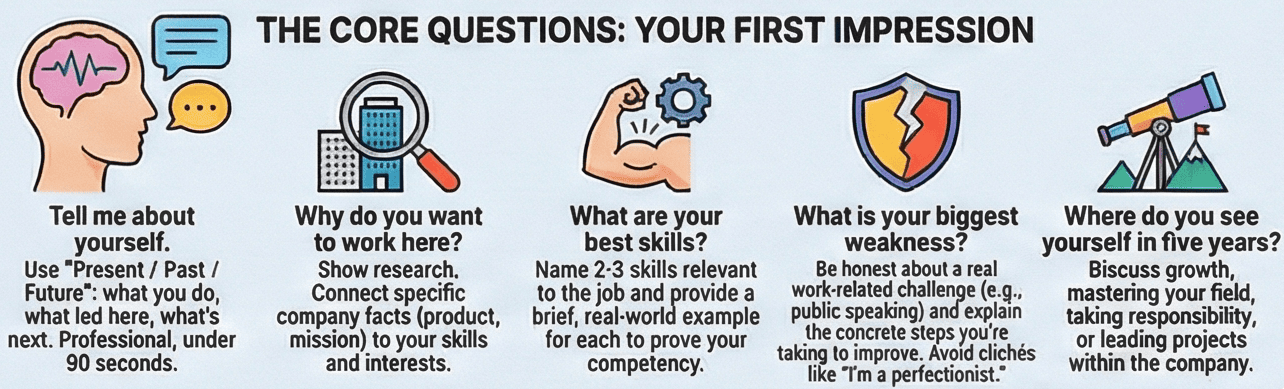
Infographics created by The Diversity Employment Team
Tell Me About a Time… Job Interview Questions
Once you get past the warm-up questions, most companies, especially the bigger ones, switch into the “behavioral” stuff.
You’ll know the time has come when everything suddenly shifts to story based answers:
“Tell me about a time when you…” or “Give me an example of…” or “How did you handle…?”
Frankly, they want real stories. They don’t want to hear your theories or any hypotheticals. They’re looking for actual moments at work that show how you behave when things aren’t going perfect. Nearly every interview you’ll ever be a part of will have at least a couple of these types of questions.
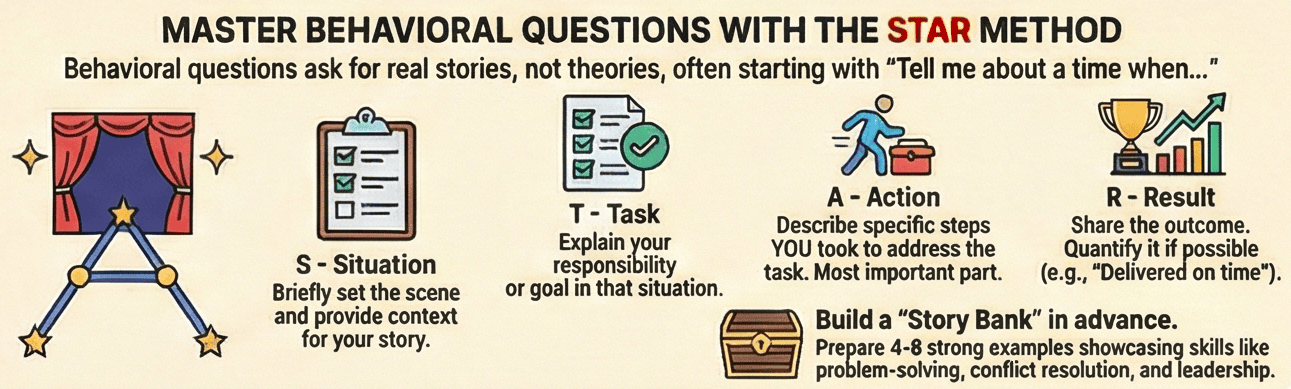
Infographics created by The Diversity Employment Team
“Explain a Time You Failed. / How Did You Bounce Back?”
This one shows up everywhere. Around 70% of interviews include it, so you’re not getting out of this one alive.
Interviewers aren’t hoping you embarrass yourself, they’re looking for someone who can take responsibility without melting down.
Pick something real. Not “I once missed one tiny email,” but also not “I destroyed an entire department by accident.”
Give the context, say what went sideways, and, most important, what you changed afterward.
Something like:
“In my first project management job, I underestimated the amount of time my second project really needed. We were short a team member. We delivered late. I owned it, told the client immediately, fixed the timeline, and then created a new scheduling template so it wouldn’t happen again. Since then we’ve delivered every project on time.”
This tells the interviewer:
- You don’t hide from mistakes
- You adapt
- You improve
- And you actually do something with the lesson
And, well… That’s the whole point of this question.
“How Do You Handle Conflict?”
No job is going to be problem-free forever. At this point in the interview they want to know, when that time does come, if you have a temper and blow up, if you maybe just close-off and shut down, or do you take time to stop and actually talk through conflicts?
Your example doesn’t have to be dramatic. Most of the time it’s just two people looking at the same piece of work differently. Needing just a bit of conversation to fully line things up. Bring up a time where you talked it through with a coworker. Stayed respectful and listened. And, just kept the project moving forward. That interaction tells the interviewer pretty much everything they want to know about your priorities… and how well you work with people.
Example:
“An equal team member and I had very different ideas on how to deliver. Instead of arguing in circles, I asked if we could each sketch out our approaches, the pros, cons, the whole thing, and get the rest of the group’s input. We also spoke separately to get each other’s reasoning first. We ended up blending our ideas and the project turned out better than we initially planned.”
Once you explain how you handled it, they’ll see you know how to read people and respond well. You won’t have to toss around buzzwords like ‘emotional intelligence’ for it.
“Was There a Time You Went Above & Beyond?”
This one (a potential red flag, depending on how they frame this question) is basically: “Do you ever step up without being asked?”
They want to see initiative and the willingness to do a little extra when it matters. (If they encourage everyone to push, push, push; or tell you that “everyone is expected to go above and beyond.” That can signal burn-out culture, and no matter the pay those positions just aren’t sustainable.)
Think of something where you didn’t just do your job, you actually solved a problem that could’ve easily been ignored.
Example:
“A client had an urgent issue late on a Friday. Support hours were technically over, but I knew waiting until Monday would cause a mess. I stayed and fixed it that night. They sent great feedback afterward and renewed their contract.”
This story lands because it shows ownership, not empty enthusiasm.
“How Do You Manage or Adapt to a Big Change.”
Adaptability is basically a required skill in 2025. Everyone’s dealt with something unpredictable: new boss, new system, new priorities, or of course, the whole “work from home overnight” era.
Talk about the change, how it threw things off, and what you personally did to make things work anyway.
For example:
“We suddenly went fully remote and everything was a little bit… chaotic, at first. I found tools like Slack and Trello. I got the team onboard. And I set up a daily check-in to keep everyone accountable. Not going to lie, it was a little rough at first; but we ended up finding our groove and hitting all our deadlines.”
Companies love answers like this because it shows flexibility and initiative. Two things hiring managers obsess over these days.
How to Structure These Answers Without Rambling
To be ready for any of these behavioral questions they may throw at you, there’s a simple structure that keeps you from drifting all over the place: the STAR method from above. Most people have heard of it at some point or another. But they either forget it or use it wrong/halfway.
STAR stands for:
- Situation: What was going on?
- Task: What needed to be solved?
- Action: What you actually did.
- Result: What happened afterward (bonus points if it’s positive).
That’s it.
No fluff. No pageantry.
Just the parts they care about.
If you use STAR, your answers will stop sounding like a diary entry.
Build a “Story Bank.”
Seriously… Do this!
Pick 4-6 examples from your past jobs (or school, volunteering, freelancing, or whatever fits your background) that show different skills:
- A big win
- A resolved conflict
- Something stressful
- A time you solved a problem
- The moment where something went wrong
- A time you helped someone else succeed
You can use the same story for different questions if you highlight different parts of it. The exact same situation might show leadership, or how you handle pressure, or how well you work with others. It really just depends on what angle you shift the focus to.
It can save you from panicking when they ask something oddly specific.
Keep The Story Positive (Even When it Isn’t)
If you’re talking about conflict, failure, or feedback, never end the story on a negative note. Find a way to circle around to a way you’ve grown from it. They don’t want drama. They want growth.
A failure that taught you something?
A conflict that turned collaborative?
A difficult customer that you actually won over?
Always end on the part where something improved… even slightly.
Above All: Be Honest.
You don’t need to be the hero in an epic story. Interviewers can always sense when someone is overacting or stretching the truth (or you managers will, after you’re hired). Plus, they’ll ask follow-up questions. Fake stories generally crumble under pressure.
If you’re brand-new to the workforce or switching fields, use examples from school, internships, volunteer work, retail jobs, personal projects, or whatever is real. Just make sure you explain the context well, so it actually makes sense.
Bottom Line
Behavioral questions are where you stop talking in generalities and start proving you can actually do the job. With a few strong stories and the STAR structure, you’ll be ready for anything they throw your way… Even those weirdly specific ones!
Technical, Job-Specific & Industry-Specific Interview Questions
After the general stuff, these interviews tend to shift toward whatever job you’re actually trying to do. Questions vary a lot by field, but most have a few things that come up again and again.

Infographics created by The Diversity Employment Team
Tech, Engineering, and IT
Technical interviews usually jump straight into real problems, pretty fast. Instead of polished questions, they focus more on the future of the job, it’s more like:
- “Let’s say a bunch of users hit the site at once and everything slows to a crawl, where would your brain go first?”
- “You ever run into a bug that refuses to throw an error? How did you chase it down?”
- “You’ve used [tool/framework] before, right? What did you actually build with it?”
IT support interviews feel a little different:
- “Someone’s computer refuses to get on the network, where do you even start?”
- “A machine keeps restarting for no clear reason… What’s your first move?”
They aren’t hunting for perfect answers. They’re listening to how you think out loud, break things down without panicking, and whether you make sense when things get weird.
Business, Finance, and Analytical Jobs
Interviews in these fields focus a lot on how you think through messy situations. The questions sound less like quizzes and more like:
- “If our numbers suddenly tanked this quarter, what would you dig into first just to figure out what went off?”
- “Say I hand you a spreadsheet that looks like chaos, what’s your way of making sense of it?”
- “You ever do an analysis that actually changed someone’s decision? What was going on there?”
Consulting-style interviews sometimes toss in brain-stretchers:
- “We’re trying to guess how many people use public transit in this city. How would you even start estimating something like that?”
Finance-heavy interviews will check that you can explain things clearly:
- “If someone on the team didn’t understand where the money went last quarter, could you walk them through it without losing them?”
They’re looking at your logic, not just your facts.
Healthcare and Education
These jobs almost always get into people-heavy scenarios. Interviewers want to hear how you function when things get intense or emotional, so the questions come out more like:
- “You know those days where everyone needs something at once? What’s one of those moments you’ve had, and how’d you decide what came first?”
- “Families can get stressed or upset, that’s normal. How have you handled someone who wasn’t thrilled with what was happening?”
- “A student keeps derailing the lesson. Not maliciously, just really struggling. What do you usually try before it turns into a bigger thing?”
Clinical roles lean heavier into calm-under-pressure moments:
- “There’s a patient who suddenly takes a turn and you’ve got two other things happening… how do you keep yourself calm and steady enough to make the right call?”
They’re listening for judgment, genuine empathy, and whether/how you can stay grounded when everything hits at once.
Sales and Customer Service
These interviews always circle back to behavior… Yours and the customer’s. The questions come out casual, like:
- “Picture someone coming in angry about a mistake. What’s your instinct in that moment? What do you actually do first?”
- “Ever have a customer swear nothing would fix their problem and somehow you still got them back on your side?”
- “Say you’re behind on your numbers? What’s your move?”
Some sales teams like to poke at your improv muscles:
- “Grab anything on my desk and try to sell it to me. Don’t overthink it.”
They’re watching how you keep your cool, how you talk to people, and whether you can turn a rough situation into something workable.
Creative, Design, Writing, UX
Creative interviews always swing back to your work and how you think through ideas. Instead of cleanly scripted questions, it’s more like:
- “Pick something from your portfolio, anything, and walk me through why you made the choices you did.”
- “Ever get feedback that totally threw you off at first? What did you end up doing with it?”
- “If you had to tweak our site or app without blowing it up completely, what would you mess with first and why?”
UX roles sometimes add:
- “When you’re stuck between two design options and both have downsides, how do you pick one without second-guessing it forever?”
They want your process. Not buzzwords. Not ‘art-speak’. Just how you think.
Management and Leadership Roles
Leadership interviews feel like therapy sometimes. They want your stories, not clichés. So you’ll hear things like:
- “Teams hit walls all the time. What’s one you’ve seen, and how’d you get people moving again?”
- “Think about someone on your team who wasn’t doing great. How did you handle it without tanking morale?”
- “You ever have to make a call that didn’t land well with everyone? How’d you deal with the fallout?”
Cross-department roles add things like:
- “You’ve got three groups who all want different things from the same project. How do you keep everyone from pulling it apart?”
They’re listening for steadiness, communication, and whether you can coach people instead of just “managing” them.
Emerging Tech, Niche Roles, and Fast-Moving Fields (AI, Robotics, Renewable Energy, etc.)
These interviews feel less like an exam and more like a conversation about curiosity. Questions tend to sound like:
- “This field changes constantly, what have you been digging into recently just because it interested you?”
- “We’ve been experimenting with [__] and it’s messy. How do you usually stay on top of stuff when everything shifts every few months?”
- “What’s a project or rabbit hole you went down on your own that has nothing to do with your job title, but you learned something from it anyway?”
Sometimes they’ll probe your take on trends:
- “Is there anything happening in the industry right now, like vibe coding, that you think everyone else is underestimating?”
They’re checking for energy, flexibility, and whether you actually like this stuff.
If You Don’t Know an Answer
If something comes up that you’ve never dealt with, it’s fine. “How would you deal with working in Antarctica?” Unless you’ve been there, there’s no way to know, and… Honestly, say this out loud: It’s okay to admit you don’t know something!
Take a second. Think and then walk them through how you’d figure it out:
“I haven’t handled that scenario/problem before, but here’s where I’d start…”
Then talk them through your first step or two. Walk them through how you troubleshoot and gather information. Interviewers pay close attention to whether someone can stay calm and collected. even when they’re unsure.
Big Picture: Prepare for the Field You’re Entering
Every industry has its own “language.” Healthcare, finance, software engineering, education, customer service, they all come with expectations around scenarios, tools, and knowledge.
If you combine solid general preparation with an understanding of the kinds of questions your field leans on, you’ll feel much more grounded in the interview. Mock interviews help a lot here, especially for fields with technical tasks or live scenarios.
Remote or Hybrid Job Interview Questions
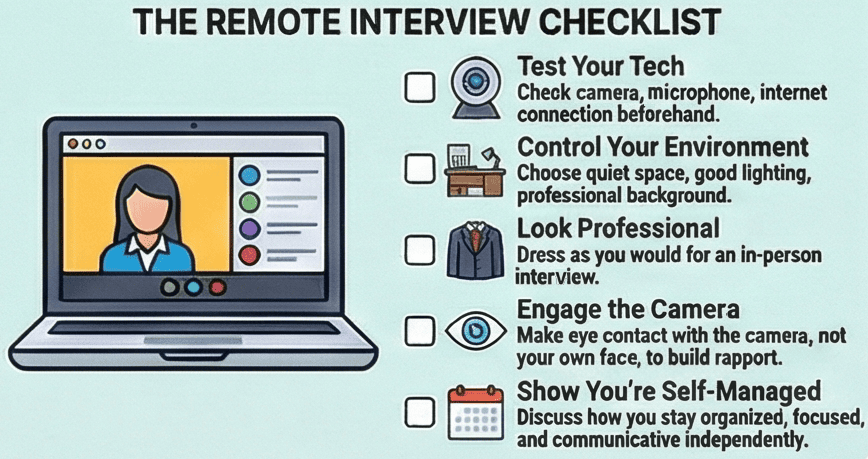
Infographics created by The Diversity Employment Team
Remote work has become a normal thing, so interviews often include a few questions about how you function when you’re not physically in an office. Companies mainly want to know:
- “Can you stay on track?”
- “Can you communicate effectively without creating confusion?”
- “Can you manage yourself without someone having to hover?”
Expect questions that answer more like conversations than formal “interview questions.”
“Have you Worked Remotely Before?”
Obviously, this one’s coming. If you’ve done remote work, just talk about what actually worked: your morning routine, the apps you relied on, or whatever kept you sane. If you haven’t? That’s not a dealbreaker. Plenty of people are figuring it out as they go. Just make it clear you understand remote work isn’t some easy vacation mode where you answer emails from bed.
Try something natural like: “I haven’t done fully remote yet, but I’ve handled plenty of independent projects from home. I’m pretty solid at structuring my day and not just drifting through it. Plus, I’m comfortable with most of the tools teams use.”
Staying Organized and Managing Time
Here’s where they dig into whether you’ll turn into a ghost once you leave the office. They’ll probably ask something like:
- “So when your day goes sideways and you’re working from home, what keeps you from spiraling?”
- “How do you actually focus when there’s no one watching?”
They want specifics: calendars, lists, blocking out chunks of time, a real workspace. Basically anything that proves you’re not just hoping tasks magically complete themselves while you watch Netflix.
Tools and Tech Comfort
Most remote teams depend on software to stay connected.
Interviewers phrase this casually:
- “What tools have you used to keep in touch with your team?”
- “Have you worked with things like Teams, Zoom, Slack… that kind of stuff?”
If you haven’t used their exact tools, just mention similar ones. Nearly all of them overlap.
Your Motivation for Remote Work
Companies want to make sure you’re not chasing remote work for the wrong reasons.
They’re hoping to hear something like focus, flexibility, increasing entrepreneurial skills, removing commute time, better balance… not, “I want to work in pajamas.”
Something simple works:
“I like the focus I get at home, and I’m more efficient without a long commute. I still communicate a lot with my team, I just do my best work from a quieter space.”
Communication, the Big One
Remote work succeeds or fails based on communication.
Expect job interview questions like:
- “When things start getting unclear on a remote team, what do you usually do?”
They want to hear you won’t disappear for hours or stay silent when confused.
Mention quick check-ins, clarifying things in writing, hopping on a short call when needed, being mindful of tone… the basics of not letting misunderstandings grow.
General Remote Concerns
Some interviewers also bring up:
- Feeling isolated
- Troubleshooting your own tech
- Handling time zones
- Knowing when to log off
They’re checking that you don’t fall apart without an office around you.
One Last Thing
Even if the job isn’t remote, the interview might be.
So the basics matter:
- Show up on time
- Test your camera and mic
- Have decent lighting
- Look like you tried
- Don’t take the call from your bed
Those tiny signals reassure them that you’ll communicate well on video and won’t be a mystery to work with.
Handling the Unexpected: Curveballs, Brainteasers, and Weird Questions
Most interviews stick to a pretty normal path. But every now and then… Someone tosses a weird question into the mix.
“If you were a tree, what kind would you be?” or, maybe “What animal symbolizes who you are?” or even, “How many cows are in Canada?”
These usually aren’t meant to stump you, per se. The point is to see how you deal with a totally unexpected situation.
What Weird Questions Are
Odd questions aren’t really about the answer. Interviewers are trying to get a quick read on:
- How you react when something you didn’t see coming comes up.
- Whether you stay relaxed or immediately tense up.
- Your personality outside of the pre-scripted answers.
- How you think when there’s no ‘perfect solution’ ready.
- Your general attitude: flexible, calm, irritated, amused, etc.
Basically: they’re looking at you, not the tree, the ghost, or the tennis balls.
If you treat the moment like no big deal, that’s usually all they wanted to see.
Take a Deep Breath
If you’re are asked something unexpected… Take a deep breath. Pause for a second, don’t rush.
A small laugh followed by ‘That’s a new one.’ or, ‘Huh, that’s interesting.’ gives you a few seconds to gather your thoughts.
A Bit of Personality Doesn’t Hurt
Off-the-cuff answers that show your real personality show that you can be you in the moment.
Give a short and focused answer that feels natural to you; and let your personality shine through a bit.
When It’s a Puzzle/Brainteaser
If they toss out something like, “How many tennis balls fit in a bus?”, don’t chase the exact number. They’re watching how you break it down:
- Thinking out loud
- Estimating size
- Stating assumptions
- Staying calm
Your reasoning matters way more than the final guess.
Asking a Clarifying Question Can Help
If a question is a little too vague or broad, ask for clarity:
“Do you mean for the job, or just in general?” or “Are we talking short-term or long-term?”
It buys you some time and shows the interviewer you don’t just run into a confusing situation blindly.
Stay Positive, Even If the Question Is Strange
A weird question isn’t worth getting irritated over.
A light tone, a simple attempt, and you’re good. Interviewers remember composure far more than content in these moments.
If the Question Feels Like a Trap
Every once in a while someone asks something with no good answer. If it’s one of those questions you feel has no good answer, redirect:
“Hard to say without more context, but here’s how I’d approach…” or “That’s a bit open-ended, so I’d start by looking at it this way…”
It shows tact without calling out the question.
Hitting the Curveballs
Surprise questions are really a reaction test. They’re more about composure over the actual answers. In reality, you may never actually even have to deal with one. But, if one does show up, keep your cool and respond naturally. It says a lot about how you operate under pressure.
Illegal or Inappropriate Job Interview Questions (Know Your Rights)
Interviews normally stay professional, but sometimes an interviewer can, mostly accidently, drift into places they shouldn’t. Any questions about age, race, religion, family situation, marital status, sexual orientation, health history, or similar protected categories are legally off-limits.
They’re not just ‘impolite’ or ‘weird.’ They are illegal.
Things like:
- “Do you plan on having kids?”
- “How old are you?”
- “Do you take medication?”
- “What religion are you?”
- “Are you married?”
- “Where do you really come from?”
Simple: If it has nothing to do with the job, they shouldn’t be asking about it.
A lot of these questions can be chalked up to the person interviewing you not even realize they’ve crossed a line. They usually come from someone who is inexperienced or just making too much small talk. Not generally someone trying to cross a line or discriminate outright. Whatever the intent, it’s good to know how to get the conversation back to the job if it does happen.
1. Stay Calm. Don’t Blow the Interview Up on the Spot.
Calling it out (“You can’t ask me that!”) might feel justified or even the right thing to do, but it will derail the conversation. It’s always more effective to pivot back with a calm, job-focused reply. That’ll keep the interview moving in the right direction.
2. Deflect and Answer the Intention Behind the Question.
Illegal question: “Do you plan on having children?”
Example redirect: “I can be fully committed to the responsibilities of this job and am able to meet all scheduling needs.”
Illegal inquiry: “Where are you from originally?”
Deflection redirect: “I’m authorized to work in the U.S. and currently based in [City]. I’m excited about the opportunity here.”
Illegal: “How old are you?”
Redirect: “I bring over [__] years of experience, and I’m confident I can deliver strong results in this role.”
The goal is addressing their real concern without opening the door to your private details.
3. Bring it Back to the Job.
Most of the inappropriate job interview questions we see come from an underlying or hidden concern:
- Will you be available?
- Can you travel?
- Do you have the right authorization?
- Can you handle the physical demands?
If you can spot the actual issue behind the wording, respond to that; not the personal question.
4. You’re Allowed to Decline to Answer.
If something really crosses the line or makes your skin crawl, shut it down:
“I’d prefer to keep the focus on the job we are discussing and my qualifications.”
A normal interviewer will drop it immediately. If they push? That’s a huge red flag. You can even, professionally, end the interview there… If you choose:
“I honestly just don’t see this as a good fit for either of us. I do appreciate the opportunity. Thank you for your time, have a nice day.”
See yourself out, and be thankful you spotted the issue before starting the job.
5. Sometimes the Wording is Bad, Not the Intention.
Example:
“Do you have any health issues?” → Not okay.
But:
“This job requires lifting 50 lbs. Are you able to meet that requirement?” → Allowed.
Example:
“What country are you from?” (probing ethnicity) → Not okay.
But:
“Where are you based now?” (location/commute) → Normal.
If you’re not sure how they really meant it, assume the best and respond in a way that fits the job-related version of the question.
6. You Can Answer if You Want to, But You Never Have to.
Some people don’t mind mentioning that they’re married, a parent, or recently relocated, whatever.
It is entirely up to you though. There’s zero necessity to share anything personal.
If you do choose to answer, keep it brief and loop it back to how it can improve job performance:
“I have two kids, with solid childcare. They’ve never interfered with my work or travel. Plus, they keep me young and my mind sharp.”
When offering up personal information be brief, be intentional, and loop the answer back to a positive and the job itself.
7. Trust Your Gut.
If they keep circling back to personal stuff or pushing past normal boundaries, that’s worth clocking. Early red flags tend to be pretty revealing. And don’t forget, this isn’t a one-sided test. You’re evaluating them too. If they ignore boundaries now, imagine them as a manager.
Most interviews will be fine and won’t cross into this territory. But having a plan for that ‘bad question’ keeps the power in your hands, and keeps you in control and centered on: your skills, experience, and whether this job still makes sense for you.
“Do You Have Any Questions for Us?”
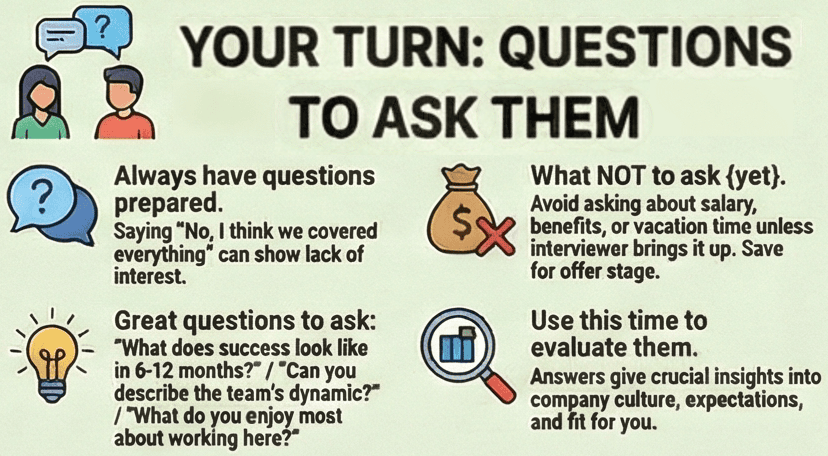
Infographics created by The Diversity Employment Team
It’s almost ritual to hear this sentence near the end of an interview (sometimes right off the bat, if they’re one of those interviewers):
“Do you have any questions for us?”
They’re not looking to make small talk. This is still, and is a very important, part of the interview.
They’re actually testing you; to see if you’re engaged or curious about the job. Are you actually picturing yourself in the job? And on your side, it’s your chance to figure out whether you even want to work at this place.
Never say, “No, I think we covered everything.”
Most hiring managers take it as lack of preparation, or just disinterest. Head in to every job interview with at least a couple of company specific questions ready. Three to five is perfect, but two can still work, because some might get answered naturally.
One that’s very rarely answered during the interview itself, and makes them really think is:
“What does success look like 6-months or a year into the job?”
If they somehow do answer all your questions, it’s a good idea to have them written down beforehand, then you can physically show them you have marked them off as answered.
Good Questions to Ask
Job interviewer questions that show you’re thinking beyond the interview and imagining the day-to-day work life:
- “What does a typical day or week look like for someone in this position?”
Helps you see the real workflow. - “What are the biggest priorities for the first few months?”
Shows you want to make an impact quickly. - “How do you actually measure success?”
Tells you exactly what matters to them. - “I saw that your team is working on [__]. How would this position connect to that?”
Shows research and genuine interest. - “Can you tell me a bit about the team dynamic?”
Helps you gauge the environment and collaboration style. - “What do you personally enjoy most about working here?”
People open up when talking about their own experience… and it gives you culture clues.
If the interviewer happens to be your potential manager, ask them about their leadership style and/or weekly expectations.
If it’s a potential teammate, that’s a goldmine of information. Ask them about the down a dirty, the projects they’re really working on, the daily challenges, how the team supports each other, anything to get a sense of ‘do I want to work here?’ . If it’s HR, ask about a clear training path, room for development, or next steps up the ladder.
What NOT to Ask (for Now)
Skip salary, promotion timelines, benefits, vacation time, or anything money-related unless they bring it up first.
Those conversations happen later or usually when they’re ready and interested in hiring you.
Also avoid asking anything that was answered five minutes earlier or something clearly explained on their website. Build on what they said, don’t repeat it.
Use This Moment to Evaluate Them, Too
This is where you learn whether the job fits you. Ask about:
- Growth opportunities
- Work-life balance expectations
- How decisions get made
- How feedback is handled
- What the first year looks like
Pay attention not just to the answer… but how confidently they answer it.
End the Interview Strong
A simple closing line can leave a great final impression:
- “I really appreciate the conversation we had today. Honestly, I’m even more interested in the position now.”
- “Is there anything you’d like me to clear-up or expand on before we finish up?”
That last one is powerful. It gives them one more chance to raise any hesitation; and gives you one more chance to clear it up.
If you still have questions but time’s tight, you can say:
- “I have a few more questions, but I want to be respectful of your schedule. Is it okay if I follow up by email?”
Shows interest without overstaying your welcome.
The Final Ask
This part of the interview isn’t optional. It’s the last thing they remember about who you are and how you think.
Thoughtful questions turn the interview into a real conversation and make you memorable; in the best way.
And if you ask the right things, you’ll walk out knowing whether this is a place worth saying “yes” to.
Final Tips: Putting It All Together
You’ve just taken in a huge range of job interview questions and strategies. Before we close this out, here are the big points that pull everything together. The stuff that works no matter what kind of job interview questions you’re walking into. TL;DR:
1. Prepare… Don’t Rehearse Yourself into a Statue
Know your talking points.
Know your examples.
Don’t memorize full scripts, they never sound natural. A few bulleted answer-starting reminders for each common question is plenty.
You want to actually sound like you. No one wants to feel like you’re reading to them from a teleprompter.
2. Use the CAR Method
Whether you use the CAR Method (Context → Action → Result), the more in-depth STAR method (discussed above for when time allows), or anything else… The main idea is all the same:
- Set the scene and provide Context
- Explain what Action you actually did
- Report how it turned out, the Result
This makes every answer cleaner and easier to follow… Especially under pressure.
3. Keep Everything Positive and Professional
If you need to mention something unpleasant from a past job, keep it cool. Maybe the place was a total mess or maybe your boss was impossible… Whatever the case was, never get emotional about it. Interviewers notice how you say what you do just as much as what you say. Trash-talking anyone or anything sends the wrong message instantly. No matter how right it really is.
4. Your Body Language Matters (In-Person or Video)
Show you want to be there: Sit up straight and keep steady eye contact with your interviewer, or the camera.
For a video interview, make sure the lighting is good, do a pre-check on your microphone and camera, then avoid staring at your own (beautiful) face the whole time.
When your body language is working for you, it shows your confidence and presence without you having to say a word.
5. Read the Room and Match Their Style
If they’re buttoned-up and formal, follow that lead.
If they’re conversational, loosen up a bit.
Interviewers aren’t just assessing your answers… They’re quietly asking, “Would this person mesh with us?”
6. You’re Allowed to Not Know Something
It’s more than acceptable, in fact it’s encouraged, to say something like…
“I haven’t dealt with that before. But, here’s how I’d figure it out.”
A calm and collected response to ‘the unknown’ actually shows maturity and problem-solving. It’s way better than fumbling or pretending to know something you don’t.
Curiosity + willingness to learn is a huge win in modern interviews.
7. Don’t Forget Your “Why”
People remember the passion behind your words more than hearing perfect phrasing.
If you have a reason you care about the sector or field, the job, or even the project itself, let that show! It adds a complexity and depth, and makes your answers feel like a story instead of a bulleted checklist.
8. Keep Your Answers Succinct and Relevant
Loop everything back to this job. If you feel like you’re kind of drifting off subject, bring it back with something like:
“Anyways that ties directly into this position because…”
It shows time management, clarity, and awareness of what they actually need.
9. Listen as Much as You Talk
Good interviews feel like conversations, like a back-and-forth. If the interviewer hints at something, circles back to an idea, or slips in a concern, catch it. That’s usually the real question.
And if something they ask doesn’t quite make sense? Just ask them to repeat or clarify. Guessing rarely works out well.
It sounds simple, but a lot of people don’t realize that paying attention, picking up on and responding to the underlying questions puts you ahead of the majority of other candidates.
10. Finish Strong, and Send a Thank-You Note
End with something simple like:
“Thanks for taking the time today. I really enjoyed learning about the company and the job.”
Send a short thank-you email, after every interview, within 24 hours. Don’t write a novel. Just show appreciation and reiterate your interest for the job.
Final Word
Interviews can seem daunting or feel intense; but most of the stuff that makes someone “good” at interviews is:
Practice. Confidence. Awareness. Authenticity.
The more familiar you are with the types of job interview questions you’ll face, the more natural your answers are going to sound.
Walk in prepared.
Stay calm.
Be yourself.
(Just be the most organized and job-ready version of yourself)
Now would be a good time to consider creating a profile and uploading your resume on Diversity Employment.com to find diversity and inclusion jobs across the country… Today!
Good luck!